Fertilisers
Contents: 8 sections
The three elements and what each one does
| Element | Symbol | What the plant uses it for | Sign of a shortage |
|---|---|---|---|
| Nitrogen | N | Making proteins and chlorophyll, so it drives leaf and stem growth | Yellow leaves, stunted growth |
| Phosphorus | P | Root growth and early development | Poor root systems, weak seedlings |
| Potassium | K | Flowering, fruit formation and resistance to disease | Poor fruit, browning leaf edges |
A crop takes these elements out of the soil every harvest and they are carried away with the grain. A fertiliser puts them back. That is the whole argument for using one, and it is what a question means by "improved plant growth".
Why ammonium salts and nitrates
A plant root can only absorb an element that is dissolved in the soil water and taken in as an ion. Nitrogen gas makes up 78 per cent of the air and is useless to almost every crop, because N₂ has a very strong triple bond and does not dissolve or react.
So nitrogen has to be supplied as a soluble ionic compound: an ammonium salt, supplying NH₄⁺, or a nitrate, supplying NO₃⁻. Both dissolve readily in water.
The common ones:
| Fertiliser | Formula | Elements supplied |
|---|---|---|
| Ammonium nitrate | NH₄NO₃ | N only |
| Ammonium sulfate | (NH₄)₂SO₄ | N only |
| Ammonium phosphate | (NH₄)₃PO₄ | N and P |
| Potassium nitrate | KNO₃ | N and K |
| Potassium chloride | KCl | K only |
Making them: acid plus ammonia
Every ammonium fertiliser is a salt made by neutralising an acid with aqueous ammonia, which behaves as the base. The ammonium ion comes from the ammonia and the rest of the salt comes from the acid.
- ammonia + nitric acid gives ammonium nitrate: NH₃ + HNO₃ → NH₄NO₃
- ammonia + sulfuric acid gives ammonium sulfate: 2NH₃ + H₂SO₄ → (NH₄)₂SO₄
- ammonia + phosphoric acid gives ammonium phosphate: 3NH₃ + H₃PO₄ → (NH₄)₃PO₄
The ammonia itself comes from the Haber process, in which nitrogen from the air reacts with hydrogen over an iron catalyst at about 450 °C and 200 atmospheres:
N₂ + 3H₂ ⇌ 2NH₃
Read down that chain and the nitrogen in a bag of fertiliser started as nitrogen in the air. Cambridge asks for the source of the nitrogen often enough that it is worth being able to say so.
Potassium nitrate is the exception to the ammonia route: it is made by neutralising nitric acid with potassium hydroxide, KOH + HNO₃ → KNO₃ + H₂O.
NPK fertilisers
An NPK fertiliser is a mixture that supplies all three elements at once, so one application covers the whole requirement rather than three separate ones.
A typical blend is ammonium phosphate with potassium chloride, or ammonium nitrate with potassium nitrate and ammonium phosphate. The bag carries three numbers, such as 20:10:10, giving the proportions of nitrogen, phosphorus and potassium it contains. A leafy crop such as lettuce is given a blend high in the first number; a root or fruit crop is given more of the other two.
Every component must be soluble, or the roots cannot take it up. That single requirement explains both the benefit and the problem.
The run-off problem
Because fertilisers dissolve, rain washes them off the field and into rivers and lakes. This links straight back to 10.1:
- Nitrates and phosphates enter the water.
- Algae grow rapidly and cover the surface.
- Light is blocked from the plants below, which die.
- Aerobic bacteria decompose the dead material and consume the dissolved oxygen.
- Fish and other aquatic organisms die.
Nitrates in drinking water are a second concern, which is why farmers are told not to spread fertiliser shortly before heavy rain and to leave an untreated strip beside a watercourse.
Comparing fertilisers by nitrogen content (Extended)
Two fertilisers can both supply nitrogen and still be very different value, so the useful comparison is the percentage by mass of nitrogen. This needs relative formula mass, which is Extended content in 0620.
Worked example. Ammonium nitrate, NH₄NO₃. Use A_r values H 1, N 14, O 16.
Mr = 14 + 4 + 14 + 48 = 80
Nitrogen in the formula: two N atoms, so 2 × 14 = 28.
percentage of nitrogen = 28 / 80 × 100 = 35%
Second example. Ammonium sulfate, (NH₄)₂SO₄, with S 32.
Mr = 36 + 32 + 64 = 132
Nitrogen: again two N atoms, so 28.
percentage of nitrogen = 28 / 132 × 100 = 21.2%
Ammonium nitrate therefore delivers about two thirds more nitrogen per kilogram than ammonium sulfate, which is why it is the more widely used of the two despite being harder to store safely.
The method generalises: total the mass of the wanted element in one formula unit, divide by the relative formula mass, multiply by 100.
Common mistakes
- Saying plants take nitrogen from the air. Almost none can; the nitrogen must arrive as NH₄⁺ or NO₃⁻ in solution.
- Swapping the jobs of phosphorus and potassium. Phosphorus is for roots, potassium is for flowers, fruit and disease resistance.
- Writing ammonium as NH₃⁺ or NH₄. The ion is NH₄⁺.
- Saying the fertiliser itself poisons the fish, instead of tracing the algae, light, bacteria and oxygen chain.
- Naming the base in fertiliser manufacture as a hydroxide when the salt is an ammonium salt. The base is ammonia.
- Counting only one nitrogen atom in NH₄NO₃. There are two, one in each half of the formula.
Check you have it
Question 1
Which bag is not suitable for use as a fertiliser? Use the source image for S20 Paper 12, question 31.
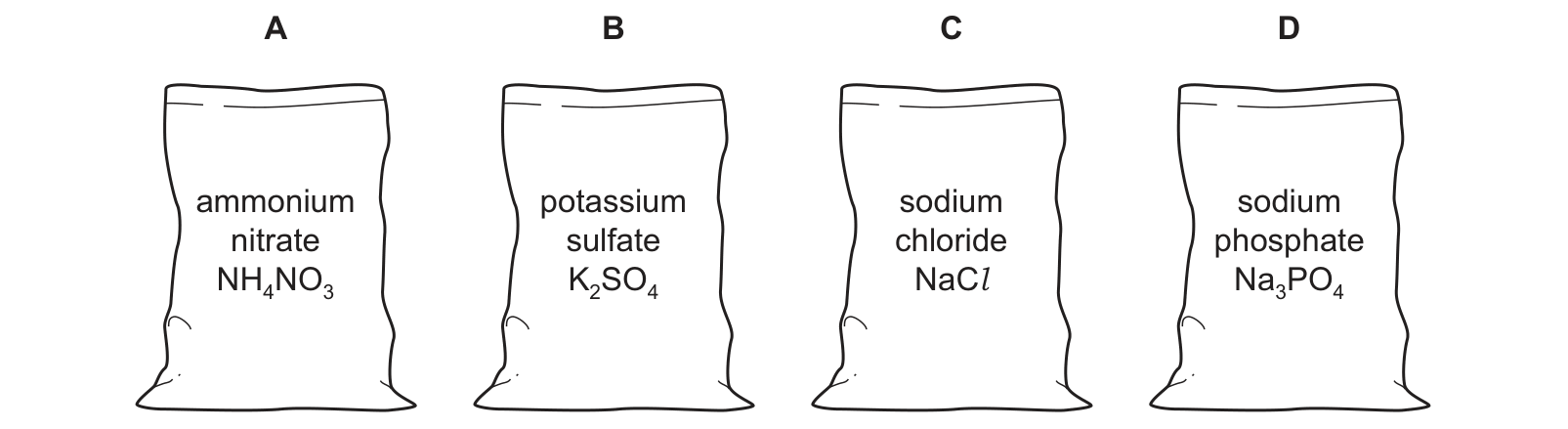
Answer: C.
Question 2
An NPK fertiliser is made by mixing two compounds.
The first compound has the formula (NH4)2HPO4.
What is the formula of the second compound?
Answer: B.
Question 3
Which gas is released when slaked lime, Ca(OH)2, is added to a field that has previously been treated with ammonium sulfate fertiliser?
Answer: A.
What the syllabus asks for on this topicSyllabus points
Syllabus points
- Describe the importance of nitrogen, phosphorus and potassium in fertilisers.
- State that ammonium salts and nitrates are used as fertilisers.
- Describe the use of NPK fertilisers to provide nitrogen, phosphorus and potassium for improved plant growth.
- Name the acid and the base from which each ammonium fertiliser is made.
- Relate the solubility that makes a fertiliser work to the run-off that damages rivers.
The syllabus content here is Core. The percentage composition calculation at the end uses relative formula mass, which is Extended in 0620, so a Core candidate can skip that section.
Related CIE 0620 Chemistry topics
Not the topic you were looking for? Describe what you are stuck on in your own words and we will take you to the notes that answer it.