Elements, compounds and mixtures
Contents: 7 sections
The three kinds of substance
| Element | Compound | Mixture | |
|---|---|---|---|
| Contains | One kind of atom | Two or more elements chemically bonded | Two or more substances not bonded |
| Proportions | Not applicable | Always fixed | Any proportion at all |
| Separated by | Cannot be separated chemically | Chemical reaction or electrolysis | Physical means: filtering, distilling, a magnet |
| Properties | Its own | Completely different from its elements | The properties of each part, unchanged |
| Melting point | Sharp | Sharp | Over a range |
| Examples | Iron, oxygen, carbon, sodium | Water, sodium chloride, carbon dioxide | Air, sea water, brass, crude oil |
The row about proportions is the one that decides most questions. A compound has one fixed composition: water is always 2 hydrogen atoms to 1 oxygen atom, never 3 to 1. A mixture can be made in any ratio you like, which is why air over a city is not the same mixture as air over an ocean and both are still air.
The row about separation is the second. Boiling sea water separates the salt from the water because they are only mixed. No amount of boiling separates water into hydrogen and oxygen, because chemical bonds hold it together; that needs electrolysis.
About 118 elements are known and each has its own symbol in the Periodic Table. Everything else in the universe is those elements combined or mixed.
Reading particle diagrams
Questions show four boxes of circles and ask which is which. Two rules answer all of them.
- Are the circles joined? Joined circles mean a molecule, either of an element or of a compound. Loose circles mean separate atoms.
- Are they all the same shade? One shade means one element. Two shades mean two elements.
That gives four cases:
- Loose circles, all identical: an element, such as argon.
- Joined pairs, both circles identical: an element made of molecules, such as O₂.
- Joined groups containing two shades: a compound, such as H₂O.
- Two different kinds of particle sitting loose together: a mixture.
A common trap is a picture of joined pairs of one shade next to joined pairs of another shade. That is a mixture of two elements, not a compound, because nothing has bonded across the two kinds.
Iron and sulfur: the experiment that shows the difference
Grey iron filings and yellow sulfur powder are stirred together. What you have is a mixture, and you can prove it:
- A magnet pulls the iron out, leaving the sulfur behind.
- Dilute hydrochloric acid reacts with the iron to give hydrogen, a gas with no smell that pops with a lighted splint.
- Both original colours are still visible.
Now heat the same mixture strongly. It glows red and keeps glowing after the flame is removed, and a black solid is left. That solid is iron(II) sulfide, a compound:
Fe(s) + S(s) → FeS(s)
Test it the same way and everything has changed:
- The magnet does nothing, because there is no free iron left.
- Dilute hydrochloric acid gives hydrogen sulfide, which smells strongly of rotten eggs.
- Neither the grey nor the yellow can be seen.
That is what "the properties of a compound differ from the properties of its elements" means in practice, and naming a specific change like the magnet or the smell is what earns the mark rather than the general statement.
Fixed proportions, with the numbers
The fixed proportions of a compound are fixed by mass as well as by atom count, and that is checkable arithmetic.
Iron(II) sulfide, FeS. One iron atom, Aᵣ 56, combines with one sulfur atom, Aᵣ 32, so 56 g of iron always combines with exactly 32 g of sulfur. The relative formula mass is 56 + 32 = 88, and the percentage of iron by mass is
56 / 88 × 100 = 63.6%
Mix 56 g of iron with 40 g of sulfur and heat it, and you still get FeS: 32 g of the sulfur reacts and 8 g is left over unreacted. The compound refuses to take the extra.
Water, H₂O. Two hydrogen atoms, Aᵣ 1, and one oxygen atom, Aᵣ 16, give a relative molecular mass of 18, so hydrogen and oxygen combine in a mass ratio of 2 to 16, which is 1 to 8. The percentage of oxygen by mass is
16 / 18 × 100 = 88.9%
Every sample of pure water on Earth gives that figure, whatever its source.
Mixtures worth knowing by name
Air is a mixture of gases, roughly 78% nitrogen and 21% oxygen by volume, with argon at about 0.9% and carbon dioxide at about 0.04% making up nearly all the rest. Those first three add to 78 + 21 + 0.9 = 99.9%. Air can be separated by fractional distillation because its parts are only mixed.
Alloys such as brass are mixtures of metals, and their composition can be varied deliberately to change their properties.
Crude oil is a mixture of hydrocarbons separated by fractional distillation, which works precisely because a mixture boils over a range rather than at one temperature.
Sea water is a mixture of water and dissolved salts, separated by distillation or by evaporating the water off.
Common mistakes
- Calling air a compound. Its gases are not chemically combined and its composition varies.
- Saying a mixture of two elements is a compound because it contains two elements. Combination, not company, makes a compound.
- Saying a compound can be separated by filtering or distilling.
- Saying an element cannot be a molecule. O₂, N₂, Cl₂ and S₈ are all elements made of molecules.
- Expecting a mixture to have a sharp melting point.
- Saying iron(II) sulfide is magnetic because it contains iron. The iron is bonded and no longer behaves as iron.
Check you have it
Question 1
Elements P and Q have the same number of electron shells.
An atom of Q has more electrons in its outer electron shell than an atom of P.
Which statements are correct?
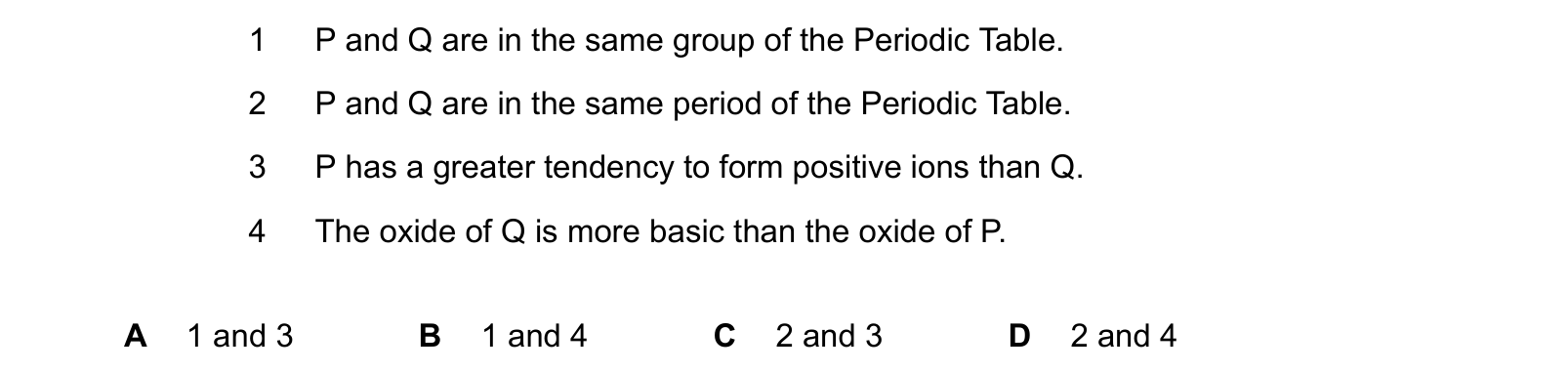
Answer: C.
Question 2
Which row shows properties of an element that is in the same group of the Periodic Table as lithium? Each answer gives, in order: electrical conductivity; density in g / cm³.
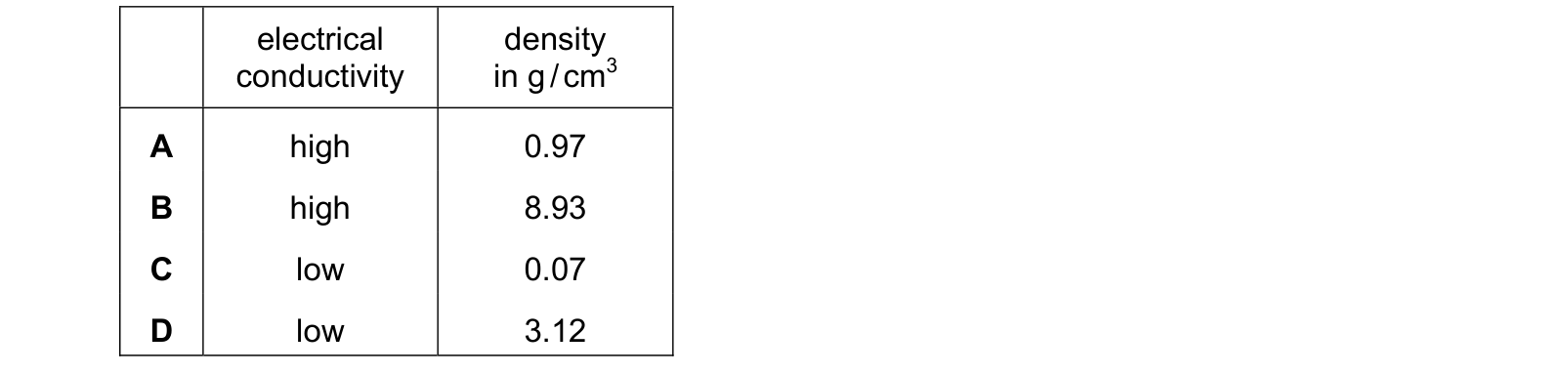
Answer: A.
Question 3
The diagrams represent some elements, compounds and mixtures. 1 2 3 4 Which row describes the numbered substances? Use the source image for S23 Paper 13, question 2.
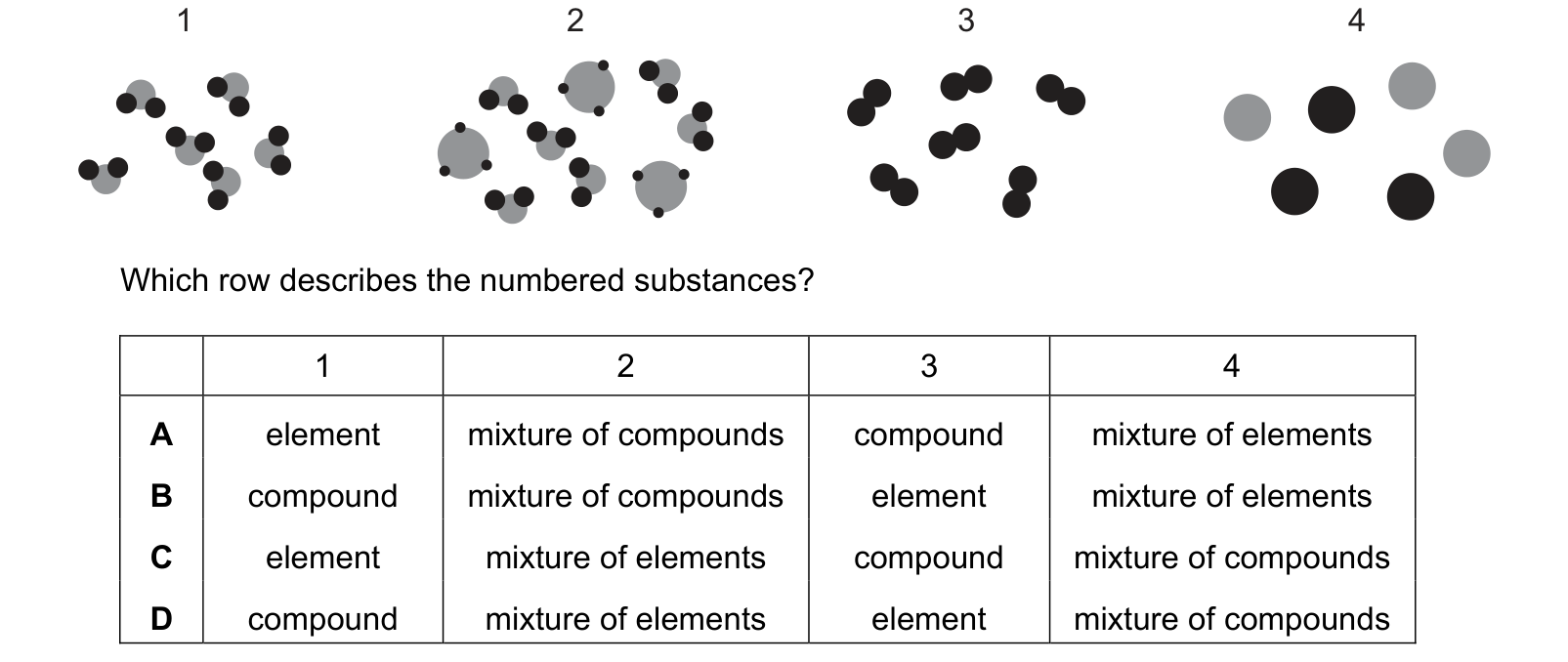
Answer: B.
What the syllabus asks for on this topicSyllabus points
Syllabus points
- Describe the differences between an element, a compound and a mixture.
- State that an element is a substance that cannot be broken down into anything simpler by chemical means.
- State that a compound contains two or more different elements chemically combined in fixed proportions.
- State that a mixture contains two or more substances that are not chemically combined.
- Identify elements, compounds and mixtures from diagrams showing their particles.
- Explain why the properties of a compound differ from those of the elements that formed it.
Everything in 2.1 is Core. There is no Extended content in this subtopic, so a Core candidate can learn it in full and an Extended candidate has nothing extra to add.
Related CIE 0620 Chemistry topics
Not the topic you were looking for? Describe what you are stuck on in your own words and we will take you to the notes that answer it.