Uses of metals
Contents: 7 sections
The rule for answering these questions
Every mark in this subtopic is awarded for a property matched to a use. Naming the use alone scores nothing, and naming a property that is irrelevant to that use scores nothing either. Aluminium in aircraft is about density; aluminium in cans is about corrosion; and giving one answer where the other is wanted is the usual way the marks go.
| Metal | Use | Property that explains it |
|---|---|---|
| Aluminium | Aircraft bodies | Low density, so the aircraft is lighter |
| Aluminium | Overhead electrical cables | Low density and good electrical conductivity |
| Aluminium | Food containers and cooking foil | Resists corrosion, and is malleable |
| Copper | Electrical wiring | Excellent electrical conductivity, and ductile |
| Copper | Water pipes and cooking pans | Unreactive with water, good thermal conductivity |
Aluminium and its low density
Aluminium has a density of 2.7 g per cm<sup>3</sup>, against 7.9 for iron and 8.9 for copper. It is roughly a third as heavy as either for the same volume, and that single number explains two of its three uses.
Worked example. Compare 1000 cm<sup>3</sup> of aluminium with the same volume of copper.
mass of aluminium = 1000 × 2.7 = 2700 g
mass of copper = 1000 × 8.9 = 8900 g
8900 / 2700 = 3.3
The copper is 3.3 times as heavy. For an overhead cable slung between pylons, that difference decides the design: copper conducts better, but an aluminium cable of the same current-carrying ability weighs far less, so it sags less and the pylons can be further apart and lighter. Overhead cables are aluminium wound round a steel core, which supplies the tensile strength that aluminium lacks.
For an aircraft, low density means less fuel burnt to lift the same structure. Pure aluminium is too soft, so aircraft bodies use aluminium alloys, which 9.3 explains are harder and stronger than the pure metal.
Aluminium and corrosion
Aluminium sits above zinc and iron in the reactivity series, so it ought to corrode quickly. It does not, and the reason is a favourite examination question.
The instant a fresh aluminium surface meets air, a thin, hard layer of aluminium oxide forms on it. That layer is impermeable and sticks firmly to the metal underneath, so air and water cannot reach it and the reaction stops. Rust, by contrast, is flaky and porous, so it falls away and exposes fresh iron to corrode in turn.
This is why aluminium is used for drinks cans, cooking foil and food containers: it does not corrode, it does not contaminate the food, and it is malleable enough to be rolled into foil a few hundredths of a millimetre thick.
The layer is why aluminium appears unreactive. It is not genuinely unreactive, and questions phrase it as "apparent" unreactivity precisely to test whether you know the difference. Aluminium powder with iron(III) oxide reacts vigorously, which is what the thermite reaction is.
Copper and its conductivity
Copper is the standard metal for electrical wiring for two reasons together:
- It has a very high electrical conductivity, second only to silver among common metals, and silver is far too expensive.
- It is ductile, so it can be drawn out into a long thin wire without snapping.
Both are needed. A metal that conducted well but could not be drawn into wire would be useless for the job.
Copper is also used for water pipes, because it is unreactive enough that hot and cold water do not attack it, and it is malleable enough to be bent into shape. It is used for the base of cooking pans because of its high thermal conductivity, which spreads the heat evenly.
Copper is not used for overhead cables even though it conducts better, because its density is more than three times that of aluminium and it costs considerably more.
Reading a new use from properties
Cambridge often gives an unfamiliar use and asks which property matters. Work backwards from what the object has to do:
- Something that must carry a current: electrical conductivity.
- Something that must be light: low density.
- Something that must be shaped or rolled: malleability; drawn into wire: ductility.
- Something outdoors or in contact with food: resistance to corrosion.
- Something that must transfer heat: thermal conductivity.
- Something that must hold a load: strength and high melting point.
Then name the metal that has that property, and say why the obvious alternative fails. Iron is not used for drinks cans because it rusts. Sodium is not used for anything structural because it reacts with water in the air.
Common mistakes
- Saying aluminium is used in aircraft because it does not corrode, when the mark is for low density.
- Saying aluminium is used in cans because it is light, when the mark is for corrosion resistance.
- Saying aluminium is unreactive, rather than that its oxide layer makes it appear unreactive.
- Giving copper for overhead cables because it conducts best, ignoring its density.
- Saying copper is used for wiring because it is malleable, when the word for making wire is ductile.
- Naming a use without naming the property, which is where the mark is.
- Placing aluminium below iron in the reactivity series because it corrodes less.
Check you have it
Question 1
Which row links a property of aluminium to its stated use? Each answer gives, in order: property; use.
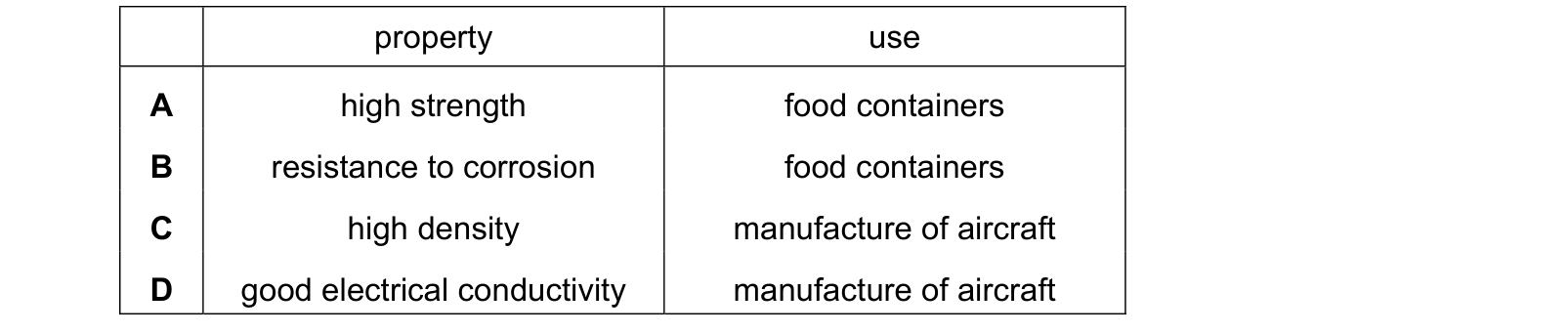
Answer: B.
Question 2
Which uses of the metals shown are correct? Each answer gives, in order: aluminium; stainless steel.
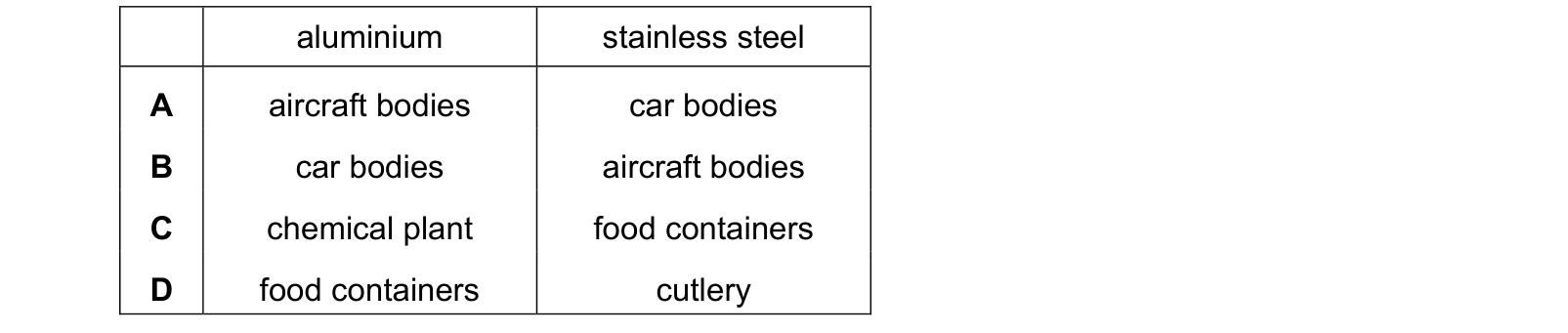
Answer: D.
Question 3
Which row links the property of a metal to its use? Each answer gives, in order: property; use.
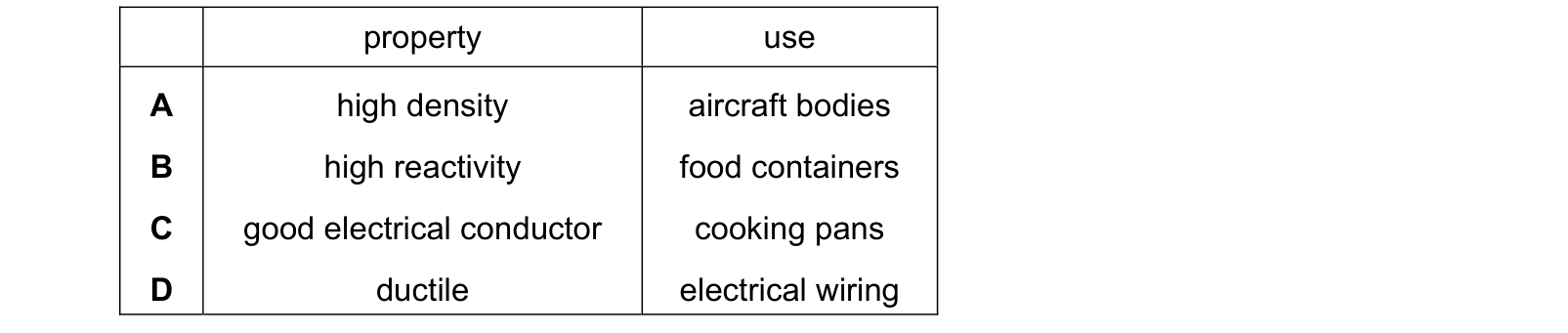
Answer: D.
What the syllabus asks for on this topicSyllabus points
Syllabus points
- Describe the uses of aluminium in the manufacture of aircraft, in overhead electrical cables and in food containers.
- Relate each use of aluminium to its low density, its electrical conductivity and its resistance to corrosion.
- Describe the uses of copper in electrical wiring and relate them to its electrical conductivity and its ductility.
- Explain the apparent unreactivity of aluminium in terms of its oxide layer.
- Relate the use of any metal to its physical and chemical properties.
Everything in 9.2 is Core. There is no Extended-only content in this subtopic.
Related CIE 0620 Chemistry topics
Not the topic you were looking for? Describe what you are stuck on in your own words and we will take you to the notes that answer it.