Diffusion
Contents: 8 sections
What diffusion is
Diffusion is the net movement of particles from a region of higher concentration to a region of lower concentration, as a result of their random motion.
Three words in that sentence carry the marks.
Net. Particles move in every direction at once. What produces the spreading is that more of them happen to move away from the crowded region than towards it, simply because there are more of them there to start with. Nothing pushes them.
Random. No particle is aiming anywhere. Cambridge rejects any answer that says particles "want" to spread out or "move to where there is more room".
Concentration. Diffusion continues until the concentration is the same throughout, at which point the random motion carries on but there is no further net change.
Diffusion happens in gases and in liquids, because in both the particles can move from place to place. It does not happen in solids, whose particles only vibrate about fixed positions.
It is much faster in gases than in liquids. Gas particles travel far faster and have large gaps to move through; liquid particles are already touching, so each one is constantly blocked by its neighbours.
Demonstrating diffusion in a gas
Bromine in a gas jar. A gas jar of dense brown bromine vapour is placed below a gas jar of air and the cover slip between them is removed. Over several minutes the brown colour spreads upwards until both jars are an even, paler brown.
The point of putting the bromine underneath is that this rules out the obvious wrong explanation. Bromine is denser than air, so it cannot be sinking or being carried by a draught. The only thing moving it upwards is the random motion of its own particles.
Bromine is slow for a gas because Br₂ has a relative molecular mass of 160, against about 29 for air.
Ammonia and litmus. Cotton wool soaked in concentrated ammonia solution is put in one end of a dry tube containing damp red litmus paper along its length. The papers turn blue one after another, from the near end to the far end, showing the ammonia gas arriving progressively.
Demonstrating diffusion in a liquid
Potassium manganate(VII) in water. A single purple crystal is dropped into a beaker of still water. Over hours the purple spreads outwards until the whole beaker is an even, pale purple.
The water must not be stirred and must not be warm, or the spreading is convection rather than diffusion, and that is the control the question is usually about.
Copper(II) sulfate under water. Copper(II) sulfate solution placed carefully at the bottom of a measuring cylinder of water shows a sharp boundary that slowly blurs and finally disappears over several days. The blue moves upwards against gravity, which again rules out sinking or settling.
Temperature
Raising the temperature makes diffusion faster, in liquids and gases alike, because the particles have more kinetic energy and so move faster. Warm water takes minutes to turn purple where cold water takes hours.
Relative molecular mass and rate (Extended)
This is the whole of the Extended content for 1.2, and it is one sentence long:
At a given temperature, the lower the relative molecular mass of a gas, the faster it diffuses.
The explanation Cambridge wants is about speed. All gas particles at the same temperature have on average the same kinetic energy. A lighter particle therefore has to be moving faster to carry that energy, so it covers ground more quickly and diffuses further in the same time.
Comparing two gases is always a comparison of Mᵣ values, so work them out first:
- Mᵣ(NH₃) = 14 + (3 × 1) = 17
- Mᵣ(HCl) = 1 + 35.5 = 36.5
- Mᵣ(H₂) = 2 × 1 = 2
- Mᵣ(CO₂) = 12 + (2 × 16) = 44
Hydrogen is the fastest-diffusing gas there is, because nothing has a smaller Mᵣ. Carbon dioxide is more than twenty times heavier and correspondingly sluggish.
The ammonia and hydrogen chloride tube (Extended)
This is the standard question. Cotton wool soaked in concentrated ammonia solution is put in one end of a long glass tube, and cotton wool soaked in concentrated hydrochloric acid in the other. Both give off a gas. Where the two gases meet, a white ring of ammonium chloride forms:
NH₃(g) + HCl(g) → NH₄Cl(s)
The ring does not form in the middle. Ammonia, at Mᵣ 17, is much lighter than hydrogen chloride at Mᵣ 36.5, so ammonia particles move faster and travel further before the two meet. The ring forms nearer the hydrochloric acid end.
Worked example. How far along a 100 cm tube does the ring form?
The ratio of the masses is 36.5 / 17 = 2.15, and the ratio of the speeds is the square root of that, roughly 1.5. So ammonia travels about 1.5 cm for every 1 cm the hydrogen chloride travels, and the two distances share the 100 cm in a 1.5 to 1 ratio:
100 × 1.5 / 2.5 = 60 cm from the ammonia end, so about 40 cm from the acid end.
The 0620 syllabus asks only which end the ring forms nearer, so a correct answer names the end and gives the Mᵣ comparison as the reason. Doing the arithmetic is still worth it, because it fixes which way round the ratio goes: the lighter gas gets the longer distance.
Common mistakes
- Saying particles move from high to low concentration because they "want more space". They move at random.
- Saying diffusion occurs in solids.
- Saying the white ring forms in the middle of the tube, or nearer the ammonia end.
- Saying the heavier gas diffuses faster because it has more energy. At a given temperature the energies are equal, so the heavier particle is the slower one.
- Explaining the bromine jar by saying bromine is denser and sinks, when the whole design of the experiment is that the bromine moves upwards.
- Stirring or warming the water in the potassium manganate(VII) experiment, which replaces diffusion with convection.
Check you have it
Question 1
Brownian motion and the diffusion of gases provide evidence for the particulate nature of matter. Which row identifies an example of Brownian motion and how molecular mass determines the rate of diffusion of gas molecules? Each answer gives, in order: Brownian motion; diffusion.
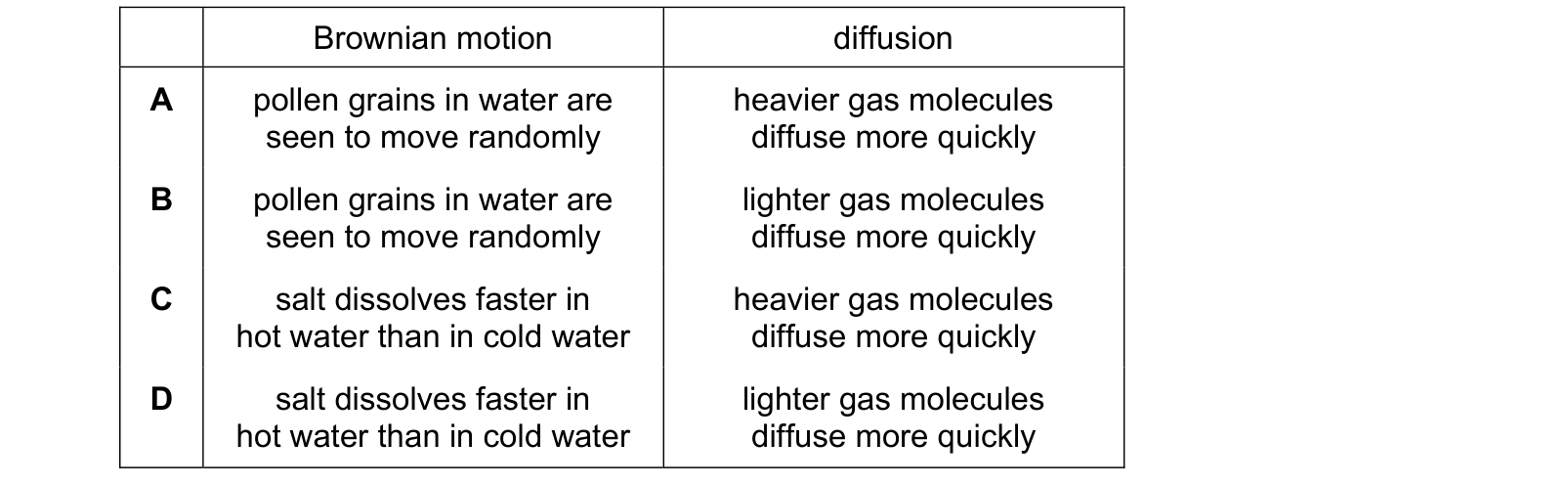
Answer: B.
Question 2
Which statements about diffusion are correct?
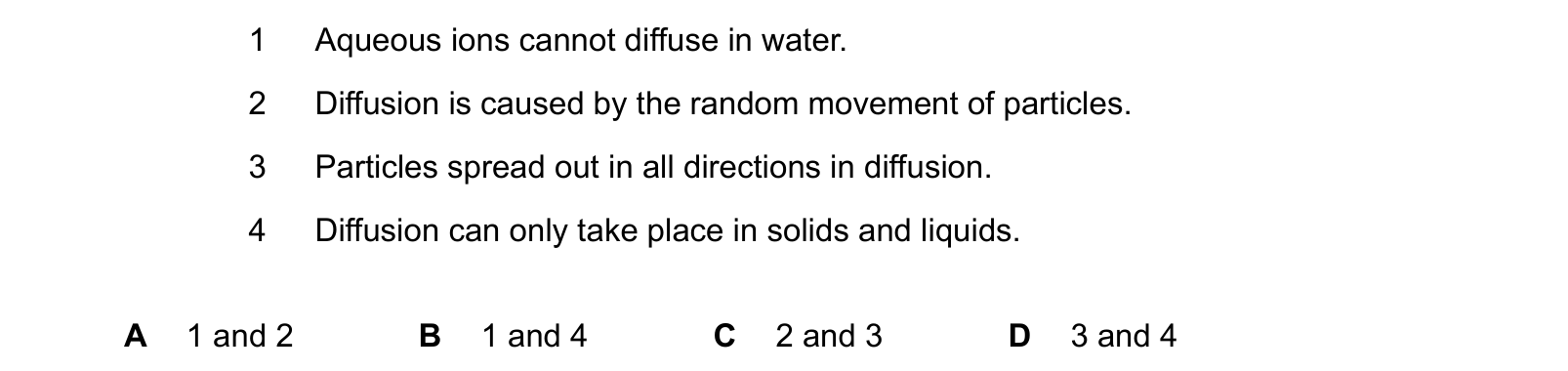
Answer: C.
Question 3
Which gas has the lowest rate of diffusion at room temperature and pressure?
Answer: C.
What the syllabus asks for on this topicSyllabus points
Syllabus points
- Describe diffusion as the spreading out of particles from a region of higher concentration to a region of lower concentration.
- Explain diffusion in terms of kinetic particle theory, using the random motion of particles.
- Describe the experiments that demonstrate diffusion in gases and in liquids.
- Extended only: describe the effect of relative molecular mass on the rate of diffusion of gases.
- Extended only: explain that effect in terms of the speed at which particles of different mass move.
Related CIE 0620 Chemistry topics
Not the topic you were looking for? Describe what you are stuck on in your own words and we will take you to the notes that answer it.