Atomic structure and the Periodic Table
Contents: 6 sections
Inside the atom
| Particle | Relative mass | Relative charge | Where it is |
|---|---|---|---|
| Proton | 1 | +1 | In the nucleus |
| Neutron | 1 | 0 | In the nucleus |
| Electron | 1/1836, taken as negligible | −1 | In shells around the nucleus |
Two consequences follow from that table and both are examined constantly.
Almost all the mass of an atom is in the nucleus, because only protons and neutrons have any appreciable mass. An electron weighs roughly one two-thousandth of a proton.
A neutral atom has equal numbers of protons and electrons, because +1 and −1 cancel one for one. That is what makes an atom neutral, and it is the sentence to write when a question asks why.
The nucleus is tiny compared with the atom. If an atom were the size of a sports stadium the nucleus would be a pea at the centre, so an atom is mostly empty space.
Proton number and nucleon number
Proton number (atomic number), symbol Z, is the number of protons in the nucleus.
>
Nucleon number (mass number), symbol A, is the total number of protons and neutrons in the nucleus.
The proton number is what makes an element that element. Change it and you have a different element altogether; it can never change in a chemical reaction.
The number of neutrons is not given directly, so you subtract:
number of neutrons = nucleon number − proton number
An atom is written with the nucleon number above and the proton number below the symbol, as in ²³₁₁Na.
Worked examples.
For ²³₁₁Na: 11 protons, and 23 − 11 = 12 neutrons. Being neutral, it has 11 electrons.
For ⁴⁰₂₀Ca: 20 protons, and 40 − 20 = 20 neutrons, with 20 electrons.
For ⁵⁶₂₆Fe: 26 protons, and 56 − 26 = 30 neutrons, with 26 electrons.
For an ion, the proton number and the neutron count are unchanged; only the electrons differ. A Cl⁻ ion built from ³⁵₁₇Cl has 17 protons, 35 − 17 = 18 neutrons, and 17 + 1 = 18 electrons. An Mg²⁺ ion has 12 protons and 12 − 2 = 10 electrons.
Electronic configuration
Electrons occupy shells, and the shells fill from the inside out. For the first 20 elements the capacities to use are:
- First shell: 2 electrons.
- Second shell: 8 electrons.
- Third shell: 8 electrons at this level.
- Fourth shell: the next 2 electrons, giving potassium and calcium.
A configuration is written as the number in each shell, separated by commas, starting from the innermost.
| Element | Proton number | Configuration |
|---|---|---|
| Hydrogen | 1 | 1 |
| Carbon | 6 | 2,4 |
| Oxygen | 8 | 2,6 |
| Neon | 10 | 2,8 |
| Sodium | 11 | 2,8,1 |
| Aluminium | 13 | 2,8,3 |
| Sulfur | 16 | 2,8,6 |
| Chlorine | 17 | 2,8,7 |
| Argon | 18 | 2,8,8 |
| Potassium | 19 | 2,8,8,1 |
| Calcium | 20 | 2,8,8,2 |
Always check that the digits add up to the proton number. Aluminium: 2 + 8 + 3 = 13. Calcium: 2 + 8 + 8 + 2 = 20. A configuration whose total is wrong is wrong however plausible it looks, and this one check catches most slips.
Configurations of ions
An ion has gained or lost electrons, so write the atom's configuration first and then adjust.
- Sodium loses 1 electron: Na is 2,8,1, so Na⁺ is 2,8.
- Magnesium loses 2: Mg is 2,8,2, so Mg²⁺ is 2,8.
- Aluminium loses 3: Al is 2,8,3, so Al³⁺ is 2,8.
- Chlorine gains 1: Cl is 2,8,7, so Cl⁻ is 2,8,8.
- Oxygen gains 2: O is 2,6, so O²⁻ is 2,8.
- Calcium loses 2: Ca is 2,8,8,2, so Ca²⁺ is 2,8,8.
Every one of those ions ends with a full outer shell, matching a noble gas. Na⁺, Mg²⁺, Al³⁺ and O²⁻ all have the configuration of neon, and Cl⁻ and Ca²⁺ both have that of argon.
Reading the Periodic Table from the configuration
Three rules connect the configuration to the element's position, and they work in both directions.
- The number of electrons in the outer shell equals the group number, for Groups I to VII.
- The number of occupied shells equals the period number.
- Group VIII, the noble gases, have a full outer shell, which is 2 for helium and 8 for the rest.
Worked example. An element has the configuration 2,8,6. Where is it and what is it?
Six electrons in the outer shell puts it in Group VI. Three occupied shells puts it in Period 3. Group VI of Period 3 is sulfur, and adding the digits confirms 2 + 8 + 6 = 16, which is sulfur's proton number.
Working the other way: an element in Group II of Period 4 has 2 outer electrons and 4 occupied shells, so it is 2,8,8,2, which is calcium.
The group number matters because it fixes how many electrons an atom must lose or gain to reach a full outer shell, which is what decides the ion it forms and how reactive it is. Group I loses one and forms a 1+ ion; Group VII gains one and forms a 1− ion; Group VIII has no need to do either, which is why the noble gases are unreactive.
Common mistakes
- Giving an electron a relative mass of 1 rather than treating it as negligible.
- Using the nucleon number as the number of neutrons instead of subtracting the proton number.
- Changing the number of protons when writing the configuration of an ion. Only the electrons change.
- Putting more than 8 electrons in the third shell for an element up to calcium.
- Writing a configuration whose digits do not add up to the proton number.
- Reading the period number from the outer shell electrons, or the group number from the number of shells. It is the other way round.
- Saying the noble gases have no outer shell electrons. They have a full one.
Check you have it
Question 1
The electronic configurations of helium, neon and argon are shown. Which row describes these gases? Each answer gives, in order: reactivity; form of the gas; electronic configuration.
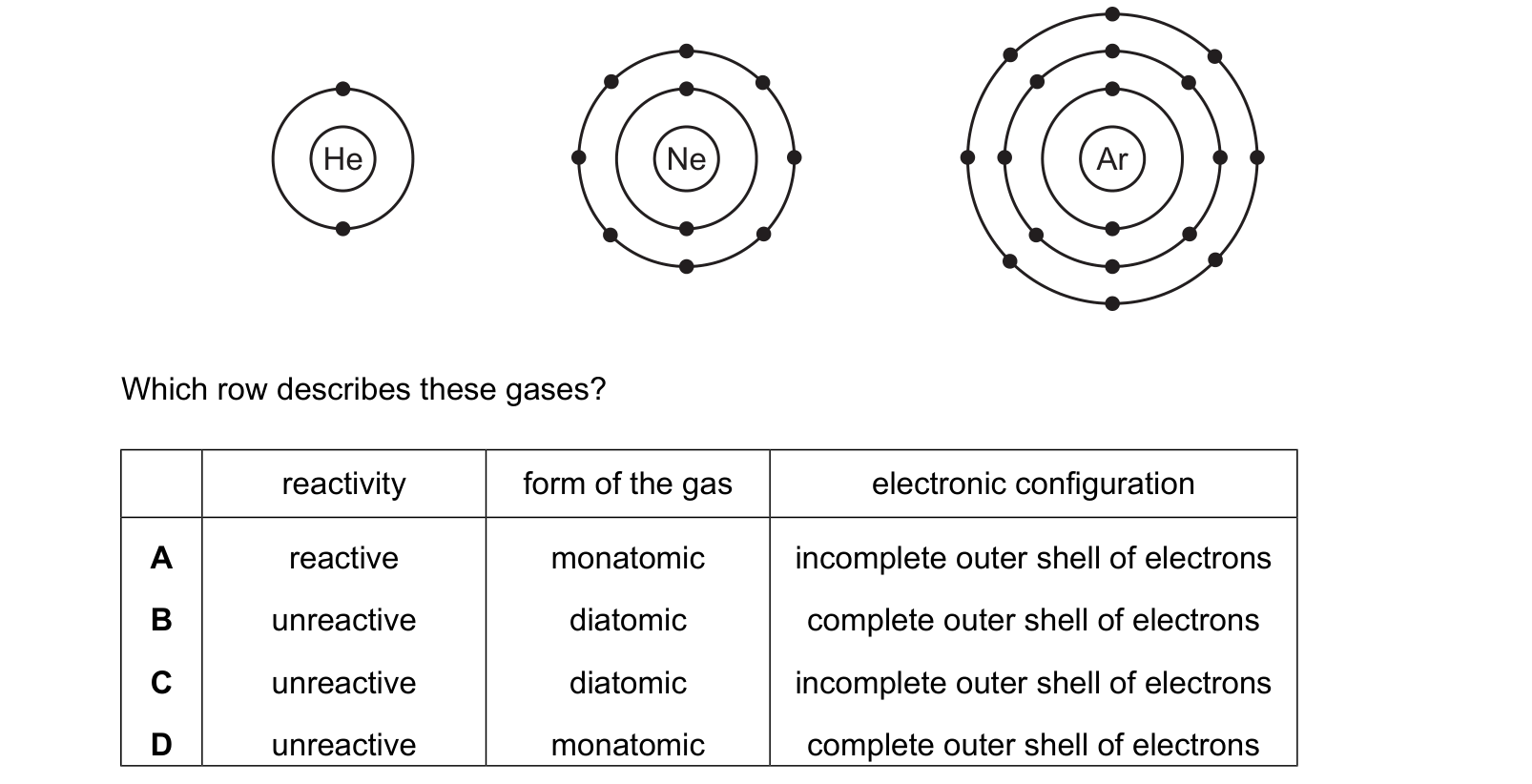
Answer: D.
Question 2
Elements in Group IV of the Periodic Table are shown. carbon silicon germanium tin lead What does not occur in Group IV as it is descended?

Answer: C.
Question 3
Element X forms ions with the formula X2–. Which row describes element X? Each answer gives, in order: group number; type of element.
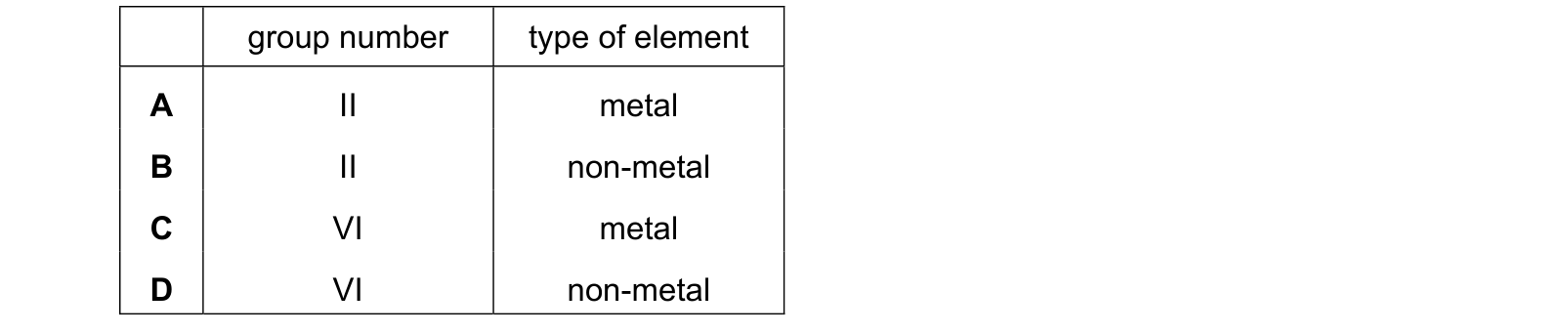
Answer: D.
What the syllabus asks for on this topicSyllabus points
Syllabus points
- Describe the structure of the atom as a central nucleus containing protons and neutrons, surrounded by electrons in shells.
- State the relative charges and relative masses of a proton, a neutron and an electron.
- Define proton number, or atomic number, as the number of protons in the nucleus of an atom.
- Define mass number, or nucleon number, as the total number of protons and neutrons in the nucleus of an atom.
- Determine the electronic configuration of elements and their ions with proton number 1 to 20.
- State how the group number, the period number and a full outer shell are read from the electronic configuration.
All of 2.2 is Core. There is no Extended content here, so this subtopic is examined the same way on Paper 1 and Paper 2.
Related CIE 0620 Chemistry topics
Not the topic you were looking for? Describe what you are stuck on in your own words and we will take you to the notes that answer it.