Arrangement of elements
Contents: 9 sections
How the table is built
- A period is a horizontal row. There are seven of them.
- A group is a vertical column, numbered I to VII with the noble gases as Group VIII or Group 0.
- The elements are placed in order of increasing proton number, which is the same as atomic number, and not in order of relative atomic mass.
That distinction is testable and is not a technicality. Argon has a relative atomic mass of 39.9 and potassium 39.1, so ordering by mass would put them the wrong way round and place a gas in Group I. Ordering by proton number, argon is 18 and potassium is 19, and each lands in the group its chemistry demands.
Two numbers can be read straight off an electronic configuration:
- The group number is the number of electrons in the outer shell.
- The period number is the number of occupied shells.
Sodium is 2,8,1, so it is in Group I and period 3. Chlorine is 2,8,7, so it is in Group VII and period 3. Neon is 2,8, so it has a full outer shell and sits in Group VIII.
Group number and the charge of the ion
An atom forms an ion by gaining or losing electrons to reach a full outer shell, and the group number says how far it has to go.
| Group | Outer shell electrons | Ion formed | Example |
|---|---|---|---|
| I | 1 | +1, by losing 1 | Na<sup>+</sup> |
| II | 2 | +2, by losing 2 | Mg<sup>2+</sup> |
| III | 3 | +3, by losing 3 | Al<sup>3+</sup> |
| V | 5 | 3−, by gaining 3 | N<sup>3−</sup> |
| VI | 6 | 2−, by gaining 2 | O<sup>2−</sup> |
| VII | 7 | 1−, by gaining 1 | Cl<sup>−</sup> |
| VIII | 8, or 2 for helium | None | Ar |
Metals lose electrons and form positive ions. Non-metals gain electrons and form negative ions. The charge on a metal ion equals the group number; the charge on a non-metal ion equals the group number minus 8.
Group IV is the exception worth stating. Carbon and silicon would have to lose or gain four electrons, which takes too much energy, so they share electrons and bond covalently instead.
Predicting a formula
Because the charges are predictable, so are the formulae. Element X in Group II forms X<sup>2+</sup> and element Y in Group VII forms Y<sup>−</sup>, so the compound needs two Y for each X, giving XY<sub>2</sub>. That is the same reasoning that gives MgCl<sub>2</sub> and CaBr<sub>2</sub>.
An element in Group III with one in Group VI gives a formula of X<sub>2</sub>Y<sub>3</sub>, as in Al<sub>2</sub>O<sub>3</sub>.
Why a group behaves as a family
Elements in the same group have the same number of outer shell electrons, and chemical reactions involve only the outer shell. Lithium, sodium and potassium all have one outer electron to lose, so all three react with water to make a hydroxide and hydrogen, all three form ions with a +1 charge and all three form chlorides of formula MCl.
This is the single most reusable sentence in chapter 8. When a question asks why two elements have similar chemical properties, the answer is the number of outer shell electrons, not the mass, the size or the position.
Across a period
Moving left to right across period 3:
- Sodium, magnesium and aluminium are metals.
- Silicon is a metalloid, with properties of both.
- Phosphorus, sulfur, chlorine and argon are non-metals.
So the character changes from metallic to non-metallic across a period, and every property follows: conductivity falls away, the elements stop being malleable, and, as 7.2 sets out, the oxides change from basic in Na<sub>2</sub>O and MgO, through amphoteric in Al<sub>2</sub>O<sub>3</sub>, to acidic in SiO<sub>2</sub>, P<sub>4</sub>O<sub>10</sub> and SO<sub>3</sub>.
Down a group
Going down a group each element has one more occupied shell than the one above. The outer electron is therefore further from the nucleus and shielded by more inner shells, so the nucleus holds it less tightly.
That one fact drives both group trends in this chapter, in opposite directions:
- A Group I metal has to lose its outer electron. Losing it gets easier down the group, so reactivity increases.
- A Group VII non-metal has to gain an electron. Attracting one gets harder down the group, so reactivity decreases.
Predicting from a data table
Cambridge often gives three members of a group and asks about a fourth. Work out the size of the step, not just its direction.
The melting points of lithium, sodium and potassium are 181 °C, 98 °C and 63 °C. The gaps are:
- 181 − 98 = 83 °C
- 98 − 63 = 35 °C
The gaps are shrinking, so rubidium should melt a little below 63 °C but not far below. Its real melting point is 39 °C, which the trend predicts well.
The same reading applies to any column of data: state the direction of the trend, note whether the steps are growing or shrinking, and place the missing element accordingly. A prediction that simply says "lower" is worth less than one that says how much lower and why.
Common mistakes
- Saying the elements are arranged in order of relative atomic mass.
- Confusing periods with groups, so quoting the period number as the number of outer electrons.
- Giving a Group VI ion a 6+ charge instead of 2−.
- Explaining similar chemistry within a group by similar mass rather than by outer shell electrons.
- Expecting carbon to form C<sup>4+</sup> ions rather than covalent bonds.
- Saying metallic character increases across a period.
- Predicting a value beyond a data table without checking whether the steps are getting bigger or smaller.
Check you have it
Question 1
Rubidium is in Group I and strontium is in Group II of the Periodic Table. Which row describes the nature of rubidium oxide, Rb2O, and strontium oxide, SrO? Each answer gives, in order: Rb2O; SrO.
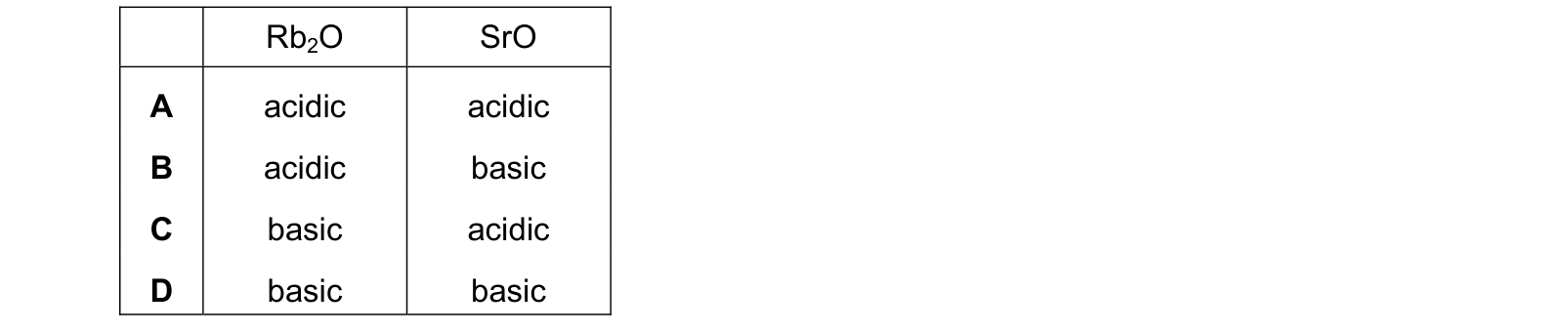
Answer: D.
Question 2
Sodium is in Group I of the Periodic Table and chlorine is in Group VII. Which row describes what happens when sodium bonds ionically with chlorine? Each answer gives, in order: sodium atoms; ion formed; chlorine atoms; ion formed.
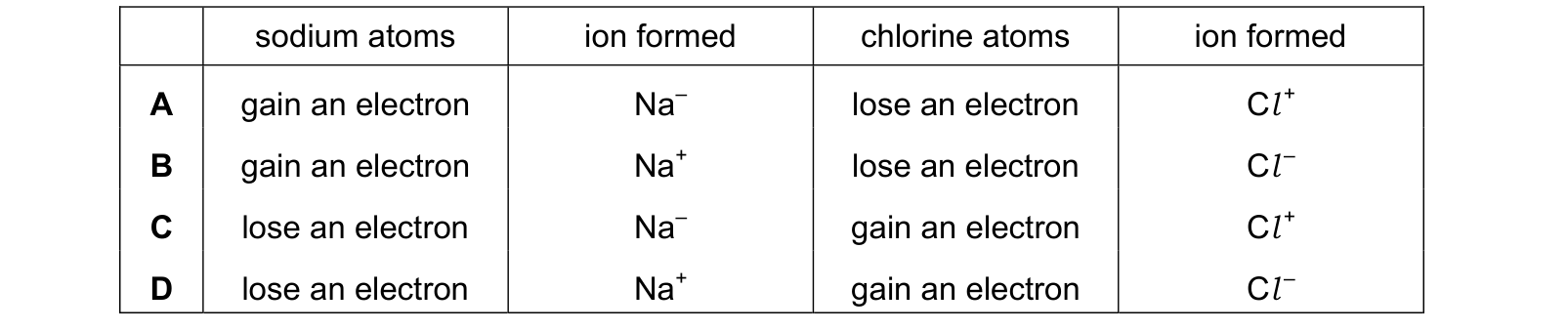
Answer: D.
Question 3
Rubidium and strontium are both in Period 5 of the Periodic Table.
Rubidium is in Group I. Strontium is in Group II.
Which statement about these elements is correct?
Answer: C.
What the syllabus asks for on this topicSyllabus points
Syllabus points
- Describe the Periodic Table as an arrangement of elements in periods and groups and in order of increasing proton number.
- Describe the change from metallic to non-metallic character across a period.
- Describe and explain the relationship between group number and the charge of the ions formed from elements in that group.
- Explain the similarities in the chemical properties of elements in the same group in terms of their electronic configuration.
- Explain how the position of an element in the Periodic Table can be used to predict its properties.
- Identify trends in groups, given information about the elements.
Everything in 8.1 is Core. There is no Extended-only content in this subtopic.
Related CIE 0620 Chemistry topics
Not the topic you were looking for? Describe what you are stuck on in your own words and we will take you to the notes that answer it.