Identification of ions and gases
Contents: 6 sections
Flame tests
Apparatus and method. Clean a nichrome or platinum wire by dipping it in concentrated hydrochloric acid and holding it in a hot blue Bunsen flame until it gives no colour. Dip it in the acid again, then in the solid sample, and hold it in the edge of a hot blue flame.
| Ion | Flame colour |
|---|---|
| Lithium, Li⁺ | Red |
| Sodium, Na⁺ | Yellow |
| Potassium, K⁺ | Lilac |
| Calcium, Ca²⁺ | Orange-red |
| Barium, Ba²⁺ | Light green |
| Copper(II), Cu²⁺ | Blue-green |
The wire must be genuinely clean because the yellow of sodium is intense and hides everything else. A trace of sodium left from the last sample turns a lilac potassium flame yellow, and the result is wrong rather than merely faint.
Cation tests
Method. Take the solution in a test tube. Add the reagent a few drops at a time, note what happens, then keep adding until the reagent is in excess. Both stages are needed: several cations look identical after the first few drops and are told apart only by what excess does.
| Cation | With aqueous sodium hydroxide | With aqueous ammonia |
|---|---|---|
| Aluminium, Al³⁺ | White precipitate, dissolves in excess to a colourless solution | White precipitate, insoluble in excess |
| Ammonium, NH₄⁺ | No precipitate; ammonia given off on warming | No precipitate |
| Calcium, Ca²⁺ | White precipitate, insoluble in excess | No precipitate, or a very faint one |
| Chromium(III), Cr³⁺ | Green precipitate, dissolves in excess | Grey-green precipitate, insoluble in excess |
| Copper(II), Cu²⁺ | Light blue precipitate, insoluble in excess | Light blue precipitate, dissolves in excess to a dark blue solution |
| Iron(II), Fe²⁺ | Green precipitate, insoluble in excess | Green precipitate, insoluble in excess |
| Iron(III), Fe³⁺ | Red-brown precipitate, insoluble in excess | Red-brown precipitate, insoluble in excess |
| Zinc, Zn²⁺ | White precipitate, dissolves in excess to a colourless solution | White precipitate, dissolves in excess to a colourless solution |
The precipitate is the insoluble metal hydroxide: adding hydroxide ions to a solution of the metal ion forms it. Aluminium hydroxide and zinc hydroxide are amphoteric, so they react with excess alkali and dissolve again.
Telling the three white precipitates apart
Aluminium, calcium and zinc all give a white precipitate with a few drops of sodium hydroxide. Two further observations separate them:
- Excess sodium hydroxide. Calcium hydroxide stays. Aluminium and zinc hydroxides dissolve.
- Excess aqueous ammonia. Aluminium hydroxide stays. Zinc hydroxide dissolves.
So a white precipitate that dissolves in excess sodium hydroxide and in excess ammonia is zinc; one that dissolves in excess sodium hydroxide only is aluminium; one that dissolves in neither is calcium.
Ammonium is the odd one out because it gives no precipitate at all. Warm the solution with aqueous sodium hydroxide and test the gas at the mouth of the tube with damp red litmus paper: it turns blue, so ammonia has been given off.
Anion tests
| Anion | Reagents | Positive result |
|---|---|---|
| Carbonate, CO₃²⁻ | Add dilute hydrochloric acid | Effervescence; the gas turns limewater milky |
| Chloride, Cl⁻ | Acidify with dilute nitric acid, then add aqueous silver nitrate | White precipitate |
| Bromide, Br⁻ | Acidify with dilute nitric acid, then add aqueous silver nitrate | Cream precipitate |
| Iodide, I⁻ | Acidify with dilute nitric acid, then add aqueous silver nitrate | Yellow precipitate |
| Nitrate, NO₃⁻ | Add aqueous sodium hydroxide, then aluminium foil, and warm carefully | Ammonia given off, turning damp red litmus blue |
| Sulfate, SO₄²⁻ | Acidify with dilute nitric acid, then add aqueous barium nitrate | White precipitate |
| Sulfite, SO₃²⁻ | Add a small amount of acidified aqueous potassium manganate(VII) | Purple turns colourless |
Why acidify, and why with nitric acid
Acidifying first removes carbonate ions. Silver carbonate and barium carbonate are both white insoluble solids, so a carbonate in the sample would give a white precipitate that looks exactly like a positive chloride or sulfate result. The acid destroys the carbonate as carbon dioxide before the test reagent is added.
The acid must be nitric acid, and the reason is different for each test:
- For the halide test, hydrochloric acid would add chloride ions, and every sample would then give a white precipitate with silver nitrate.
- For the sulfate test, sulfuric acid would add sulfate ions, and every sample would then give a white precipitate with barium nitrate.
Nitric acid introduces nitrate ions, which form no precipitate with either reagent.
The three silver halide precipitates differ only in shade, so describe them exactly: white for chloride, cream for bromide, yellow for iodide, in that order down Group VII.
In the nitrate test the aluminium reduces the nitrate ion to ammonia, which is why the positive result is a gas and not a precipitate. Warm carefully, since the mixture froths.
Gas tests
| Gas | Test | Positive result |
|---|---|---|
| Ammonia, NH₃ | Hold damp red litmus paper in the gas | Turns blue |
| Carbon dioxide, CO₂ | Bubble the gas through limewater | Limewater turns milky |
| Chlorine, Cl₂ | Hold damp litmus paper in the gas | The paper is bleached white |
| Hydrogen, H₂ | Apply a lighted splint | Burns with a squeaky pop |
| Oxygen, O₂ | Apply a glowing splint | The splint relights |
| Sulfur dioxide, SO₂ | Add acidified aqueous potassium manganate(VII) | Purple turns colourless |
The litmus paper must be damp for both ammonia and chlorine, because the gas has to dissolve in the water on the paper before it can act on it.
Chlorine is acidic as well as bleaching, so damp blue litmus first turns red and is then bleached. The answer expected is that it bleaches the paper, since that is the part no other gas on this list does.
The two splint tests differ by one word. Hydrogen needs a lighted splint and pops; oxygen needs a glowing splint and relights it. Writing "lighted splint relights" scores nothing.
Common mistakes
- Reporting only what a few drops of sodium hydroxide do, without adding excess.
- Saying calcium gives a white precipitate that dissolves in excess. It does not.
- Missing the dark blue solution that copper(II) gives with excess ammonia.
- Using hydrochloric acid to acidify before adding silver nitrate.
- Using sulfuric acid to acidify before adding barium nitrate.
- Giving "white" for the silver bromide precipitate, which is cream.
- Using dry litmus paper for ammonia or chlorine.
- Swapping the two splints, or saying the limewater turns white rather than milky.
Check you have it
Question 1
Different methods of separation rely on substances having different properties.
Which property does distillation make use of?
Answer: A.
Question 2
A substance is tested with three different reagents. Which row shows the results obtained with aqueous iron(II) nitrate? aqueous acidified aqueous acidified aqueous sodium hydroxide silver nitrate barium nitrate Use the source image for S24 Paper 23, question 39.
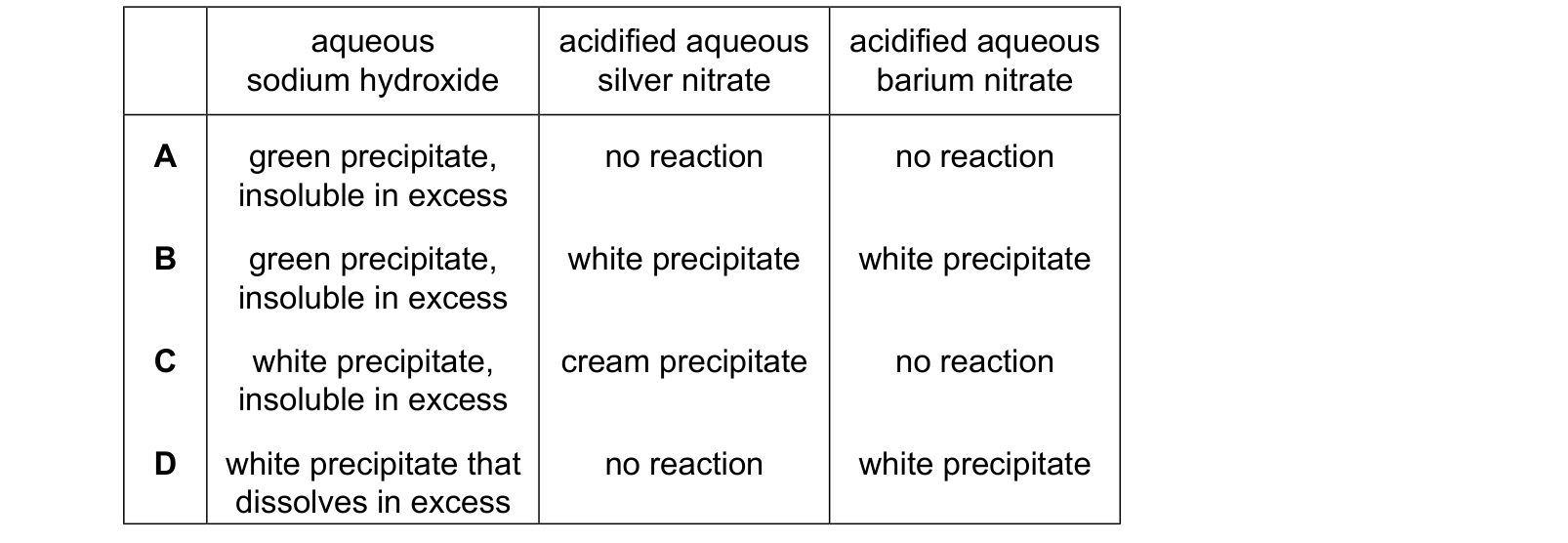
Answer: A.
Question 3
Aqueous solutions containing copper(II) ions can be identified using flame tests and by adding aqueous sodium hydroxide. Which row describes what is observed in these tests? Each answer gives, in order: flame test; aqueous sodium hydroxide.
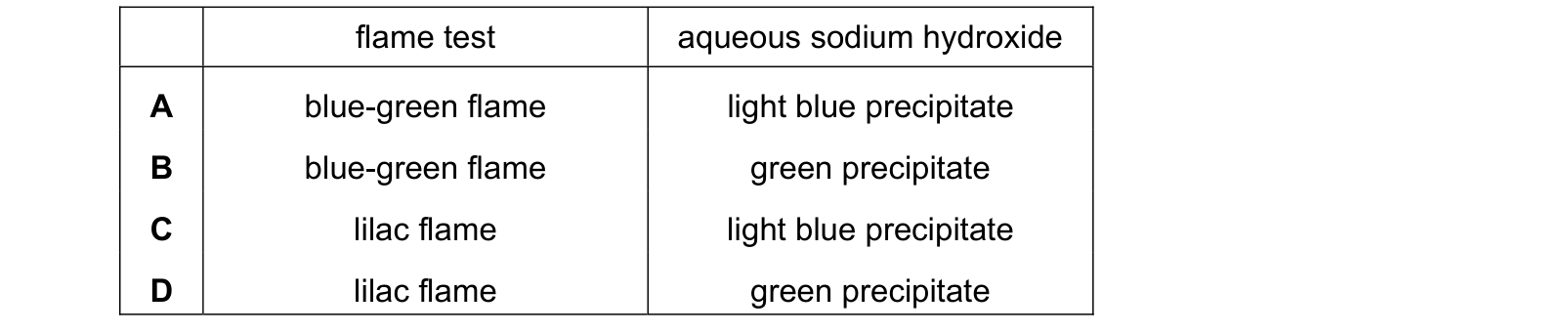
Answer: A.
What the syllabus asks for on this topicSyllabus points
Syllabus points
- Describe the flame tests used to identify lithium, sodium, potassium, calcium, barium and copper(II) ions.
- Describe tests for aluminium, ammonium, calcium, chromium(III), copper(II), iron(II), iron(III) and zinc ions using aqueous sodium hydroxide and aqueous ammonia.
- Describe tests for the anions carbonate, chloride, bromide, iodide, nitrate, sulfate and sulfite.
- Describe tests for ammonia, carbon dioxide, chlorine, hydrogen, oxygen and sulfur dioxide.
- Explain why a solution is acidified before a precipitation test, and which acid is used.
All of this subtopic is Core, so Extended candidates must know every test below.
Related CIE 0620 Chemistry topics
Not the topic you were looking for? Describe what you are stuck on in your own words and we will take you to the notes that answer it.