Polymers
Contents: 8 sections
Monomer and polymer
A polymer is a large molecule built up from many smaller molecules called monomers. Poly(ethene) chains contain thousands of ethene units joined end to end, which is why a sheet of it is tough while ethene itself is a gas.
The name carries the information: poly(ethene) is made from ethene, poly(propene) from propene, poly(chloroethene) from chloroethene. Read the bracket and you have the monomer.
Addition polymerisation (Core)
Many alkene monomers join together in a long chain, and the polymer is the only product. Nothing else is formed, so every atom in the monomer ends up in the polymer.
The mechanism in one sentence: the C=C double bonds open, and the freed bonds join each carbon to the carbon of the next molecule.
n CH₂=CH₂ → -(CH₂-CH₂)ₙ-
| Monomer | Polymer | Everyday use |
|---|---|---|
| Ethene, CH₂=CH₂ | Poly(ethene) | Plastic bags, bottles |
| Propene, CH₃CH=CH₂ | Poly(propene) | Ropes, crates, carpets |
| Chloroethene, CH₂=CHCl | Poly(chloroethene), PVC | Drainpipes, window frames, cable insulation |
| Tetrafluoroethene, CF₂=CF₂ | Poly(tetrafluoroethene), PTFE | Non-stick pan coatings |
Only a molecule with a C=C double bond can polymerise in this way. Ethane cannot, because it is saturated and has no bond to open.
Drawing a repeat unit (Extended)
Four rules turn any alkene into its polymer:
- Change the C=C into a single C-C bond.
- Draw the two carbon atoms with all the groups that were attached to them.
- Draw a bond extending out of each end, passing through the brackets.
- Write n outside the closing bracket.
Worked example. Chloroethene, CH₂=CHCl. Open the double bond, keep the two hydrogens on the first carbon and the hydrogen and chlorine on the second, and add the extending bonds. The repeat unit is -(CH₂-CHCl)-, and the polymer is written -(CH₂-CHCl)ₙ-.
Working backwards from a polymer to its monomer, take one repeat unit, delete the two extending bonds and put the double bond back between the two carbons in the backbone. A repeat unit of -(CH₂-CHCH₃)- therefore came from CH₂=CHCH₃, which is propene.
The extending bonds are not decoration. Without them the drawing is a small molecule, not a section of a chain, and the mark is lost.
Condensation polymerisation (Extended)
In condensation polymerisation, monomers join and a small molecule, usually water, is lost each time a link forms.
This needs monomers with a functional group at each end, so that a chain can grow in both directions. That is the structural difference from addition polymerisation, where one double bond in the middle is enough.
Nylon, a polyamide
Nylon is made from a dicarboxylic acid, with a COOH group at each end, and a diamine, with an NH₂ group at each end. Where a COOH meets an NH₂, an OH from the acid and an H from the amine leave together as water, and the remaining atoms form the link.
The amide linkage is drawn as a carbon with a double bond to an oxygen, joined to a nitrogen that carries a hydrogen: C(=O)-N(-H), written -CONH-.
In a simplified diagram the monomers are drawn as blocks: the acid as a block with OH on both ends, the diamine as a block with H on both ends of its nitrogens, and the chain as alternating blocks joined by amide linkages.
PET, a polyester
PET is made from a dicarboxylic acid and a diol, which has an OH group at each end. Again water is lost at every link.
The ester linkage is a carbon with a double bond to one oxygen and a single bond to a second oxygen that joins on to the next block: C(=O)-O-, written -COO-.
PET can be broken down by hydrolysis back into the two monomers it was made from, and those monomers can be used to make new PET. That is chemical recycling, and it is why PET drinks bottles are collected separately.
Proteins
Proteins are natural polyamides. Their monomers are amino acids, each of which carries an NH₂ group at one end and a COOH group at the other, so a single monomer type can link to itself repeatedly. The link formed is the same amide linkage, -CONH-, which in a protein is also called the peptide linkage, and water is lost each time.
Comparing the two kinds
| Addition | Condensation | |
|---|---|---|
| Monomer needs | One C=C double bond | Two functional groups, one at each end |
| Number of products | One, the polymer only | Two, the polymer and a small molecule |
| Small molecule lost | None | Water, at every link |
| Examples | Poly(ethene), PVC, PTFE | Nylon, PET, proteins |
Environmental challenges of plastics (Core)
Most addition polymers are built from saturated carbon chains and are non-biodegradable, so microorganisms cannot break them down. Three consequences are named on the syllabus:
- Landfill. Plastics take up space in landfill sites for hundreds of years, and suitable land is limited.
- Accumulation in the oceans. Fragments harm aquatic life, which swallows them or becomes entangled in the larger pieces.
- Toxic gases when burnt. Burning PVC gives hydrogen chloride, which is toxic and contributes to acid rain, and burning any plastic in a limited supply of oxygen gives carbon monoxide.
The unreactivity that makes poly(ethene) a good material is precisely what makes it a waste problem. Condensation polymers such as PET are easier to deal with, because the ester linkage can be hydrolysed and the monomers reused.
Common mistakes
- Drawing a repeat unit with the double bond still in place.
- Leaving off the bonds that extend through the brackets.
- Saying water is lost in addition polymerisation. Nothing is lost; the polymer is the only product.
- Giving one monomer for nylon or PET. Each needs two, or a monomer with two different groups.
- Confusing the linkages: -COO- is the ester linkage, -CONH- is the amide linkage.
- Saying plastics are burnt to make them biodegradable, rather than naming the toxic gases produced.
- Calling a protein a polyester. It is a natural polyamide.
Check you have it
Question 1
The equation shows the formation of a polymer called Kevlar. Which row describes Kevlar? Each answer gives, in order: how the polymer is formed; type of polymer.
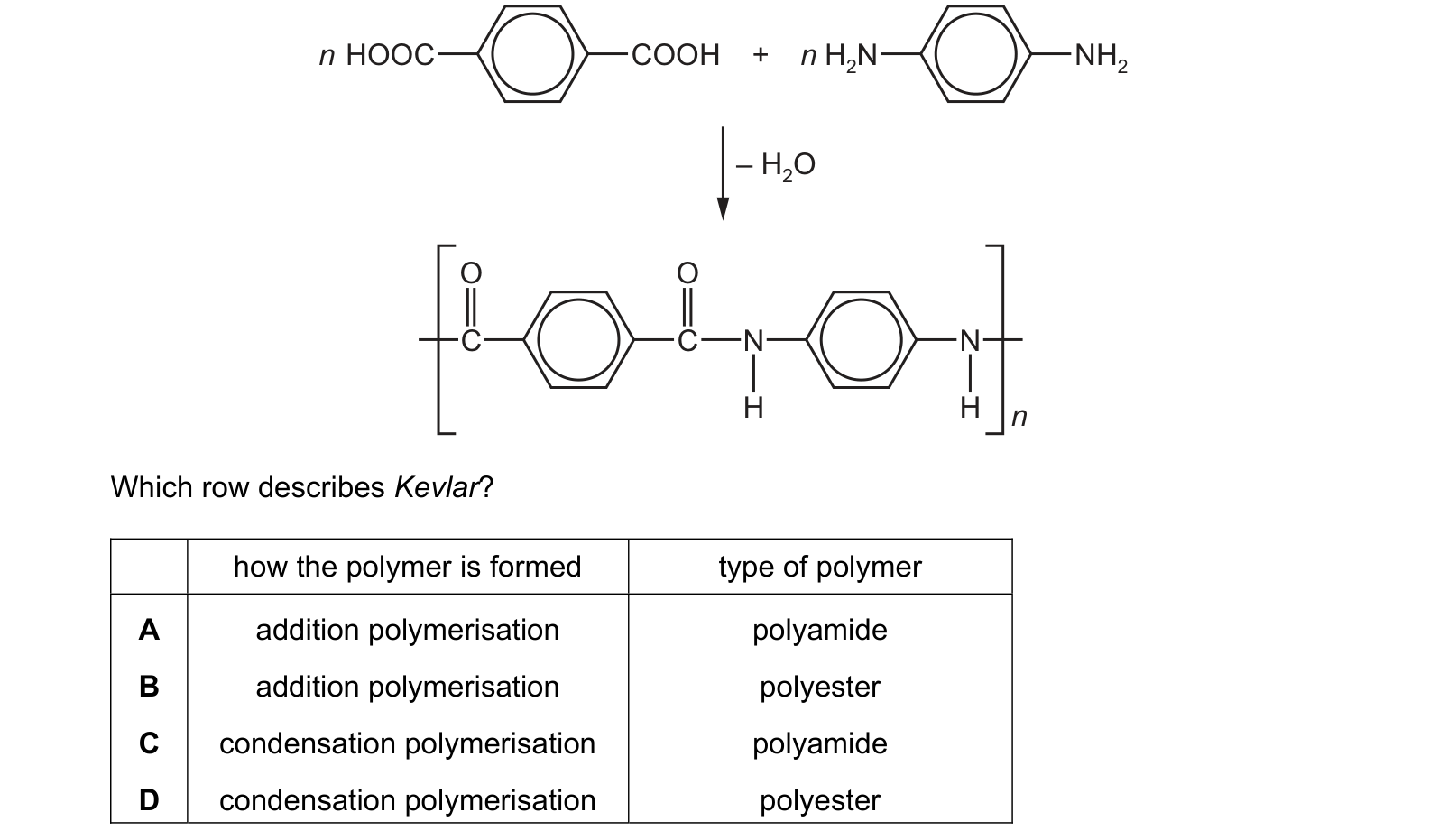
Answer: C.
Question 2
The flow diagram shows how poly(ethene) may be made from petroleum. What are stages 1, 2 and 3? Use the source image for W23 Paper 13, question 37.
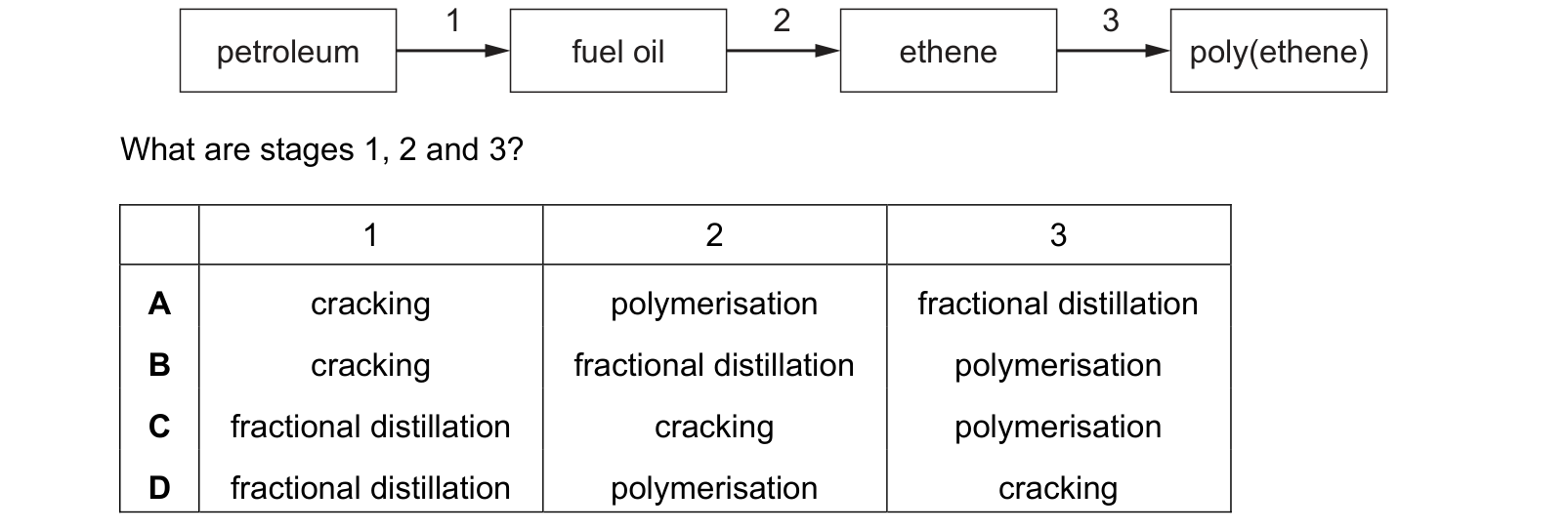
Answer: C.
Question 3
The flow diagram shows how poly(ethene) may be made from petroleum. What are stages 1, 2 and 3? Use the source image for W23 Paper 23, question 38.
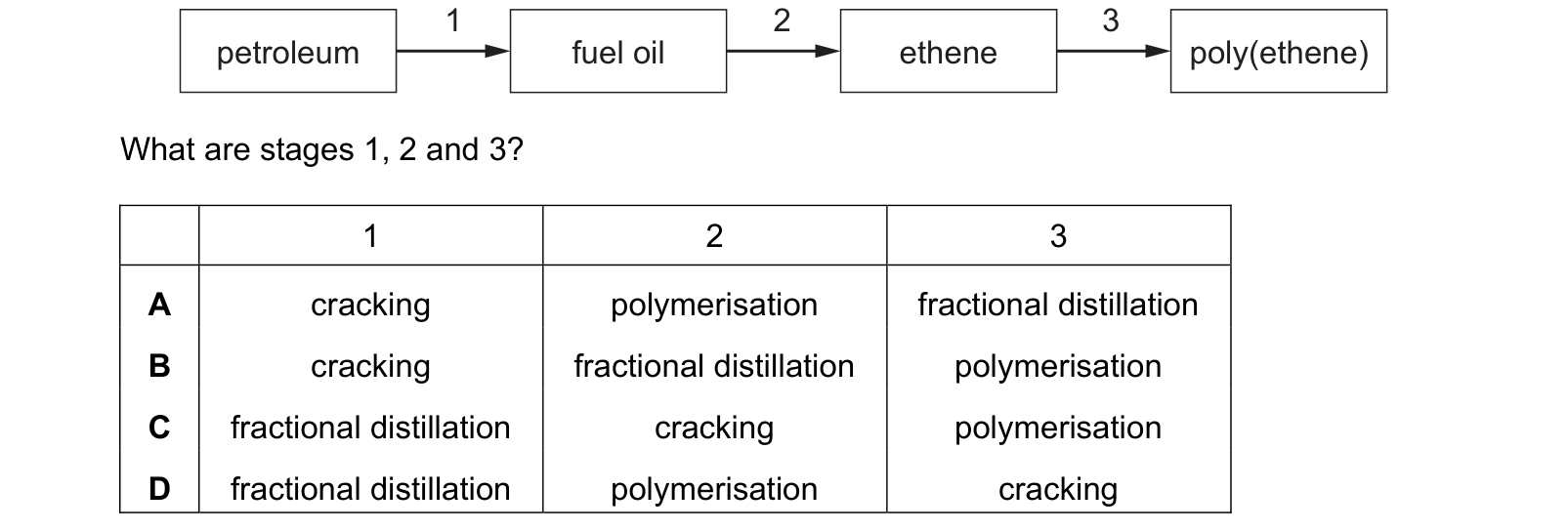
Answer: C.
What the syllabus asks for on this topicSyllabus points
Syllabus points
- Define polymers as large molecules built up from many smaller molecules called monomers.
- Describe the formation of poly(ethene) as an example of addition polymerisation using ethene monomers.
- Describe the environmental challenges caused by plastics: disposal in landfill, accumulation in the oceans, and the formation of toxic gases when burnt.
- Extended: identify the repeat unit and the linkages in a polymer, and deduce an addition polymer from its monomer and a monomer from its polymer.
- Extended: describe the formation of nylon, a polyamide, and of PET, a polyester, by condensation polymerisation.
- Extended: describe proteins as natural polyamides formed from amino acids.
Related CIE 0620 Chemistry topics
Not the topic you were looking for? Describe what you are stuck on in your own words and we will take you to the notes that answer it.