Carboxylic acids
Contents: 7 sections
The carboxyl group
General formula CₙH₂ₙ₊₁COOH. The functional group is the carboxyl group, -COOH, and drawing it correctly is worth doing slowly:
a carbon atom with a double bond to one oxygen, and a single bond to a second oxygen which itself carries a hydrogen.
In text that is C(=O)-O-H. The two oxygen atoms are doing different jobs and must be drawn differently. A displayed formula showing two O-H groups, or a single bond to both oxygens, is a different compound.
| Acid | Structural formula | Total carbon atoms |
|---|---|---|
| Methanoic acid | HCOOH | 1 |
| Ethanoic acid | CH₃COOH | 2 |
| Propanoic acid | CH₃CH₂COOH | 3 |
| Butanoic acid | CH₃CH₂CH₂COOH | 4 |
In the general formula the n counts only the carbons before the COOH group, so ethanoic acid has n = 1 and two carbons in total. Methanoic acid is the special case where there is no chain at all and a hydrogen sits directly on the carboxyl carbon.
Ethanoic acid behaves as an acid
Every reaction below is a standard acid reaction from topic 7, applied to an organic acid. The salts formed are called ethanoates.
With a metal
salt + hydrogen
2CH₃COOH + Mg → (CH₃COO)₂Mg + H₂
Observations: effervescence, the magnesium ribbon dissolves and disappears, and the gas collected pops with a lighted splint. The salt is magnesium ethanoate.
With a base
salt + water
CH₃COOH + NaOH → CH₃COONa + H₂O
This is neutralisation, so no gas is produced. With a solid metal oxide such as copper(II) oxide the mixture is warmed and the black solid dissolves to give a blue solution of copper(II) ethanoate.
With a carbonate
salt + water + carbon dioxide
2CH₃COOH + Na₂CO₃ → 2CH₃COONa + H₂O + CO₂
Observations: effervescence, and the gas turns limewater milky.
The two gas-producing reactions are told apart by the gas test, not by the fizzing. Metal gives hydrogen, which pops with a lighted splint. Carbonate gives carbon dioxide, which turns limewater milky.
Ethanoic acid is a weak acid (Extended)
In water, ethanoic acid is only partially dissociated:
CH₃COOH ⇌ CH₃COO⁻ + H⁺
The double arrow is the point. Only a small fraction of the molecules release their hydrogen ion at any moment, so a solution of ethanoic acid has a lower concentration of H⁺ than hydrochloric acid of the same concentration.
Three measurable consequences, all examined:
- Its pH is higher, typically about 3 rather than about 1.
- It reacts more slowly with magnesium, so the effervescence is gentler.
- It is a poorer conductor of electricity, because there are fewer ions in solution.
Weak does not mean dilute. A concentrated solution of ethanoic acid is still a weak acid, because "weak" describes how far it dissociates, not how much of it is present.
Making ethanoic acid (Extended)
Both routes start from ethanol and are covered from the alcohol's side in 11.6.
- Acidified aqueous potassium manganate(VII), warmed with ethanol. The purple colour turns colourless: C₂H₅OH + 2[O] → CH₃COOH + H₂O.
- Bacterial oxidation, leaving dilute ethanol open to the air: C₂H₅OH + O₂ → CH₃COOH + H₂O. This is how wine becomes vinegar.
Esterification (Extended)
A carboxylic acid reacts with an alcohol to form an ester and water.
Conditions: warm the acid and the alcohol together with a few drops of concentrated sulfuric acid as the catalyst, heating under reflux.
CH₃COOH + CH₃CH₂OH → CH₃COOCH₂CH₃ + H₂O
The product is ethyl ethanoate. The ester functional group is the -COO- linkage, drawn as a carbon with a double bond to one oxygen and a single bond to a second oxygen, which is joined on to another carbon: C(=O)-O-C. It is the carboxyl group with the acidic hydrogen replaced by an alkyl group, which is why the product is no longer acidic.
The naming rule from 11.2 applies. The alcohol gives the first word, ending in -yl; the acid gives the second word, ending in -oate.
| Acid | Alcohol | Ester | Formula |
|---|---|---|---|
| Ethanoic acid | Ethanol | Ethyl ethanoate | CH₃COOCH₂CH₃ |
| Propanoic acid | Methanol | Methyl propanoate | CH₃CH₂COOCH₃ |
| Methanoic acid | Butan-1-ol | Butyl methanoate | HCOOCH₂CH₂CH₂CH₃ |
Esters have sweet, fruity smells, which is the observation an exam expects, and they are used as flavourings, in perfumes and as solvents. The concentrated sulfuric acid is a catalyst, so it is not consumed and does not appear in the equation.
Common mistakes
- Drawing -COOH with two O-H bonds, or with no double bond at all.
- Counting the carboxyl carbon twice, so CH₃CH₂COOH is called butanoic acid.
- Naming the salt of ethanoic acid an ethanate or an ethanoate acid. It is an ethanoate.
- Expecting a gas from the reaction with a base. Only metals and carbonates give one.
- Saying a weak acid is a dilute acid.
- Reversing the ester name, so ethanoic acid plus ethanol is called ethanoyl ethanoate or ethanoic ethyl.
- Leaving water out of the esterification equation.
- Writing the sulfuric acid catalyst in as a reactant.
Check you have it
Question 1
Which statements about ethanoic acid are correct?
1 It is a strong acid.
2 It reacts with ethanol to form an ester.
3 It has the formula CH3COOH.
Answer: C.
Question 2
Carboxylic acids react with alcohols when warmed with an acid catalyst.
Which type of substance is formed in this reaction?
Answer: B.
Question 3
The structure of an ester is shown.
O What is the name of the ester?
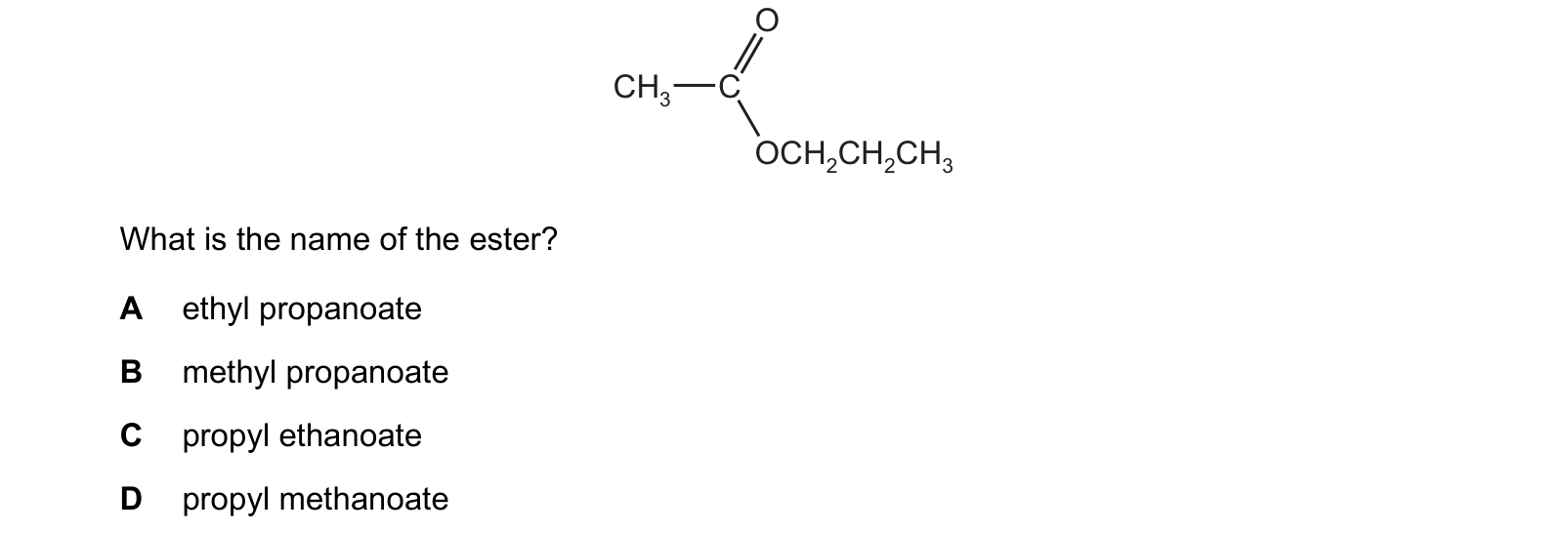
Answer: C.
What the syllabus asks for on this topicSyllabus points
Syllabus points
- Draw the structures of carboxylic acids containing up to four carbon atoms, and state the general formula CₙH₂ₙ₊₁COOH.
- Describe the reactions of ethanoic acid with metals, with bases and with carbonates.
- Extended: describe the formation of ethanoic acid by the oxidation of ethanol with acidified aqueous potassium manganate(VII) and by bacterial oxidation.
- Extended: describe the reaction of a carboxylic acid with an alcohol, using an acid catalyst, to form an ester.
- Extended: name and draw the structures of the esters formed from unbranched alcohols and carboxylic acids.
Related CIE 0620 Chemistry topics
Not the topic you were looking for? Describe what you are stuck on in your own words and we will take you to the notes that answer it.