Noble gases
Contents: 8 sections
The group and its configurations
The noble gases are the final column of the Periodic Table, labelled Group VIII, and sometimes Group 0 because these elements form no ions and so carry no charge.
| Noble gas | Electronic configuration | Boiling point in °C |
|---|---|---|
| Helium | 2 | −269 |
| Neon | 2,8 | −246 |
| Argon | 2,8,8 | −186 |
| Krypton | 2,8,18,8 | −152 |
| Xenon | 2,8,18,18,8 | −108 |
Helium is the odd one out of the configurations: it has two outer electrons rather than eight, and two is a full first shell, which is all that matters.
Reading down the group, the boiling points increase and the densities increase, in step with the increasing mass of the atoms. All of them are still gases at room temperature, and helium boils at −269 °C, the lowest boiling point of any substance.
Why they are unreactive
A noble gas atom already has a full outer electron shell.
Chemical reactions happen because atoms lose, gain or share electrons in order to reach a full outer shell. A noble gas has nothing to gain by doing any of those things, so:
- it does not lose electrons, so it forms no positive ions
- it does not gain electrons, so it forms no negative ions
- it does not share electrons, so it forms no covalent bonds
That is the whole explanation, and it is worth writing in exactly those terms. An answer saying only "they are stable" or "they are full" is usually not enough; the mark is for linking the full outer shell to having no need to transfer or share electrons.
Everything else in chapter 8 is measured against this. A Group I metal is reactive because losing one electron leaves it with a full shell, and a Group VII non-metal is reactive because gaining one does the same. The noble gas configuration is the target both of them are aiming at.
Monatomic
The noble gases exist as single atoms, written He, Ne and Ar. That is unusual: the other gaseous elements are diatomic, written H<sub>2</sub>, N<sub>2</sub>, O<sub>2</sub>, F<sub>2</sub> and Cl<sub>2</sub>.
The reason is the same as before. Two chlorine atoms bond because sharing a pair of electrons completes both outer shells. Two argon atoms have nothing to share and no shell to complete, so they stay apart.
Uses, each from a property
- Helium in balloons and airships. Helium has a very low density and, unlike hydrogen, is non-flammable. The relative atomic mass of helium is 4 and the average relative molecular mass of air is about 29, so
4 / 29 = 0.14
meaning helium is roughly a seventh of the density of air, which is what makes the balloon rise. Hydrogen is lighter still, but it burns explosively, and the safety argument is usually the mark being tested.
- Argon in filament lamps. The filament runs white hot and would burn away instantly in air. Argon provides an inert atmosphere so the hot metal cannot react with oxygen.
- Argon in welding. A stream of argon over the weld keeps oxygen and nitrogen away from the molten metal, so the joint does not oxidise as it cools.
- Neon in advertising signs. A current passed through neon at low pressure makes it glow red-orange. It is used because it is unreactive and glows, not because it is the only gas that glows: other noble gases give other colours in the same kind of tube.
- Helium in deep sea diving mixtures and in cooling superconducting magnets, the second because liquid helium is the coldest liquid available.
Every use traces back to unreactivity or to low density, so a question asking why a particular gas is chosen has one of those two answers underneath it.
Argon in the air
Argon is the third most abundant gas in the atmosphere, after nitrogen at about 78 per cent and oxygen at about 21 per cent.
78 + 21 = 99
100 − 99 = 1
The remaining 1 per cent is mostly argon, at about 0.9 per cent by volume, with carbon dioxide and the other noble gases making up the rest. That is where industrial argon comes from: the fractional distillation of liquefied air.
Reading a data table on this group
Given three noble gases and asked about a fourth, continue the trends:
- Higher boiling point than the one above, though still well below 0 °C.
- Higher density.
- Still unreactive, because the outer shell is still full.
- Still monatomic.
The last two do not change down the group, and saying so is the correct answer rather than a missed one. Unlike Group I and Group VII, where reactivity changes steadily, the defining property of Group VIII is constant, because a full outer shell is a full outer shell however many shells are underneath it.
Common mistakes
- Writing the noble gases as diatomic molecules such as Ne<sub>2</sub>.
- Saying they are unreactive because they have eight outer electrons, and then being caught by helium, which has two.
- Saying helium is used in balloons only because it is light, without mentioning that it does not burn.
- Saying argon is used in lamps because it glows, which is neon's use.
- Claiming the noble gases become more reactive down the group.
- Explaining unreactivity as "they are stable" without linking it to losing, gaining or sharing electrons.
Check you have it
Question 1
The noble gases are in Group VIII of the Periodic Table.
Which statement explains why noble gases are unreactive?
Answer: B.
Question 2
The noble gases are placed in Group VIII of the Periodic Table.
Which statement explains why they are unreactive?
Answer: B.
Question 3
Clean, dry air contains nitrogen, oxygen and small amounts of other gases. The noble gases have been left out of the table. Which row shows the composition of clean, dry air? nitrogen / % oxygen / % other gases Use the source image for W19 Paper 12, question 29.
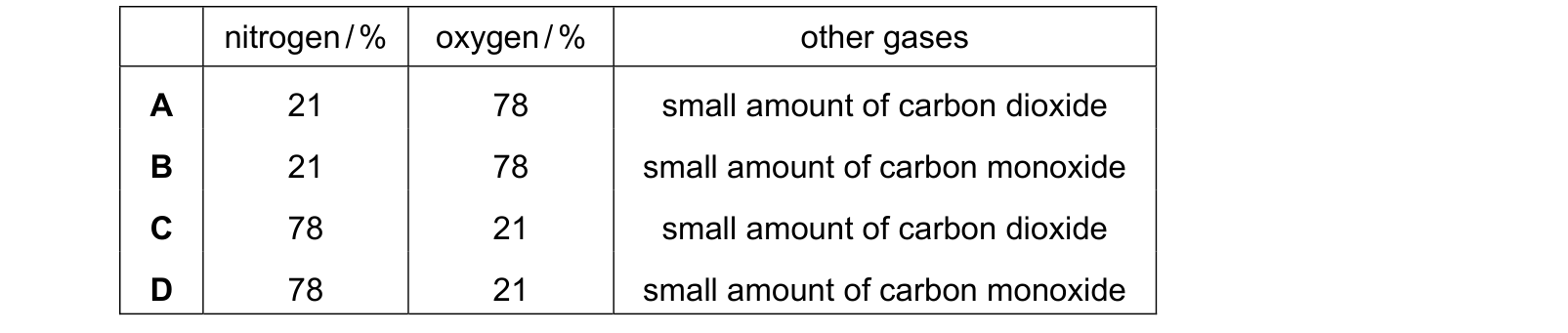
Answer: C.
What the syllabus asks for on this topicSyllabus points
Syllabus points
- Describe the Group VIII noble gases as unreactive, monatomic gases.
- Explain the lack of reactivity of the noble gases in terms of their electronic configuration.
- Identify the noble gases from their position in the Periodic Table and from their electronic configurations.
- State uses of helium, argon and neon, and relate each use to a property.
- Identify trends down the group, given information about the elements.
Everything in 8.5 is Core. There is no Extended-only content in this subtopic.
Related CIE 0620 Chemistry topics
Not the topic you were looking for? Describe what you are stuck on in your own words and we will take you to the notes that answer it.