Oxides
Contents: 7 sections
The rule that decides the class
Look at the element bonded to the oxygen.
- Metal + oxygen gives a basic oxide.
- Non-metal + oxygen gives an acidic oxide.
That single rule answers most questions in this subtopic, and it is the reason the syllabus ties oxides to metallic character.
| Type | Element | Examples | Reacts with acid | Reacts with alkali |
|---|---|---|---|---|
| Basic | Metal | Na<sub>2</sub>O, MgO, CaO, CuO, Fe<sub>2</sub>O<sub>3</sub> | Yes | No |
| Acidic | Non-metal | CO<sub>2</sub>, SO<sub>2</sub>, SO<sub>3</sub>, NO<sub>2</sub>, SiO<sub>2</sub>, P<sub>4</sub>O<sub>10</sub> | No | Yes |
| Amphoteric | Al, Zn | Al<sub>2</sub>O<sub>3</sub>, ZnO | Yes | Yes |
| Neutral | Non-metal | CO, NO, N<sub>2</sub>O | No | No |
The bottom two rows are Extended only. A Core student needs the first two.
Basic oxides
A basic oxide neutralises an acid to give a salt and water:
CuO + H<sub>2</sub>SO<sub>4</sub> → CuSO<sub>4</sub> + H<sub>2</sub>O
MgO + 2HCl → MgCl<sub>2</sub> + H<sub>2</sub>O
Most metal oxides are insoluble in water, which is exactly what makes them useful in 7.3: copper(II) oxide can be added to warm acid in excess and the leftover filtered off.
The few that do dissolve give an alkaline solution, because a hydroxide is formed:
Na<sub>2</sub>O + H<sub>2</sub>O → 2NaOH
CaO + H<sub>2</sub>O → Ca(OH)<sub>2</sub>
Calcium oxide reacting with water is the reaction behind spreading lime on acidic soil, and it releases so much heat that the lump crumbles and steams.
Acidic oxides
An acidic oxide neutralises a base or alkali to give a salt and water:
CO<sub>2</sub> + 2NaOH → Na<sub>2</sub>CO<sub>3</sub> + H<sub>2</sub>O
SO<sub>2</sub> + 2NaOH → Na<sub>2</sub>SO<sub>3</sub> + H<sub>2</sub>O
Acidic oxides that dissolve in water give acidic solutions:
- CO<sub>2</sub> + H<sub>2</sub>O → H<sub>2</sub>CO<sub>3</sub>, carbonic acid, which is why rain is naturally about pH 5.6
- SO<sub>2</sub> gives sulfurous acid and, after oxidation in the air, sulfuric acid
- NO<sub>2</sub> gives a mixture of nitrous and nitric acids
Sulfur dioxide and the nitrogen oxides are the two causes of acid rain, and the reason a limestone building or a magnesium alloy structure is attacked by polluted air.
Worked example. Sulfur in a fuel burns to sulfur dioxide, S + O<sub>2</sub> → SO<sub>2</sub>. The relative atomic mass of sulfur is 32 and the relative formula mass of sulfur dioxide is 64, so 3.2 g of sulfur gives:
mass of sulfur dioxide = 3.2 × 64 / 32 = 6.4 g
The mass doubles, because every sulfur atom picks up two oxygen atoms of mass 16 each.
Silicon dioxide is the awkward member of this group. It is acidic and reacts with calcium oxide in the blast furnace to form slag, but it does not dissolve in water and does not turn litmus red, because its giant covalent structure keeps it unreactive at ordinary temperatures.
Extended only: neutral oxides
Carbon monoxide, nitrogen monoxide and dinitrogen oxide are oxides of non-metals that are neither acidic nor basic. They do not react with acids, they do not react with alkalis, and they do not form acidic solutions in water.
Carbon monoxide is the one to remember, because the metal and non-metal rule predicts the wrong answer for it. Carbon is a non-metal, but CO is neutral while CO<sub>2</sub> is acidic. The rule is a good guide, not a law.
Extended only: amphoteric oxides
An amphoteric oxide reacts with acids and with bases, in both cases giving a salt and water. Two examples are examined:
Aluminium oxide
Al<sub>2</sub>O<sub>3</sub> + 6HCl → 2AlCl<sub>3</sub> + 3H<sub>2</sub>O, behaving as a base
Al<sub>2</sub>O<sub>3</sub> + 2NaOH → 2NaAlO<sub>2</sub> + H<sub>2</sub>O, behaving as an acid to give sodium aluminate
Zinc oxide
ZnO + 2HCl → ZnCl<sub>2</sub> + H<sub>2</sub>O, behaving as a base
ZnO + 2NaOH → Na<sub>2</sub>ZnO<sub>2</sub> + H<sub>2</sub>O, behaving as an acid to give sodium zincate
Aluminium and zinc sit at the boundary between the metals and the non-metals, which is precisely why their oxides can go either way. Aluminium is in period 3 between metallic sodium and magnesium on one side and non-metallic silicon, phosphorus and sulfur on the other, and its oxide is the changeover point from basic to acidic.
Worked example. How much hydrochloric acid neutralises 5.1 g of aluminium oxide?
The relative formula mass of Al<sub>2</sub>O<sub>3</sub> is
2 × 27 + 3 × 16 = 102
moles of aluminium oxide = 5.1 / 102 = 0.050 mol
The equation shows 6 mol of acid to 1 mol of oxide, so
moles of hydrochloric acid = 0.050 × 6 = 0.30 mol
Note that an amphoteric oxide is not a neutral one. Amphoteric means it reacts with both; neutral means it reacts with neither. Those two answers are always offered together.
Common mistakes
- Classifying an oxide from its formula rather than from whether the element is a metal.
- Calling carbon monoxide acidic because carbon dioxide is.
- Saying amphoteric oxides are neutral.
- Saying every metal oxide dissolves to give an alkali, when most metal oxides are insoluble.
- Forgetting that an acidic oxide reacting with an alkali still gives a salt and water.
- Naming aluminium oxide as basic only, or zinc oxide as acidic only.
- Giving the acid rain gases as carbon dioxide, when the pair examined is sulfur dioxide and the nitrogen oxides.
Check you have it
Question 1
A mixture of two substances, R and S, is heated. The damp red litmus paper turns blue. What are R and S? Each answer gives, in order: R; S.
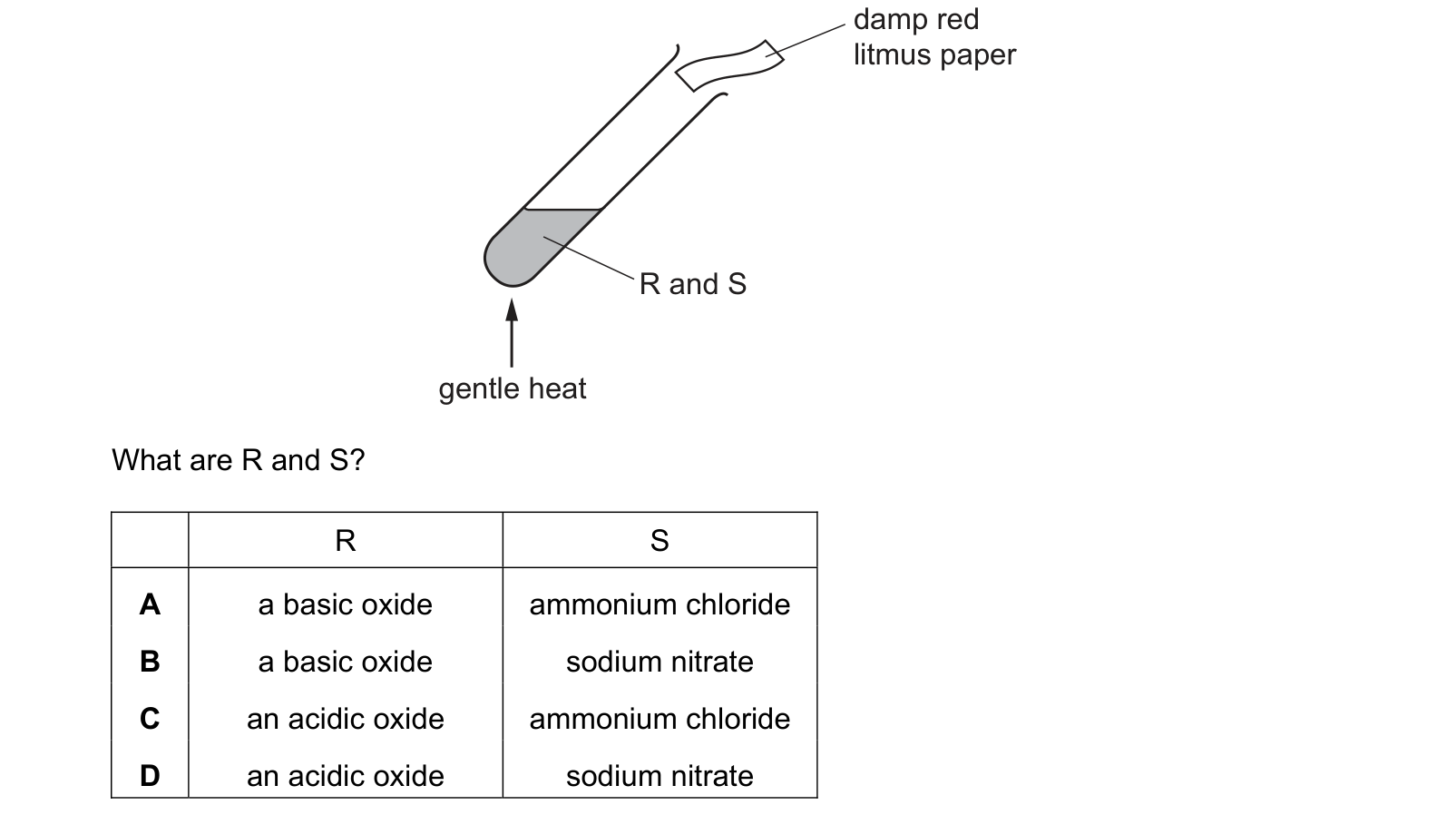
Answer: A.
Question 2
Information about the solubility in water of four oxides is shown. Which oxide, when added to water, gives a solution with a pH less than pH 7? Each answer gives, in order: name of oxide; solubility in water.
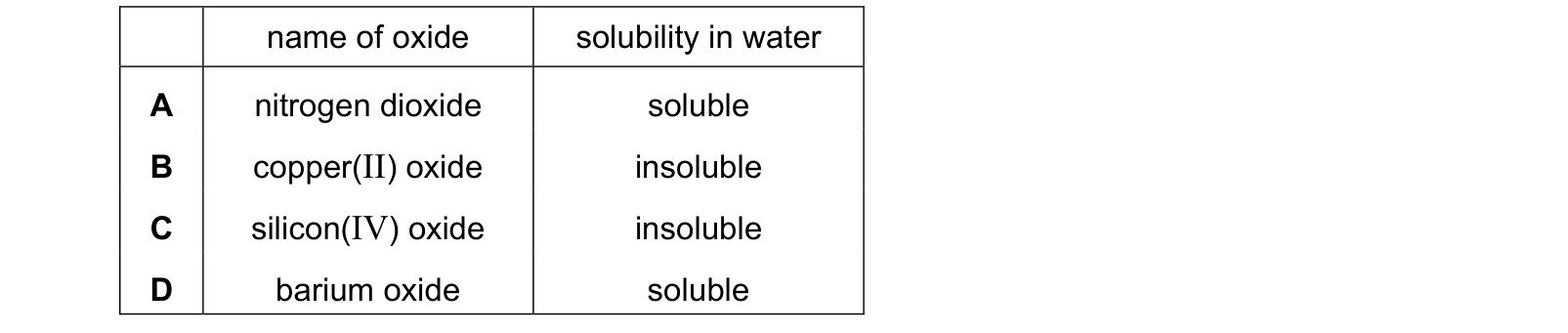
Answer: A.
Question 3
Four solid oxides are added to dilute hydrochloric acid and aqueous sodium hydroxide. Which row describes an amphoteric oxide? hydrochloric acid sodium hydroxide Use the source image for W21 Paper 23, question 19.
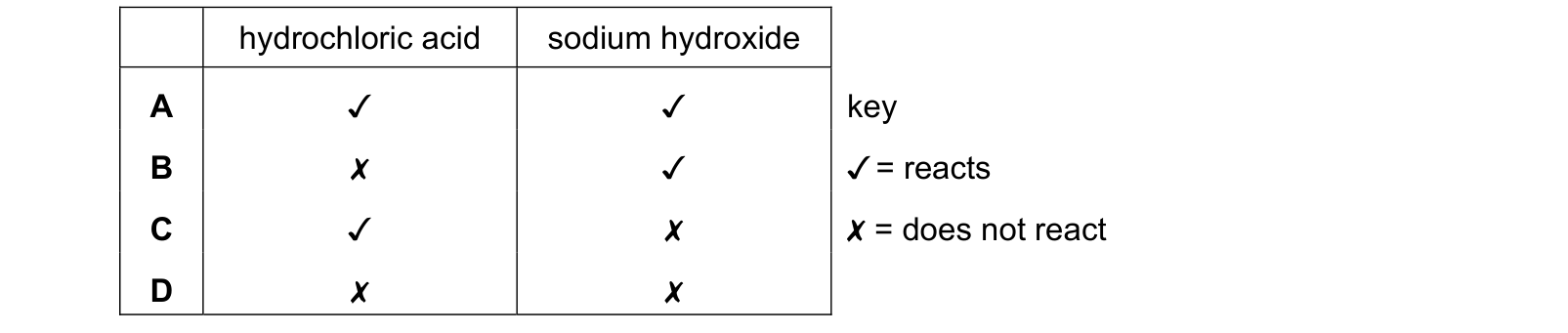
Answer: A.
What the syllabus asks for on this topicSyllabus points
Syllabus points
- Classify oxides as either acidic or basic, related to the metallic or non-metallic character of the element.
- State that basic oxides are oxides of metals and react with acids to produce a salt and water.
- State that acidic oxides are oxides of non-metals and react with bases to produce a salt and water.
- Extended only: classify other oxides as neutral or amphoteric.
- Extended only: describe amphoteric oxides as oxides that react with acids and with bases to produce a salt and water, using aluminium oxide and zinc oxide as the examples.
Related CIE 0620 Chemistry topics
Not the topic you were looking for? Describe what you are stuck on in your own words and we will take you to the notes that answer it.