43 past-paper questions on this unit. Five of them are below. Answer on the page: each one is marked the moment you pick, the correct option is shown whether or not you found it, and the full explanation opens either way.
CIE 0620 ChemistryPaper 1 and Paper 2 MCQsFree account
Oxides: five questions to try now
Real past-paper questions, the answer key from the mark scheme, and the explanation that goes with it. No account needed to answer them.
Question 1
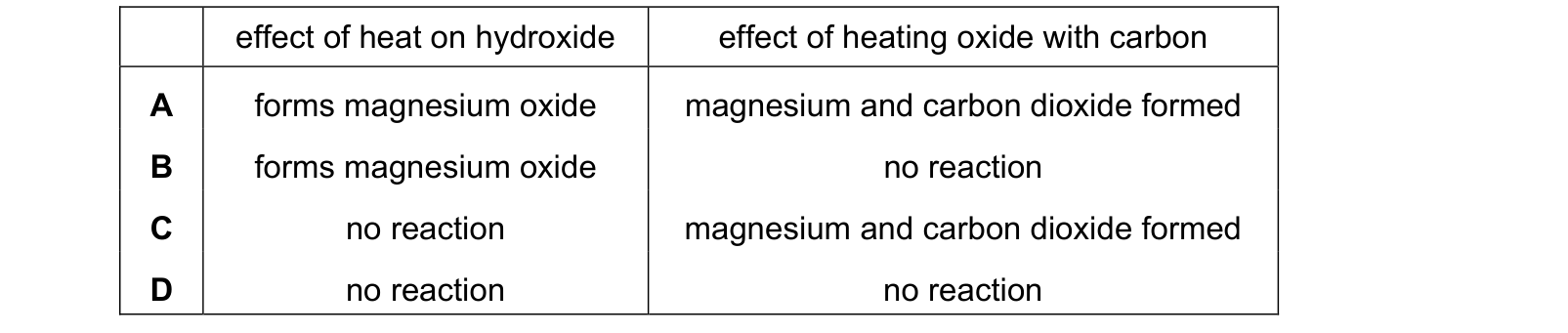
Which row describes the reactions of magnesium hydroxide and magnesium oxide? Each answer gives, in order: effect of heat on hydroxide; effect of heating oxide with carbon.
Answer: B.
Two separate reactions are being judged here, and both turn on where magnesium sits in the reactivity series. Metal hydroxides outside group 1 decompose when heated, so magnesium hydroxide loses water and leaves magnesium oxide, which disposes of both rows claiming no reaction for the hydroxide. Carbon can only reduce the oxide of a metal less reactive than itself, which is why the blast furnace works for iron but never for aluminium, and magnesium lies well above carbon, so heating magnesium oxide with carbon achieves nothing. The rows promising magnesium and carbon dioxide are applying blast furnace reasoning to a metal far too reactive for it, and that limitation is exactly why magnesium has to be extracted by electrolysis instead.
Question 2
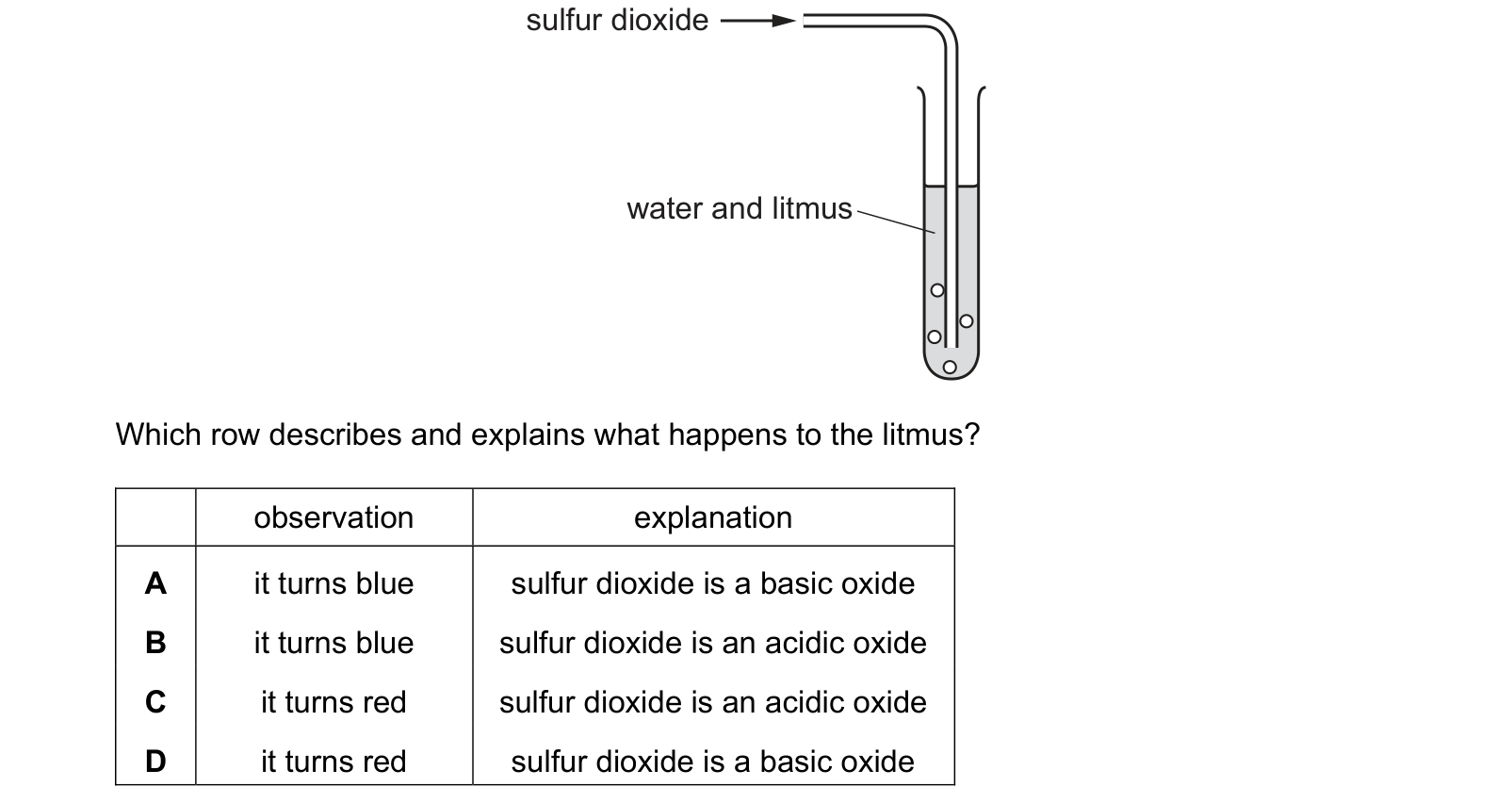
Sulfur dioxide is bubbled through water containing litmus. Which row describes and explains what happens to the litmus? Each answer gives, in order: observation; explanation.
Answer: C.
Sulfur dioxide is the oxide of a non-metal, and non-metal oxides that dissolve in water form acids, sulfurous acid in this case. An acidic solution turns litmus red, so the observation and the explanation both have to point the same way, and only one row manages that. The row combining a red colour with the claim that sulfur dioxide is basic reaches the right observation by the wrong reasoning, which is why it fails even though half of it looks familiar. The two rows predicting blue litmus have treated sulfur dioxide as though it were ammonia or a metal oxide, and blue is what litmus shows in an alkali, the opposite of what a dissolved acidic oxide produces.
Question 3
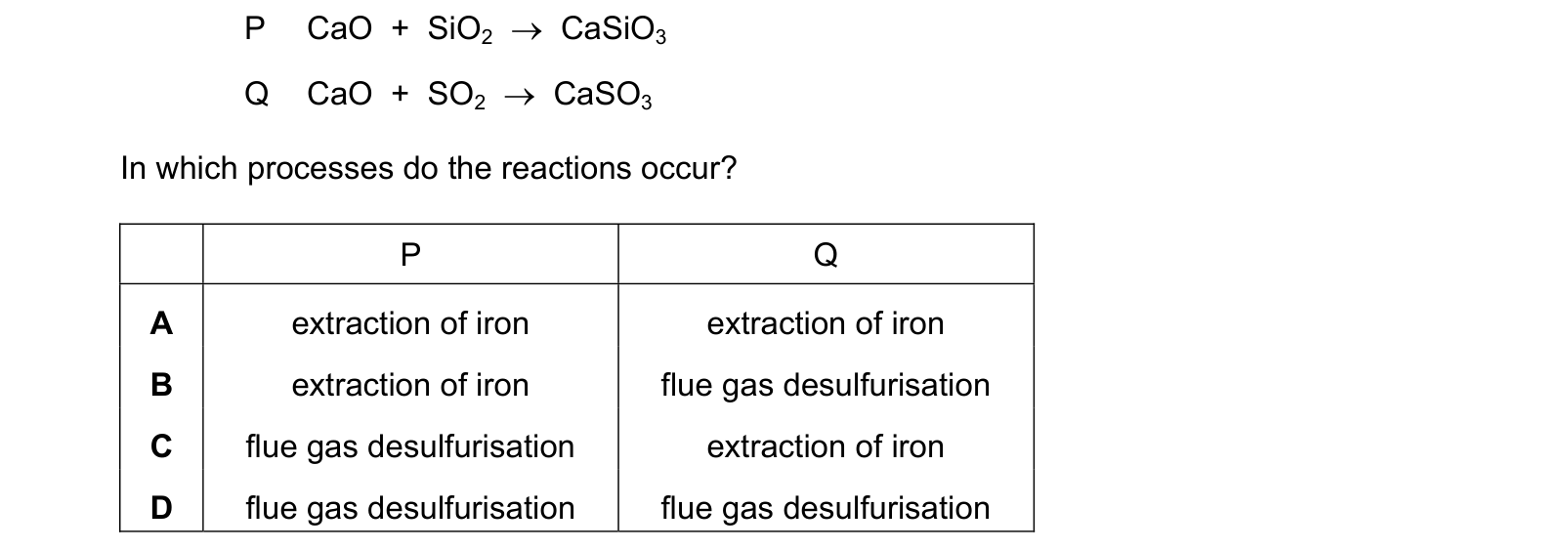
The equations represent two reactions, P and Q, of lime (calcium oxide). P CaO + SiO2 → CaSiO3 Q CaO + SO2 → CaSO3 In which processes do the reactions occur? Each answer gives, in order: P; Q.
Answer: B.
Both equations show calcium oxide, a basic oxide, neutralising an acidic non-metal oxide, so the two are told apart by asking where each acidic oxide comes from. Silicon(IV) oxide is the sandy impurity in iron ore, and inside the blast furnace the limestone decomposes to calcium oxide, which combines with it to form calcium silicate, the molten slag floating on the iron, so that is reaction P. Sulfur dioxide comes from burning fuels that contain sulfur, and it is stripped from power station chimneys by spraying calcium oxide or powdered limestone into the gases to give calcium sulfite, so that is reaction Q. Assigning both reactions to a single process ignores the fact that no sulfur dioxide is being treated inside a blast furnace and no silicon dioxide travels up a chimney. Swapping the two labels simply reverses the source of each impurity.
Question 4
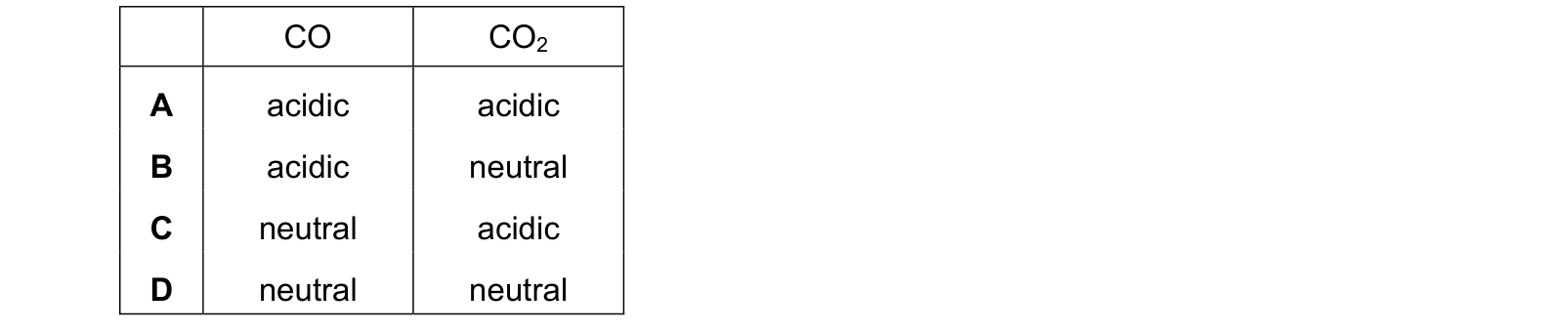
Carbon forms two oxides: carbon monoxide, CO, and carbon dioxide, CO2. Which row describes these two oxides? Each answer gives, in order: CO; CO2.
Answer: C.
Both are oxides of a non-metal, so the temptation is to call both acidic, but carbon monoxide is one of the few genuine exceptions. Carbon dioxide dissolves in water to form carbonic acid and reacts with alkalis to give carbonates, so it is acidic in the ordinary way. Carbon monoxide reacts with neither acids nor bases and forms no acid in water, which places it among the neutral oxides beside water and nitrogen(II) oxide. Calling carbon monoxide acidic is the commonest error, made by applying the non-metal rule without recalling its exceptions, while calling carbon dioxide neutral would leave the fizz of carbonated water and the mild acidity of rain unexplained.
Question 5
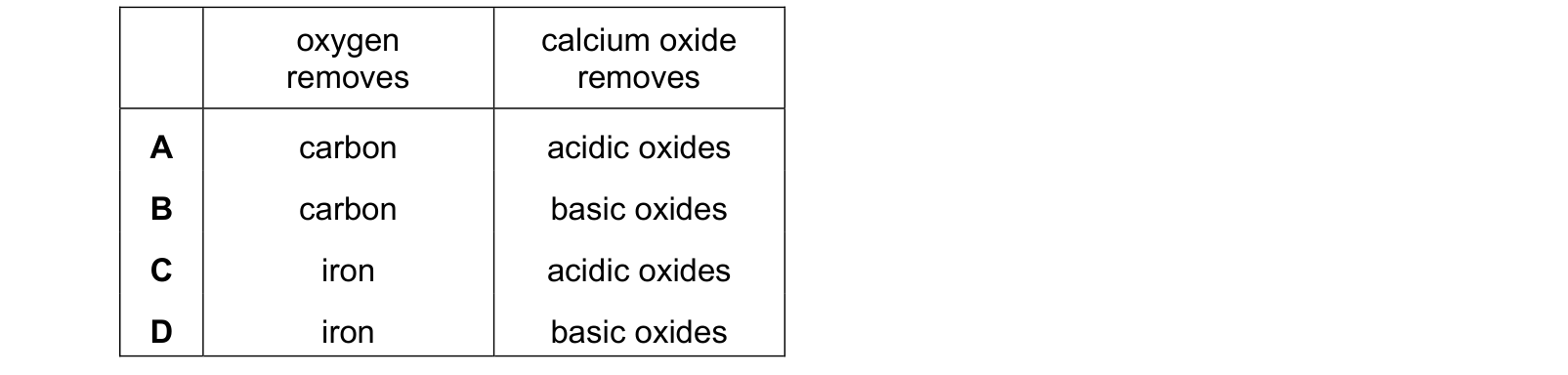
Iron from a blast furnace is treated with oxygen and with calcium oxide to make steel. Which substances in the iron are removed? Each answer gives, in order: oxygen removes; calcium oxide removes.
Answer: A.
Steel making is about stripping out the impurities the blast furnace leaves behind, principally carbon along with non-metals such as silicon and phosphorus. Oxygen is blown through the molten iron to burn the excess carbon away as carbon dioxide, which escapes as a gas, so oxygen is the reagent dealing with the carbon. The silicon and phosphorus are oxidised too, and their oxides are acidic, so calcium oxide is added as a base to neutralise them and form a slag that floats clear of the metal. Saying that oxygen removes iron has the process backwards, since iron is the product being purified rather than an impurity, and pairing calcium oxide with basic oxides would mean adding a base to remove other bases, which neutralises nothing.
These questions are drawn from past CIE 0620 Chemistry papers and filtered to oxides. You answer, you find out immediately whether you were right, and you get the reasoning for the correct option and for each distractor. Wrong answers go to a mistakes locker so you can come back to exactly those.
Practice is free. You need an account only so your progress and your mistakes are still there next time.
These are the errors that cost marks on oxides, taken from our own topic notes. Read them before you practise and you will recognise the traps in the questions.
Classifying an oxide from its formula rather than from whether the element is a metal.
Calling carbon monoxide acidic because carbon dioxide is.
Saying amphoteric oxides are neutral.
Saying every metal oxide dissolves to give an alkali, when most metal oxides are insoluble.
Forgetting that an acidic oxide reacting with an alkali still gives a salt and water.
Naming aluminium oxide as basic only, or zinc oxide as acidic only.
Giving the acid rain gases as carbon dioxide, when the pair examined is sulfur dioxide and the nitrogen oxides.
Revise it first
If any of the above is unfamiliar, work through the notes before practising: Oxides revision notes.