The characteristic properties of acids and bases
Contents: 9 sections
The three reactions of an acid
Learn these as word equations first, because every salt preparation in 7.3 is one of them.
- acid + metal → salt + hydrogen Mg + 2HCl → MgCl<sub>2</sub> + H<sub>2</sub>
- acid + base → salt + water CuO + H<sub>2</sub>SO<sub>4</sub> → CuSO<sub>4</sub> + H<sub>2</sub>O
- acid + carbonate → salt + water + carbon dioxide CaCO<sub>3</sub> + 2HCl → CaCl<sub>2</sub> + H<sub>2</sub>O + CO<sub>2</sub>
The gas tests go with them and are recall marks:
- Hydrogen gives a squeaky pop with a lighted splint.
- Carbon dioxide turns limewater milky, or cloudy white.
The salt formed is named by the acid, not by the metal: hydrochloric acid gives chlorides, sulfuric acid gives sulfates, nitric acid gives nitrates, and ethanoic acid gives ethanoates.
The reactions of a base
A base is a metal oxide or metal hydroxide that neutralises an acid. An alkali is a base that dissolves in water, so sodium hydroxide is both a base and an alkali while copper(II) oxide is a base only.
- base + acid → salt + water
- alkali + ammonium salt → salt + water + ammonia NaOH + NH<sub>4</sub>Cl → NaCl + H<sub>2</sub>O + NH<sub>3</sub>
Ammonia is tested with damp red litmus paper, which turns blue. This reaction, warming an ammonium salt with sodium hydroxide, is how ammonium ions are identified.
Indicators
| Indicator | Colour in acid | Colour in alkali |
|---|---|---|
| Litmus | Red | Blue |
| Thymolphthalein | Colourless | Blue |
| Methyl orange | Red | Yellow |
Thymolphthalein and methyl orange are single colour change indicators used in titrations, where the sharp change at the end point matters more than a full range of colours. Litmus is the one that also comes as paper.
The pH scale
Universal indicator is a mixture of dyes that gives a different colour at each pH, so it measures how acidic rather than simply whether.
| pH | Universal indicator colour | Meaning |
|---|---|---|
| 1 | Red | Strongly acidic |
| 4 | Orange or yellow | Weakly acidic |
| 7 | Green | Neutral |
| 10 | Blue | Weakly alkaline |
| 13 | Purple | Strongly alkaline |
- pH below 7 is acidic, and the lower the pH the higher the hydrogen ion concentration.
- pH exactly 7 is neutral.
- pH above 7 is alkaline, and the higher the pH the higher the hydroxide ion concentration.
Each whole pH unit is a factor of ten in hydrogen ion concentration.
Worked example. How much more concentrated in hydrogen ions is a solution at pH 2 than one at pH 5?
The difference is 3 pH units, so the factor is
10 × 10 × 10 = 1000
The pH 2 solution has one thousand times the hydrogen ion concentration.
Neutralisation
In every acid and alkali reaction, the ionic equation is the same:
H<sup>+</sup> + OH<sup>−</sup> → H<sub>2</sub>O
The metal ion and the acid's negative ion take no part; they are spectator ions and stay in solution as the salt. When the water is evaporated they are what crystallises.
Everyday neutralisation to be able to quote: indigestion tablets containing magnesium hydroxide or calcium carbonate treating excess stomach acid, and calcium hydroxide or calcium oxide spread on acidic soil.
Extended only: proton donors and proton acceptors
- An acid is a proton donor.
- A base is a proton acceptor.
A hydrogen ion, H<sup>+</sup>, is a hydrogen atom that has lost its only electron, so it is a bare proton. That is why the two definitions describe the same thing.
Hydrogen chloride donates a proton to water:
HCl + H<sub>2</sub>O → H<sub>3</sub>O<sup>+</sup> + Cl<sup>−</sup>
Ammonia accepts one, which is why it is a base even though it contains no hydroxide:
NH<sub>3</sub> + H<sup>+</sup> → NH<sub>4</sub><sup>+</sup>
Extended only: strong and weak acids
- A strong acid is completely dissociated into ions in aqueous solution: HCl → H<sup>+</sup> + Cl<sup>−</sup>. Hydrochloric, sulfuric and nitric acids are strong.
- A weak acid is only partially dissociated, so an equilibrium is set up: CH<sub>3</sub>COOH ⇌ H<sup>+</sup> + CH<sub>3</sub>COO<sup>−</sup>. Ethanoic acid and carbonic acid are weak, and most of the ethanoic acid stays as whole molecules.
Comparing solutions of the same concentration, the strong acid has:
- the lower pH, typically pH 1 against about pH 3 for ethanoic acid at 0.1 mol/dm<sup>3</sup>
- the faster reaction with magnesium, giving hydrogen more quickly
- the higher electrical conductivity, because there are more ions
But it needs exactly the same volume of alkali to neutralise it, and that is the point candidates miss. Neutralisation uses up all the acid, including the undissociated molecules, which dissociate further as the hydrogen ions are removed.
Worked example. 25.0 cm<sup>3</sup> of 0.100 mol/dm<sup>3</sup> sodium hydroxide is titrated.
moles of sodium hydroxide = 25.0 × 0.100 / 1000 = 0.00250 mol
That neutralises 0.00250 mol of hydrochloric acid and 0.00250 mol of ethanoic acid alike, so 25.0 cm<sup>3</sup> of either acid at 0.100 mol/dm<sup>3</sup> is required.
Strong is not the same word as concentrated. Strong describes how completely the acid dissociates, which is a property of the substance. Concentrated describes how much acid there is per cubic decimetre of solution, which is a property of the mixture. A concentrated solution of a weak acid and a dilute solution of a strong acid are both perfectly ordinary things.
Common mistakes
- Calling every base an alkali, when only the soluble ones are.
- Writing acid plus carbonate as giving hydrogen instead of carbon dioxide.
- Giving thymolphthalein as pink in alkali, which is phenolphthalein, not on this syllabus.
- Saying pH 3 is three times as acidic as pH 4, rather than ten times.
- Using "strong" to mean "concentrated".
- Saying a weak acid needs less alkali to neutralise it.
- Forgetting that the ionic equation for every neutralisation is H<sup>+</sup> + OH<sup>−</sup> → H<sub>2</sub>O.
- Testing for ammonia with dry litmus paper rather than damp.
Check you have it
Question 1
Zinc oxide is an amphoteric oxide. Which row describes the reactions of zinc oxide? reaction reaction with alkalis with acids Use the source image for W20 Paper 23, question 23.
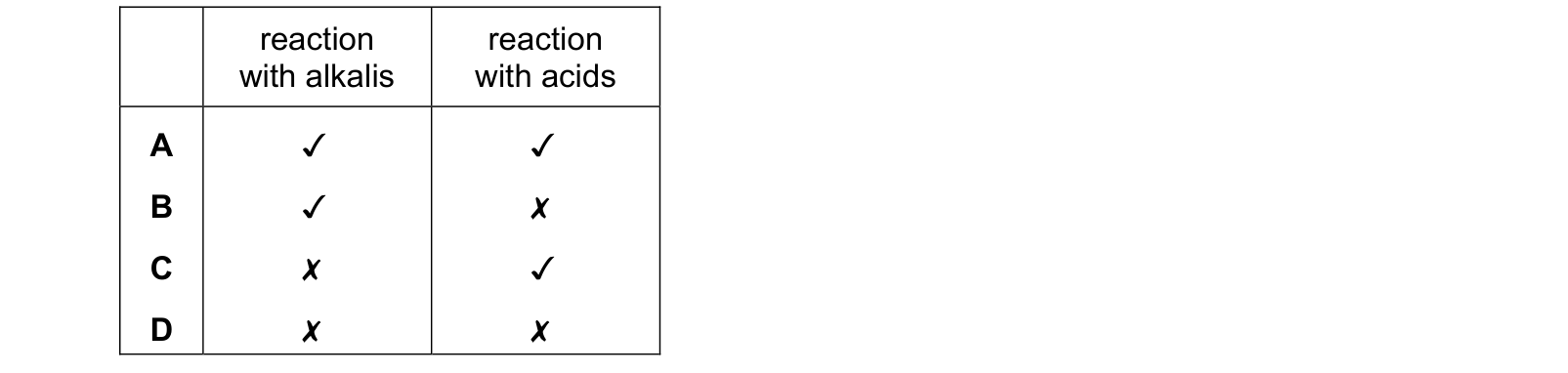
Answer: A.
Question 2
Four different acids are dissolved in water. Which beaker contains the most concentrated strong acid solution? Use the source image for M20 Paper 22, question 19.
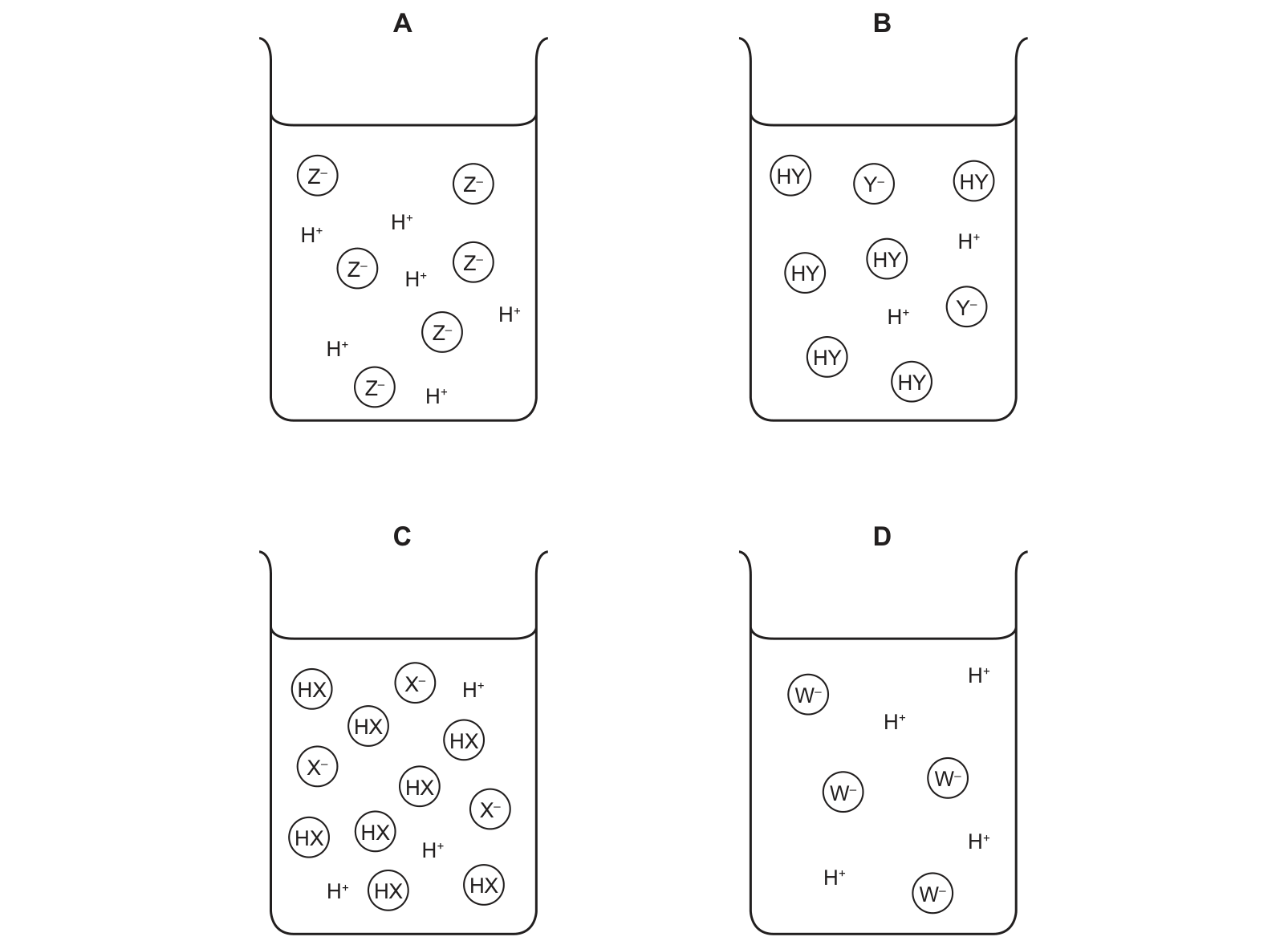
Answer: A.
Question 3
Four metals, Q, R, S and T, are each added to separate samples of water, steam and dilute hydrochloric acid.
The results are shown. Which statements are correct?
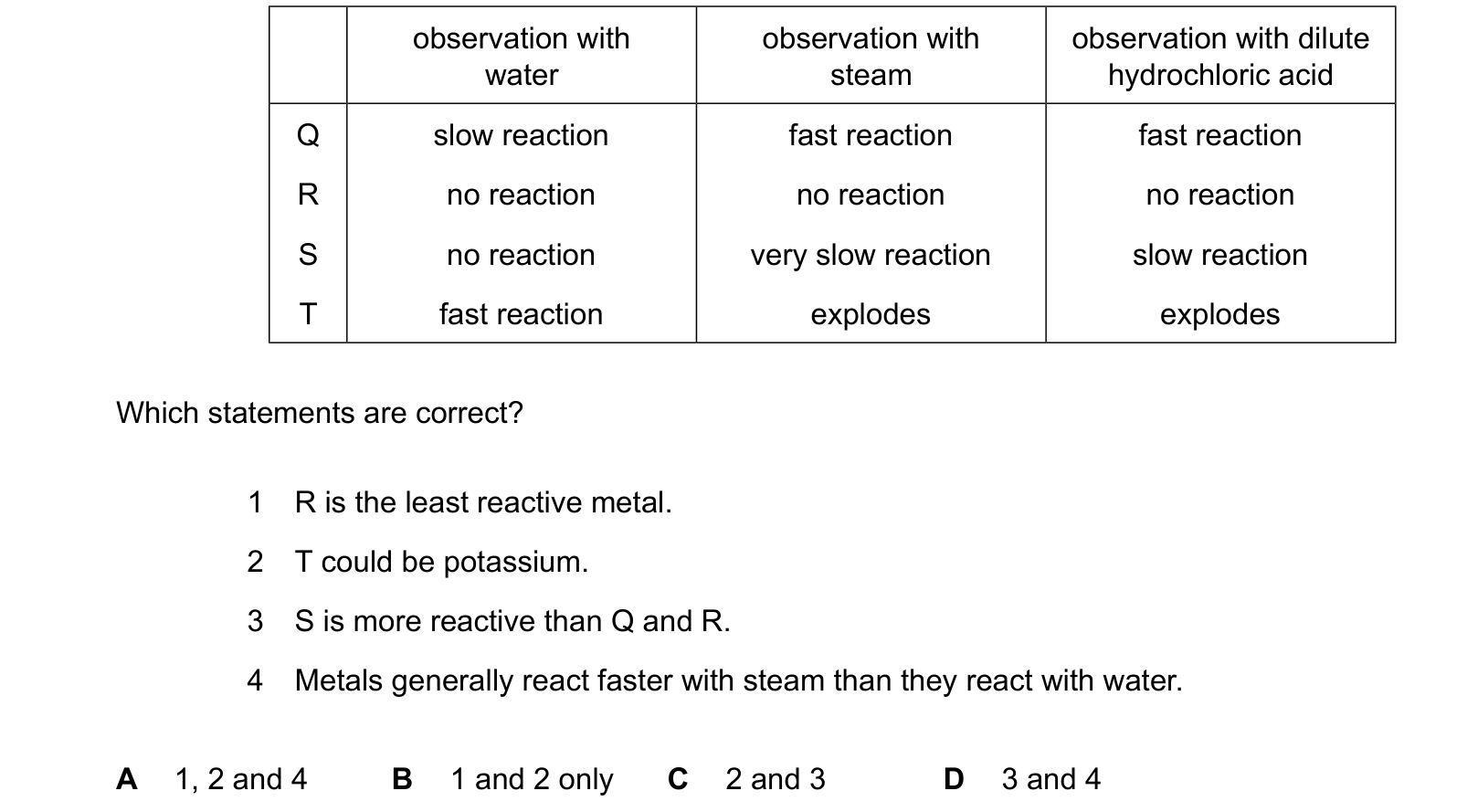
Answer: A.
What the syllabus asks for on this topicSyllabus points
Syllabus points
- Describe the characteristic properties of acids in terms of their reactions with metals, with bases and with carbonates.
- Describe the characteristic properties of bases in terms of their reactions with acids and with ammonium salts.
- Describe the effect of acids and alkalis on litmus, thymolphthalein and methyl orange.
- Describe the use of universal indicator and the pH scale to compare relative acidity and alkalinity, and relate pH to hydrogen ion concentration.
- Describe neutralisation as the reaction between hydrogen ions and hydroxide ions to produce water.
- Extended only: define acids as proton donors and bases as proton acceptors, and define strong and weak acids in terms of complete and partial dissociation.
Related CIE 0620 Chemistry topics
Not the topic you were looking for? Describe what you are stuck on in your own words and we will take you to the notes that answer it.