Formulae
Contents: 9 sections
Formulae you are expected to know
Seven elements exist as diatomic molecules and must be written with a 2 in every equation: H₂, N₂, O₂, F₂, Cl₂, Br₂, I₂. Writing O instead of O₂ makes an otherwise perfect equation unbalanceable.
Everything else is written as single atoms in equations: Na, Mg, Ca, Fe, Cu, Zn, C, S.
Compounds worth knowing on sight:
| Substance | Formula | Substance | Formula |
|---|---|---|---|
| Water | H₂O | Sulfuric acid | H₂SO₄ |
| Carbon dioxide | CO₂ | Nitric acid | HNO₃ |
| Carbon monoxide | CO | Hydrochloric acid | HCl |
| Ammonia | NH₃ | Sodium hydroxide | NaOH |
| Methane | CH₄ | Calcium carbonate | CaCO₃ |
| Sulfur dioxide | SO₂ | Copper(II) sulfate | CuSO₄ |
Molecular formula
The molecular formula gives the number and type of each different atom in one molecule.
Ethanol is C₂H₆O: two carbon atoms, six hydrogen atoms and one oxygen atom in every molecule, which is 2 + 6 + 1 = 9 atoms in total.
A small number written after a symbol multiplies only that symbol. A number in front multiplies the whole formula, and a bracket collects a group before multiplying it. So in Ca(NO₃)₂ there is one calcium, 2 × 1 = 2 nitrogen atoms and 2 × 3 = 6 oxygen atoms; and 3H₂SO₄ contains 3 × 2 = 6 hydrogen atoms.
Deducing a formula from a model
A ball-and-stick model or a diagram is counted, not interpreted. Count how many balls of each colour there are in one molecule and write the symbols with those numbers.
A model showing one black ball joined to two red balls, with black as carbon and red as oxygen, is CO₂. A model showing two black balls each joined to three white balls, with the two black balls joined to each other, is C₂H₆.
If the diagram shows several identical molecules, describe one of them. The formula of a substance never depends on how much of it there is.
Ionic formulae from charges (Extended)
An ionic compound has no molecules, so its formula is the simplest ratio of ions that makes the compound electrically neutral: the total positive charge must equal the total negative charge.
| Charge | Cations | Anions |
|---|---|---|
| 1 | Na⁺, K⁺, Ag⁺, H⁺, NH₄⁺ | Cl⁻, Br⁻, I⁻, OH⁻, NO₃⁻ |
| 2 | Mg²⁺, Ca²⁺, Zn²⁺, Cu²⁺, Fe²⁺, Pb²⁺ | O²⁻, S²⁻, SO₄²⁻, CO₃²⁻ |
| 3 | Al³⁺, Fe³⁺ |
Sodium chloride. Na⁺ and Cl⁻ balance one for one, so the formula is NaCl.
Calcium nitrate. Ca²⁺ needs two 1− ions to balance it:
- 1 × (+2) = +2 from the one calcium ion
- 2 × (−1) = −2 from the two nitrate ions
Two nitrate ions are written by bracketing the whole ion: Ca(NO₃)₂. Writing CaNO₃₂ or CaN₂O₆ is wrong; the bracket is what shows the ion is being taken twice.
Aluminium sulfate. Al³⁺ and SO₄²⁻ balance at two to three:
- 2 × (+3) = +6 from two aluminium ions
- 3 × (−2) = −6 from three sulfate ions
So the formula is Al₂(SO₄)₃.
A quick way to reach the same answer is to take each ion's charge as the other ion's subscript and then cancel: Al³⁺ with O²⁻ gives Al₂O₃, and Mg²⁺ with O²⁻ gives Mg₂O₂, which cancels to MgO.
Word equations and symbol equations
A word equation names the substances: magnesium + oxygen → magnesium oxide. No formulae, no numbers, and it does not need balancing.
A symbol equation uses formulae and must be balanced: the same number of atoms of every element on each side, because atoms are neither created nor destroyed.
2Mg + O₂ → 2MgO
The rule that decides most marks: change only the big numbers in front of a formula, never the small subscripts inside it. Turning O₂ into O₃ to balance an equation changes oxygen into ozone and destroys the chemistry.
Worked example 1. Burning methane. Write the formulae, then count.
CH₄ + 2O₂ → CO₂ + 2H₂O
Carbon: 1 on each side. Hydrogen: 4 on the left, and 2 × 2 = 4 on the right. Oxygen: 2 × 2 = 4 on the left, and 2 + 2 = 4 on the right.
Worked example 2. Aluminium burning in oxygen. Al + O₂ → Al₂O₃ is not balanced. Balance the oxygen by taking 3 O₂ and 2 Al₂O₃, giving 3 × 2 = 6 oxygen atoms on each side, then balance the aluminium at 4:
4Al + 3O₂ → 2Al₂O₃
Worked example 3. Reducing iron(III) oxide in the blast furnace.
Fe₂O₃ + 3CO → 2Fe + 3CO₂
Iron: 2 on each side. Carbon: 3 on each side. Oxygen: 3 + 3 = 6 on the left, and 3 × 2 = 6 on the right.
State symbols
Every symbol equation should carry them: (s) solid, (l) liquid, (g) gas, (aq) aqueous, meaning dissolved in water.
CaCO₃(s) + 2HCl(aq) → CaCl₂(aq) + H₂O(l) + CO₂(g)
Note that (l) and (aq) are different. Water made in a reaction is (l); anything dissolved in water is (aq).
Ionic equations (Extended)
An ionic equation shows only the ions that actually change. Ions that appear unchanged on both sides are spectator ions and are left out.
Precipitation of silver chloride. The full equation is
AgNO₃(aq) + NaCl(aq) → AgCl(s) + NaNO₃(aq)
Sodium ions and nitrate ions are aqueous before and after, so they are spectators, and the ionic equation is
Ag⁺(aq) + Cl⁻(aq) → AgCl(s)
Neutralisation of any strong acid by any alkali reduces to the same thing:
H⁺(aq) + OH⁻(aq) → H₂O(l)
An ionic equation must balance for charge as well as for atoms. Here the left side carries +1 and −1, which is zero, and the right side is neutral.
Common mistakes
- Writing O, H or Cl instead of O₂, H₂ and Cl₂.
- Balancing by changing a subscript rather than the number in front.
- Losing the bracket in Ca(NO₃)₂ or Al₂(SO₄)₃.
- Leaving state symbols out, especially the (s) that marks a precipitate.
- Including spectator ions in an ionic equation.
- Balancing the atoms but not the charge in an ionic equation.
- Counting only the first molecule when a big number multiplies the whole formula.
Check you have it
Question 1
The incomplete equation for photosynthesis is shown. wCO2 + xH2O →P + yO2 Compound P is a product of the reaction. Which row describes the values of w, x and y and gives the empirical formula of compound P? Each answer gives, in order: values of w, x and y; empirical formula of compound P.
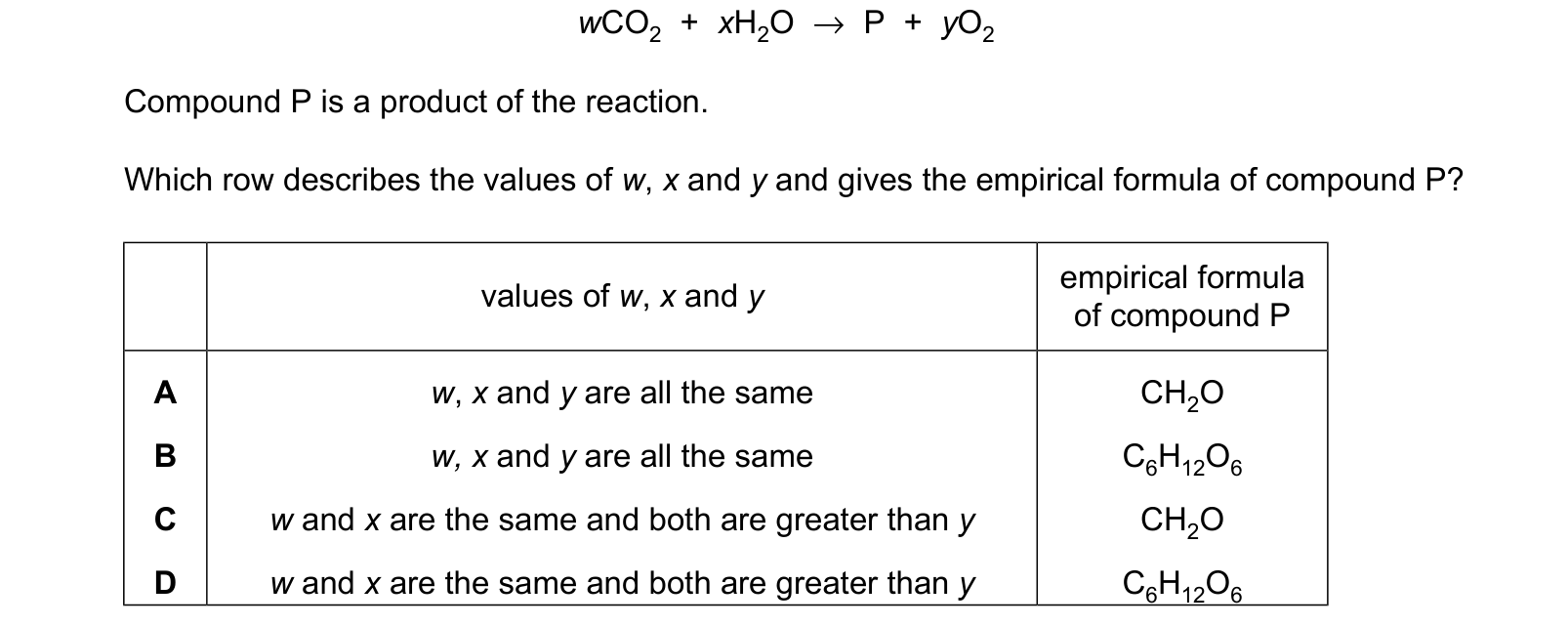
Answer: A.
Question 2
Which word equation represents a reaction which occurs?
Answer: D.
Question 3
Which word equation represents the rusting of iron?
Answer: D.
What the syllabus asks for on this topicSyllabus points
Syllabus points
- State the formulae of the elements and compounds named in the syllabus.
- Define the molecular formula of a compound as the number and type of different atoms in one molecule.
- Deduce the formula of a simple compound from the relative numbers of atoms shown in a model or diagram.
- Construct word equations and symbol equations to show how reactants form products, including state symbols.
- Extended only: deduce the formula of an ionic compound from the relative numbers of ions shown in a model or diagram, or from the charges on the ions.
- Extended only: construct symbol equations with state symbols, including ionic equations, from information given.
Related CIE 0620 Chemistry topics
Not the topic you were looking for? Describe what you are stuck on in your own words and we will take you to the notes that answer it.