Simple molecules and covalent bonds
Contents: 7 sections
What a covalent bond is
A covalent bond is formed when a pair of electrons is shared between two atoms, so that each atom achieves a noble gas electronic configuration.
Covalent bonding happens between non-metal atoms. Neither atom can give electrons away to the other, because both need to gain, so they share instead and the shared pair counts towards the outer shell of both atoms at once.
The target is a full outer shell, which means 8 electrons for almost every atom, and 2 electrons for hydrogen, which is aiming at helium.
The Core molecules
| Molecule | Bonds | Lone pairs | Outer electrons round the central atom |
|---|---|---|---|
| H₂ | 1 single H to H | none | 2 round each H |
| Cl₂ | 1 single Cl to Cl | 3 on each Cl | 8 round each Cl |
| HCl | 1 single H to Cl | 3 on the Cl | 8 round Cl, 2 round H |
| H₂O | 2 single O to H | 2 on the O | 8 round O |
| NH₃ | 3 single N to H | 1 on the N | 8 round N |
| CH₄ | 4 single C to H | none | 8 round C |
The number of bonds an atom forms is the number of electrons it is short of, so it comes straight from the group number:
- Carbon, Group IV, has 4 outer electrons and needs 4 more, so it forms 4 bonds. Round carbon in methane: 4 + 4 = 8.
- Nitrogen, Group V, has 5 and needs 3, so it forms 3 bonds. Round nitrogen in ammonia: 5 + 3 = 8.
- Oxygen, Group VI, has 6 and needs 2, so it forms 2 bonds. Round oxygen in water: 6 + 2 = 8.
- Chlorine, Group VII, has 7 and needs 1, so it forms 1 bond. Round chlorine in HCl: 7 + 1 = 8.
Anything left over that is not being shared is a lone pair. Oxygen in water shares 2 of its 6 outer electrons and keeps 4, which is 2 lone pairs.
Drawing the dot-and-cross diagram
- Draw the outer shell only of each atom, as overlapping circles.
- Use dots for one atom's electrons and crosses for the other's, so a shared pair shows as one dot and one cross together in the overlap.
- Put every unshared electron in as well. A water diagram missing the two lone pairs on oxygen is incomplete.
- No brackets and no charges. Those belong to ionic diagrams, and putting them on a covalent one is a straight error.
Count the electrons round each atom before moving on. Every atom except hydrogen should have 8; every hydrogen should have 2.
Double and triple bonds (Extended)
When one shared pair is not enough, atoms share two or three pairs.
Oxygen, O₂. Each atom has 6 outer electrons and needs 2, so the two atoms share two pairs, a double bond, written O=O. Each oxygen also keeps 2 lone pairs, giving 8 in total.
Carbon dioxide, CO₂. Carbon needs 4 and each oxygen needs 2, so carbon forms a double bond to each oxygen: O=C=O. Round the carbon there are 4 shared pairs, which is 8 electrons; round each oxygen, 2 shared pairs and 2 lone pairs, again 8.
Nitrogen, N₂. Each nitrogen has 5 and needs 3, so they share three pairs, a triple bond. Each nitrogen keeps 1 lone pair. The triple bond is very strong, which is why nitrogen gas is so unreactive.
Ethene, C₂H₄. A double bond between the two carbons and one single bond from each carbon to each of two hydrogens. Check the carbons: 2 pairs in the C=C and 2 pairs to hydrogen gives 4 shared pairs, so 8 electrons.
Methanol, CH₃OH. Carbon bonds to three hydrogens and to the oxygen; the oxygen bonds to carbon and to the remaining hydrogen and keeps 2 lone pairs. Every atom is single bonded here, so the difficulty is entirely in remembering the oxygen's lone pairs.
Properties of simple molecular substances
Low melting and boiling points.
| Substance | Melting point in °C | Boiling point in °C |
|---|---|---|
| Methane, CH₄ | −182 | −161 |
| Chlorine, Cl₂ | −101 | −34 |
| Water, H₂O | 0 | 100 |
| Sodium chloride, NaCl | 801 | 1413 |
Methane and chlorine are gases at room temperature and sodium chloride is a solid that has to be heated past 800 °C to melt. The reason (Extended) is the distinction that carries the marks:
The covalent bonds within each molecule are strong, but the forces between molecules are weak. Melting or boiling separates the molecules from one another, so only the weak intermolecular forces have to be overcome. The covalent bonds are not broken.
An answer saying "the covalent bonds are weak" is wrong and is marked as such. Covalent bonds are among the strongest in chemistry; what is weak is the attraction between one whole molecule and the next.
Intermolecular forces get stronger as molecules get larger, which is why the boiling points rise from methane to chlorine and further down a homologous series.
Poor electrical conductivity. Simple molecular substances do not conduct in any state, because their molecules are neutral: there are no free electrons and no ions to carry a charge. That holds whether the substance is solid, liquid or gas.
Solubility. Many simple molecular substances dissolve in organic solvents rather than in water, which is the opposite of the pattern for ionic compounds.
Common mistakes
- Saying electrons are transferred in a covalent bond. They are shared.
- Drawing brackets and charges on a covalent dot-and-cross diagram.
- Leaving lone pairs off water, ammonia or chlorine.
- Giving carbon 4 electrons in methane instead of counting the shared pairs, which give 8.
- Saying simple molecular substances have low boiling points because their covalent bonds are weak.
- Saying a molecular substance conducts when molten. It has no ions to move.
- Drawing a single bond in O₂ or CO₂, which leaves the atoms short of a full outer shell.
Check you have it
Question 1
Ammonia, NH3, is a covalent molecule. Which diagram shows the outer-shell electron arrangement in a molecule of ammonia? Use the source image for S23 Paper 12, question 5.
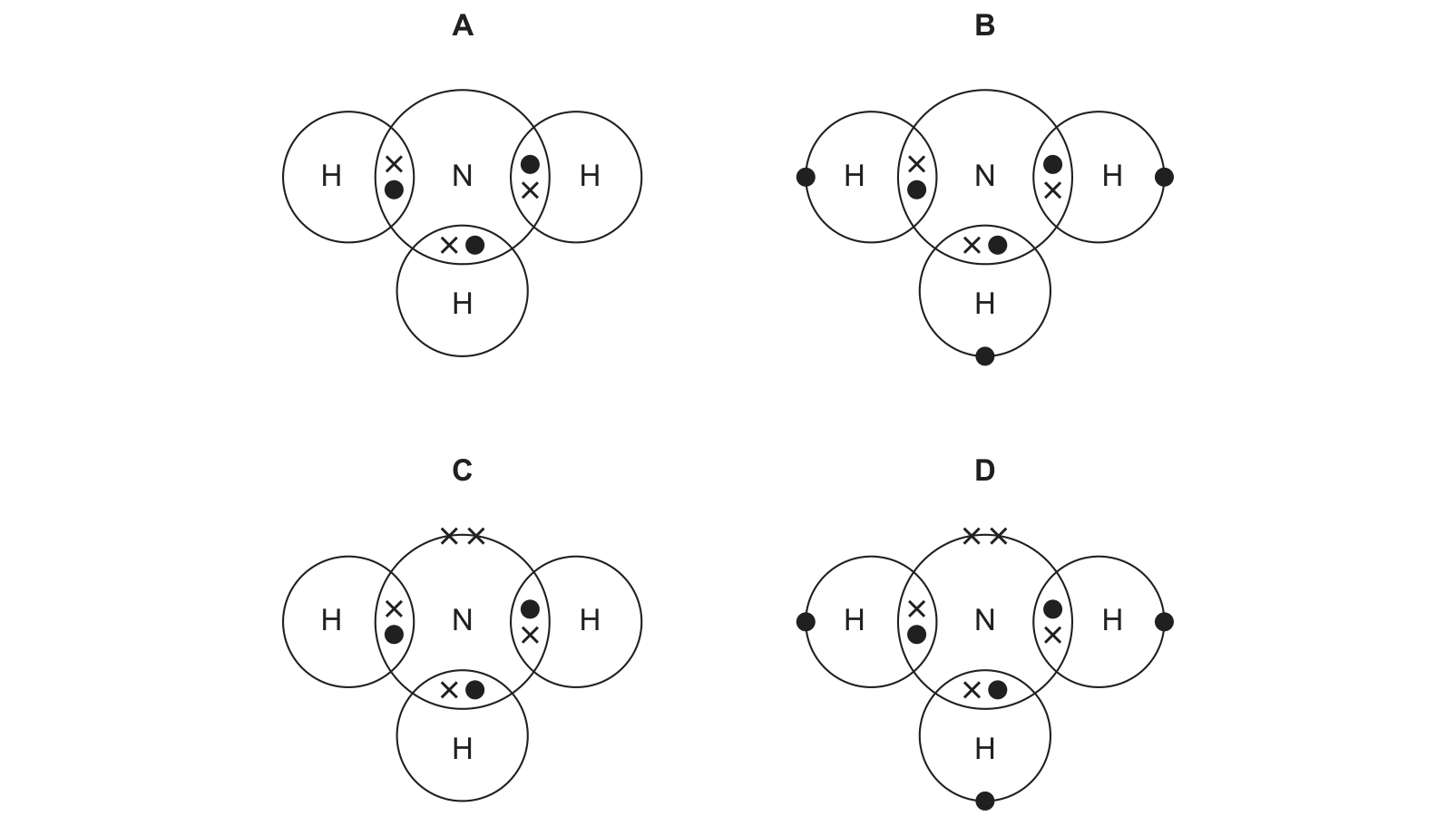
Answer: C.
Question 2
Nitrogen monoxide, NO, is a simple molecular compound. Which row shows the properties of nitrogen monoxide? Each answer gives, in order: boiling point; electrical conductivity.
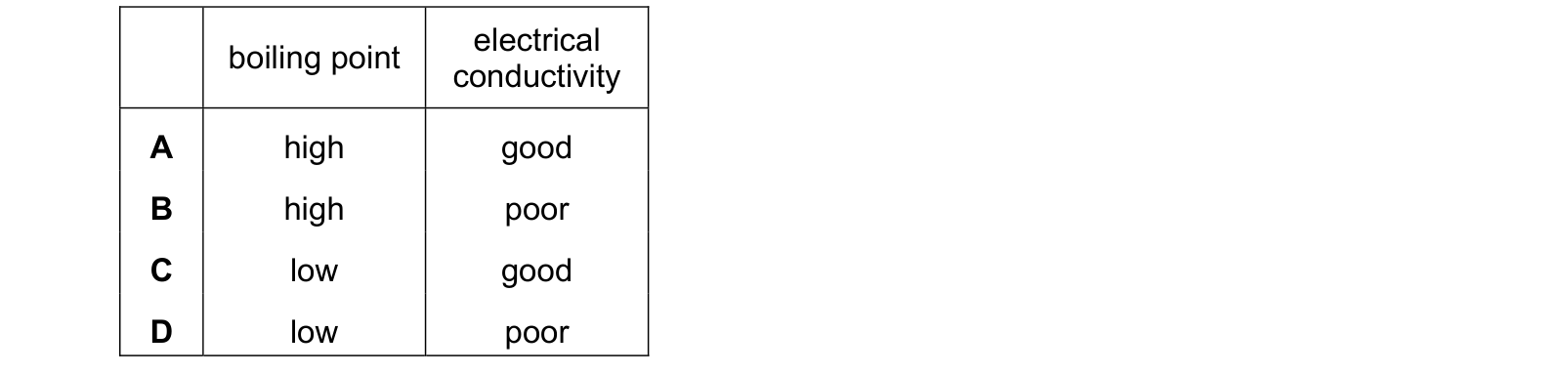
Answer: D.
Question 3
Which dot-and-cross diagram shows the arrangement of outer shell electrons in a molecule of hydrogen chloride? Use the source image for S22 Paper 12, question 7.

Answer: A.
What the syllabus asks for on this topicSyllabus points
Syllabus points
- State that a covalent bond is formed when a pair of electrons is shared between two atoms, leading to noble gas electronic configurations.
- Describe the formation of covalent bonds in H₂, Cl₂, H₂O, CH₄, NH₃ and HCl, using dot-and-cross diagrams.
- Describe the properties of simple molecular compounds: low melting points and boiling points, and poor electrical conductivity.
- Extended only: describe the formation of covalent bonds in CH₃OH, C₂H₄, O₂, CO₂ and N₂, using dot-and-cross diagrams.
- Extended only: explain those properties in terms of structure and bonding, distinguishing the forces between molecules from the bonds within them.
Related CIE 0620 Chemistry topics
Not the topic you were looking for? Describe what you are stuck on in your own words and we will take you to the notes that answer it.