Simple molecules and covalent bonds Exam Questions
47 past-paper questions on this unit. Five of them are below. Answer on the page: each one is marked the moment you pick, the correct option is shown whether or not you found it, and the full explanation opens either way.
CIE 0620 ChemistryPaper 1 and Paper 2 MCQsFree account
Simple molecules and covalent bonds: five questions to try now
Real past-paper questions, the answer key from the mark scheme, and the explanation that goes with it. No account needed to answer them.
Question 1
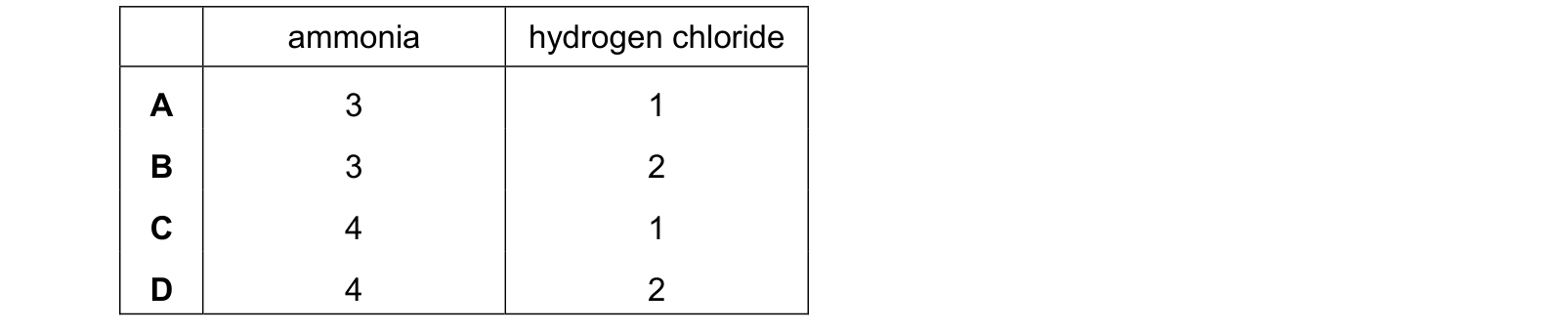
Which row gives the number of covalent bonds in one molecule of ammonia and in one molecule of hydrogen chloride? Each answer gives, in order: ammonia; hydrogen chloride.
Answer: A.
The number of covalent bonds an atom forms equals the number of electrons it still needs to fill its outer shell. Nitrogen is in group V with five outer electrons, so it needs three more and forms 3 bonds, one to each hydrogen in NH3. Chlorine is in group VII with seven outer electrons, so it needs only one more and forms 1 bond, which is why hydrogen chloride is written HCl. The rows giving ammonia 4 have counted the atoms in the molecule, nitrogen plus three hydrogens, rather than the bonds joining them, and the rows giving hydrogen chloride 2 repeat that slip on a molecule of two atoms. Bonds are the links between atoms, so a molecule always has fewer bonds than atoms when the atoms are strung in a chain.
Question 2
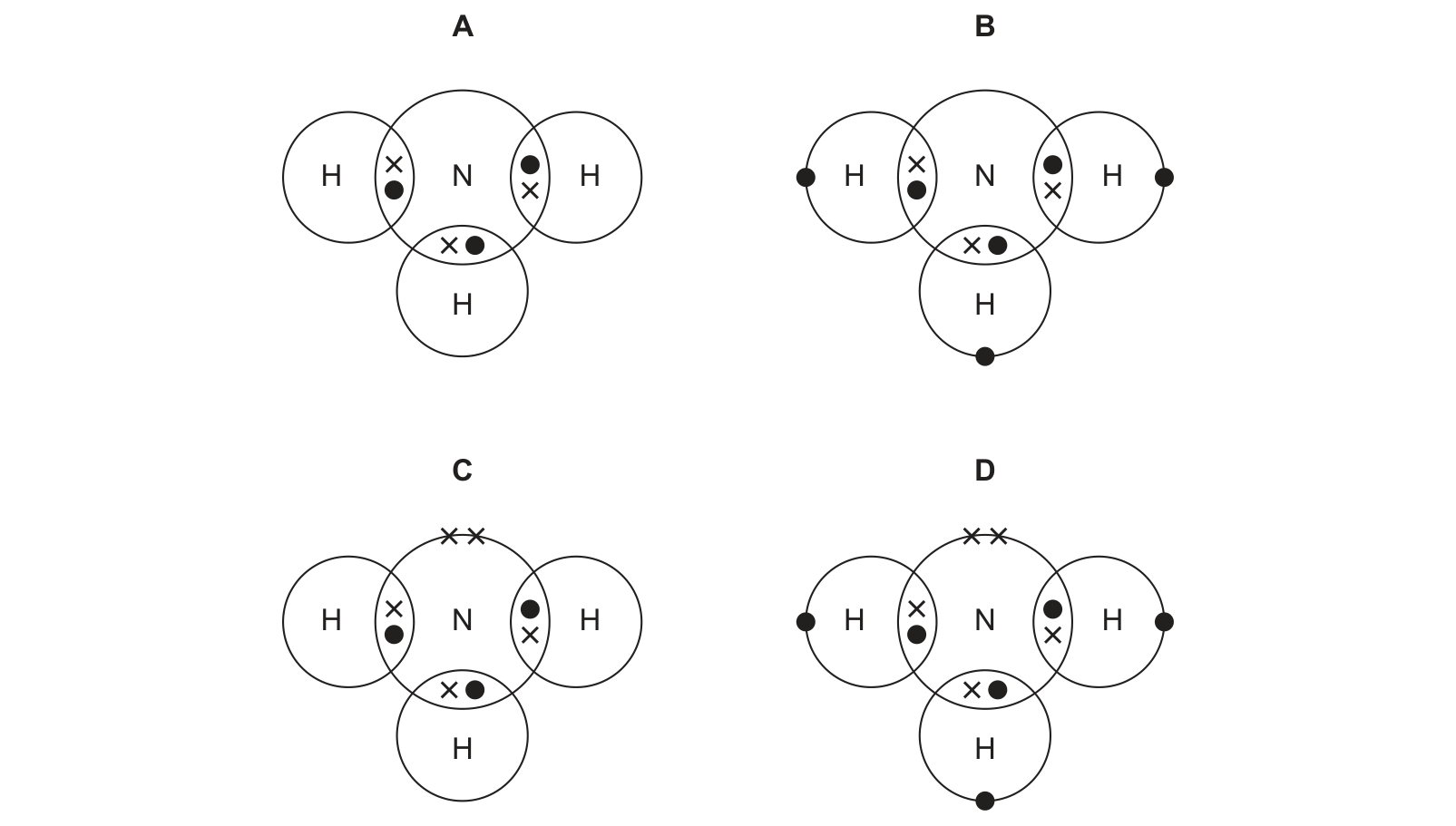
Ammonia, NH3, is a covalent molecule. Which diagram shows the outer shell electron arrangement in a molecule of ammonia? Use the source image for M20 Paper 12, question 6.
Answer: C.
An ammonia molecule (NH3) contains a central nitrogen atom covalently bonded to three hydrogen atoms by sharing three pairs of electrons. Nitrogen is in Group V with five valence electrons, so after using three electrons in single covalent N-H bonds, it retains one non-bonding lone pair of electrons (two crosses on the nitrogen ring), giving nitrogen a complete octet of 8 outer electrons and each hydrogen a complete duet of 2 electrons. C correctly shows three shared pairs and one unshared pair on nitrogen. A misses the non-bonding lone pair on nitrogen. B and D show extra unshared dots on the hydrogen atoms, which is impossible because hydrogen possesses only one electron.
Question 3
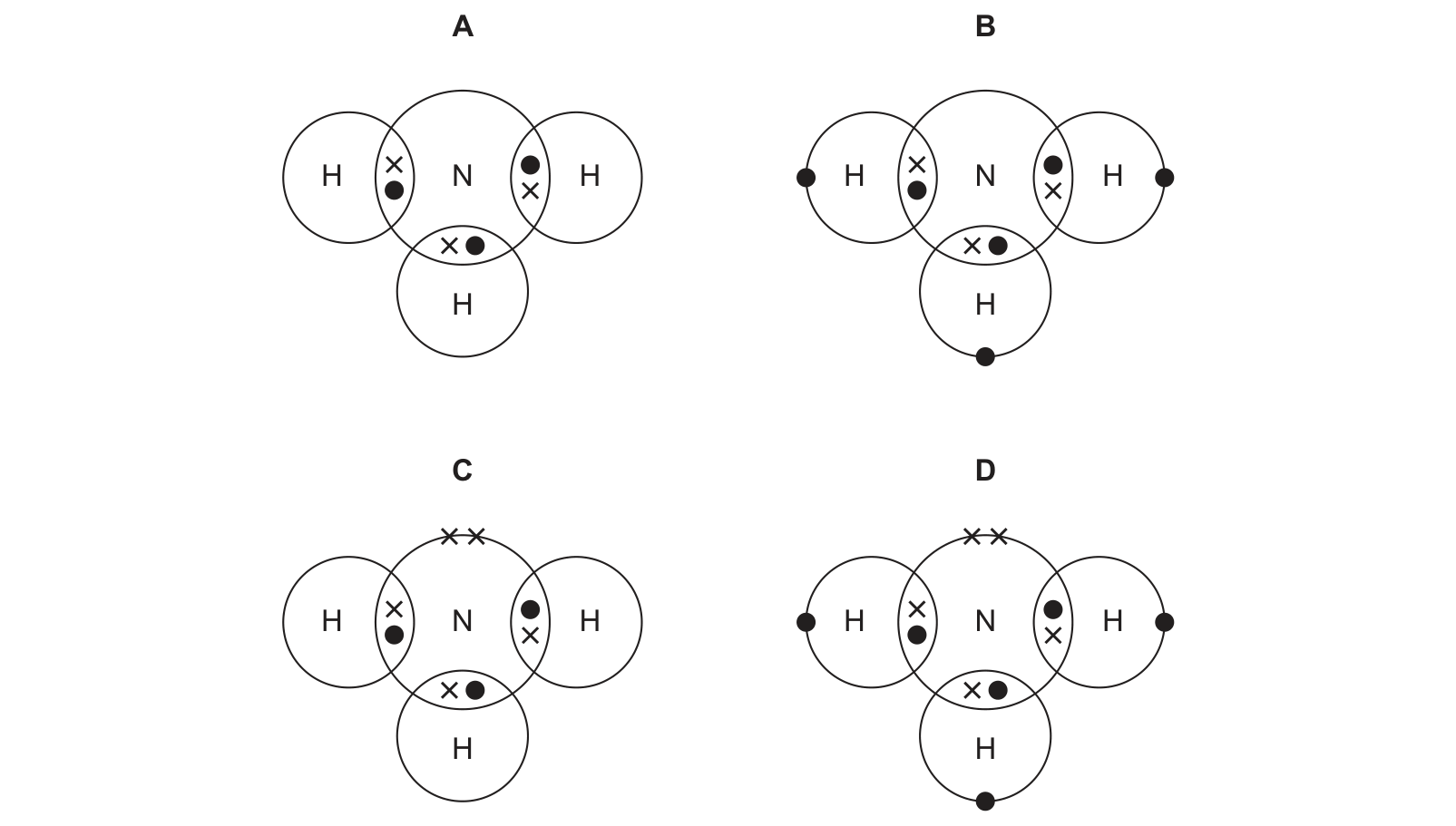
Ammonia, NH3, is a covalent molecule. Which diagram shows the outer-shell electron arrangement in a molecule of ammonia? Use the source image for S23 Paper 22, question 3.
Answer: C.
Every outer electron has to be accounted for. Nitrogen brings five, spends three in bonds to the hydrogens and keeps the remaining two together as a lone pair, which must be drawn on the nitrogen. Each hydrogen brings one electron and puts it straight into a bond, so nothing at all should appear outside a hydrogen circle. Only one diagram satisfies both conditions, with three overlaps each holding a shared pair and one further pair on the nitrogen alone; those that omit the lone pair leave nitrogen two electrons short of a full shell, and those with dots outside the hydrogens invent electrons that hydrogen does not have.
Question 4
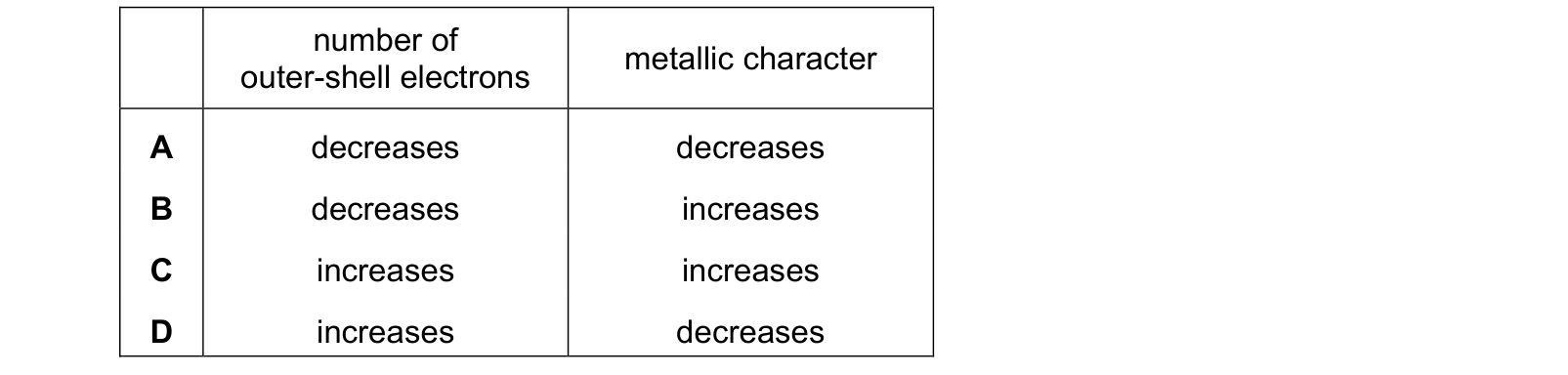
Which row describes the changes across a period of the Periodic Table, from left to right? Each answer gives, in order: number of outer-shell electrons; metallic character.
Answer: D.
Crossing a period, each successive element adds one more electron to the same outer shell, so the count of outer shell electrons rises from left to right, which removes both rows showing it fall. Metallic character depends on how readily an atom parts with those outer electrons, and the more of them an atom has, the harder they are to lose, so metallic character declines in the very direction the electron count climbs. Period 3 shows it plainly: sodium with one outer electron is a reactive metal, aluminium with three is still a metal, silicon with four sits on the borderline, and sulfur and chlorine with six and seven are firmly non metals. The row that has both quantities increasing would mean an atom becomes more metallic the more outer electrons it collects, which contradicts the reason metals conduct and react as they do.
Question 5
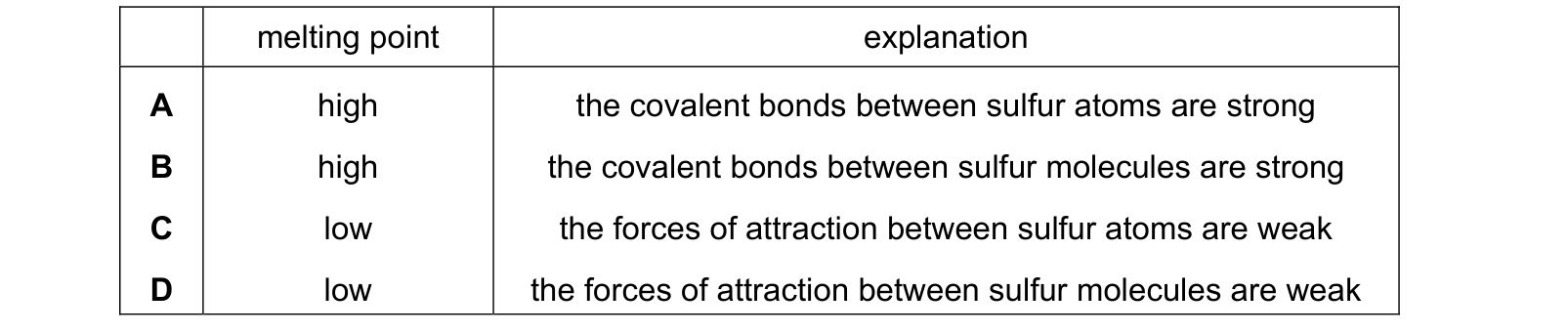
Sulfur is a simple molecule with the formula S8. Which row describes and explains the melting point of sulfur? Each answer gives, in order: melting point; explanation.
Answer: D.
Sulfur exists as S8 molecules, each with eight atoms held by strong covalent bonds, but those bonds lie inside the molecule and melting never touches them. Melting has only to separate whole S8 molecules from one another, and the attraction between separate molecules is weak, so the melting point is low, at about 115 degrees C. The two rows offering a high melting point mistake the strength of the bonds within a molecule for the strength of the attraction between molecules, which is the classic error with simple molecular substances. The remaining wrong row lands on the right verdict for the wrong reason, blaming weak forces between sulfur atoms, since the atoms within each ring are joined by strong covalent bonds; it is the molecules, not the atoms, that attract each other weakly.
These questions are drawn from past CIE 0620 Chemistry papers and filtered to simple molecules and covalent bonds. You answer, you find out immediately whether you were right, and you get the reasoning for the correct option and for each distractor. Wrong answers go to a mistakes locker so you can come back to exactly those.
Practice is free. You need an account only so your progress and your mistakes are still there next time.
These are the errors that cost marks on simple molecules and covalent bonds, taken from our own topic notes. Read them before you practise and you will recognise the traps in the questions.
Saying electrons are transferred in a covalent bond. They are shared.
Drawing brackets and charges on a covalent dot-and-cross diagram.
Leaving lone pairs off water, ammonia or chlorine.
Giving carbon 4 electrons in methane instead of counting the shared pairs, which give 8.
Saying simple molecular substances have low boiling points because their covalent bonds are weak.
Saying a molecular substance conducts when molten. It has no ions to move.
Drawing a single bond in O₂ or CO₂, which leaves the atoms short of a full outer shell.