Isotopes
Contents: 6 sections
What an isotope is
Isotopes are different atoms of the same element that have the same number of protons but different numbers of neutrons.
The proton number is fixed because it defines the element. What varies is the neutron count, so isotopes of one element have different nucleon numbers and therefore different masses.
Chlorine is the standard example. Both isotopes have 17 protons and 17 electrons; one has 18 neutrons and the other has 20.
| Isotope | Protons | Neutrons | Electrons | Nucleon number |
|---|---|---|---|---|
| Chlorine-35 | 17 | 18 | 17 | 35 |
| Chlorine-37 | 17 | 20 | 17 | 37 |
Neutron counts come from subtraction every time: 35 − 17 = 18 and 37 − 17 = 20.
Reading the symbol
An atom is written with the nucleon number above and the proton number below the symbol, as in ¹²₆C.
That symbol says 6 protons, and 12 − 6 = 6 neutrons, and, since it is a neutral atom, 6 electrons.
The same element written ¹⁴₆C still has 6 protons, but 14 − 6 = 8 neutrons. The lower number never changes for a given element, which is a fast way to check that two symbols really are isotopes of each other rather than two different elements.
Sets worth recognising on sight:
- Hydrogen: ¹₁H with 0 neutrons, ²₁H with 1 neutron, ³₁H with 2 neutrons. Hydrogen is the only element where the isotopes differ in mass by a factor of two or three, which is why its isotopes have their own names.
- Carbon: ¹²₆C, ¹³₆C and ¹⁴₆C, with 6, 7 and 8 neutrons. Carbon-12 is the standard against which all relative masses are measured; carbon-14 is the unstable one used in dating.
- Oxygen: ¹⁶₈O and ¹⁸₈O, with 8 and 10 neutrons.
Why isotopes are chemically identical
Isotopes of an element have the same chemical properties, and the reason is the whole of the Core requirement here:
They have the same number of electrons, and therefore the same electronic configuration, and chemical reactions involve only the outer electrons.
Chlorine-35 and chlorine-37 both have the configuration 2,8,7. Both need one more electron for a full outer shell, so both form Cl⁻ ions, both react with sodium to give sodium chloride, and both bleach damp litmus paper. The extra two neutrons in the nucleus take no part in any of it.
Their physical properties do differ slightly, because those depend on mass. Chlorine-37 is denser and diffuses a little more slowly than chlorine-35. Saying that isotopes are identical in every way is therefore wrong; it is the chemistry that is identical.
Relative atomic mass from abundances (Extended)
Because a normal sample of chlorine contains both isotopes, its relative atomic mass is not a whole number. This calculation is Extended only, so a Core candidate needs the definition of an isotope but not the arithmetic below.
Relative atomic mass, Aᵣ, is the average mass of the isotopes of an element, weighted by how abundant each one is, compared with 1/12 of the mass of an atom of carbon-12.
The method is always the same: multiply each isotope's mass by its percentage, add the products, and divide by 100.
Worked example 1. Chlorine is 75% chlorine-35 and 25% chlorine-37.
Aᵣ(Cl) = ((75 × 35) + (25 × 37)) / 100 = 3550 / 100 = 35.5
The answer lies nearer 35 than 37, which is the check to apply: the answer must always sit between the two isotope masses, and closer to the more abundant one. An answer of 36 would mean equal amounts, and an answer outside the range 35 to 37 is impossible.
Worked example 2. Boron is 20% boron-10 and 80% boron-11.
Aᵣ(B) = ((20 × 10) + (80 × 11)) / 100 = 1080 / 100 = 10.8
Worked example 3. Bromine is almost exactly half bromine-79 and half bromine-81.
Aᵣ(Br) = (79 + 81) / 2 = 80
Worked example 4, three isotopes. Magnesium is 79% magnesium-24, 10% magnesium-25 and 11% magnesium-26.
Aᵣ(Mg) = ((79 × 24) + (10 × 25) + (11 × 26)) / 100 = 2432 / 100 = 24.32
The same method extends to any number of isotopes; the percentages simply have to add to 100, and checking that they do is the quickest way to spot a misread table.
Working backwards
Some questions give the relative atomic mass and ask for an abundance. Chlorine again: the isotopes are 35 and 37 and the relative atomic mass is 35.5.
Let the fraction of chlorine-35 be x, so the fraction of chlorine-37 is 1 − x, and
35x + 37(1 − x) = 35.5
37 − 2x = 35.5, so 2x = 1.5 and x = 0.75, which is 75% chlorine-35.
If abundances are given as a ratio rather than percentages, convert first. A 3 to 1 ratio of chlorine-35 to chlorine-37 is 3 parts in 4, which is 75% and 25%, giving the same 35.5.
Common mistakes
- Saying isotopes have different numbers of protons. Different protons means a different element.
- Saying isotopes have different numbers of electrons. Neutral atoms of any isotope have the same number as protons.
- Saying isotopes react differently. Their chemistry is identical because their electronic configurations are identical.
- Taking a simple mean of the isotope masses when the abundances are unequal. Chlorine would come out as 36 rather than 35.5.
- Forgetting to divide by 100 at the end, giving an answer in the thousands.
- Quoting a relative atomic mass with a unit. It is a ratio and has none.
- Rounding relative atomic mass to a whole number when the question asks for it from isotope data.
Check you have it
Question 1
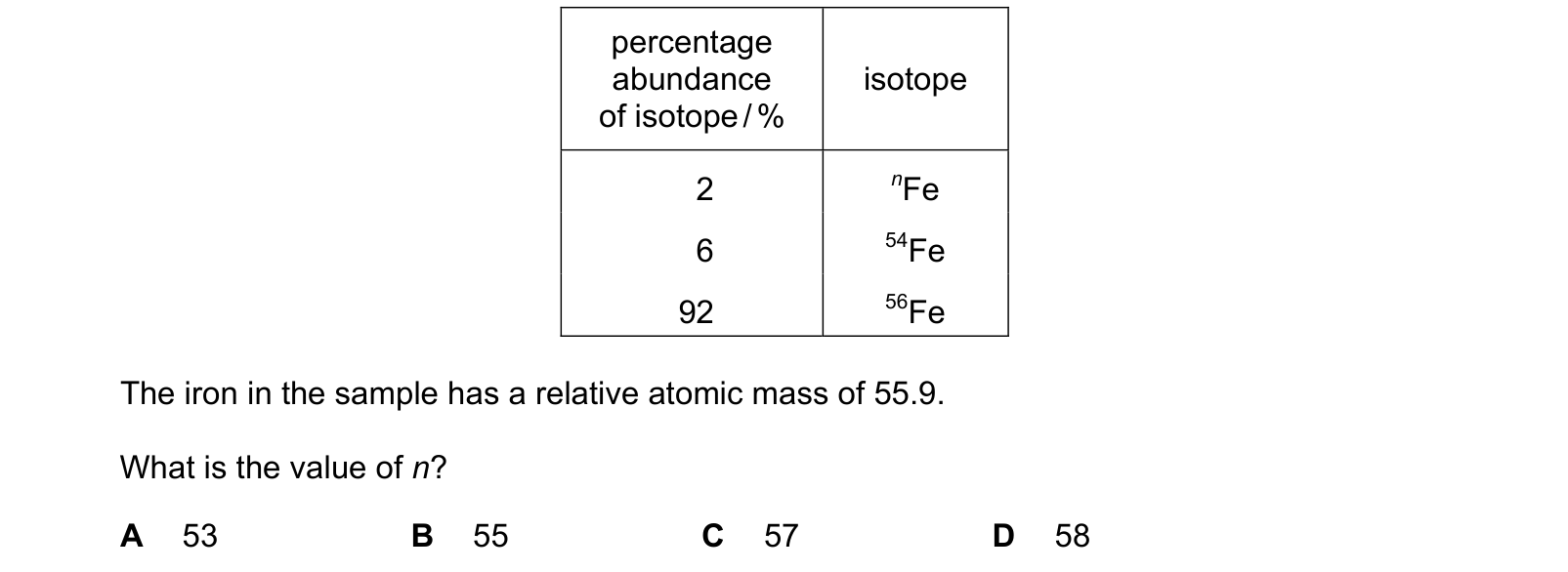
A sample of pure iron contains three isotopes only.
percentage abundance isotope of isotope / % 2 nFe
6 54Fe
92 56Fe
The iron in the sample has a relative atomic mass of 55.9.
What is the value of n?
Answer: C.
Question 2
The relative atomic mass, Ar, of an element is the average mass of the isotopes of that element compared to another particle.
Which particle is used for this comparison?
Answer: B.
Question 3
A sample of iridium has a relative atomic mass of 192.29.
The sample contains two isotopes only.
64.50% of the sample is 193Ir.
What is the other isotope in the sample?
Answer: C.
What the syllabus asks for on this topicSyllabus points
Syllabus points
- Define isotopes as different atoms of the same element that have the same number of protons but different numbers of neutrons.
- Interpret and use symbols for atoms, such as ¹²₆C.
- State that isotopes of the same element have the same chemical properties because they have the same number of electrons and therefore the same electronic configuration.
- Extended only: calculate the relative atomic mass of an element from the relative masses and abundances of its isotopes.
Related CIE 0620 Chemistry topics
Not the topic you were looking for? Describe what you are stuck on in your own words and we will take you to the notes that answer it.