Reversible reactions and equilibrium
Contents: 8 sections
The reversible arrow
A reversible reaction goes both ways under the same conditions, and is written with ⇌ rather than →. Changing the conditions changes which direction dominates.
If the forward reaction is exothermic, the reverse reaction is endothermic by exactly the same amount of energy. That pairing is worth stating early because Le Chatelier questions depend on it.
The two salts to learn by heart
These two appear in Core and Extended papers alike, and the colours are recall marks.
| Compound | Hydrated colour | Anhydrous colour |
|---|---|---|
| Copper(II) sulfate | Blue | White |
| Cobalt(II) chloride | Pink | Blue |
CuSO<sub>4</sub>·5H<sub>2</sub>O ⇌ CuSO<sub>4</sub> + 5H<sub>2</sub>O
CoCl<sub>2</sub>·6H<sub>2</sub>O ⇌ CoCl<sub>2</sub> + 6H<sub>2</sub>O
Heating drives the water off and is endothermic. Adding water back restores the colour and is exothermic, releasing enough heat that the watch glass gets noticeably warm.
Using them as tests for water
- Anhydrous copper(II) sulfate turns from white to blue if water is present.
- Anhydrous cobalt(II) chloride turns from blue to pink if water is present.
Both tests show only that water is present. Neither shows that the liquid is pure water. To show purity, measure the physical constants: pure water boils at exactly 100 °C and freezes at exactly 0 °C at atmospheric pressure, and any dissolved solute raises the boiling point and lowers the freezing point.
Worked example: how much water comes off
Relative formula mass of CuSO<sub>4</sub>·5H<sub>2</sub>O is 63.5 + 32 + 64 + 90 = 249.5, of which 90 is water. Heat 12.5 g of the blue crystals to constant mass.
mass of water driven off = 12.5 × 90 / 249.5 = 4.51 g
mass of white residue = 12.5 − 4.51 = 7.99 g
Heating "to constant mass" means weighing, heating again and reweighing until two readings agree. That is what tells you all the water has gone rather than some of it.
Extended only: dynamic equilibrium
Equilibrium needs a closed system, meaning nothing enters and nothing leaves. A reaction in an open beaker that lets a gas escape can never reach equilibrium, because the reverse reaction has nothing to work with.
At equilibrium:
- The rate of the forward reaction equals the rate of the reverse reaction.
- The concentrations of reactants and products stay constant.
- Both reactions are still happening, which is what "dynamic" means.
The concentrations are constant, not equal. An equilibrium can sit at 98 per cent products or at 2 per cent products and still be an equilibrium. Writing that the amounts of reactants and products are equal is the single commonest error here.
Extended only: Le Chatelier's principle
If a change is made to a system at equilibrium, the position of equilibrium shifts so as to oppose that change.
| Change | Equilibrium shifts |
|---|---|
| Increase temperature | In the endothermic direction |
| Decrease temperature | In the exothermic direction |
| Increase pressure | Towards the side with fewer molecules of gas |
| Decrease pressure | Towards the side with more molecules of gas |
| Increase concentration of a reactant | To the right, making more product |
| Remove a product as it forms | To the right, making more product |
| Add a catalyst | Not at all |
A catalyst changes nothing about the position. It speeds up the forward and the reverse reactions by the same factor, so equilibrium is reached sooner with exactly the same yield. Any answer that has a catalyst raising a yield is wrong.
To use the pressure rule you must count gas molecules on each side of the equation, and only gases count.
Extended only: the Haber process
N<sub>2</sub>(g) + 3H<sub>2</sub>(g) ⇌ 2NH<sub>3</sub>(g)
The forward reaction is exothermic. The nitrogen comes from the air and the hydrogen from methane or from cracking.
The essential conditions are 450 °C, 200 atm and an iron catalyst.
Each is a compromise you should be able to justify:
- Temperature. The forward reaction is exothermic, so a low temperature would give the higher yield. At a low temperature the rate is uselessly slow, so 450 °C is chosen as a compromise between yield and rate.
- Pressure. There are 4 molecules of gas on the left and 2 on the right, so high pressure pushes the equilibrium to the right and raises the yield. Pressures far above 200 atm need thicker vessels and more energy for the compressors, so 200 atm is a compromise between yield and cost.
- Catalyst. Iron raises the rate only. It does not change the yield.
At these conditions only about 15 per cent of the mixture converts on each pass, so the ammonia is condensed out and the unreacted nitrogen and hydrogen are recycled. That recycling is why a modest yield per pass is commercially acceptable.
Extended only: the Contact process
2SO<sub>2</sub>(g) + O<sub>2</sub>(g) ⇌ 2SO<sub>3</sub>(g)
The forward reaction is exothermic. The essential conditions are 450 °C, 2 atm and a vanadium(V) oxide catalyst.
The temperature argument is identical to the Haber one. The pressure is different, and knowing why is worth a mark: there are 3 molecules of gas on the left and 2 on the right, so high pressure would help, but the yield at 2 atm is already about 96 per cent, and paying for high pressure to gain a few per cent is not worth it.
The sulfur trioxide is then absorbed and converted to sulfuric acid.
Common mistakes
- Saying the concentrations of reactants and products are equal at equilibrium.
- Saying the reactions stop at equilibrium.
- Claiming a catalyst increases the yield of ammonia.
- Giving 450 °C as the condition that maximises yield, when it lowers yield and is chosen for rate.
- Reversing the cobalt(II) chloride colours, which are blue when dry and pink when wet.
- Saying anhydrous copper(II) sulfate turning blue proves the liquid is pure water.
- Counting solids or liquids when applying the pressure rule.
- Applying Le Chatelier to a reaction in an open container, which is not at equilibrium at all.
Check you have it
Question 1
Two reactions, M and N, both form carbon dioxide. M N Which types of reaction are M and N? Each answer gives, in order: M; N.
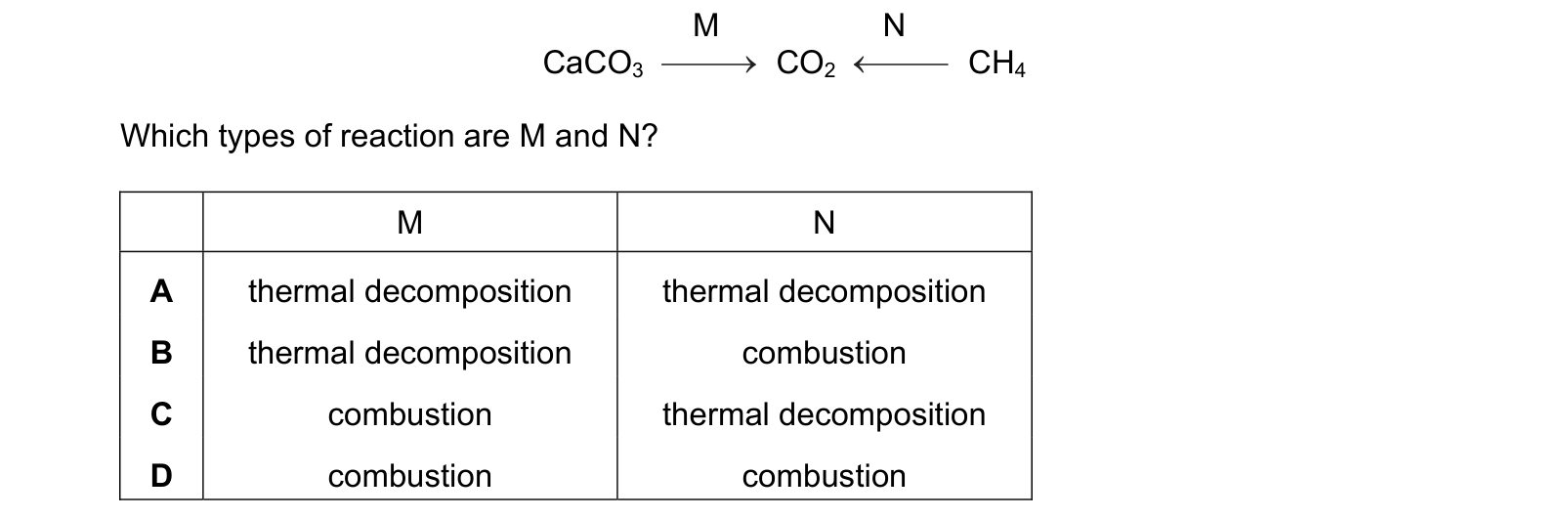
Answer: B.
Question 2
The reversible reaction shown takes place in a closed system at constant temperature. When the reaction has reached equilibrium, more T is added.
After the addition of T, which other substances increase in concentration?

Answer: C.
Question 3
The diagram represents an outline of the carbon cycle. Which processes are X and Y? Each answer gives, in order: X; Y.
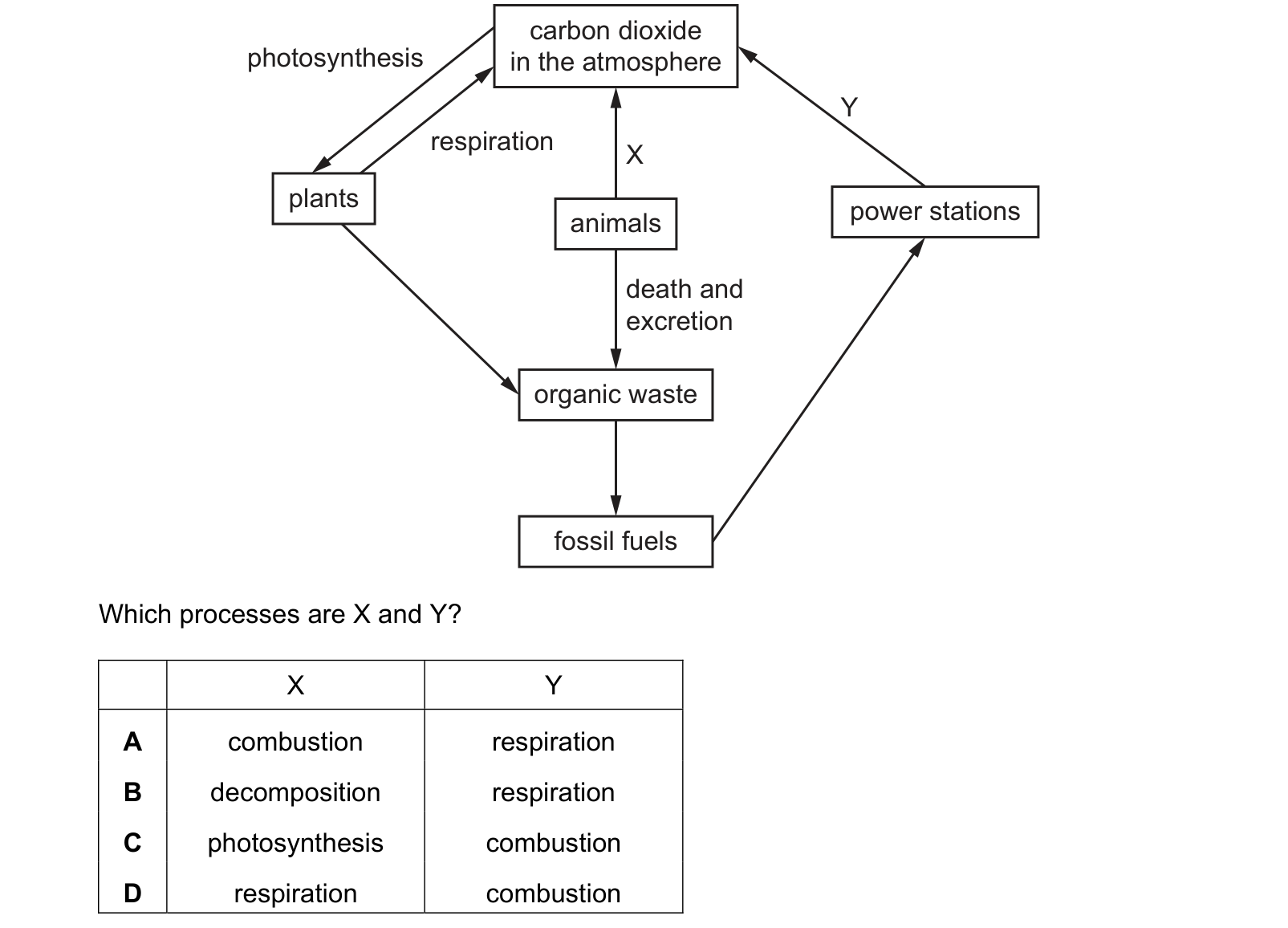
Answer: D.
What the syllabus asks for on this topicSyllabus points
Syllabus points
- State that some chemical reactions are reversible, as shown by the symbol ⇌.
- Describe the effect of heat on hydrated copper(II) sulfate and on hydrated cobalt(II) chloride, including the colour changes, and describe their use as tests for the presence of water.
- Extended only: state that a reversible reaction in a closed system is at equilibrium when the rate of the forward reaction equals the rate of the reverse reaction and the concentrations are no longer changing.
- Extended only: state and use Le Chatelier's principle to predict and explain the effect of changes in temperature, concentration and pressure.
- Extended only: state the symbol equation and the essential conditions for the Haber process and for the Contact process.
Related CIE 0620 Chemistry topics
Not the topic you were looking for? Describe what you are stuck on in your own words and we will take you to the notes that answer it.