Corrosion of metals
Contents: 7 sections
What rust is
Rust is hydrated iron(III) oxide, Fe<sub>2</sub>O<sub>3</sub>·xH<sub>2</sub>O, an orange-brown solid.
It is flaky and porous, and that is the reason rusting is so destructive. The rust does not stick to the iron underneath, so it falls away and exposes fresh metal, which rusts in turn. The process continues until the whole object has crumbled.
Compare that with aluminium, whose oxide layer is thin, hard and impermeable, sticks firmly to the surface and stops the corrosion after a fraction of a millimetre. Both metals corrode; only one of them keeps going.
Rusting is a word reserved for iron and steel. Other metals corrode, but they do not rust, and using the word for copper or aluminium loses the mark.
Worked example. Iron corrodes according to 4Fe + 3O<sub>2</sub> → 2Fe<sub>2</sub>O<sub>3</sub>. Take 5.6 g of iron, where the relative atomic mass of iron is 56 and the relative formula mass of Fe<sub>2</sub>O<sub>3</sub> is 160.
moles of iron = 5.6 / 56 = 0.10 mol
moles of iron(III) oxide = 0.10 / 2 = 0.050 mol
mass of iron(III) oxide = 0.050 × 160 = 8.0 g
The object gains 2.4 g of oxygen from the air, and gains volume as well, which is why a rusted bolt swells and splits the metal around it.
The two conditions
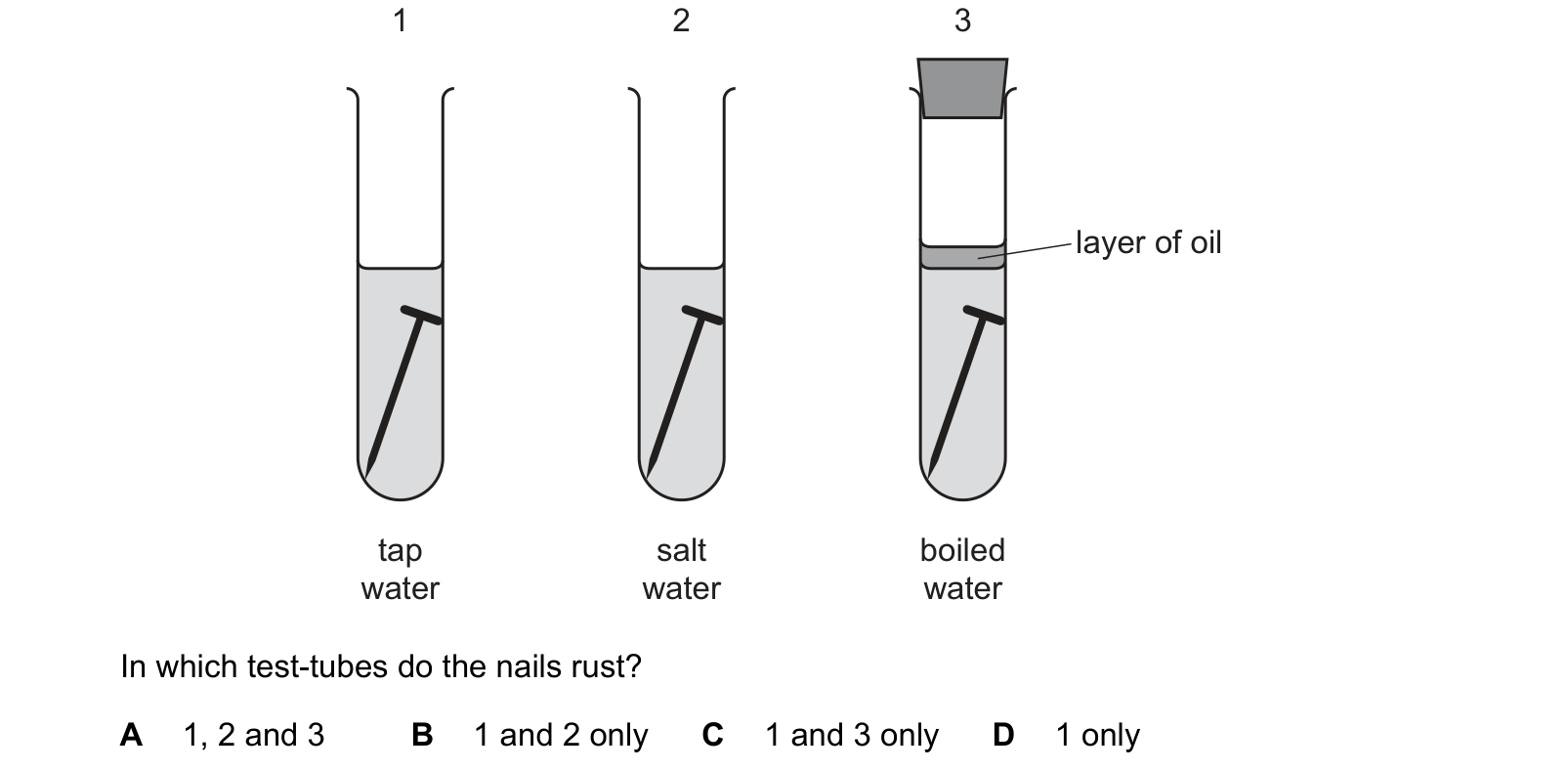
Rusting needs oxygen and water, both of them. The standard experiment proves it with three test tubes, each holding an iron nail, left for several days.
| Test tube | Contents | Result |
|---|---|---|
| 1 | Nail in ordinary tap water, open to the air | Rusts |
| 2 | Nail in water that has been boiled to drive out dissolved air, sealed under a layer of oil | No rust |
| 3 | Nail in dry air, with anhydrous calcium chloride to absorb moisture, sealed with a bung | No rust |
Tube 1 is the control with both conditions present. Tube 2 has water but no oxygen. Tube 3 has oxygen but no water. Neither of the last two rusts, so both are necessary.
Two details are marked: the water in tube 2 must be boiled to remove dissolved oxygen and then covered with oil to stop more dissolving, and the drying agent in tube 3 is anhydrous calcium chloride.
Salt accelerates rusting. Dissolved sodium chloride makes the water a better conductor of the ions involved, so cars rust faster where roads are salted in winter and ships rust faster than river boats. Acidic conditions speed it up as well.
Barrier methods
A barrier keeps the oxygen and the water off the iron.
| Method | Where it is used |
|---|---|
| Painting | Bridges, ships, car bodies, railings |
| Greasing or oiling | Bicycle chains, machinery, tools, anything that moves |
| Coating with plastic | Garden furniture, dishwasher racks, wire fencing |
| Electroplating with chromium or tin | Taps and bumpers, and the inside of food cans |
Every barrier shares one weakness: it works only while it is unbroken. Scratch the paint and the iron underneath rusts, and the rust then creeps outwards beneath the paint.
Tin plating on a food can shows the weakness clearly. Tin is below iron in the reactivity series, so once the tin is scratched the iron rusts, and rusts faster than it would have done bare.
Galvanising
Galvanising is coating iron or steel with a layer of zinc, usually by dipping the object in molten zinc. Galvanised steel is used for buckets, corrugated roofing, nails and crash barriers.
It protects in two ways, and the second is what makes it better than paint:
- As a barrier, keeping air and water off the iron.
- By sacrificial protection, because zinc is above iron in the reactivity series. Even where the coating is scratched and the iron is exposed, the zinc corrodes in preference to the iron and the iron does not rust.
Extended only: sacrificial protection
Blocks of a more reactive metal are attached to the iron object. Zinc or magnesium blocks are bolted to a ship's hull, to the legs of an oil rig and to buried pipelines.
In terms of the reactivity series: zinc and magnesium are above iron, so they lose electrons more readily and corrode first. The blocks are eaten away and are replaced from time to time, which is far cheaper than replacing a hull.
In terms of electrons, which is the explanation the Extended paper asks for:
Mg → Mg<sup>2+</sup> + 2e<sup>−</sup>
Those electrons flow into the iron. Rusting requires iron to lose electrons, Fe → Fe<sup>2+</sup> + 2e<sup>−</sup>, and an iron that is being supplied with electrons cannot lose them. The iron is kept as the metal, so it is being reduced while the magnesium is oxidised.
The metal chosen must be above iron in the series. Attaching tin or copper does the opposite and makes the rusting worse.
Common mistakes
- Saying rusting needs only air, or only water.
- Naming rust as iron(II) oxide, or as iron oxide with no mention of water.
- Saying rust protects the iron underneath, which is what aluminium oxide does and rust does not.
- Using the word rusting for copper or aluminium.
- Saying galvanising works only as a barrier, missing the sacrificial half.
- Choosing a metal below iron for sacrificial protection.
- Forgetting to boil the water in test tube 2, so the experiment does not exclude oxygen.
- Saying salt causes rusting, when it accelerates a process that needs oxygen and water anyway.
Check you have it
Question 1
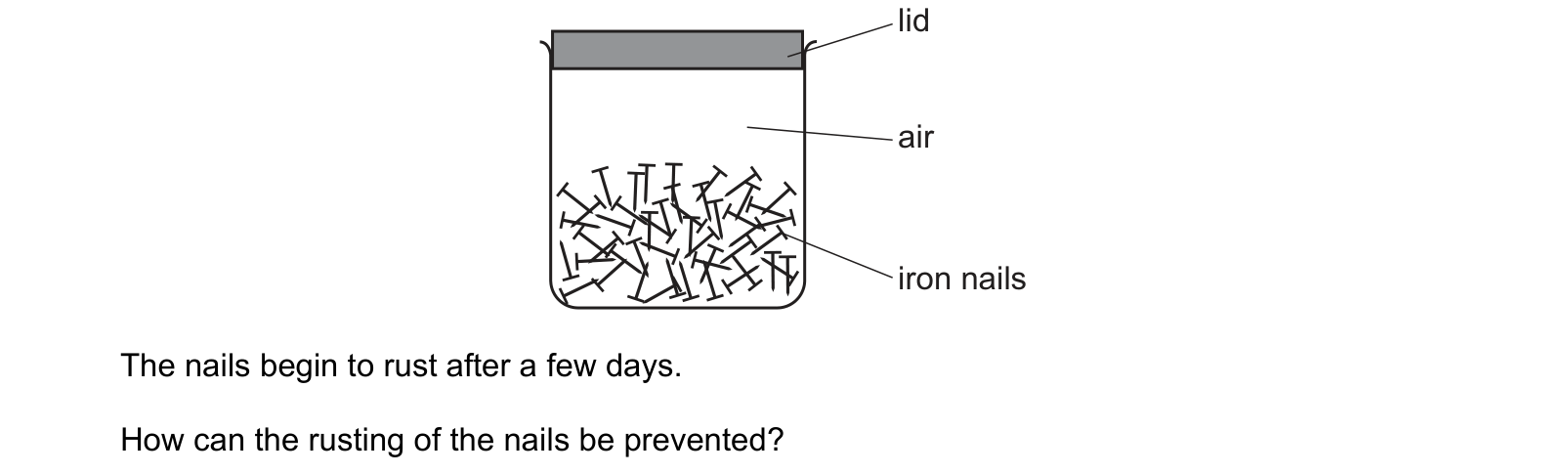
Iron nails are stored in an airtight container. The nails begin to rust after a few days.
How can the rusting of the nails be prevented?
Answer: B.
Question 2
The diagrams show experiments to investigate rusting of iron nails.
1 2 3 water water water
In which test-tubes do the nails rust?
Answer: B.
Question 3
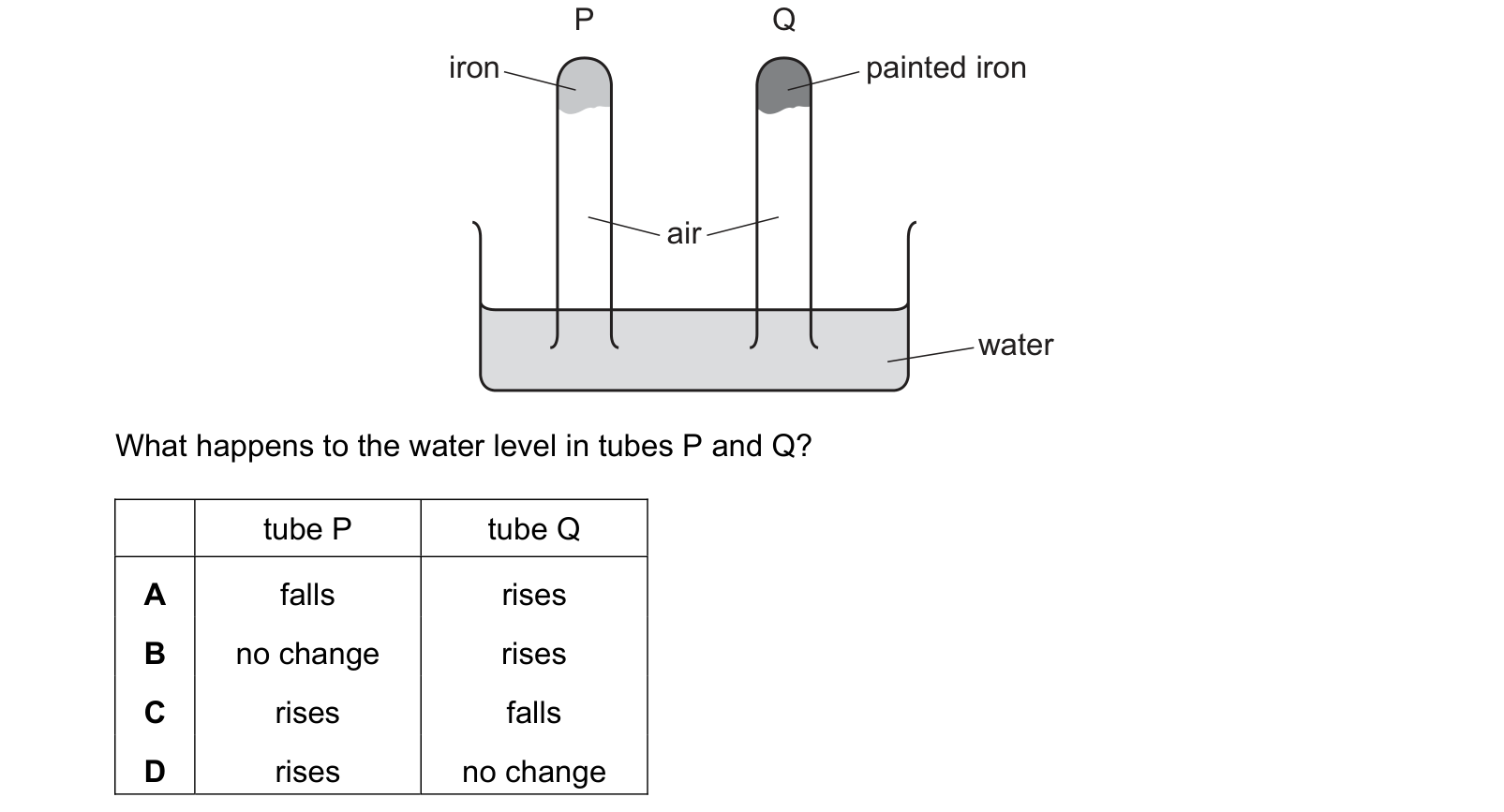
The diagram shows an experiment to investigate how paint affects the rusting of iron. P Q What happens to the water level in tubes P and Q? Each answer gives, in order: tube P; tube Q.
Answer: D.
What the syllabus asks for on this topicSyllabus points
Syllabus points
- State that the rusting of iron and steel requires the presence of both oxygen and water.
- State that rusting is accelerated by the presence of salt.
- Name rust as hydrated iron(III) oxide.
- Describe barrier methods of rust prevention, including painting, greasing and coating with plastic.
- Describe galvanising as a method of rust prevention.
- Extended only: explain sacrificial protection in terms of the reactivity series and in terms of the loss of electrons.
Related CIE 0620 Chemistry topics
Not the topic you were looking for? Describe what you are stuck on in your own words and we will take you to the notes that answer it.