45 past-paper questions on this unit. Five of them are below. Answer on the page: each one is marked the moment you pick, the correct option is shown whether or not you found it, and the full explanation opens either way.
CIE 0620 ChemistryPaper 1 and Paper 2 MCQsFree account
Corrosion of metals: five questions to try now
Real past-paper questions, the answer key from the mark scheme, and the explanation that goes with it. No account needed to answer them.
Question 1
Uses of metals depend on their properties. Which property is necessary for the use given? Each answer gives, in order: use of the metal; property of the metal.
Answer: C.
Each pairing has to be tested by asking whether the use would fail without that property. A food container must not react with what it holds, so resisting corrosion is exactly what aluminium contributes. Ductility matters for wire rather than for a car body, which is pressed from sheet and needs strength and low cost instead. Cutlery needs corrosion resistance rather than thermal conductivity, since a spoon that conducted heat well would simply grow too hot to hold in soup, and overhead cables need a low density so that they do not sag, which makes high density the reverse of the property required.
Question 2
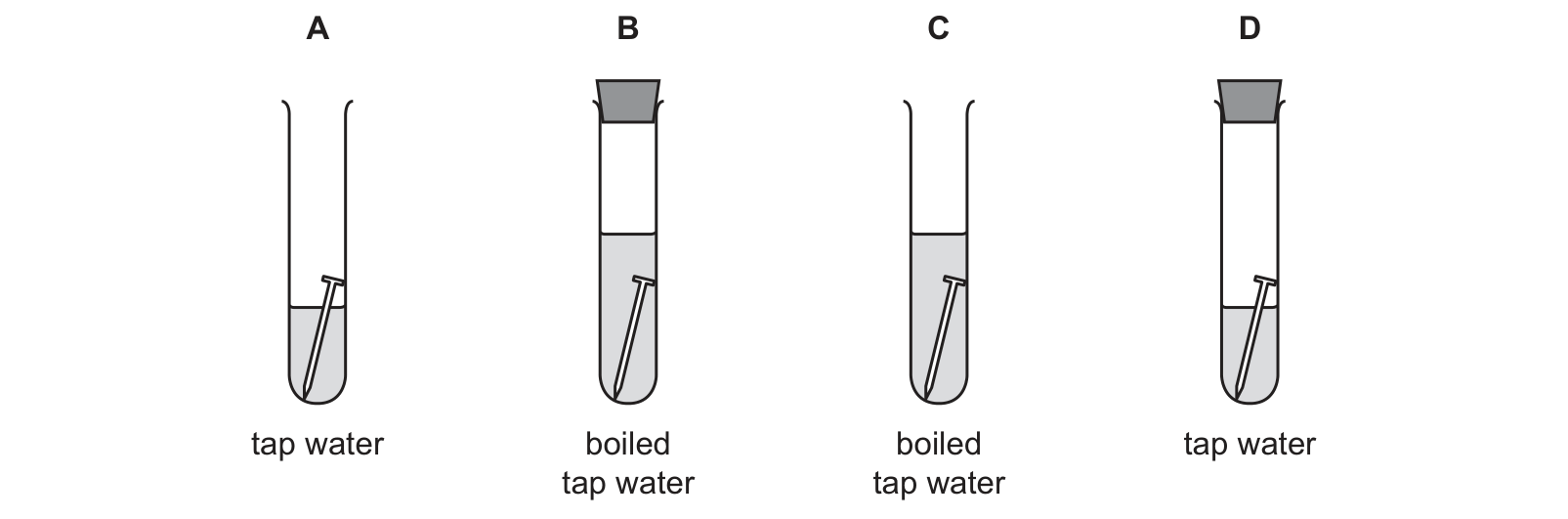
Four different test-tubes containing water and an iron nail are left for two weeks. Which nail showed the least amount of rusting? Use the source image for W21 Paper 12, question 29.
Answer: B.
Rusting needs water and oxygen together, so removing either one slows it, and the tube short of both shows the least rust. Boiling drives the dissolved oxygen out of the water, and a bung stops fresh air redissolving into it, so the nail in boiled water under a bung has almost no oxygen available to it. The tube of boiled water left open to the air loses that advantage within hours, as oxygen dissolves back into the water from above. The tube of unboiled tap water under a bung still holds oxygen dissolved in the water and more trapped in the air space, so boiling is the step it is missing. The open tube of ordinary tap water has water and a continuous supply of oxygen, and it rusts most of all.
Question 3
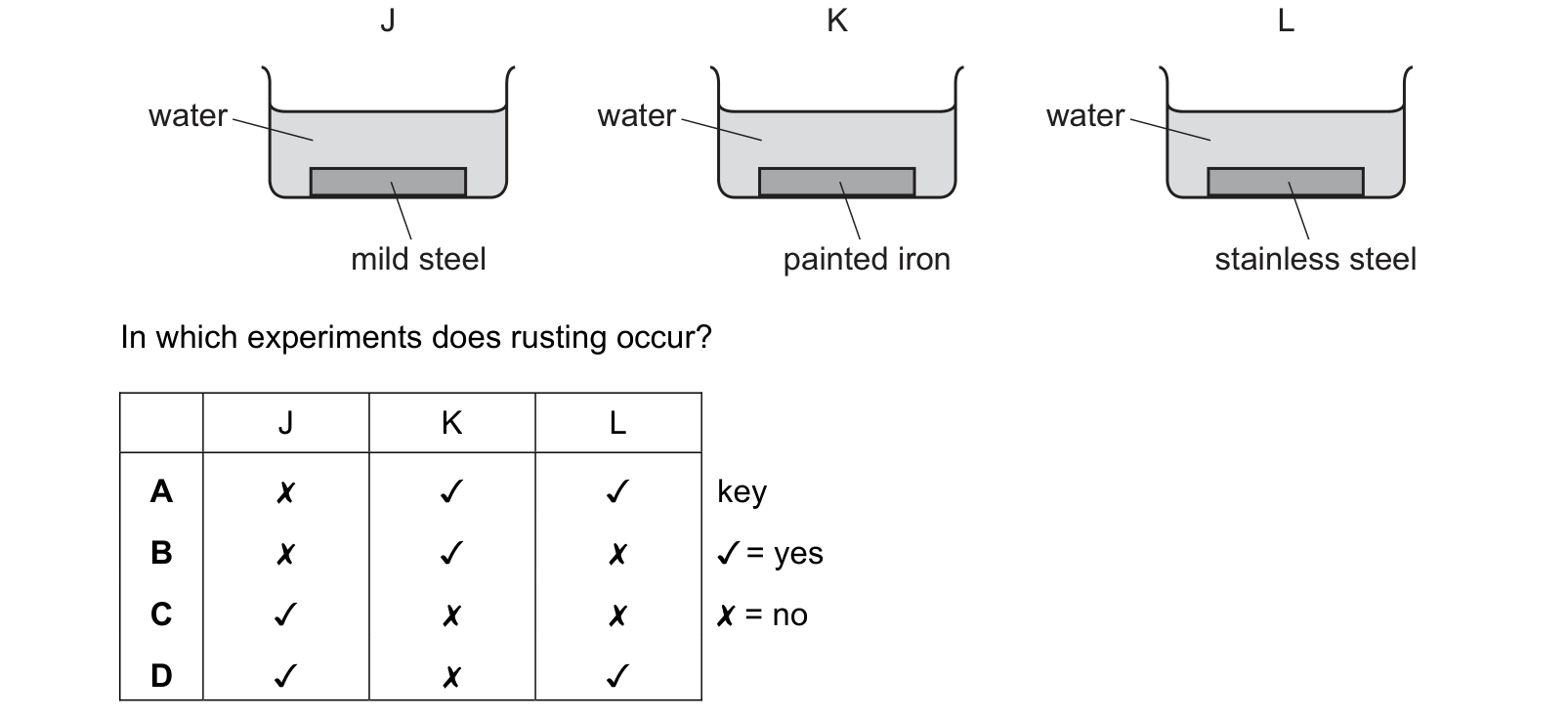
Three experiments, J, K and L, are set up to investigate rusting. J K L water water water In which experiments does rusting occur? Use the source image for W22 Paper 22, question 25.
Answer: C.
Rusting needs iron in contact with both water and oxygen, so the question is which samples actually get that contact. The mild steel is essentially bare iron sitting in water open to the air, so it has everything required and it rusts. The painted iron is separated from the water by the paint film, which acts as a barrier and keeps water and oxygen off the metal, so nothing happens while the paint stays intact. The stainless steel is unaffected because the chromium in it forms a protective oxide layer, much as aluminium protects itself, so the water touches it without damage. Only the first experiment shows rusting, and the two protected samples resist for different reasons, one through a coating applied on top and one through the composition of the alloy itself.
Question 4
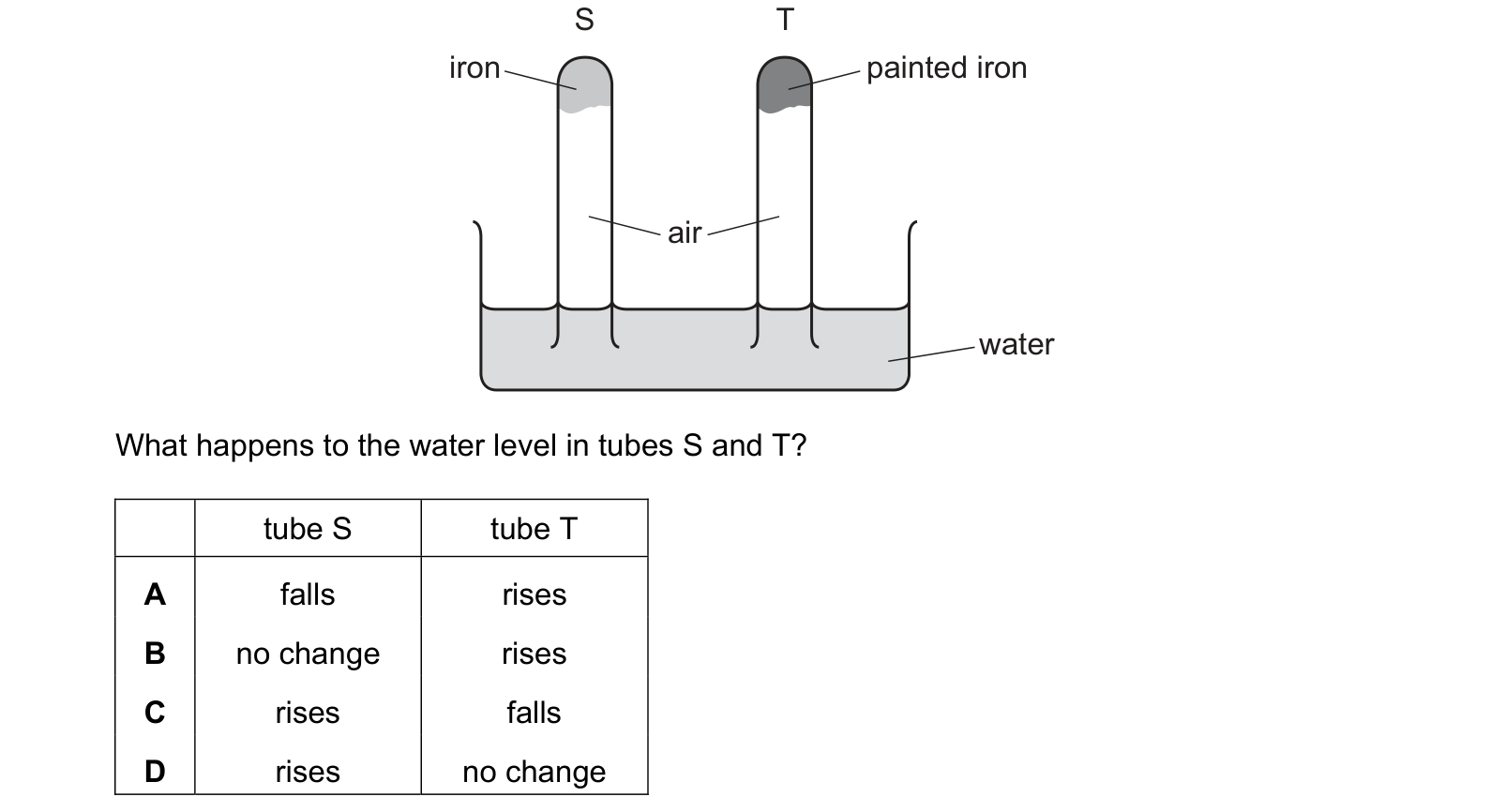
The diagram shows an experiment to investigate how paint affects the rusting of iron. S T What happens to the water level in tubes S and T? Each answer gives, in order: tube S; tube T.
Answer: D.
Rusting consumes the oxygen in the air trapped above the water, and as that oxygen disappears the remaining air occupies less space, so atmospheric pressure pushes water up into the tube. In tube S the iron is bare, so it rusts, oxygen is removed and the water level rises by roughly the fifth of the air that was oxygen. In tube T the iron is painted, and paint is a barrier that keeps water and oxygen away from the metal, so no rusting happens, no oxygen is used and the level stays exactly where it was. Any row showing a level falling has the argument inverted, since nothing in this experiment generates a gas that could push water down. Any row showing tube T rising credits paint with permitting rusting, which is the opposite of what a protective coating is for.
Question 5
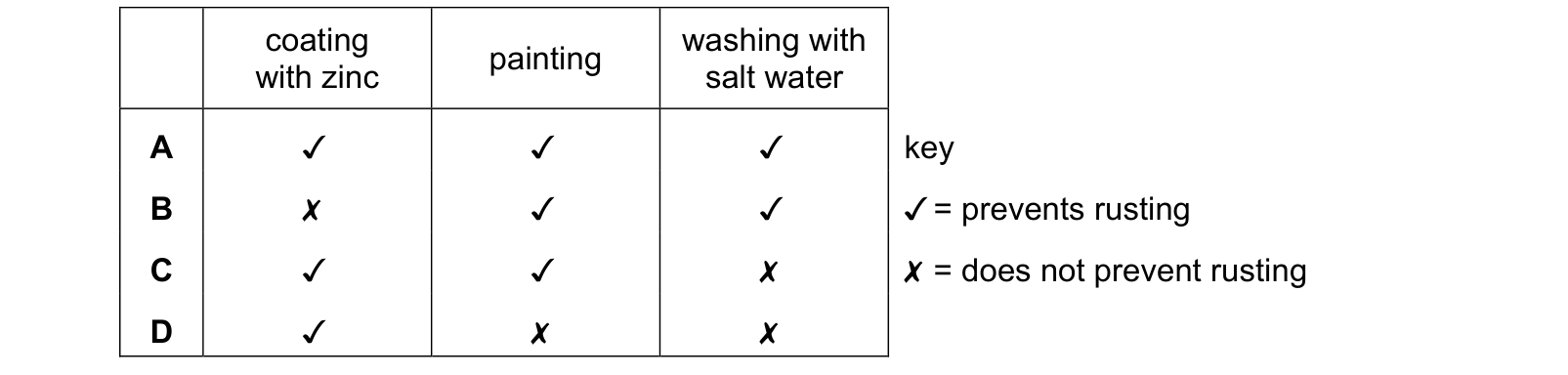
Which methods prevent iron from rusting? coating washing with painting with zinc salt water Use the source image for M20 Paper 12, question 29.
Answer: C.
Rusting needs water and oxygen to reach the iron, so a successful method must keep at least one of them away or protect the metal some other way. Painting works as a physical barrier that excludes both, which is why bridges and railings are painted. Coating with zinc works twice over, as a barrier and, more importantly, as a sacrificial metal, since zinc lies above iron in the reactivity series and corrodes in preference to it even where the coating has been scratched. Washing with salt water does the opposite of protecting, because dissolved salt makes the water a better electrolyte and speeds rusting up, so the row ticking all three cannot stand.
These questions are drawn from past CIE 0620 Chemistry papers and filtered to corrosion of metals. You answer, you find out immediately whether you were right, and you get the reasoning for the correct option and for each distractor. Wrong answers go to a mistakes locker so you can come back to exactly those.
Practice is free. You need an account only so your progress and your mistakes are still there next time.
These are the errors that cost marks on corrosion of metals, taken from our own topic notes. Read them before you practise and you will recognise the traps in the questions.
Saying rusting needs only air, or only water.
Naming rust as iron(II) oxide, or as iron oxide with no mention of water.
Saying rust protects the iron underneath, which is what aluminium oxide does and rust does not.
Using the word rusting for copper or aluminium.
Saying galvanising works only as a barrier, missing the sacrificial half.
Choosing a metal below iron for sacrificial protection.
Forgetting to boil the water in test tube 2, so the experiment does not exclude oxygen.
Saying salt causes rusting, when it accelerates a process that needs oxygen and water anyway.