Alloys and their properties
Contents: 7 sections
An alloy is a mixture
An alloy is a mixture of a metal with one or more other elements, usually other metals or carbon.
The word mixture is the one that is marked. An alloy is not a compound, so:
- there is no chemical formula for brass or for steel
- the proportions can be varied, and different grades of the same alloy have different compositions
- the components are not chemically bonded to one another, and each keeps its own chemistry
Calling an alloy a compound is the most common single error in this subtopic.
The two named in the syllabus
| Alloy | Made from | Property gained | Typical use |
|---|---|---|---|
| Brass | Copper and zinc | Harder than copper, resists corrosion, gold coloured | Musical instruments, door fittings, screws |
| Stainless steel | Iron with chromium, nickel and carbon | Hard, strong and does not rust | Cutlery, sinks, chemical plant, surgical instruments |
Two more that appear in questions:
- Mild steel, iron with a small proportion of carbon, used for car bodies and girders because it is strong and cheap. It rusts, so it must be painted.
- Bronze, copper and tin, harder than copper and used for statues and bells.
Stainless steel does not rust because the chromium in it forms a thin, hard, impermeable oxide layer over the surface, in the same way aluminium protects itself. That is why it is chosen for cutlery, which spends its life wet, and for surgical instruments, which are repeatedly sterilised.
Worked example. A brass door handle has a mass of 250 g and the alloy is 70 per cent copper by mass.
mass of copper = 250 × 70 / 100 = 175 g
mass of zinc = 250 − 175 = 75 g
Because brass is a mixture, another grade might be 60 per cent copper and would still be brass. A compound could not vary like that.
A typical stainless steel is 18 per cent chromium and 8 per cent nickel:
18 + 8 = 26
100 − 26 = 74
leaving about 74 per cent iron, along with a small percentage of carbon.
Extended only: why an alloy is harder
Start from the pure metal. A pure metal is a lattice of positive ions of identical size, arranged in regular layers, held together by a sea of delocalised electrons. Because the layers are regular and the ions are all the same size, the layers can slide over one another when a force is applied. That is why pure metals are soft and malleable.
An alloy contains atoms of a different size. These disrupt the regular arrangement, so the layers are no longer smooth and even. The layers can no longer slide over one another easily, and a much larger force is needed to deform the metal. The alloy is therefore harder and stronger than the pure metal.
Two details make the difference between a full answer and a partial one:
- The alloying atoms distort the layers; they do not form bonds that hold the layers together.
- The metallic bonding itself is unchanged, which is why an alloy still conducts electricity and is still shiny.
That second point answers the question of why brass is still a good conductor even though it is harder than copper.
Choosing an alloy from properties
Work from what the object must survive:
- Wet or acidic surroundings: stainless steel, for its chromium oxide layer.
- Load bearing and cheap: mild steel, accepting that it must be painted.
- Decorative and hard wearing: brass or bronze, for hardness plus corrosion resistance.
- Light and strong: an aluminium alloy, as in aircraft, where pure aluminium would be too soft.
The general answer to "why is an alloy used instead of the pure metal" is always the same shape: the pure metal is too soft or corrodes too easily, and mixing in atoms of a different size makes it harder and stronger while keeping the useful properties of the metal.
Separating the ideas that get confused
- Alloy against compound. A mixture with variable proportions against a fixed formula.
- Harder against stronger. Harder means more resistant to scratching and denting; stronger means it withstands a greater force before breaking. Alloying usually improves both.
- Rusting against corrosion. Rusting is specifically what happens to iron and steel. Aluminium and copper corrode but do not rust.
- Stainless steel against mild steel. Both are iron alloys, but only stainless steel resists rusting, and only because of the chromium.
Common mistakes
- Describing an alloy as a compound, or giving it a chemical formula.
- Saying alloys are harder because the atoms bond more strongly, rather than because the layers cannot slide.
- Saying an alloy does not conduct electricity, when the delocalised electrons are still there.
- Giving brass as copper and tin, which is bronze.
- Saying stainless steel does not rust because it contains nickel, when the chromium oxide layer is the reason.
- Explaining hardness without mentioning that the added atoms are a different size.
- Saying steel is a pure metal, when it is iron alloyed with carbon.
Check you have it
Question 1
Which row links the property of the stated metal with its use? Each answer gives, in order: metal; property; use.
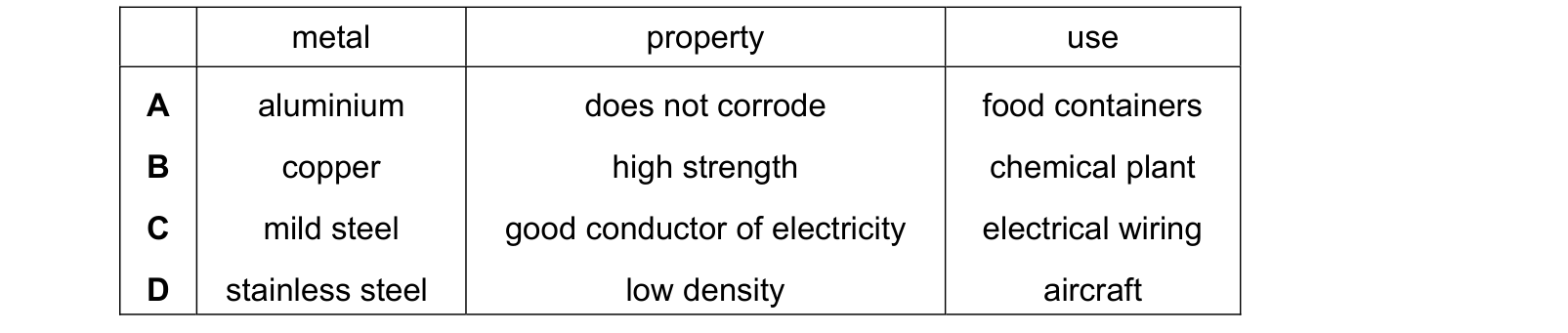
Answer: A.
Question 2
Which diagram represents the arrangement of atoms in an alloy? Use the source image for S22 Paper 22, question 27.

Answer: D.
Question 3
Which statements about the alloy brass are correct?
1 It is harder than pure copper.
2 It does not conduct electricity.
3 It is a mixture of copper and nickel.
4 It is stronger than pure copper.
Answer: B.
What the syllabus asks for on this topicSyllabus points
Syllabus points
- Describe an alloy as a mixture of a metal with other elements.
- State that brass is a mixture of copper and zinc, and that stainless steel is a mixture of iron with other elements such as chromium, nickel and carbon.
- State that alloys can be harder and stronger than the pure metals and are more useful.
- Describe the uses of alloys in terms of their properties.
- Extended only: explain in terms of structure how an alloy can be harder and stronger than the pure metal.
Related CIE 0620 Chemistry topics
Not the topic you were looking for? Describe what you are stuck on in your own words and we will take you to the notes that answer it.