Redox
Contents: 9 sections
Roman numerals
A Roman numeral in a name gives the oxidation number of that element in that compound, and nothing else.
- Iron(II) chloride is FeCl<sub>2</sub>, containing Fe<sup>2+</sup>.
- Iron(III) chloride is FeCl<sub>3</sub>, containing Fe<sup>3+</sup>.
- Copper(II) oxide is CuO, containing Cu<sup>2+</sup>.
- Potassium manganate(VII) is KMnO<sub>4</sub>, with manganese at +7.
- Vanadium(V) oxide is V<sub>2</sub>O<sub>5</sub>, with vanadium at +5.
The numeral is not the number of atoms and not the charge on the whole compound. Iron(III) oxide is Fe<sub>2</sub>O<sub>3</sub>, which has three oxygens and two irons, and the III refers to neither count.
Core: the oxygen definitions
- Oxidation is the gain of oxygen.
- Reduction is the loss of oxygen.
- A redox reaction is one in which both happen at the same time, which is every reaction where oxygen moves from one substance to another.
In the blast furnace:
Fe<sub>2</sub>O<sub>3</sub> + 3CO → 2Fe + 3CO<sub>2</sub>
Iron(III) oxide loses oxygen, so it is reduced. Carbon monoxide gains oxygen, so it is oxidised. Both happen in one equation, which is what makes it redox.
Two more to recognise on sight:
- 2Mg + O<sub>2</sub> → 2MgO. Magnesium gains oxygen and is oxidised.
- CuO + H<sub>2</sub> → Cu + H<sub>2</sub>O. Copper(II) oxide loses oxygen and is reduced, and the hydrogen is oxidised.
Extended only: the electron definitions
OIL RIG: Oxidation Is Loss, Reduction Is Gain, of electrons.
Mg → Mg<sup>2+</sup> + 2e<sup>−</sup> is oxidation, because magnesium loses two electrons.
Cl<sub>2</sub> + 2e<sup>−</sup> → 2Cl<sup>−</sup> is reduction, because each chlorine atom gains one electron.
The electron definition is the wider one. Every reaction that is redox by the oxygen definition is also redox by the electron definition, but many electron transfers involve no oxygen at all, such as magnesium burning in chlorine.
Extended only: oxidation numbers
Four rules cover everything the syllabus asks:
- An element on its own has oxidation number 0. That covers Mg, O<sub>2</sub>, Cl<sub>2</sub> and Fe.
- A simple ion has the oxidation number of its charge. Na<sup>+</sup> is +1, Cl<sup>−</sup> is −1, O<sup>2−</sup> is −2.
- In a compound, oxygen is usually −2 and hydrogen is usually +1.
- The oxidation numbers in a neutral compound sum to 0, and in an ion they sum to the charge on the ion.
Worked example. Find the oxidation number of manganese in KMnO<sub>4</sub>.
Potassium is +1 and there are four oxygens at −2 each:
contribution of the oxygens = 4 × (−2) = −8
oxidation number of manganese = 0 − 1 + 8 = +7
which is why the compound is named potassium manganate(VII).
Worked example. Find the oxidation number of chromium in Cr<sub>2</sub>O<sub>7</sub><sup>2−</sup>.
Seven oxygens contribute 7 × (−2) = −14, and the numbers must sum to −2:
total for the two chromiums = −2 + 14 = 12
oxidation number of each chromium = 12 / 2 = +6
A rise in oxidation number is oxidation. A fall is reduction. Applying that to the blast furnace equation above: iron falls from +3 to 0, so it is reduced, and carbon rises from +2 to +4, so it is oxidised. The two definitions agree, as they must.
Extended only: oxidising and reducing agents
- An oxidising agent oxidises another substance and is itself reduced.
- A reducing agent reduces another substance and is itself oxidised.
The wording matters because the agent is the one doing the opposite of what its name suggests happening to it. In Cl<sub>2</sub> + 2KBr → 2KCl + Br<sub>2</sub>, chlorine is the oxidising agent: it oxidises bromide from −1 to 0 while chlorine itself falls from 0 to −1.
Common oxidising agents: oxygen, chlorine, acidified potassium manganate(VII).
Common reducing agents: hydrogen, carbon, carbon monoxide, reactive metals such as zinc, and iodide ions.
Extended only: the two colour tests
| Reagent | Colour before | Colour after | What it shows |
|---|---|---|---|
| Acidified potassium manganate(VII) | Purple | Colourless | The added substance is a reducing agent |
| Potassium iodide solution | Colourless | Brown | The added substance is an oxidising agent |
Read them by asking what happened to the reagent.
Acidified potassium manganate(VII) goes from purple to colourless because the manganese falls from +7 to +2. The manganate(VII) has been reduced, so whatever it was added to must have been the reducing agent.
Potassium iodide goes from colourless to brown because iodide ions are oxidised to iodine, 2I<sup>−</sup> → I<sub>2</sub> + 2e<sup>−</sup>. The iodide has been oxidised, so whatever it was added to must have been the oxidising agent.
Which reactions are not redox
Recognising the reactions where no oxidation number changes saves marks in multiple choice questions.
- Neutralisation, HCl + NaOH → NaCl + H<sub>2</sub>O. Every element keeps its oxidation number.
- Precipitation, AgNO<sub>3</sub> + NaCl → AgCl + NaNO<sub>3</sub>. The ions swap partners and nothing is oxidised.
- Acid with a carbonate, and thermal decomposition of a carbonate such as CaCO<sub>3</sub> → CaO + CO<sub>2</sub>.
By contrast, displacement of one metal by another, the reaction of a metal with an acid, combustion, and electrolysis are always redox.
Common mistakes
- Reading the Roman numeral as the number of atoms in the formula.
- Saying the oxidising agent is oxidised.
- Giving only the oxygen definition on an Extended paper when the reaction involves no oxygen.
- Writing oxidation as the gain of electrons.
- Forgetting that a fall in oxidation number is reduction, and calling +7 to +2 an oxidation because the numbers are both positive.
- Calling neutralisation a redox reaction.
- Saying potassium manganate(VII) turning colourless shows an oxidising agent was added, when it shows the opposite.
Check you have it
Question 1
In which change is the sulfur, S, in sulfur(I) oxide, S2O, reduced? SO3 Use the source image for W20 Paper 11, question 21.

Answer: D.
Question 2
In a blast furnace, iron(III) oxide is converted to iron and carbon monoxide is converted to carbon dioxide.
Fe2O3 + 3CO → 2Fe + 3CO2
What happens to each of these reactants?
Answer: D.
Question 3
Coke (carbon) and limestone are two raw materials used in the extraction of iron from hematite. Which type of reaction occurs when each substance is heated during the process? Each answer gives, in order: coke; limestone.
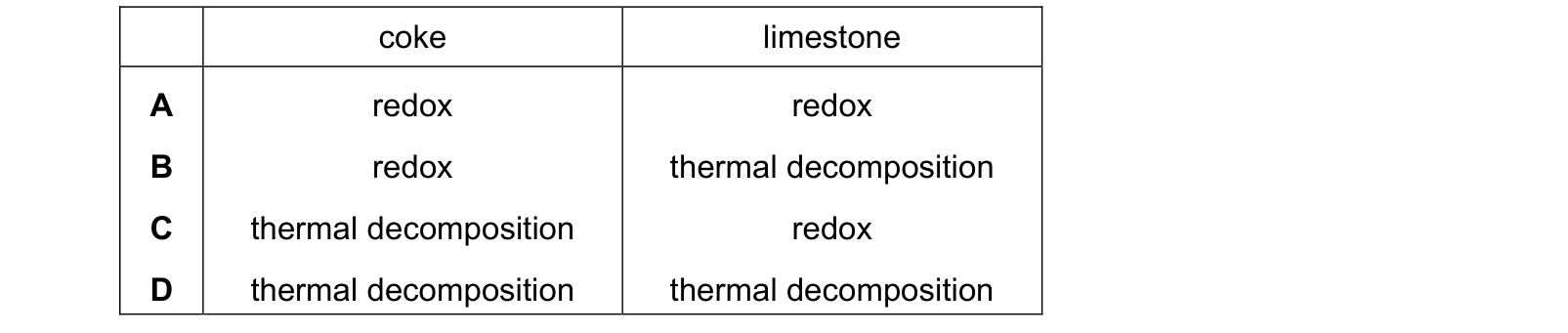
Answer: B.
What the syllabus asks for on this topicSyllabus points
Syllabus points
- Use a Roman numeral to indicate the oxidation number of an element in a compound.
- Define oxidation as the gain of oxygen and reduction as the loss of oxygen.
- Identify redox reactions as reactions in which oxygen is both gained and lost.
- Extended only: define oxidation as the loss of electrons and reduction as the gain of electrons.
- Extended only: identify redox reactions from changes in oxidation number, and define an oxidising agent and a reducing agent.
- Extended only: identify oxidation and reduction from the colour changes of acidified potassium manganate(VII) and of potassium iodide.
Related CIE 0620 Chemistry topics
Not the topic you were looking for? Describe what you are stuck on in your own words and we will take you to the notes that answer it.