Preparation of salts
Contents: 8 sections
The solubility rules
Everything in this subtopic starts here, because the rules decide which method you are allowed to use.
| Compounds | Solubility |
|---|---|
| All sodium, potassium and ammonium salts | Soluble |
| All nitrates | Soluble |
| Chlorides | Soluble, except silver chloride and lead(II) chloride |
| Sulfates | Soluble, except barium sulfate, calcium sulfate and lead(II) sulfate |
| Carbonates | Insoluble, except sodium, potassium and ammonium carbonates |
| Hydroxides | Insoluble, except sodium, potassium and ammonium hydroxides, with calcium hydroxide slightly soluble |
Choosing the method
Answer two questions in order and the method chooses itself.
- Is the salt soluble? If not, prepare it by precipitation.
- Is it a sodium, potassium or ammonium salt? If so, prepare it by titration, because its base is soluble and cannot be filtered off.
- Otherwise, prepare it by adding an excess solid to the acid.
So copper(II) sulfate uses the excess solid method, potassium nitrate uses titration, and barium sulfate uses precipitation. Getting the method right is usually the first mark of the question.
Method 1: acid plus an excess of a solid
Use this whenever the salt is soluble and the other reactant is not. The solid can be a metal, an insoluble base such as copper(II) oxide, or an insoluble carbonate such as calcium carbonate.
- Warm the dilute acid in a beaker. Warming speeds the reaction up; do not boil.
- Add the solid a little at a time, stirring, until it is in excess. You know it is in excess when solid stays undissolved at the bottom and no more bubbling occurs.
- Filter to remove the unreacted solid. The filtrate is a solution of the salt.
- Evaporate the filtrate until about half remains, or until crystals just begin to form at the edge. This is the point of crystallisation.
- Leave to cool and crystallise slowly. Slow cooling gives larger, purer crystals.
- Filter off the crystals and dry them between two pieces of filter paper, or in a warm oven.
Two points earn marks almost every time they are asked:
- Why excess? So that all the acid is used up. Any acid left over would evaporate with the water and contaminate the crystals.
- Why filter? The excess solid is insoluble, so filtration removes it and nothing else.
Not every metal can be used. Potassium, sodium and calcium react dangerously with acid, and copper, silver and gold do not react at all. The metals used in practice are magnesium, zinc and iron.
Examples with their equations:
- Zn + H<sub>2</sub>SO<sub>4</sub> → ZnSO<sub>4</sub> + H<sub>2</sub>
- CuO + H<sub>2</sub>SO<sub>4</sub> → CuSO<sub>4</sub> + H<sub>2</sub>O
- CaCO<sub>3</sub> + 2HCl → CaCl<sub>2</sub> + H<sub>2</sub>O + CO<sub>2</sub>
Method 2: titration
Sodium, potassium and ammonium salts must be made from an alkali, and an excess of an alkali dissolves, so it cannot be filtered out. The volume has to be measured instead.
- Pipette 25.0 cm<sup>3</sup> of the alkali into a conical flask and add a few drops of indicator, such as methyl orange or thymolphthalein.
- Run acid in from a burette, swirling, until the indicator just changes colour. Record the volume.
- Repeat without the indicator, using exactly the volume found. This is the step candidates leave out, and the reason for it is that the indicator would colour and contaminate the crystals.
- Evaporate to the point of crystallisation, cool, filter and dry as before.
Method 3: precipitation
Use this for an insoluble salt. Mix two solutions, each of which is soluble and one of which carries each of the ions you need.
To make barium sulfate, mix barium chloride solution with sodium sulfate solution:
BaCl<sub>2</sub> + Na<sub>2</sub>SO<sub>4</sub> → BaSO<sub>4</sub> + 2NaCl
Ba<sup>2+</sup>(aq) + SO<sub>4</sub><sup>2−</sup>(aq) → BaSO<sub>4</sub>(s)
- Mix the two solutions. A precipitate forms immediately.
- Filter to collect the precipitate as the residue.
- Wash the residue with distilled water, to remove the soluble salt left clinging to it. Skipping this leaves sodium chloride in the product.
- Dry in a warm oven or between filter papers.
Two more worth knowing by their colours: lead(II) iodide is a bright yellow precipitate from lead(II) nitrate and potassium iodide, and silver chloride is a white precipitate from silver nitrate and sodium chloride.
Extended only: water of crystallisation
Water of crystallisation is water that is chemically combined into the crystal structure in a fixed proportion. A salt containing it is hydrated; one with none is anhydrous.
CuSO<sub>4</sub>·5H<sub>2</sub>O is hydrated copper(II) sulfate, with five water molecules per formula unit. CoCl<sub>2</sub>·6H<sub>2</sub>O is hydrated cobalt(II) chloride.
This is why the crystals must be dried gently. Strong heating drives the water of crystallisation off and changes the substance: blue hydrated copper(II) sulfate becomes white anhydrous copper(II) sulfate.
Worked example. Heating 4.92 g of hydrated magnesium sulfate, MgSO<sub>4</sub>·xH<sub>2</sub>O, to constant mass leaves 2.40 g of the anhydrous salt. Find x. The relative formula mass of MgSO<sub>4</sub> is 120.
mass of water driven off = 4.92 − 2.40 = 2.52 g
moles of magnesium sulfate = 2.40 / 120 = 0.0200 mol
moles of water = 2.52 / 18 = 0.140 mol
ratio of water to salt = 0.140 / 0.0200 = 7.00
So x is 7 and the formula is MgSO<sub>4</sub>·7H<sub>2</sub>O.
Common mistakes
- Using a metal to make a sodium or potassium salt, when sodium and potassium react violently with acid.
- Trying to filter off excess alkali, which is soluble.
- Leaving the indicator in during the second titration, so the crystals are coloured.
- Evaporating the solution to dryness instead of to the point of crystallisation, which spoils the crystals.
- Forgetting to wash the precipitate, leaving the soluble salt behind.
- Saying the excess solid is added so the reaction goes faster, rather than to use up all the acid.
- Choosing precipitation for a soluble salt, which would leave both salts in the same solution.
Check you have it
Question 1
Four stages used to prepare an insoluble salt are listed. 1 drying 2 filtration 3 precipitation 4 washing In which order are the stages done?
Answer: B.
Question 2
Which methods of salt preparation are suitable for copper(II) chloride?
1 Add copper(II) carbonate to dilute hydrochloric acid.
2 Add copper to dilute hydrochloric acid.
3 Warm copper(II) oxide with dilute hydrochloric acid.
Answer: C.
Question 3
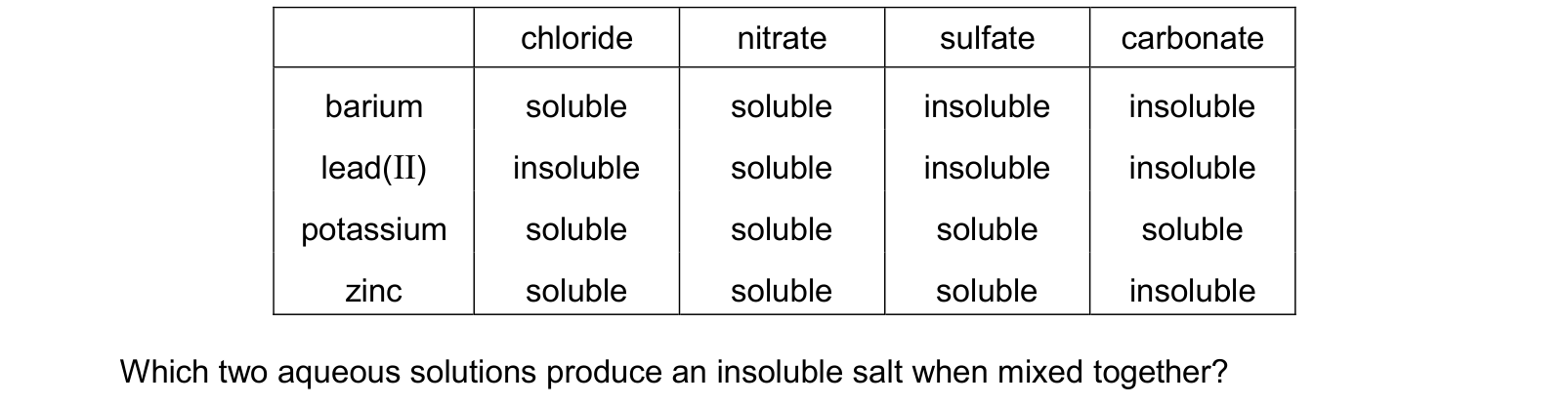
The solubility of some salts is shown.
chloride nitrate sulfate carbonate
barium soluble soluble insoluble insoluble
lead(II) insoluble soluble insoluble insoluble
potassium soluble soluble soluble soluble
zinc soluble soluble soluble insoluble
Which two aqueous solutions produce an insoluble salt when mixed together?
Answer: C.
What the syllabus asks for on this topicSyllabus points
Syllabus points
- Describe the preparation, separation and purification of soluble salts by the reaction of an acid with an excess of a metal, an excess of an insoluble base or an excess of an insoluble carbonate.
- Describe the preparation of a soluble salt from an acid and an alkali by titration.
- Describe the preparation of insoluble salts by precipitation.
- Describe the general rules of solubility for common salts.
- Extended only: define the term water of crystallisation and use it in the formulae of hydrated salts.
Related CIE 0620 Chemistry topics
Not the topic you were looking for? Describe what you are stuck on in your own words and we will take you to the notes that answer it.