Giant covalent structures
Contents: 7 sections
What makes a structure giant
A simple molecular substance such as methane contains separate small molecules. A giant covalent structure contains no molecules at all: strong covalent bonds run through the whole crystal, so a single crystal is effectively one enormous structure.
That difference produces the properties. To melt a giant covalent substance you must break covalent bonds, of which there are millions, not merely pull weakly attracted molecules apart. So every giant covalent substance has a very high melting point and is insoluble in water.
Diamond and graphite are both made of nothing but carbon atoms, and their properties are completely different. That is the whole point of the topic: structure decides properties, not composition.
Diamond
- Each carbon atom is bonded to four other carbon atoms.
- The bonds are strong covalent bonds arranged tetrahedrally.
- This gives a rigid three-dimensional lattice with no layers and no weak directions.
It is extremely hard, in fact the hardest natural substance, because every atom is locked in place by four strong bonds pointing in four different directions. Pressure from any angle is resisted by bonds, so nothing can slide.
It has a very high melting point, about 3550 °C, because melting requires a very large number of strong covalent bonds to be broken.
It does not conduct electricity. Carbon has 4 outer electrons and all 4 are used in bonding, so there are no free electrons to carry a charge.
Its use follows directly. Diamond is used in cutting tools, drill tips and glass cutters, because it is hard enough to cut almost anything else and does not soften when the friction heats it.
Graphite
- Each carbon atom is bonded to three other carbon atoms.
- Those bonds form flat layers of hexagonal rings.
- The layers are held to one another by weak forces, not by covalent bonds.
- Carbon has 4 outer electrons and only 3 are used in bonding, so 4 − 3 = 1 electron per atom is delocalised and free to move between the layers.
It is soft and slippery, because the weak forces between layers let the layers slide over one another. Nothing about the layers themselves is weak; it is the gap between them.
It conducts electricity, because of the delocalised electrons. Graphite is the only common non-metal that conducts, and this is why.
It has a very high melting point, about 3650 °C, because melting still means breaking the strong covalent bonds inside the layers.
Its uses follow. Graphite is used as a lubricant, because sliding layers reduce friction between moving parts, and it works where an oil would burn off. It is used as electrodes in electrolysis, because it conducts electricity, has a very high melting point so survives molten electrolytes, and is unreactive and cheap. It is also the "lead" in a pencil, layers rubbing off onto the paper.
Diamond and graphite side by side
| Property | Diamond | Graphite |
|---|---|---|
| Bonds per carbon atom | 4 | 3 |
| Delocalised electrons | None | 1 per atom |
| Structure | Rigid tetrahedral lattice | Flat layers of hexagons |
| Between the layers | No layers | Weak forces |
| Hardness | Extremely hard | Soft and slippery |
| Conducts electricity | No | Yes |
| Melting point | About 3550 °C | About 3650 °C |
| Use to quote | Cutting tools | Lubricant, electrodes |
Almost every question on this pair is answered from the first two rows. Three bonds instead of four leaves one electron spare, and that one electron is the entire reason graphite conducts and diamond does not.
Silicon(IV) oxide (Extended)
Silicon(IV) oxide, SiO₂, also called silica, is what sand and quartz are made of. This subtopic is Extended only, so a Core candidate needs diamond and graphite but not silica.
- Each silicon atom is bonded to four oxygen atoms.
- Each oxygen atom is bonded to two silicon atoms.
- The bonds are strong covalent bonds in a tetrahedral arrangement, giving a giant three-dimensional lattice.
The formula follows from those two numbers. Each silicon has four oxygen neighbours, but each of those oxygens is shared with one other silicon, so the oxygen atoms per silicon come to 4 / 2 = 2, giving SiO₂.
Why it resembles diamond
Silicon(IV) oxide has the same shape of structure as diamond, with every atom held by four strong covalent bonds in three dimensions, so it has the same kind of properties:
- Hard, because the rigid lattice has no layers to slide.
- A high melting point, about 1710 °C, because covalent bonds must be broken.
- Does not conduct electricity, because all outer electrons are used in bonding and none is delocalised.
- Insoluble in water.
It melts lower than diamond even so, because the silicon to oxygen bond is not as strong as the carbon to carbon bond. Both are still far above anything simple molecular: chlorine boils at −34 °C.
Those properties explain its use in furnace linings and in glass, both of which need a material that stays solid and rigid when very hot.
Common mistakes
- Saying diamond and graphite are different because they contain different atoms. Both are pure carbon.
- Saying graphite conducts because the layers slide. Sliding explains softness; delocalised electrons explain conduction.
- Saying graphite has a low melting point because the forces between layers are weak. Melting breaks the covalent bonds within the layers, so the melting point is very high.
- Saying diamond conducts electricity because it is made of carbon like graphite.
- Saying weak covalent bonds hold graphite's layers together. The forces between layers are not covalent bonds at all.
- Giving silicon(IV) oxide the formula SiO or Si₂O.
- Saying a giant covalent substance dissolves in water. None of the three does.
Check you have it
Question 1
Which row describes the properties of silicon(IV) oxide? Each answer gives, in order: giant covalent structure; melting point.

Answer: C.
Question 2
The arrangement of particles in each of two solids, S and T, are shown. What are S and T? Each answer gives, in order: S; T.
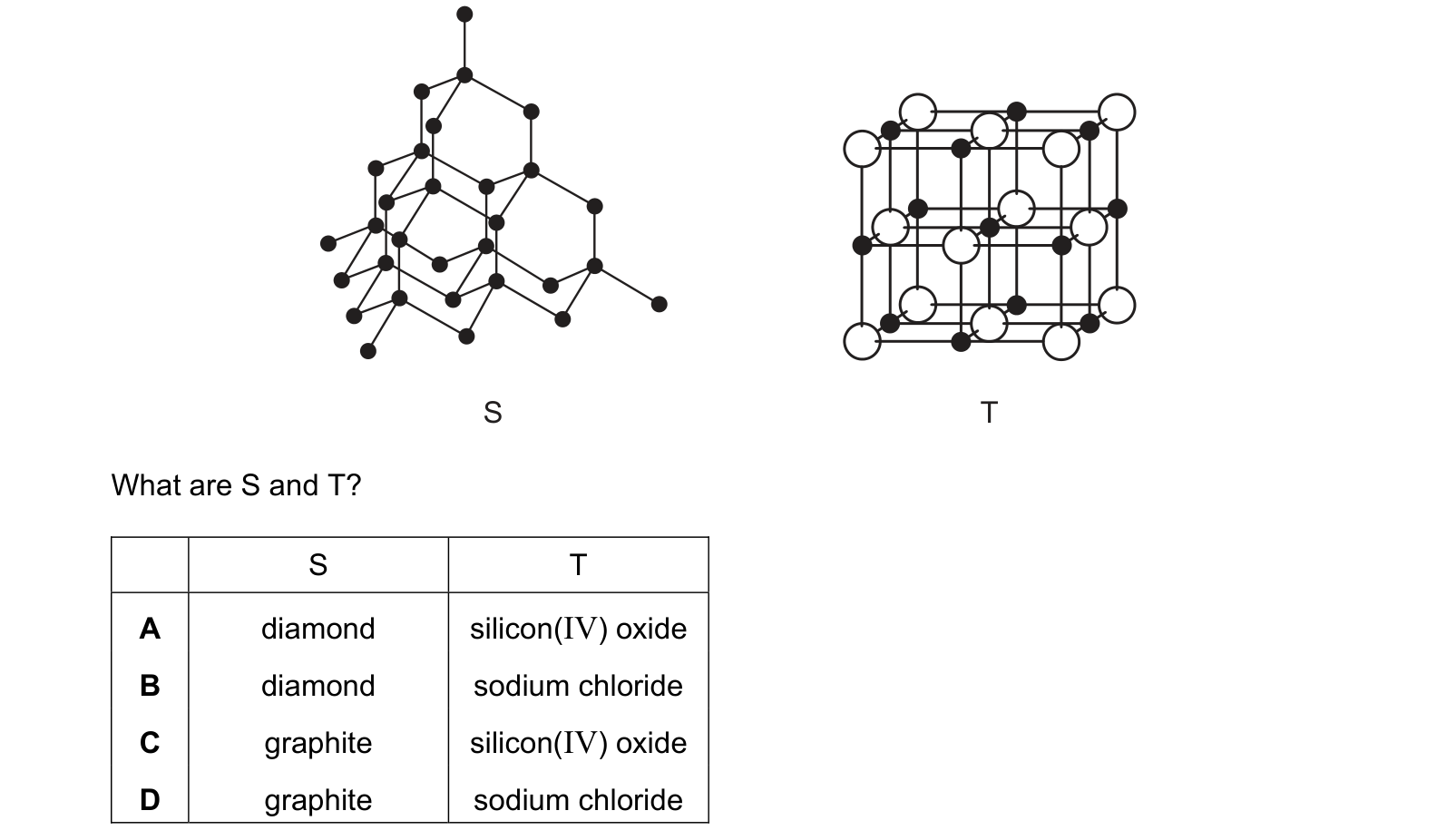
Answer: B.
Question 3
Which row about the structures and uses of diamond and graphite is correct? Each answer gives, in order: structure; use.
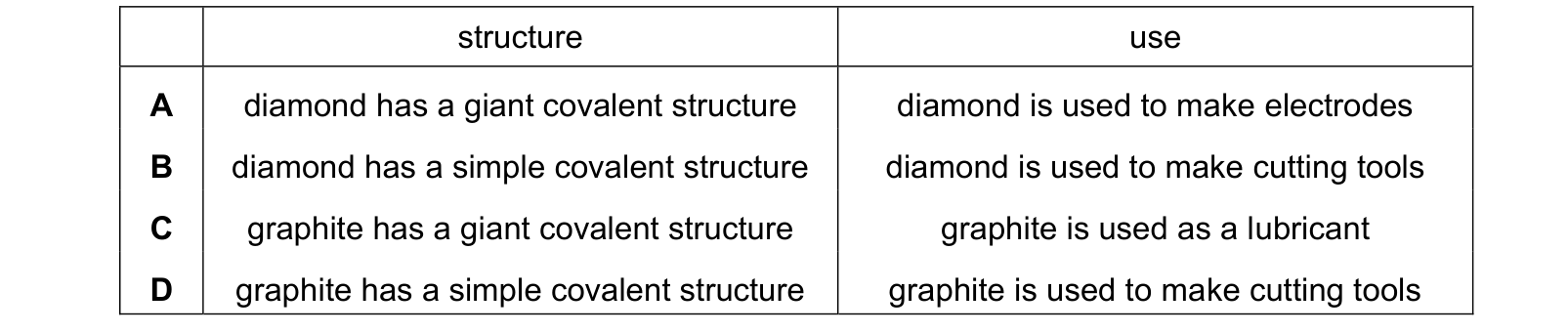
Answer: C.
What the syllabus asks for on this topicSyllabus points
Syllabus points
- Describe the giant covalent structure of diamond.
- Describe the giant covalent structure of graphite.
- Relate the structure and bonding of graphite to its uses as a lubricant and as electrodes.
- Relate the structure and bonding of diamond to its use in cutting tools.
- Extended only: describe the giant covalent structure of silicon(IV) oxide, SiO₂.
- Extended only: describe the similarity in properties between diamond and silicon(IV) oxide, related to their structures.
Related CIE 0620 Chemistry topics
Not the topic you were looking for? Describe what you are stuck on in your own words and we will take you to the notes that answer it.