49 past-paper questions on this unit. Five of them are below. Answer on the page: each one is marked the moment you pick, the correct option is shown whether or not you found it, and the full explanation opens either way.
CIE 0620 ChemistryPaper 1 and Paper 2 MCQsFree account
Giant covalent structures: five questions to try now
Real past-paper questions, the answer key from the mark scheme, and the explanation that goes with it. No account needed to answer them.
Question 1
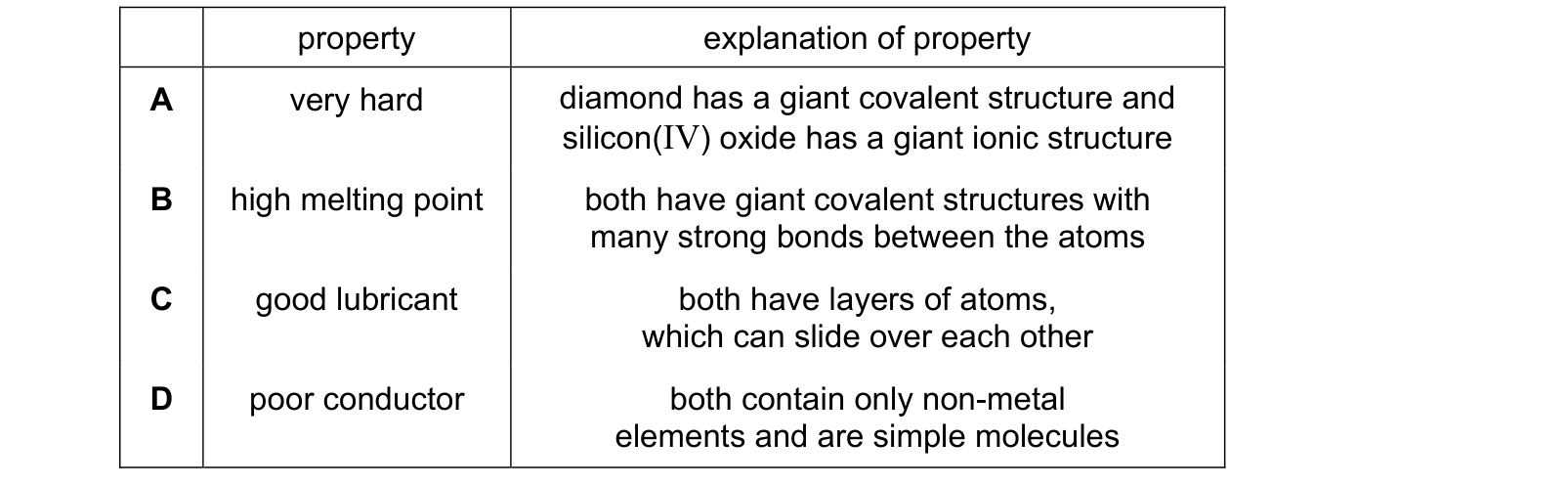
Which row identifies a property and an explanation of the property for both diamond and silicon(IV) oxide? Each answer gives, in order: property; explanation of property.
Answer: B.
Diamond and silicon(IV) oxide share one structure type, giant covalent, so a correct row has to state something that follows from that for both of them. Bonds run in every direction throughout each solid, so melting means breaking an enormous number of strong covalent bonds and both have very high melting points; property and explanation match for each substance. The row calling them very hard states a true property of diamond but explains it by calling silicon(IV) oxide giant ionic, which it is not, since it is giant covalent too. The lubricant row belongs to graphite, the form of carbon built in layers, and neither substance here has layers to slide. The poor conductor row states a property that is true but supports it by calling them simple molecules, which contradicts the giant structures and the high melting points.
Question 2
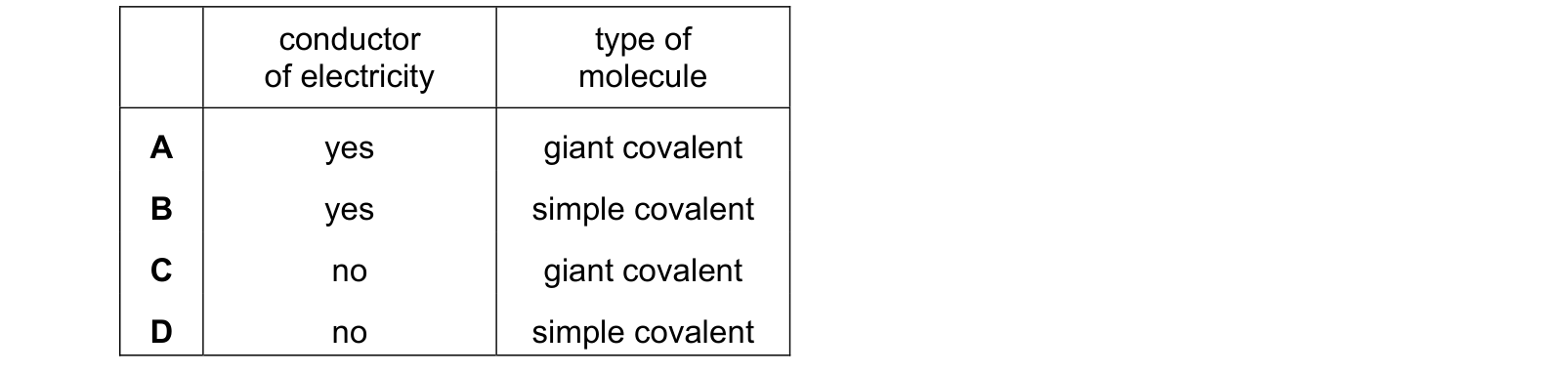
Which row about the properties of both diamond and silicon(IV) oxide is correct? Each answer gives, in order: conductor of electricity; type of molecule.
Answer: C.
Diamond and silicon(IV) oxide are both giant covalent structures, networks in which every atom is joined to its neighbours by strong covalent bonds running right through the solid. In each of them every outer electron is committed to a bond, so there are no delocalised electrons and no ions, and neither substance conducts electricity in any state. The rows answering yes to conduction have confused a giant structure with a metal or with graphite, where mobile charge genuinely exists. The rows describing them as simple covalent confuse a giant lattice with small separate molecules; if these were simple molecular they would melt easily, whereas both need temperatures well above 1600 degrees C. One picture of the structure settles both columns at once.
Question 3
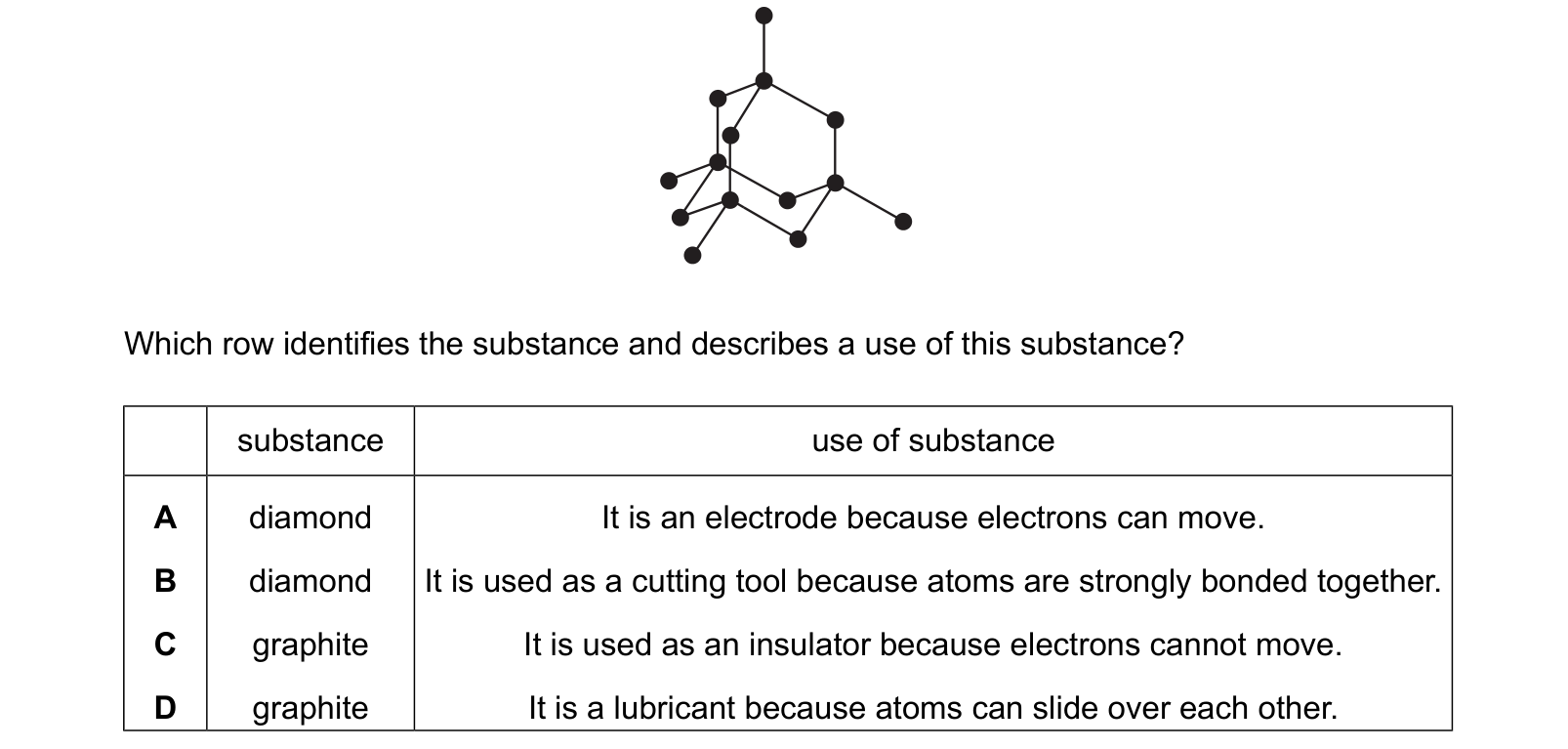
The diagram shows the arrangement of carbon atoms in a giant covalent structure. Which row identifies the substance and describes a use of this substance? Use the source image for S24 Paper 13, question 8.
Answer: B.
Every carbon in the picture is bonded to four others arranged tetrahedrally through three dimensions, and that rigid framework is diamond; graphite would be drawn as flat sheets of hexagons with each carbon bonded to only three neighbours. Because all four outer electrons on each atom are locked into strong covalent bonds, the structure resists being deformed, which is why diamond is used for cutting and drilling tools. Those same four bonds leave no delocalised electrons, so describing this substance as an electrode with electrons free to move contradicts the very diagram given. The two rows naming graphite fail at the structure before their properties matter, and the lubricant description genuinely belongs to graphite, whose separate layers slide over one another, a motion this interlocked network cannot make.
Question 4
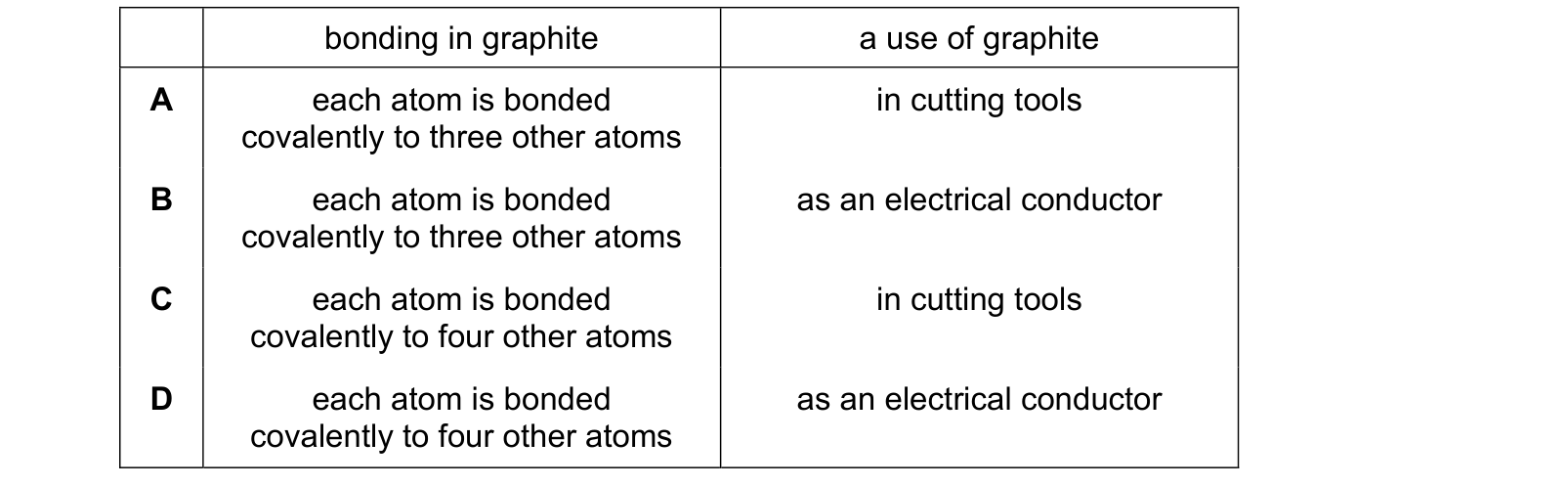
Which row describes the bonding in graphite and a use of graphite? Each answer gives, in order: bonding in graphite; a use of graphite.
Answer: B.
Graphite is built from flat layers of hexagons in which each carbon is covalently bonded to only three neighbours, which leaves one outer electron per atom free to move along the layer. Those delocalised electrons carry a current, so graphite serves as an electrode and as the brushes in motors, and it is unusual among non metals in conducting at all. The rows claiming four bonds per atom are describing diamond, where all four outer electrons are committed to bonding and none is left over to move. The cutting tool use belongs to diamond too, because its rigid three dimensional framework makes it extremely hard, whereas graphite is soft precisely because the weak forces between its layers let them slide past one another.
Question 5
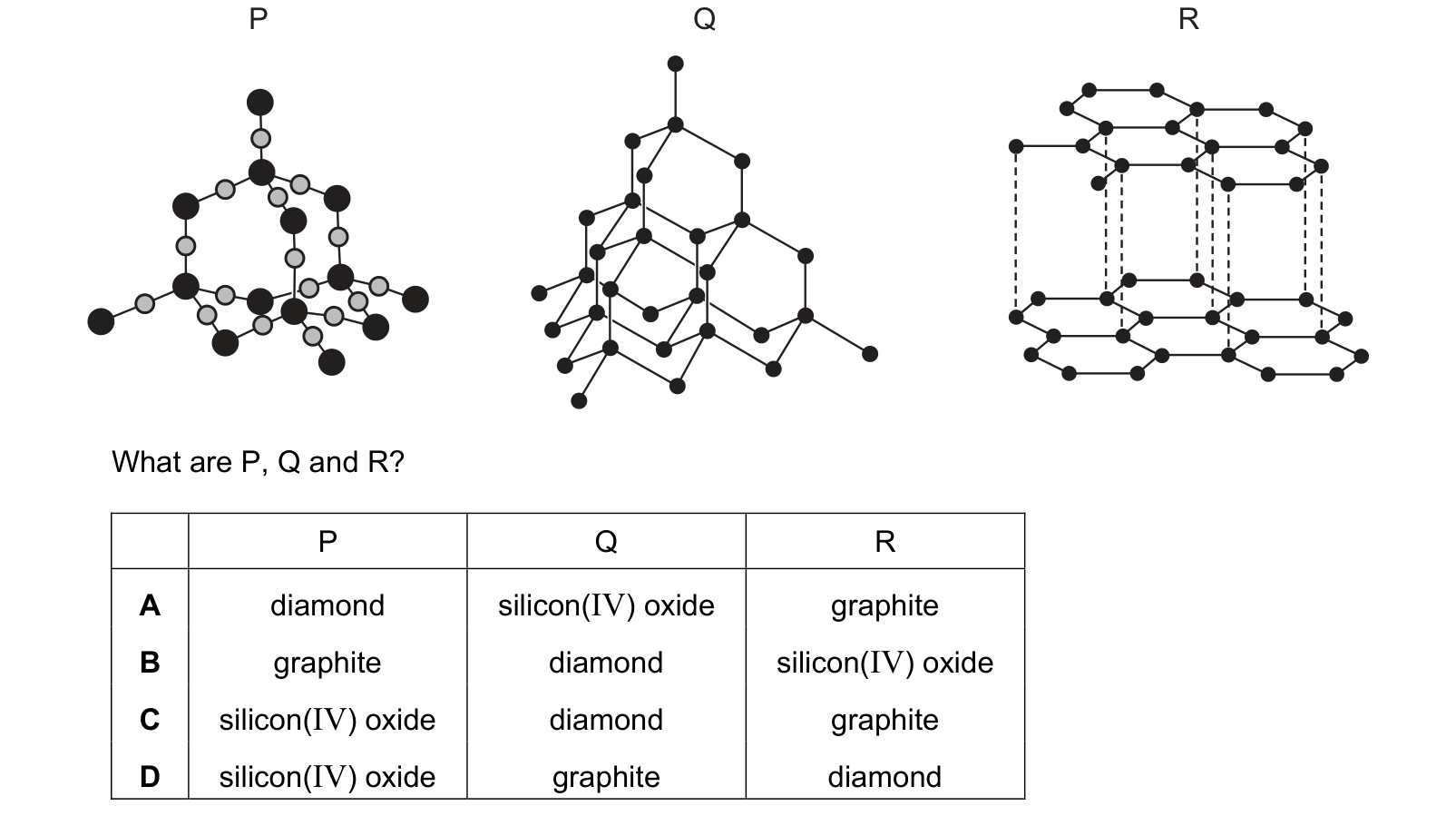
The diagrams show the structures of three macromolecules P, Q and R. P Q R What are P, Q and R? Each answer gives, in order: P; Q; R.
Answer: C.
P is the only structure drawn with two kinds of atom, large and small, which makes it a compound rather than an element, so P is silicon(IV) oxide. That leaves the two forms of carbon for Q and R. R is drawn as flat sheets of hexagons stacked above one another with dashed lines marking the weak attraction between layers, which is graphite. Q is a single continuous network with every atom bonded in three dimensions and no layers anywhere, which is diamond, and option A is the trap for anyone who reads any hexagonal pattern as graphite without checking whether the sheets are separate.
These questions are drawn from past CIE 0620 Chemistry papers and filtered to giant covalent structures. You answer, you find out immediately whether you were right, and you get the reasoning for the correct option and for each distractor. Wrong answers go to a mistakes locker so you can come back to exactly those.
Practice is free. You need an account only so your progress and your mistakes are still there next time.
These are the errors that cost marks on giant covalent structures, taken from our own topic notes. Read them before you practise and you will recognise the traps in the questions.
Saying diamond and graphite are different because they contain different atoms. Both are pure carbon.
Saying graphite conducts because the layers slide. Sliding explains softness; delocalised electrons explain conduction.
Saying graphite has a low melting point because the forces between layers are weak. Melting breaks the covalent bonds within the layers, so the melting point is very high.
Saying diamond conducts electricity because it is made of carbon like graphite.
Saying weak covalent bonds hold graphite's layers together. The forces between layers are not covalent bonds at all.
Giving silicon(IV) oxide the formula SiO or Si₂O.
Saying a giant covalent substance dissolves in water. None of the three does.