Metallic bonding
Contents: 8 sections
What metallic bonding is
Metallic bonding is the electrostatic attraction between the positive ions in a giant metallic lattice and a sea of delocalised electrons.
Every part of that definition is marked, so learn it as a whole sentence:
- Positive ions. Each metal atom releases its outer shell electrons, and what is left is a positively charged ion. The ion keeps all its protons, so a sodium atom, 2,8,1, releases 1 electron and becomes Na⁺ with 11 − 1 = 10 electrons. An aluminium atom, 2,8,3, releases 3 and becomes Al³⁺ with 13 − 3 = 10 electrons.
- Giant metallic lattice. The ions sit in a regular, closely packed arrangement extending throughout the piece of metal. There are no molecules.
- Delocalised electrons. The released electrons no longer belong to any one atom. They are free to move throughout the whole lattice, which is what "delocalised" means.
- Electrostatic attraction. The bond is the attraction between the positive ions and the negative electrons that surround them all.
To draw it: a regular grid of circles each labelled with a positive charge, with minus signs scattered in the spaces between them, and a label saying "sea of delocalised electrons". The charges are what earn the marks; a grid of plain circles is not a metallic lattice.
Electrical conductivity
Metals are good conductors of electricity in the solid state, which is what separates them from ionic compounds, and the reason is one sentence:
The delocalised electrons are free to move through the lattice, so when a potential difference is applied they drift through the metal and carry the charge.
The ions themselves do not move. That contrast is worth holding on to: in a metal it is electrons that carry the current and the ions stay put, whereas in a molten or aqueous ionic compound it is the ions that move.
A metal also conducts when molten, because the electrons remain delocalised, whereas an ionic solid conducts only after melting has freed its ions.
Thermal conductivity
Metals conduct heat well for the same reason. The delocalised electrons gain kinetic energy at the hot end, move through the lattice, and transfer that energy on collision, which carries energy far faster than the vibration of the ions alone could.
Malleability and ductility
Malleable means it can be hammered into shape without shattering. Ductile means it can be drawn out into a wire.
The ions are arranged in layers that can slide over one another when a force is applied. The delocalised electrons move with them, so the metallic bonding is not broken and the metal changes shape instead of cracking.
The comparison with an ionic solid is what makes this explanation land. Hitting an ionic crystal also shifts a layer, but there the layer is made of alternating positive and negative ions, so a shift brings like charges next to each other, they repel and the crystal splits. A metal has only one kind of ion and a shared sea of electrons, so a shifted layer looks exactly like the layer before it and the bonding survives.
That is why a copper pipe can be bent and a salt crystal cannot.
Melting points and the strength of the bonding
Most metals have high melting points, because a large number of strong attractions between ions and delocalised electrons must be overcome.
How high depends on two things: how many electrons each atom releases and how large the resulting charge on the ion is. More delocalised electrons and a higher charge mean stronger attraction.
| Metal | Configuration | Electrons released per atom | Ion | Melting point in °C |
|---|---|---|---|---|
| Sodium | 2,8,1 | 1 | Na⁺ | 98 |
| Magnesium | 2,8,2 | 2 | Mg²⁺ | 650 |
| Aluminium | 2,8,3 | 3 | Al³⁺ | 660 |
Aluminium releases three times as many electrons per atom as sodium and forms an ion with three times the charge, and its melting point is higher by more than 500 °C. Reading across a period of the Periodic Table, this is the trend to quote.
Mercury is the exception worth knowing: it is a liquid at room temperature, with a melting point of −39 °C, so "all metals have high melting points" is not a safe sentence.
Telling the three bond types apart
| Ionic | Covalent | Metallic | |
|---|---|---|---|
| Between | Metal and non-metal | Non-metal and non-metal | Metal and metal |
| Electrons | Transferred | Shared | Delocalised |
| Conducts as a solid | No | No | Yes |
| Conducts when molten | Yes, ions move | No | Yes, electrons move |
The third row alone identifies a metal, and the fourth row separates an ionic compound from a simple molecular one. Questions that give a table of properties and ask which substance is which are answered from these two rows almost every time.
Common mistakes
- Describing metallic bonding as attraction between positive and negative ions. There are no negative ions in a metal.
- Saying metal atoms are held together by a sea of electrons. It is the ions, not atoms, that the electrons hold.
- Saying metals conduct because their ions move. The ions are fixed; the electrons move.
- Explaining malleability by saying the bonds break and re-form. The bonding is not broken, because the electrons move with the layers.
- Leaving the charges off a drawing of the metallic lattice.
- Forgetting that this whole subtopic is Extended and revising it in place of Core material.
Check you have it
Question 1
Which row explains the malleability and electrical conductivity of a solid metal? Each answer gives, in order: malleability; electrical conductivity.
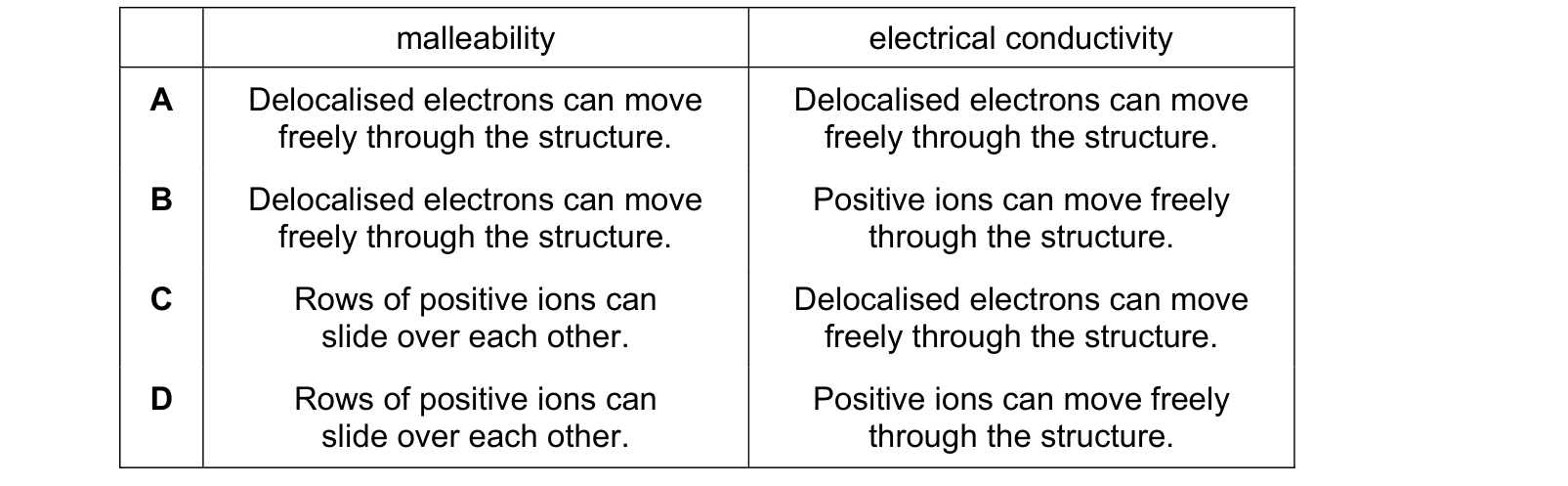
Answer: C.
Question 2
Metals and ionic compounds have similarities and differences in their structure and properties. Which row about metals and ionic compounds is correct? Each answer gives, in order: similarity; difference.
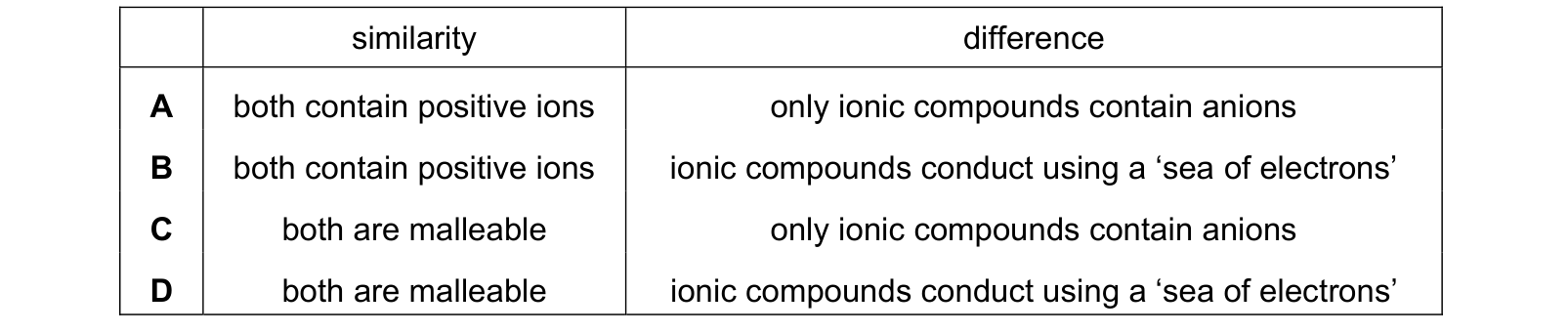
Answer: A.
Question 3
Which statement about copper, diamond and silicon(IV) oxide is correct?
Answer: D.
What the syllabus asks for on this topicSyllabus points
Syllabus points
- Extended only: describe metallic bonding as the electrostatic attraction between the positive ions in a giant metallic lattice and a sea of delocalised electrons.
- Extended only: explain the good electrical conductivity of metals in terms of that structure and bonding.
- Extended only: explain the malleability and ductility of metals in terms of that structure and bonding.
- Extended only: relate the strength of metallic bonding to the number of delocalised electrons and the charge on the ion.
The whole of subtopic 2.7 is Extended. It appears on Paper 2 and not on Paper 1, so a Core candidate can leave this page out entirely. Extended candidates should note that metallic bonding is the third of the three strong bonds, alongside ionic and covalent, and questions often ask you to tell all three apart.
Related CIE 0620 Chemistry topics
Not the topic you were looking for? Describe what you are stuck on in your own words and we will take you to the notes that answer it.