5 past-paper questions on this unit. Three of them are below. Answer on the page: each one is marked the moment you pick, the correct option is shown whether or not you found it, and the full explanation opens either way.
CIE 0620 ChemistryPaper 1 and Paper 2 MCQsFree account
Metallic bonding: three questions to try now
Real past-paper questions, the answer key from the mark scheme, and the explanation that goes with it. No account needed to answer them.
Question 1
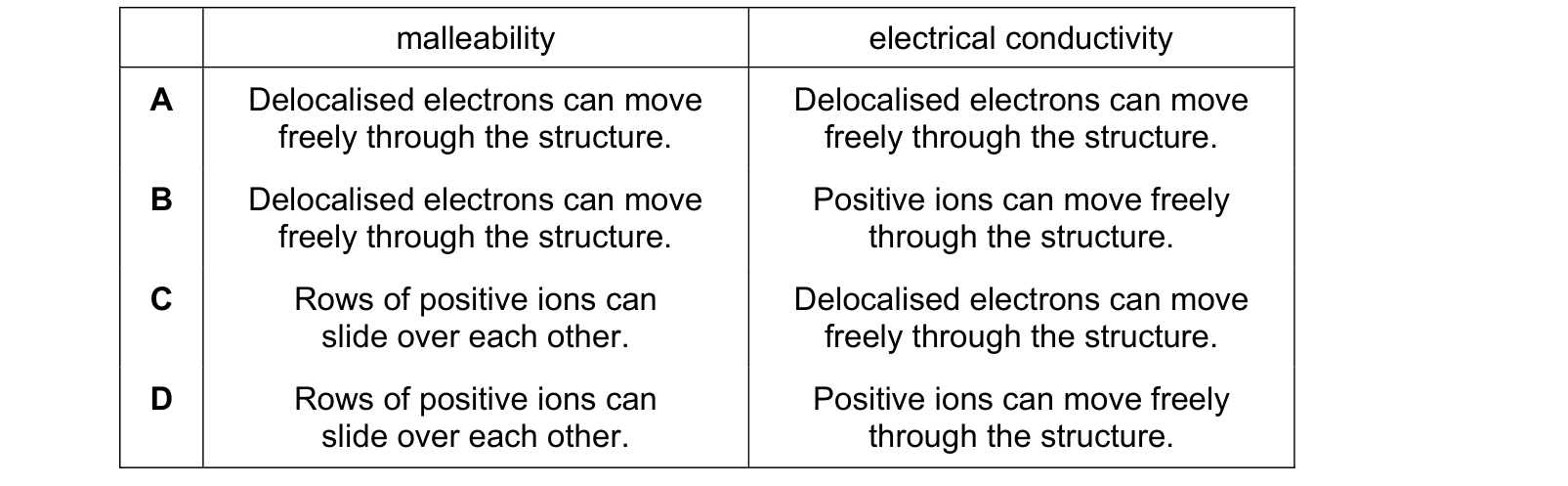
Which row explains the malleability and electrical conductivity of a solid metal? Each answer gives, in order: malleability; electrical conductivity.
Answer: C.
Metallic bonding is a lattice of positive ions held together by delocalised electrons spread through the whole structure, and the two properties come from the two different parts of that picture. Malleability comes from the ions, because rows of identical positive ions can slide over one another into new positions while the delocalised electrons continue to hold the lattice together, so the metal changes shape rather than shattering. Conductivity comes from the electrons, which drift through the structure and carry charge. The row explaining malleability by delocalised electrons has borrowed the conduction explanation and applied it to a mechanical property. The rows claiming positive ions move freely through the structure describe a molten or dissolved ionic compound, not a solid metal, in which the ions stay put in the lattice.
Question 2
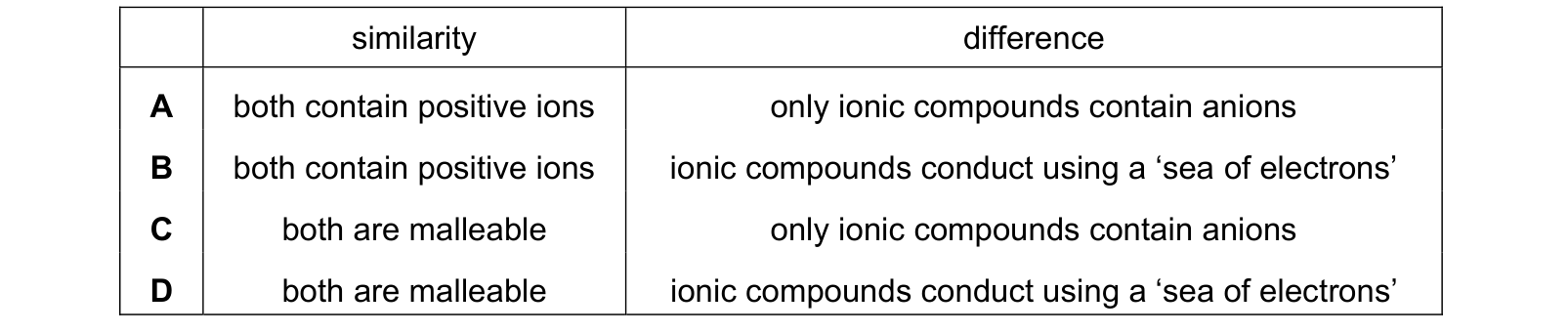
Metals and ionic compounds have similarities and differences in their structure and properties. Which row about metals and ionic compounds is correct? Each answer gives, in order: similarity; difference.
Answer: A.
A metal lattice is positive ions in a sea of delocalised electrons and an ionic lattice is positive ions alongside negative ions, so positive ions are what the two structures have in common. The difference is that a metal contains no negative ions at all, since the electrons it released stay delocalised rather than attaching to anything, while an ionic compound must contain anions to balance the charge. Options C and D claim both are malleable, but an ionic solid shatters when struck, because sliding its layers brings ions of like charge face to face. Options B and D give a sea of electrons to ionic compounds, when that phrase belongs to metals alone and is exactly why a metal conducts while a solid ionic compound does not.
Question 3
Which statement about copper, diamond and silicon(IV) oxide is correct?
Answer: D.
Metallic bonding in copper consists of a regular giant lattice of positive metal cations surrounded by a sea of delocalised valence electrons, which matches statement D. A is incorrect because copper is an excellent electrical conductor due to free electrons, whereas giant covalent silicon(IV) oxide has no mobile charged particles and is an electrical insulator. B is false because carbon atoms in diamond form a rigid three-dimensional tetrahedral lattice rather than flat layers. C is false because silicon(IV) oxide forms a continuous three-dimensional tetrahedral network structure analogous to diamond.
These questions are drawn from past CIE 0620 Chemistry papers and filtered to metallic bonding. You answer, you find out immediately whether you were right, and you get the reasoning for the correct option and for each distractor. Wrong answers go to a mistakes locker so you can come back to exactly those.
Practice is free. You need an account only so your progress and your mistakes are still there next time.
These are the errors that cost marks on metallic bonding, taken from our own topic notes. Read them before you practise and you will recognise the traps in the questions.
Describing metallic bonding as attraction between positive and negative ions. There are no negative ions in a metal.
Saying metal atoms are held together by a sea of electrons. It is the ions, not atoms, that the electrons hold.
Saying metals conduct because their ions move. The ions are fixed; the electrons move.
Explaining malleability by saying the bonds break and re-form. The bonding is not broken, because the electrons move with the layers.
Leaving the charges off a drawing of the metallic lattice.
Forgetting that this whole subtopic is Extended and revising it in place of Core material.