Group VII properties
Contents: 8 sections
Appearance, which is pure recall
| Halogen | Formula | State at room temperature | Colour |
|---|---|---|---|
| Chlorine | Cl<sub>2</sub> | Gas | Pale yellow-green |
| Bromine | Br<sub>2</sub> | Liquid | Red-brown, with a red-brown vapour |
| Iodine | I<sub>2</sub> | Solid | Grey-black, subliming to a purple vapour |
Three facts sit inside that table and each is asked separately.
The formulae are all diatomic: two atoms joined by a single covalent bond, because each atom has seven outer electrons and needs one more.
The states run gas, liquid, solid down the group, because the melting and boiling points increase as the molecules get larger. Iodine is the only one that is solid at room temperature, and it sublimes, turning straight from a grey-black solid to a purple vapour without melting.
The density increases down the group, in step with the increasing mass of the molecules.
Reactivity decreases down the group
This is the opposite direction to Group I, and the explanation is the mirror image.
A halogen atom reacts by gaining one electron to complete its outer shell. Going down the group each atom has one more occupied shell, so the outer shell is further from the nucleus and shielded by more inner shells. The nucleus therefore attracts an incoming electron less strongly, the electron is gained less easily, and the element is less reactive.
Chlorine is the most reactive of the three and iodine the least. Fluorine, above chlorine, is more reactive than all of them.
Colours in solution
These matter because they are how displacement is observed.
- Chlorine water is very pale, almost colourless with a faint green tint.
- Bromine water is orange.
- Iodine solution is brown in water, and purple in an organic solvent such as hexane.
Displacement reactions
A more reactive halogen displaces a less reactive halogen from a solution of its salt. Since reactivity falls down the group, chlorine displaces bromine and iodine, bromine displaces iodine only, and iodine displaces neither.
| Added to | Potassium chloride | Potassium bromide | Potassium iodide |
|---|---|---|---|
| Chlorine water | No reaction | Turns orange | Turns brown |
| Bromine water | No reaction | No reaction | Turns brown |
| Iodine solution | No reaction | No reaction | No reaction |
The equations:
Cl<sub>2</sub> + 2KBr → 2KCl + Br<sub>2</sub>
Cl<sub>2</sub> + 2KI → 2KCl + I<sub>2</sub>
Br<sub>2</sub> + 2KI → 2KBr + I<sub>2</sub>
Written ionically, with the potassium as a spectator ion:
Cl<sub>2</sub> + 2Br<sup>−</sup> → 2Cl<sup>−</sup> + Br<sub>2</sub>
Displacement is redox. Chlorine gains electrons, so it is reduced and is acting as the oxidising agent. Bromide ions lose electrons, so they are oxidised. Chlorine is a better oxidising agent than bromine, which is another way of saying it is more reactive, and the oxidising power falls down the group in step with the reactivity.
The colour change is the evidence, so quote it. Adding chlorine water to colourless potassium bromide solution turns it orange because bromine has been set free. Adding it to potassium iodide turns the solution brown because iodine has been set free, and a grey-black solid may settle out if enough forms.
Worked example. Excess chlorine is bubbled through a solution containing 2.38 g of potassium bromide. What mass of bromine is displaced? The relative formula mass of KBr is 119 and of Br<sub>2</sub> is 160.
moles of potassium bromide = 2.38 / 119 = 0.0200 mol
The equation shows 2 mol of KBr giving 1 mol of Br<sub>2</sub>, so
moles of bromine = 0.0200 / 2 = 0.0100 mol
mass of bromine = 0.0100 × 160 = 1.60 g
Compounds of the halogens
Each halogen gains one electron to form a 1− ion: chloride Cl<sup>−</sup>, bromide Br<sup>−</sup>, iodide I<sup>−</sup>. With a metal that gives an ionic compound such as NaCl or MgBr<sub>2</sub>. With a non-metal it shares instead, giving covalent HCl.
The halide ions are identified with acidified silver nitrate solution, and the three precipitate colours are recall marks:
- Chloride gives a white precipitate of silver chloride.
- Bromide gives a cream precipitate of silver bromide.
- Iodide gives a yellow precipitate of silver iodide.
Chlorine itself is used to kill bacteria in drinking water and in swimming pools, and in the manufacture of bleach.
Predicting the next element
Astatine, below iodine, follows every trend:
- A solid at room temperature, since the states run gas to liquid to solid down the group.
- Darker than iodine, so black.
- Higher density than iodine.
- Less reactive than iodine, so it displaces no other halogen and is displaced by all of them.
- Forms the astatide ion At<sup>−</sup> and the compound NaAt.
Fluorine, above chlorine, runs the other way: a pale yellow gas, less dense, and the most reactive halogen of all, displacing every other halide from solution.
Common mistakes
- Writing the halogens as single atoms, Cl rather than Cl<sub>2</sub>.
- Saying reactivity increases down Group VII, by carrying the Group I trend across.
- Explaining decreasing reactivity by "fewer electrons" instead of by the outer shell being further from the nucleus and shielded.
- Giving iodine as purple in the solid state, when it is grey-black and only its vapour is purple.
- Saying iodine displaces bromine, which is the reaction that does not happen.
- Confusing the colours of bromine water, which is orange, with an iodine solution, which is brown.
- Forgetting that a displacement reaction is redox, and that the displacing halogen is the oxidising agent.
Check you have it
Question 1
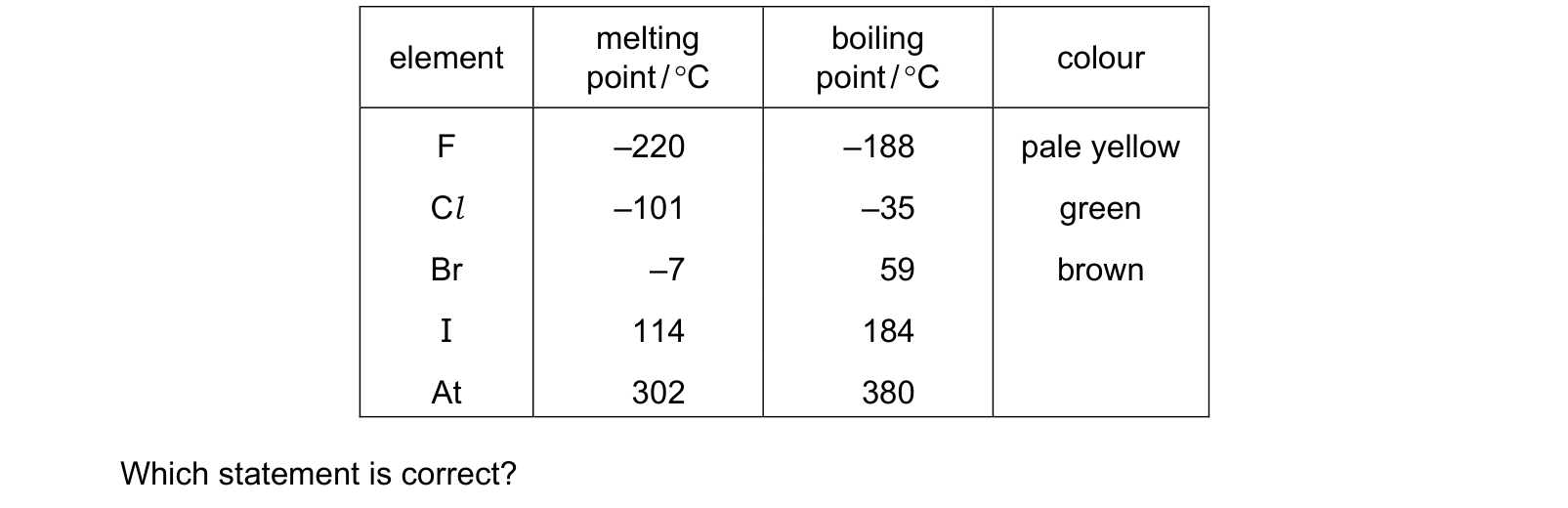
Some properties of the elements in Group VII of the Periodic Table are shown.
melting boiling element colour point / °C point / °C
F –220 –188 pale yellow
Cl –101 –35 green
Br –7 59 brown
I 114 184
At 302 380
Which statement is correct?
Answer: B.
Question 2
Fluorine is the element at the top of Group VII of the Periodic Table.
Which statement describes fluorine?
Answer: C.
Question 3
Bromine and iodine are elements in Group VII of the Periodic Table.
Which statement about these elements is correct?
Answer: B.
What the syllabus asks for on this topicSyllabus points
Syllabus points
- Describe the Group VII halogens, chlorine, bromine and iodine, as diatomic non-metals.
- State the appearance of chlorine, bromine and iodine at room temperature and pressure.
- Describe the general trends down the group of increasing density and decreasing reactivity.
- Predict the properties of other elements in Group VII, given information about the elements.
- Describe and explain the displacement reactions of halogens with other halide ions.
Every objective in 8.3 is Core. There is no Supplement content in this subtopic, so a Core candidate needs all of it.
Related CIE 0620 Chemistry topics
Not the topic you were looking for? Describe what you are stuck on in your own words and we will take you to the notes that answer it.