15 past-paper questions on this unit. Five of them are below. Answer on the page: each one is marked the moment you pick, the correct option is shown whether or not you found it, and the full explanation opens either way.
CIE 0620 ChemistryPaper 1 and Paper 2 MCQsFree account
Group VII properties: five questions to try now
Real past-paper questions, the answer key from the mark scheme, and the explanation that goes with it. No account needed to answer them.
Question 1
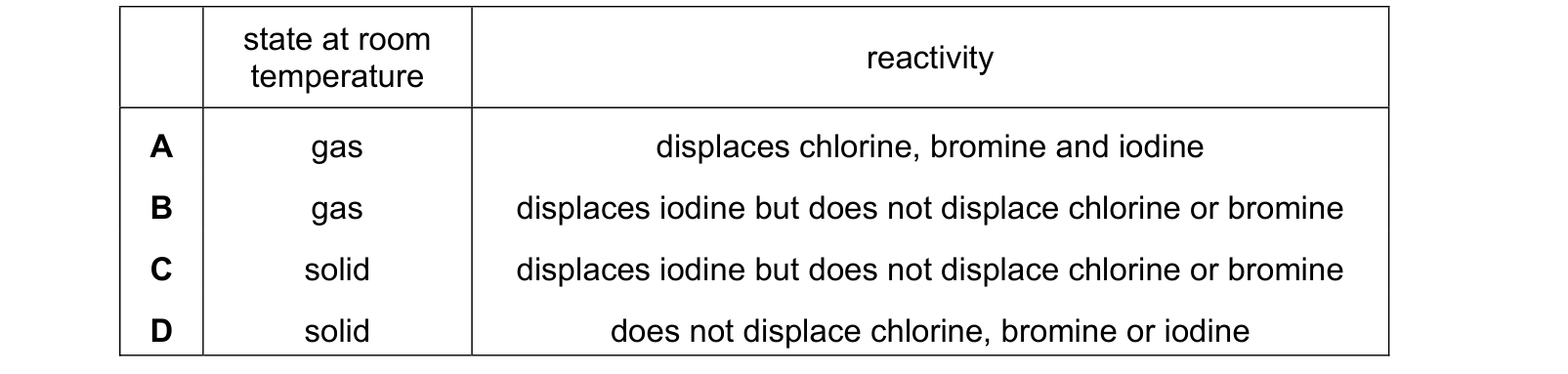
Astatine is below iodine in Group VII in the Periodic Table. Which row describes the properties of astatine? Each answer gives, in order: state at room temperature; reactivity.
Answer: D.
Group VII properties change steadily down the group: the halogens grow darker and denser, their melting points rise and their reactivity falls. Iodine is already a solid, so astatine, sitting below it, must be a solid too, which removes both gas rows. Reactivity falls because the outer shell lies further from the nucleus and an extra electron is harder to attract, so astatine is the least reactive halogen of all and cannot displace chlorine, bromine or iodine from their salts. The row that allows it to displace iodine reverses the trend for the one halogen immediately above it.
Question 2
Two properties of element R are listed. ● It is a dark solid at room temperature. ● It is a diatomic molecule. Where on the Periodic Table is R placed?
Answer: B.
A dark solid existing as diatomic molecules is iodine, and iodine belongs to Group VII. The diatomic molecule is the giveaway, because Group VII atoms each need one more electron and reach a full shell by sharing a pair with another atom of the same element. Group I elements are soft shiny metals, not dark molecular solids. Group VIII elements exist as single atoms, so they cannot be diatomic. Transition elements are metals with high melting points and metallic bonding, so they form giant structures rather than discrete molecules.
Question 3
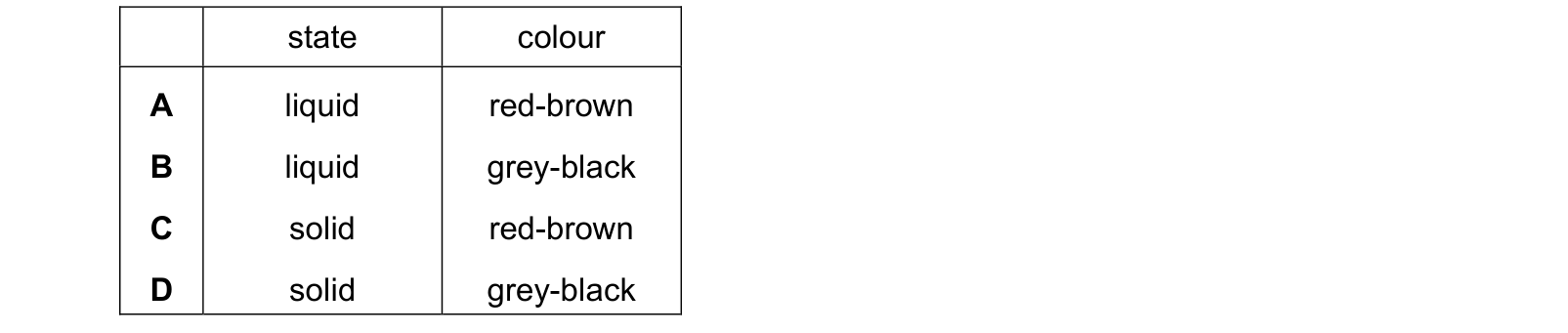
Which row describes the state and colour of bromine at room temperature and pressure? Each answer gives, in order: state; colour.
Answer: A.
Bromine sits in the middle of Group VII, and its melting point of -7 °C with a boiling point of 59 °C puts room temperature between the two, so bromine is a liquid; it is in fact the only non metal that is liquid at room temperature. Its colour is red brown, and the dense orange brown vapour above the liquid is a standard laboratory sight. Grey black belongs to solid iodine, which lies below bromine and is darker in keeping with the trend down the group. Describing bromine as a solid gives it iodine's state, and one row gives it iodine's colour as well.
Question 4
Some information about an element from Group VII of the Periodic Table is shown. melting point / °C –7 boiling point / °C 59 What is the element?
Answer: C.
Room temperature is about 20 °C, and this element melts at -7 °C and boils at 59 °C, so room temperature falls between the two values and the element is a liquid. The only halogen that is liquid at room temperature is bromine. Fluorine boils at -188 °C and chlorine at -35 °C, so both are gases well below room temperature and neither could show a melting point of -7 °C. Iodine melts at 114 °C and is a solid, far above the figures given. Checking where room temperature sits between the two values is all the question needs.
Question 5
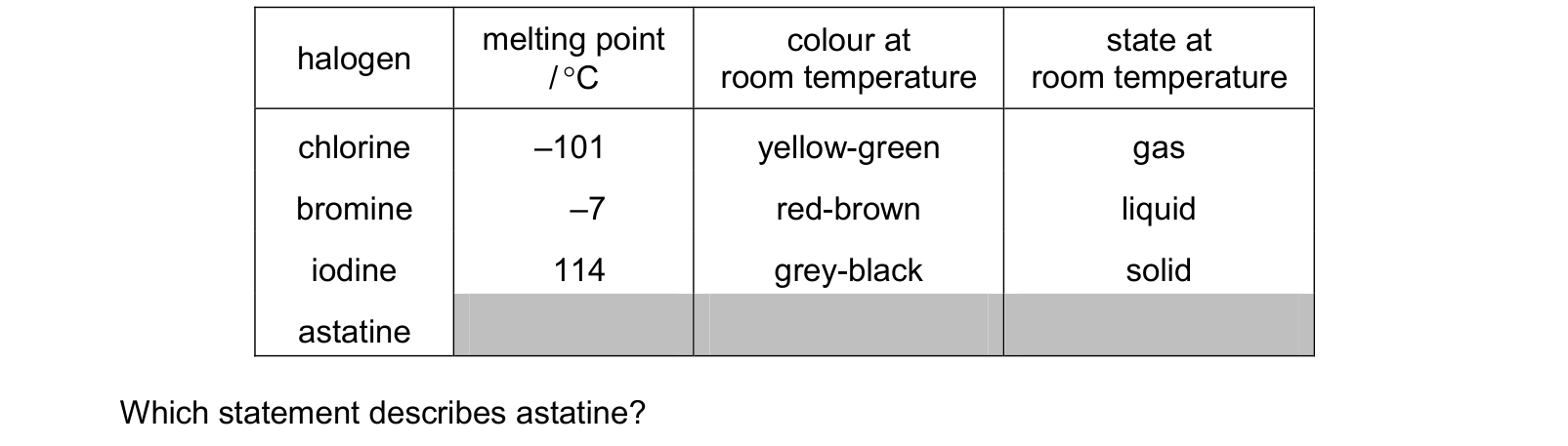
The table shows some properties of the halogens. Which statement describes astatine?
Answer: D.
Astatine lies below iodine in Group VII, so the trends in the table have to be carried one step further. Melting point rises down the group, from -101 °C for chlorine to -7 °C for bromine and 114 °C for iodine, so astatine must melt above 114 °C, higher than both iodine and bromine. That also makes it a solid at room temperature, so the descriptions of a yellow gas and of a black liquid both fail. Colour darkens down the group, so astatine would be darker than the grey black of iodine rather than yellow, and the statement placing its melting point between bromine and chlorine reverses the trend completely.
These questions are drawn from past CIE 0620 Chemistry papers and filtered to group vii properties. You answer, you find out immediately whether you were right, and you get the reasoning for the correct option and for each distractor. Wrong answers go to a mistakes locker so you can come back to exactly those.
Practice is free. You need an account only so your progress and your mistakes are still there next time.
These are the errors that cost marks on group vii properties, taken from our own topic notes. Read them before you practise and you will recognise the traps in the questions.
Writing the halogens as single atoms, Cl rather than Cl<sub>2</sub>.
Saying reactivity increases down Group VII, by carrying the Group I trend across.
Explaining decreasing reactivity by "fewer electrons" instead of by the outer shell being further from the nucleus and shielded.
Giving iodine as purple in the solid state, when it is grey-black and only its vapour is purple.
Saying iodine displaces bromine, which is the reaction that does not happen.
Confusing the colours of bromine water, which is orange, with an iodine solution, which is brown.
Forgetting that a displacement reaction is redox, and that the displacing halogen is the oxidising agent.