Group I properties
Contents: 9 sections
What the metals are like
The alkali metals are soft enough to cut with a knife, and the freshly cut surface is shiny silver for a second or two before it tarnishes to a dull grey as it reacts with oxygen and water vapour in the air. That is why they are stored under oil.
They are unusual metals in three ways. They have low densities, low enough that lithium, sodium and potassium all float on water. They have low melting points for metals, low enough that sodium melts in the heat of its own reaction. And they are soft, where most metals are hard.
The three trends
| Element | Melting point in °C | Density in g per cm<sup>3</sup> | Reaction with cold water |
|---|---|---|---|
| Lithium | 181 | 0.53 | Steady fizzing, floats, does not melt |
| Sodium | 98 | 0.97 | Rapid fizzing, melts into a ball, darts about |
| Potassium | 63 | 0.86 | Violent, lilac flame, may crackle |
| Rubidium | 39 | 1.53 | Violent enough to be dangerous |
Reading down the group:
- Melting point decreases: 181 °C, then 98 °C, then 63 °C.
- Density increases overall, from 0.53 to 1.53 g per cm<sup>3</sup>, though potassium at 0.86 is slightly less dense than sodium at 0.97. Cambridge asks for the general trend, so state the trend and do not be thrown by the one step that goes the other way.
- Reactivity with water increases.
Note that lithium, sodium and potassium are all below 1.00 g per cm<sup>3</sup>, the density of water, which is why they float, while rubidium at 1.53 would sink.
The reaction with water
The equation is the same for all of them, with the metal in place of sodium:
2Na + 2H<sub>2</sub>O → 2NaOH + H<sub>2</sub>
The products are a metal hydroxide and hydrogen. The hydroxide dissolves to give an alkaline solution, turning universal indicator blue or purple at about pH 13, and it is this that gives the group its name.
The observations differ, and they are recall marks:
- Lithium floats, fizzes steadily and gradually disappears. It stays solid throughout.
- Sodium floats, melts into a shiny ball because the reaction gives out enough heat to reach its melting point of 98 °C, and darts rapidly across the surface pushed by escaping hydrogen. It may ignite with an orange flame.
- Potassium floats, melts, moves violently and burns with a lilac flame, often ending with a small explosion as the hydrogen ignites.
Sodium melting and lithium not melting is a direct consequence of the melting points in the table, and questions expect you to make that link rather than to recite it.
Why reactivity increases down the group
Each element down the group has one more occupied electron shell. So its single outer electron is:
- further from the nucleus, and
- shielded from the nucleus by more inner shells.
The attraction between the nucleus and that outer electron is therefore weaker, so the electron is lost more easily, and losing that electron is exactly what the reaction requires. An element that loses its outer electron more easily reacts more vigorously.
This is the opposite of the Group VII trend in 8.3, for the same underlying reason: Group I atoms need to lose an electron and Group VII atoms need to gain one.
Other reactions
With oxygen, to give the oxide:
4Na + O<sub>2</sub> → 2Na<sub>2</sub>O
With chlorine, to give the chloride, burning with a bright flame and leaving a white solid:
2Na + Cl<sub>2</sub> → 2NaCl
Every Group I compound has the metal present as a +1 ion, because there is one outer electron to lose. So the chlorides are LiCl, NaCl and KCl, the oxides are Li<sub>2</sub>O, Na<sub>2</sub>O and K<sub>2</sub>O, and all of them are soluble in water, as the solubility rules in 7.3 state.
Worked example: how much hydrogen
0.23 g of sodium is dropped into water. What volume of hydrogen is produced at room temperature and pressure, where one mole of any gas occupies 24 dm<sup>3</sup>?
The relative atomic mass of sodium is 23.
moles of sodium = 0.23 / 23 = 0.010 mol
The equation shows 2 mol of sodium giving 1 mol of hydrogen, so
moles of hydrogen = 0.010 / 2 = 0.0050 mol
volume of hydrogen = 0.0050 × 24 = 0.12 dm<sup>3</sup>
That is 120 cm<sup>3</sup>, from a piece of sodium smaller than a grain of rice.
Predicting the next element
Given lithium, sodium and potassium, a question will ask about rubidium or caesium. Continue every trend:
- Lower melting point than potassium, so below 63 °C.
- Higher density than potassium, and above 1.00, so it would sink in water rather than float.
- More reactive with water, violently or explosively, giving rubidium hydroxide and hydrogen.
- Softer than potassium.
- Same formulae with the metal at +1, so RbCl, RbOH and Rb<sub>2</sub>O.
Answers that name the products as well as the vigour score better than answers that only say "more reactive".
Common mistakes
- Saying the reaction with water gives an acid, when it gives an alkali.
- Forgetting hydrogen as a product, and writing only the hydroxide.
- Explaining increasing reactivity by "more electrons" rather than by the outer electron being further from the nucleus and shielded.
- Saying the metals are stored under oil to stop them melting, rather than to keep out air and water.
- Giving potassium's flame as orange and sodium's as lilac, which is the wrong way round.
- Saying all alkali metals melt during the reaction, when lithium does not.
- Predicting that rubidium floats, when its density is above that of water.
Check you have it
Question 1
Lithium, sodium and potassium are elements in Group I of the Periodic Table.
Which statement about these elements is correct?
Answer: A.
Question 2
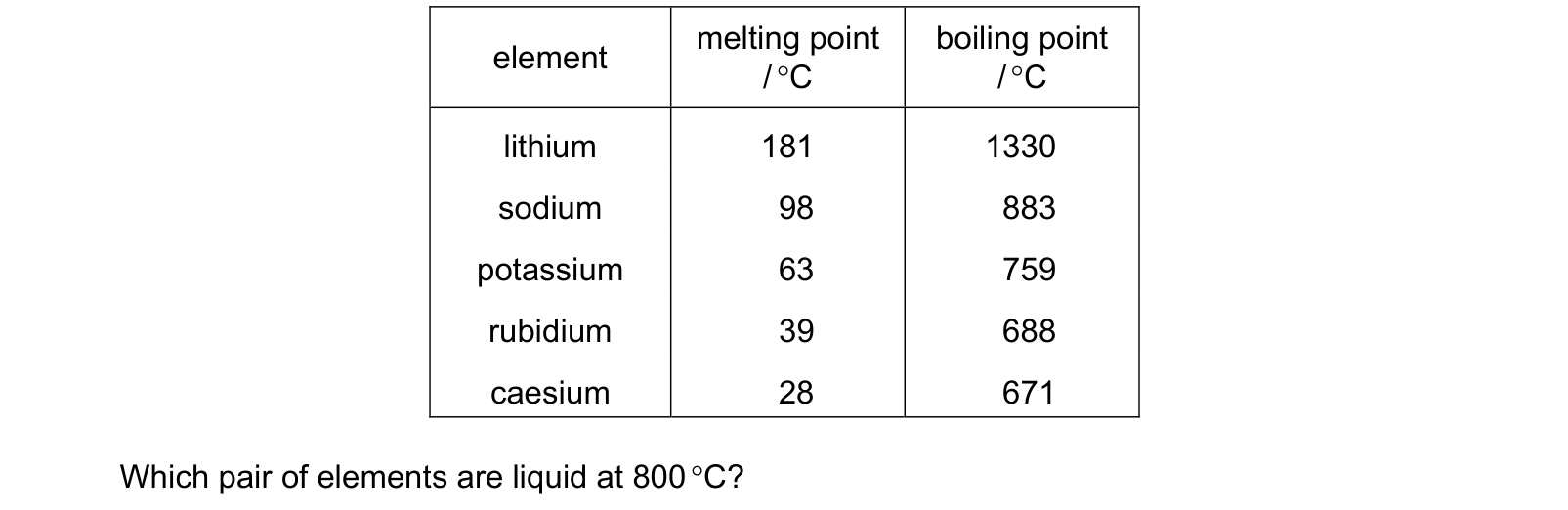
The melting points and boiling points of the elements of Group I of the Periodic Table are shown. melting point boiling point element / °C / °C lithium 181 1330 sodium 98 883 potassium 63 759 rubidium 39 688 caesium 28 671 Which pair of elements are liquid at 800 °C?
Answer: C.
Question 3
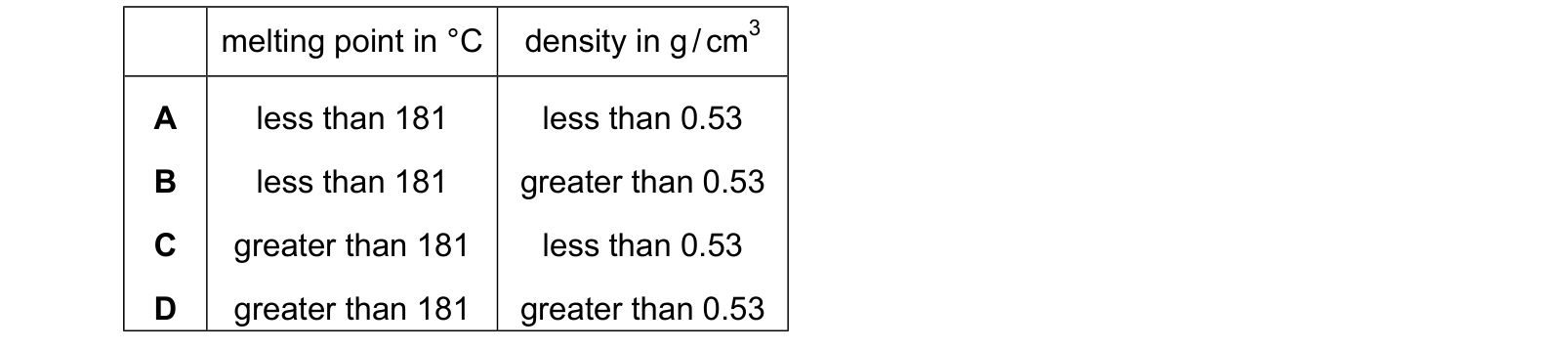
Lithium and potassium are metals in Group I of the Periodic Table. Lithium has a melting point of 181°C and a density of 0.53 g/cm³. Which row describes the melting point and density of potassium? melting point in °C density in g/cm³ Use the source image for S24 Paper 22, question 21.
Answer: B.
What the syllabus asks for on this topicSyllabus points
Syllabus points
- Describe the Group I alkali metals, lithium, sodium and potassium, as relatively soft metals with low densities and low melting points.
- Describe the general trends down the group of decreasing melting point, increasing density and increasing reactivity with water.
- Describe the reactions of lithium, sodium and potassium with cold water, including the observations and the products formed.
- Explain the increase in reactivity down the group in terms of the loss of the outer electron.
- Predict the properties of other elements in Group I, given information about the elements.
Everything in 8.2 is Core. There is no Extended-only content in this subtopic.
Related CIE 0620 Chemistry topics
Not the topic you were looking for? Describe what you are stuck on in your own words and we will take you to the notes that answer it.