Exothermic and endothermic reactions
Contents: 8 sections
The two kinds of reaction
An exothermic reaction transfers thermal energy to the surroundings, so the temperature of the surroundings rises.
>
An endothermic reaction takes in thermal energy from the surroundings, so the temperature of the surroundings falls.
Note carefully that both definitions describe what happens to the surroundings, not to the reaction. In an exothermic reaction the mixture gets hotter and so does the beaker holding it; in an endothermic one the mixture gets colder and the beaker can frost over on the outside.
Exothermic reactions include:
- Combustion, such as methane burning.
- Respiration, which is how a living cell releases energy from glucose.
- Neutralisation of an acid by an alkali.
- Metals reacting with acids, such as magnesium with hydrochloric acid.
- Displacement reactions, such as zinc with copper(II) sulfate solution.
Endothermic reactions include:
- Thermal decomposition, such as CaCO₃ → CaO + CO₂, which needs continuous heating.
- Photosynthesis, which takes in energy from light.
- Electrolysis, which takes in energy from the power supply.
- Dissolving ammonium nitrate in water, and mixing citric acid with sodium hydrogencarbonate solution, both of which are used in instant cold packs.
Measuring it. Pour 25 cm³ of hydrochloric acid into a polystyrene cup, record the temperature, add 25 cm³ of sodium hydroxide solution and record the highest temperature reached. A rise from 20.0 °C to 26.5 °C is a rise of 26.5 − 20.0 = 6.5 °C, so the reaction is exothermic. The cup is used because polystyrene is a poor conductor and reduces the heat lost to the room, which would otherwise make the measured rise too small.
Reaction pathway diagrams
A reaction pathway diagram plots energy on the vertical axis against the progress of the reaction on the horizontal axis. It shows a level for the reactants, a level for the products and a hump between them.
Exothermic: the products are lower than the reactants. Energy has left the chemicals and gone to the surroundings.
Endothermic: the products are higher than the reactants. Energy has been taken from the surroundings into the chemicals.
Reading such a diagram is Core work, and the question is answered by one comparison: look at whether the product line is below or above the reactant line. Everything else on the diagram follows.
Enthalpy change (Extended)
The thermal energy transferred in a reaction is the enthalpy change, symbol ΔH, measured in kJ/mol.
The sign is fixed by the direction of the transfer and is examined constantly:
- Exothermic: ΔH is negative, because the chemicals have lost energy.
- Endothermic: ΔH is positive, because the chemicals have gained energy.
So the combustion of methane is written with ΔH = −890 kJ/mol, and the sign is part of the answer. Writing 890 kJ/mol for an exothermic reaction loses the mark even when the number is right.
The arrow on the diagram runs from the reactant level to the product level: downwards for exothermic, upwards for endothermic. Its length is ΔH.
Activation energy (Extended)
Activation energy, Eₐ, is the minimum energy that colliding particles must have in order to react.
On the diagram it is the height of the hump measured from the reactants up to the peak, never from the products and never the whole height of the curve.
Activation energy explains why a mixture of methane and air sits unreacted until a spark is applied. The reaction is strongly exothermic, but nothing happens until some particles are given enough energy to get over the barrier.
Both exothermic and endothermic reactions have an activation energy, so every pathway diagram has a hump.
Bond breaking and bond making (Extended)
Two statements underpin the whole of the Extended content here:
Bond breaking is endothermic: energy must be put in to break a bond.
>
Bond making is exothermic: energy is given out when a bond forms.
Whether a reaction overall is exothermic or endothermic is a straight comparison of the two:
- If more energy is released making bonds than was taken in breaking them, the reaction is exothermic and ΔH is negative.
- If more energy is needed to break bonds than is released making them, the reaction is endothermic and ΔH is positive.
Calculating ΔH from bond energies (Extended)
A bond energy is the energy needed to break one mole of that bond, in kJ/mol. The same value is released when the bond forms.
ΔH = total energy to break bonds − total energy released making bonds
| Bond | Bond energy in kJ/mol |
|---|---|
| H to H | 436 |
| Cl to Cl | 242 |
| H to Cl | 431 |
| C to H | 413 |
| O to O in O₂ | 498 |
| C to O in CO₂ | 805 |
| O to H | 464 |
| N to N in N₂ | 945 |
Worked example 1. H₂ + Cl₂ → 2HCl
Bonds broken: one H to H and one Cl to Cl.
436 + 242 = 678 kJ
Bonds made: two H to Cl bonds.
2 × 431 = 862 kJ
678 − 862 = −184 kJ/mol
The answer is negative, so the reaction is exothermic, which fits: hydrogen burning in chlorine gives out a great deal of heat.
Worked example 2. CH₄ + 2O₂ → CO₂ + 2H₂O
Count the bonds from the formulae. Methane has 4 C to H bonds and each O₂ has one O to O bond, so 2 of those. Carbon dioxide has 2 C to O bonds and each water molecule has 2 O to H bonds, so 4 of those.
Bonds broken: (4 × 413) + (2 × 498) = 1652 + 996 = 2648 kJ
Bonds made: (2 × 805) + (4 × 464) = 1610 + 1856 = 3466 kJ
2648 − 3466 = −818 kJ/mol
Worked example 3, an endothermic one. N₂ + O₂ → 2NO, where the N to O bond energy is 631 kJ/mol.
Bonds broken: 945 + 498 = 1443 kJ
Bonds made: 2 × 631 = 1262 kJ
1443 − 1262 = +181 kJ/mol
The answer is positive, so this reaction is endothermic, which is why it happens in a hot car engine and not in the open air.
Always count the bonds from the balanced equation, including the balancing numbers. Missing the 2 in front of O₂ is what turns a correct method into a wrong answer.
Common mistakes
- Saying an exothermic reaction takes in energy because the reaction "gets hot". It is the surroundings that gain the energy.
- Giving ΔH a positive value for an exothermic reaction, or leaving the sign off altogether.
- Measuring the activation energy from the products rather than from the reactants.
- Drawing an endothermic diagram with the products below the reactants.
- Saying bond breaking releases energy. It always absorbs energy.
- Subtracting the bonds broken from the bonds made, giving the right number with the wrong sign.
- Forgetting the balancing numbers when counting bonds.
Check you have it
Question 1
Which row describes the reaction pathway diagram and energy change in an exothermic reaction? Each answer gives, in order: reaction pathway diagram; energy is.
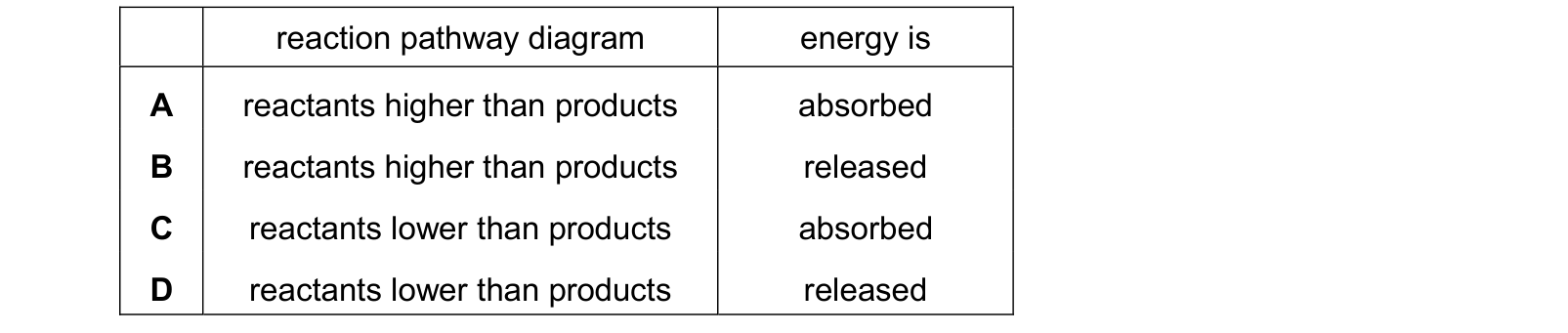
Answer: B.
Question 2
Two reaction pathway diagrams are shown. Which arrow represents the activation energy for a reaction which releases thermal energy? Use the source image for W24 Paper 21, question 14.
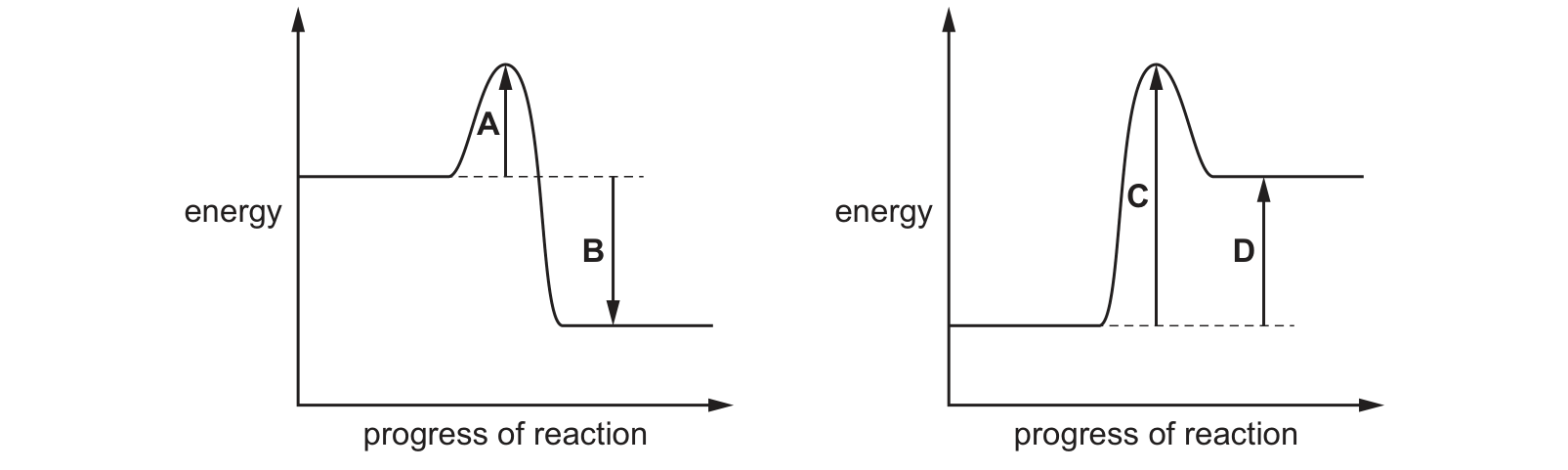
Answer: A.
Question 3
Which arrow on the energy level diagram shows the overall energy change for an endothermic reaction? Use the source image for S22 Paper 22, question 16.

Answer: B.
What the syllabus asks for on this topicSyllabus points
Syllabus points
- State that an exothermic reaction transfers thermal energy to the surroundings, so the temperature of the surroundings rises.
- State that an endothermic reaction takes in thermal energy from the surroundings, so the temperature of the surroundings falls.
- Interpret reaction pathway diagrams showing exothermic and endothermic reactions.
- Extended only: state that the thermal energy transferred is the enthalpy change, ΔH, which is negative for exothermic and positive for endothermic reactions, and define activation energy, Eₐ.
- Extended only: draw and label reaction pathway diagrams showing the reactants, the products, ΔH and Eₐ.
- Extended only: state that bond breaking is endothermic and bond making is exothermic, and calculate the enthalpy change of a reaction using bond energies.
Related CIE 0620 Chemistry topics
Not the topic you were looking for? Describe what you are stuck on in your own words and we will take you to the notes that answer it.