Formulae, functional groups and terminology
Contents: 7 sections
The kinds of formula
| Type | Ethanol written this way | What it tells you |
|---|---|---|
| Molecular | C₂H₆O | How many of each atom |
| Structural | CH₃CH₂OH | How the atoms are grouped |
| Displayed | Every atom and every bond shown | The full arrangement |
| General | CₙH₂ₙ₊₁OH | The pattern for the whole series |
A displayed formula must show every atom and every bond, including the ones inside a functional group. Three valency rules make it self-checking:
- Carbon forms four bonds.
- Hydrogen forms one.
- Oxygen forms two.
Ethanol therefore has eight bonds: one C-C, five C-H, one C-O and one O-H. Since 1 + 5 + 1 + 1 = 8, and each carbon shows four lines while the oxygen shows two, the drawing is either right or visibly wrong. Marks are lost most often for leaving the O-H bond out and writing the group as a single blob "OH".
Functional groups
A functional group is the atom or group of atoms that determines the chemical properties of a compound. The hydrocarbon chain attached to it is comparatively inert, so the group is what a reaction happens to.
| Series | Functional group drawn in text | Shorthand |
|---|---|---|
| Alkanes | none; only C-C and C-H single bonds | saturated |
| Alkenes | a carbon to carbon double bond, C=C | C=C |
| Alcohols | an O joined to a carbon and to an H, C-O-H | -OH |
| Carboxylic acids | a carbon carrying a double bonded O and an O-H, C(=O)-O-H | -COOH |
| Esters | a carbon carrying a double bonded O and an O joined to a second carbon, C(=O)-O-C | -COO- |
This is why ethanol and propan-1-ol behave almost identically and why ethanol and ethane do not. Ethanol and ethane have nearly the same carbon skeleton; the -OH group is the whole difference.
Homologous series
A homologous series is a family of similar compounds with similar chemical properties, due to the presence of the same functional group.
Five characteristics are examinable, and the wording matters:
- All members contain the same functional group.
- All members fit the same general formula.
- Each member differs from the next by CH₂, which adds 14 to the relative molecular mass.
- There is a trend in physical properties down the series.
- Members have similar chemical properties.
The alkanes show all five at once:
| Alkane | Molecular formula | Boiling point / °C |
|---|---|---|
| Methane | CH₄ | -164 |
| Ethane | C₂H₆ | -89 |
| Propane | C₃H₈ | -42 |
| Butane | C₄H₁₀ | -1 |
| Pentane | C₅H₁₂ | 36 |
Each formula gains CH₂ on the one above, and each boiling point is higher than the one above. The boiling point rises because the molecules get larger, so the attractive forces between molecules are stronger and more energy is needed to separate them. That explains, without any extra theory, why methane arrives through a pipe as a gas and pentane arrives in a bottle as a liquid.
Using a general formula
| Series | General formula |
|---|---|
| Alkanes | CₙH₂ₙ₊₂ |
| Alkenes | CₙH₂ₙ |
| Alcohols | CₙH₂ₙ₊₁OH |
| Carboxylic acids | CₙH₂ₙ₊₁COOH |
Substitute the number of carbon atoms for n.
Worked example 1. The alkane with five carbon atoms. Hydrogens = 2 × 5 + 2 = 12, so the formula is C₅H₁₂.
Worked example 2. The alkene with four carbon atoms. Hydrogens = 2 × 4 = 8, so the formula is C₄H₈.
Worked example 3. The alcohol with three carbon atoms. Take n = 3 in CₙH₂ₙ₊₁OH, giving C₃H₇OH. Collected together as a molecular formula that is C₃H₈O, because the H of the OH group joins the count.
Two traps sit in that third example. The general formula for an alcohol counts the OH hydrogen separately, so C₃H₇OH and C₃H₈O are the same compound written two ways. And in a carboxylic acid, CₙH₂ₙ₊₁COOH, the n counts only the carbons in the chain before the COOH group: ethanoic acid, CH₃COOH, has two carbons in total but n = 1.
Read backwards, a general formula also identifies a series. C₆H₁₂ fits CₙH₂ₙ with n = 6, so it is an alkene. C₆H₁₄ fits CₙH₂ₙ₊₂, so it is an alkane.
Structural isomers (Extended)
Structural isomers are compounds with the same molecular formula but different structural formulae. Core candidates do not need this section.
- C₄H₁₀ gives two: butane, CH₃CH₂CH₂CH₃, an unbranched chain of four carbons; and methylpropane, CH₃CH(CH₃)CH₃, a chain of three with a CH₃ branch on the middle carbon.
- C₃H₈O gives two alcohols: propan-1-ol, CH₃CH₂CH₂OH, with the OH on an end carbon; and propan-2-ol, CH₃CH(OH)CH₃, with the OH on the middle carbon.
- C₄H₈ gives but-1-ene, CH₂=CHCH₂CH₃, and but-2-ene, CH₃CH=CHCH₃, differing in where the double bond sits.
Isomers are different compounds with different physical properties. Propan-1-ol boils at 97 °C and propan-2-ol at 82 °C, so they can be separated by fractional distillation. Counting atoms is the check: if the two structures do not give identical molecular formulae, they are not isomers at all.
Common mistakes
- Drawing a displayed formula with a carbon showing three or five bonds.
- Writing the alcohol group as a lump "OH" in a displayed formula instead of showing the C-O and O-H bonds separately.
- Saying members of a homologous series differ by CH₃. They differ by CH₂.
- Using CₙH₂ₙ for an alkane. That is the alkene formula; alkanes are CₙH₂ₙ₊₂.
- Counting the acid carbon twice in CₙH₂ₙ₊₁COOH.
- Calling two drawings of the same molecule "isomers" because they have been turned round on the page.
- Saying isomers have identical properties. They share a molecular formula, nothing more.
Check you have it
Question 1
Which row identifies the homologous series to which the molecular structure belongs? Use the source image for M23 Paper 12, question 32.
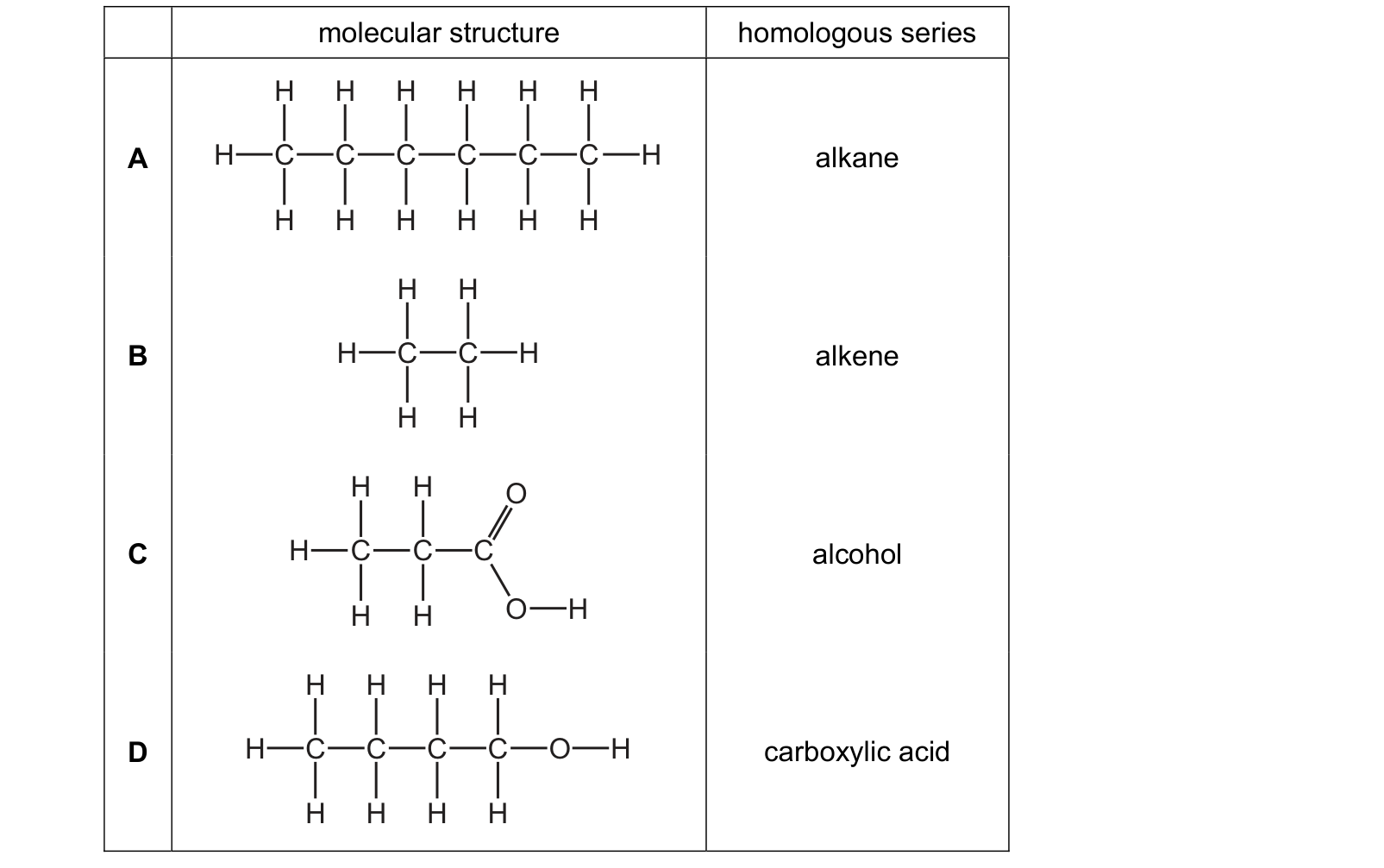
Answer: A.
Question 2
Which row shows the general formula for alkenes and for alcohols? Each answer gives, in order: alkenes; alcohols.
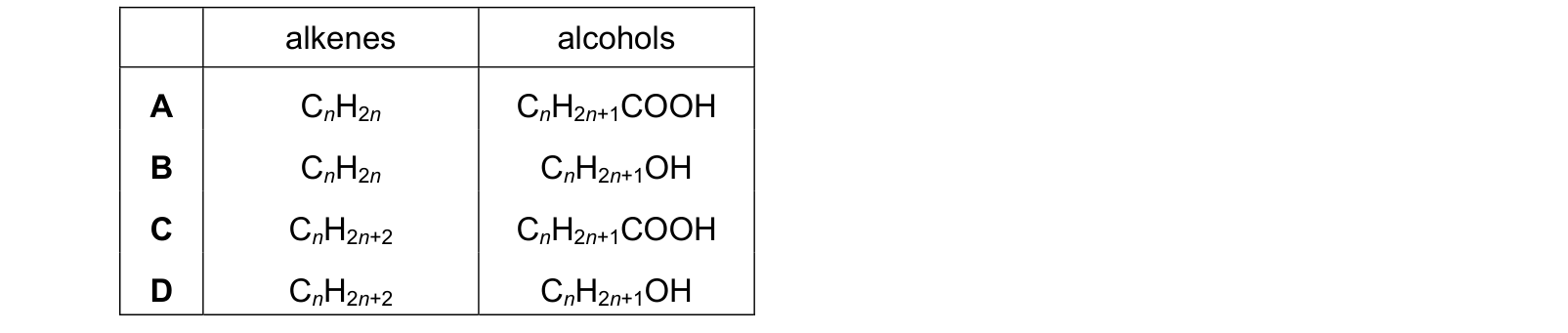
Answer: B.
Question 3
The structures of four organic molecules are shown. 1 2 H Which molecules are structural isomers of structure 1?
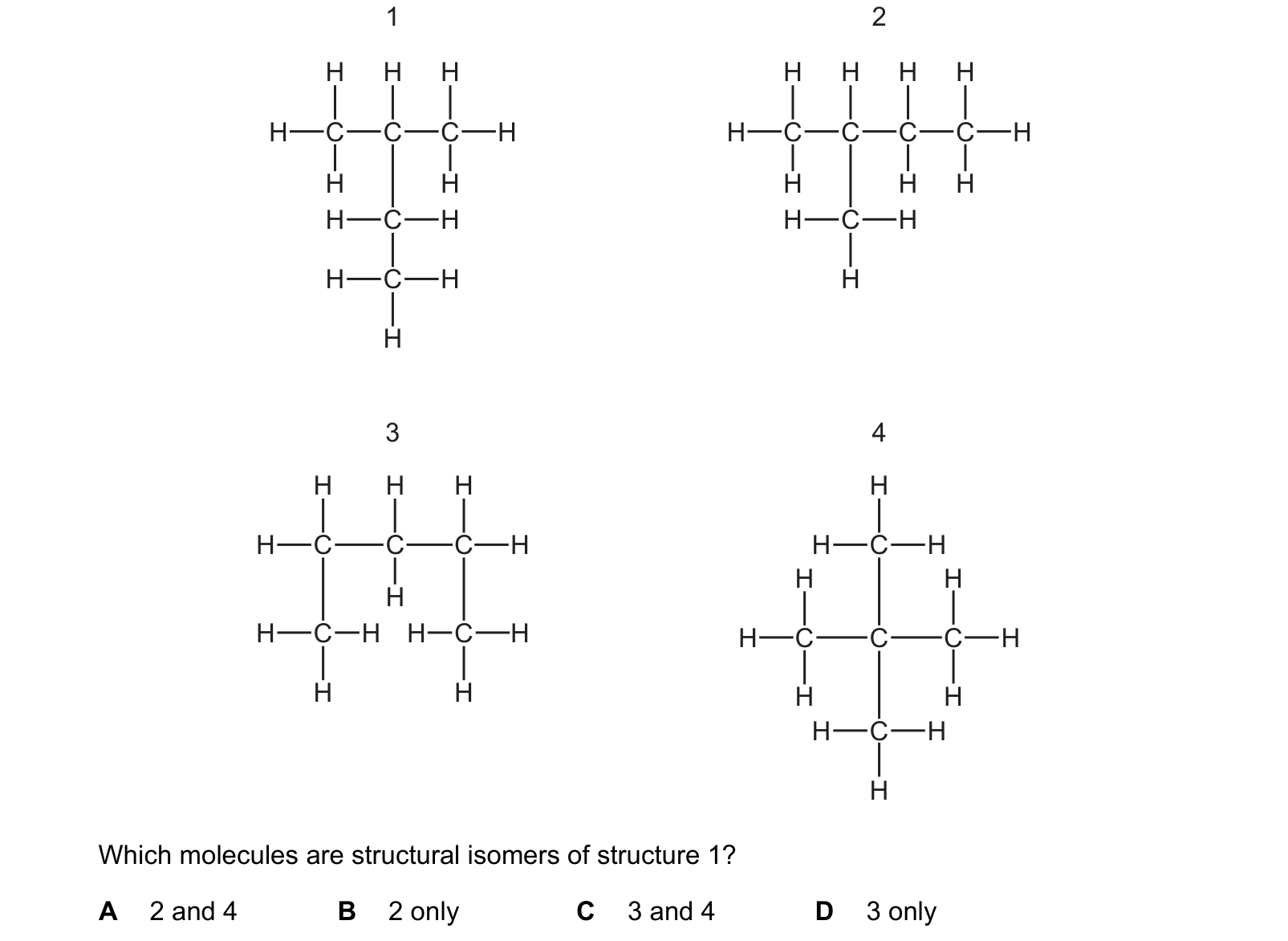
Answer: C.
What the syllabus asks for on this topicSyllabus points
Syllabus points
- Draw and interpret the displayed formula of a molecule to show all the atoms and all the bonds.
- Write and interpret the general formulae of compounds in the same homologous series.
- Understand that a functional group is the group of atoms that determines the chemical properties of a compound.
- Define a homologous series as a family of similar compounds with similar chemical properties, due to the presence of the same functional group.
- Describe the general characteristics of a homologous series.
- Extended: describe structural isomers as compounds with the same molecular formula but different structural formulae.
Related CIE 0620 Chemistry topics
Not the topic you were looking for? Describe what you are stuck on in your own words and we will take you to the notes that answer it.