Formulae, functional groups and terminology Exam Questions
31 past-paper questions on this unit. Five of them are below. Answer on the page: each one is marked the moment you pick, the correct option is shown whether or not you found it, and the full explanation opens either way.
CIE 0620 ChemistryPaper 1 and Paper 2 MCQsFree account
Formulae, functional groups and terminology: five questions to try now
Real past-paper questions, the answer key from the mark scheme, and the explanation that goes with it. No account needed to answer them.
Question 1
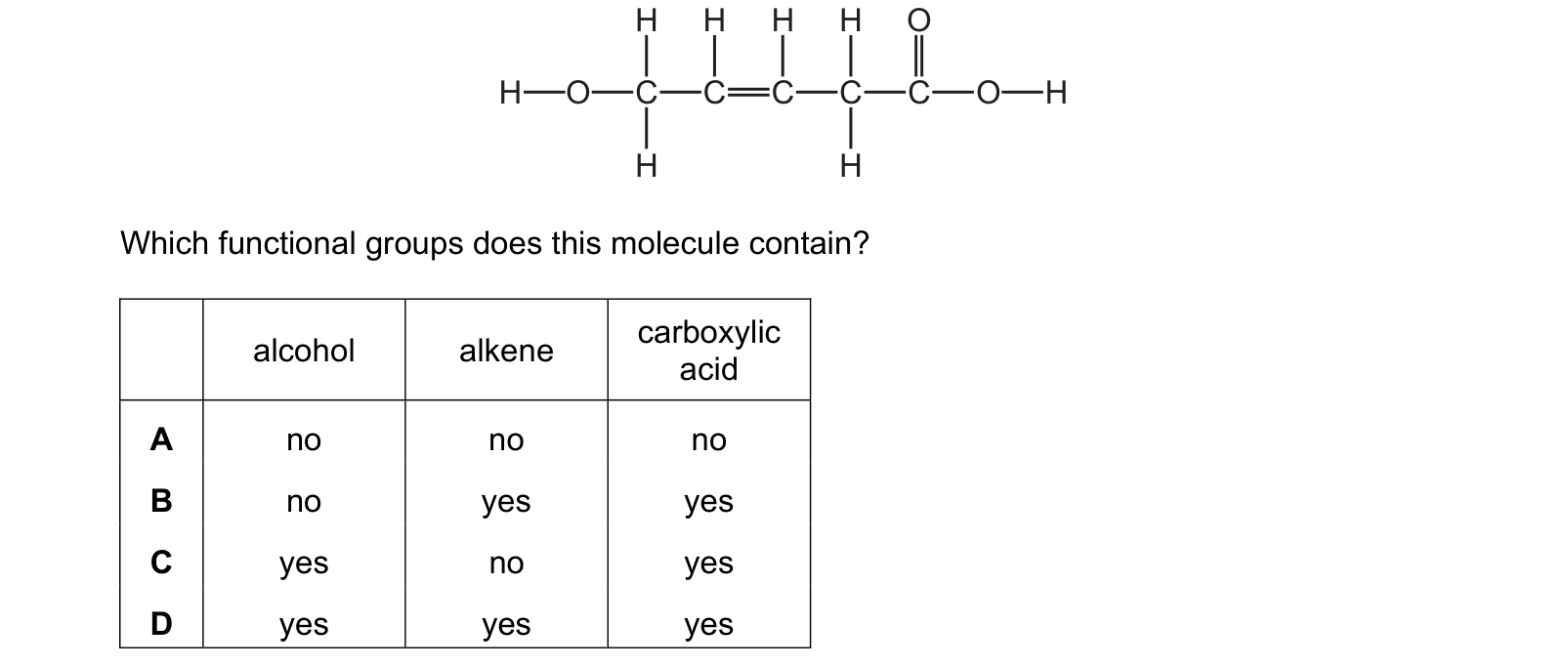
The structure of an organic molecule is shown. H H H H O Which functional groups does this molecule contain? Each answer gives, in order: alcohol; alkene; carboxylic acid.
Answer: D.
Work along the chain and name every group met on the way. At the left end an oxygen atom sits between a hydrogen atom and a carbon atom, which is an OH group on a saturated carbon and therefore the alcohol group. In the middle two carbon atoms are joined by a double bond, so the alkene group is there as well. At the right end one carbon carries a double bonded oxygen and an OH, and those together make COOH, the carboxylic acid group, so every column deserves a yes. Rows answering no to the alcohol usually treat the OH of the COOH group as the only OH in the molecule and overlook the separate one at the far end.
Question 2
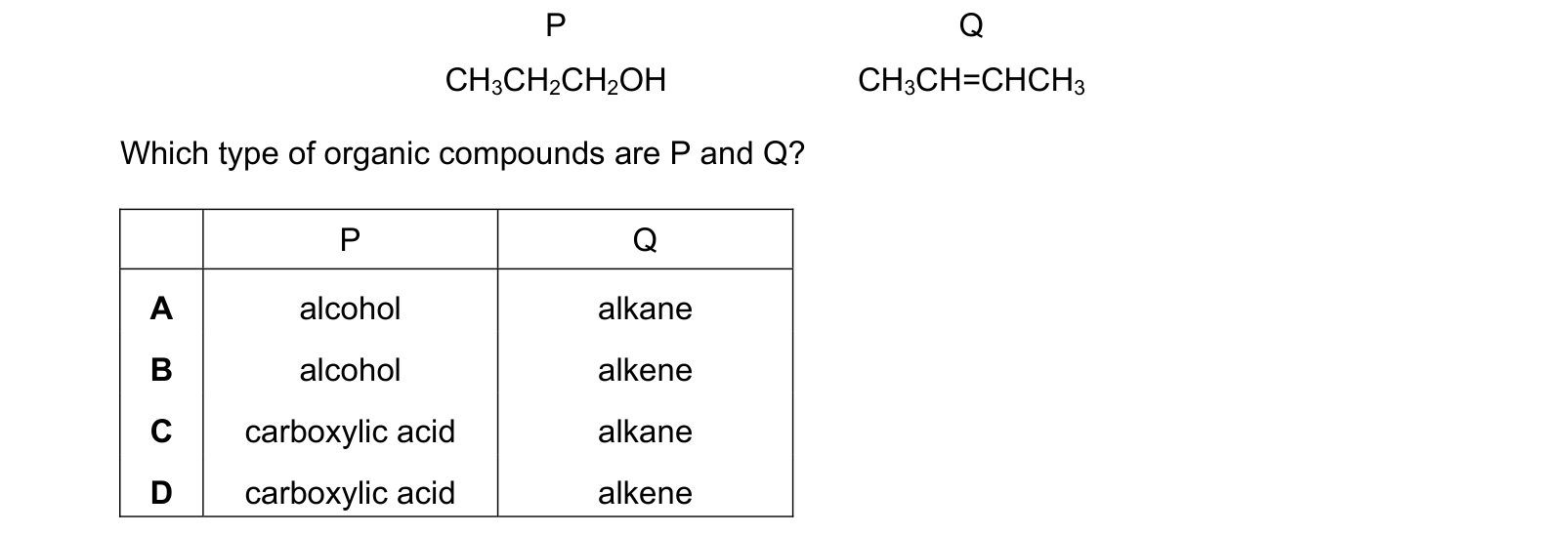
The formulae of two organic compounds, P and Q, are shown. P Q CH3CH2CH2OH CH3CH=CHCH3 Which type of organic compounds are P and Q? Each answer gives, in order: P; Q.
Answer: B.
Reading each formula for its functional group is what settles the series. P is CH3CH2CH2OH, a chain of three carbons ending in an OH group, which makes it an alcohol; a carboxylic acid would need the whole COOH group, with a double bonded oxygen alongside the OH. Q is CH3CH=CHCH3, and the equals sign marks a carbon to carbon double bond, which makes it an alkene rather than an alkane, since an alkane carries single bonds throughout. Rows calling P a carboxylic acid have seen the OH and stopped there, missing the second oxygen that an acid group requires. Rows calling Q an alkane have ignored the double bond, which is the one feature separating the two hydrocarbon series.
Question 3
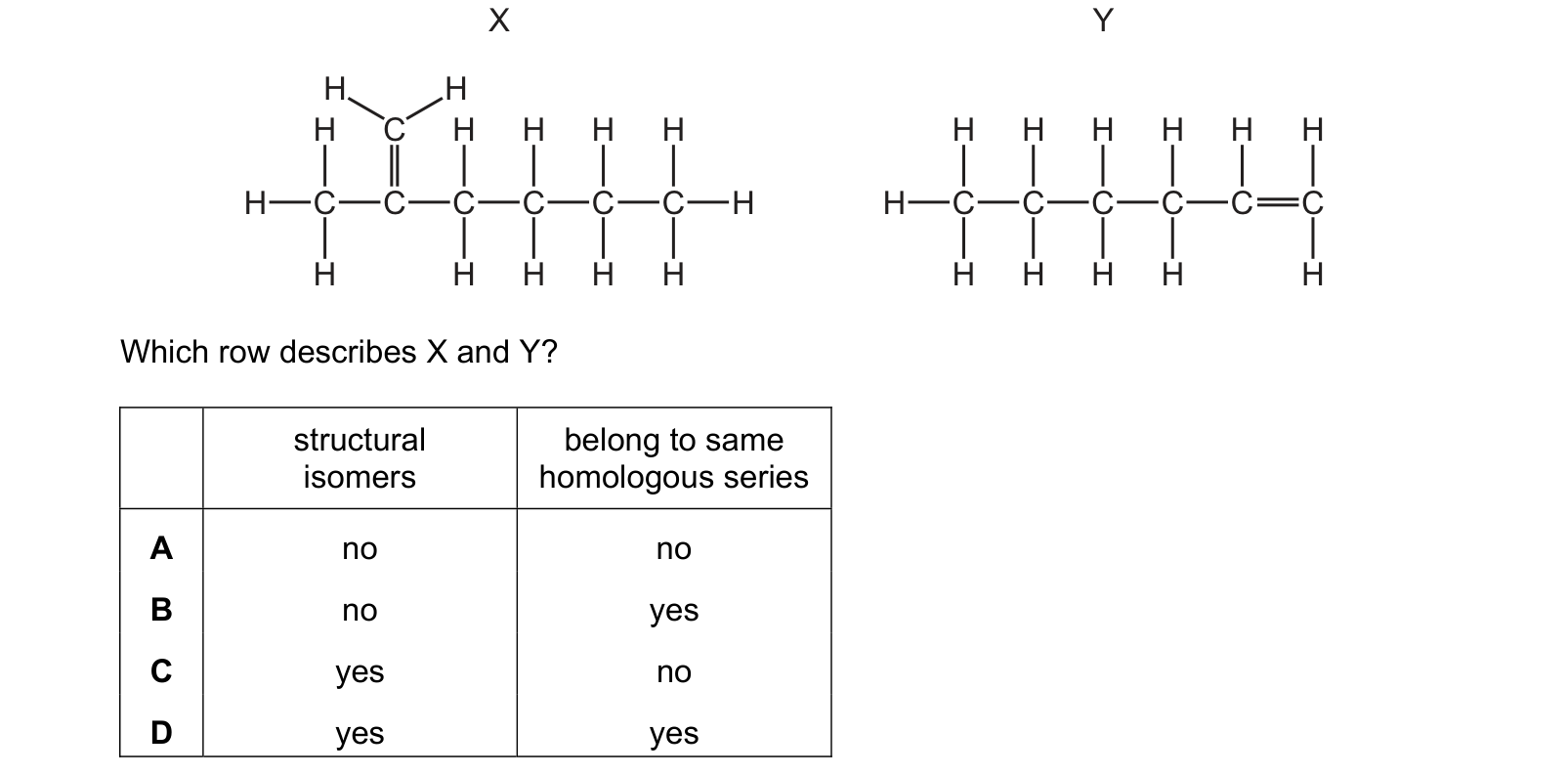
The structures of two molecules, X and Y, are shown. X Y Which row describes X and Y? Each answer gives, in order: structural isomers; belong to same homologous series.
Answer: B.
Count the atoms in each structure before deciding either column. X has six carbon atoms in its chain plus one more in the CH2 group double bonded to the second carbon, making seven, and its hydrogen atoms come to 14, so X is C7H14. Y is a six-carbon chain with the double bond at the end, which makes it C6H12. Different molecular formulae mean the two cannot be structural isomers, so the first column is no. Both fit CnH2n and both contain a C=C, so both are alkenes and the second column is yes, since a homologous series is expected to contain members of different sizes.
Question 4
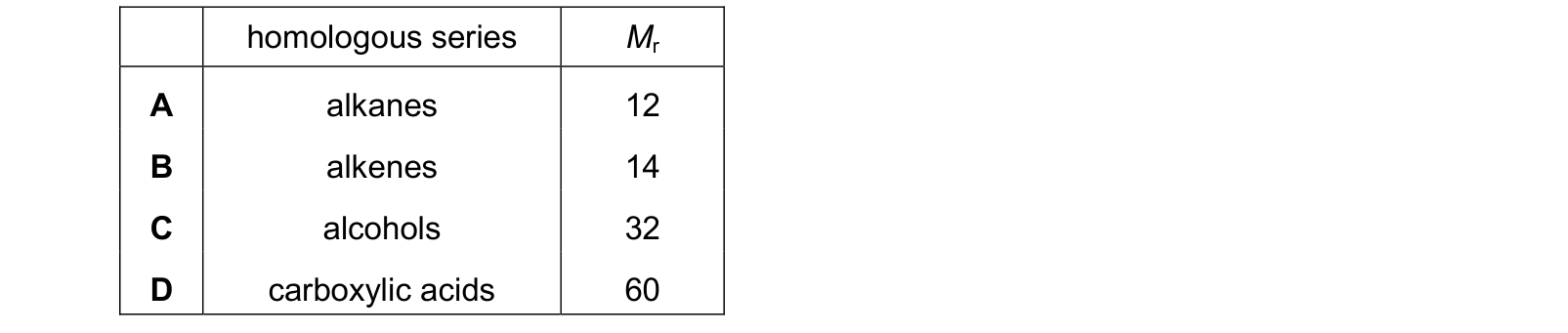
Which row gives the relative molecular mass, Mr, of the first member of the named homologous series? Each answer gives, in order: homologous series; Mr.
Answer: C.
The first member of a series is the one with fewest carbon atoms, so each row has to be checked by naming that compound before working out its Mr. Alcohols begin with methanol, CH3OH, and 12 + 4 + 16 gives an Mr of 32, so that row stands. Alkanes begin with methane, CH4, whose Mr is 12 + 4 = 16 rather than the 12 offered, and 12 is the mass of a bare carbon atom on its own. Alkenes begin with ethene, C2H4, because an alkene needs two carbons to carry a double bond, and its Mr is 24 + 4 = 28 rather than 14. Carboxylic acids begin with methanoic acid, HCOOH, whose Mr is 12 + 2 + 32 = 46, while 60 is actually the Mr of ethanoic acid, the second member of that series.
Question 5
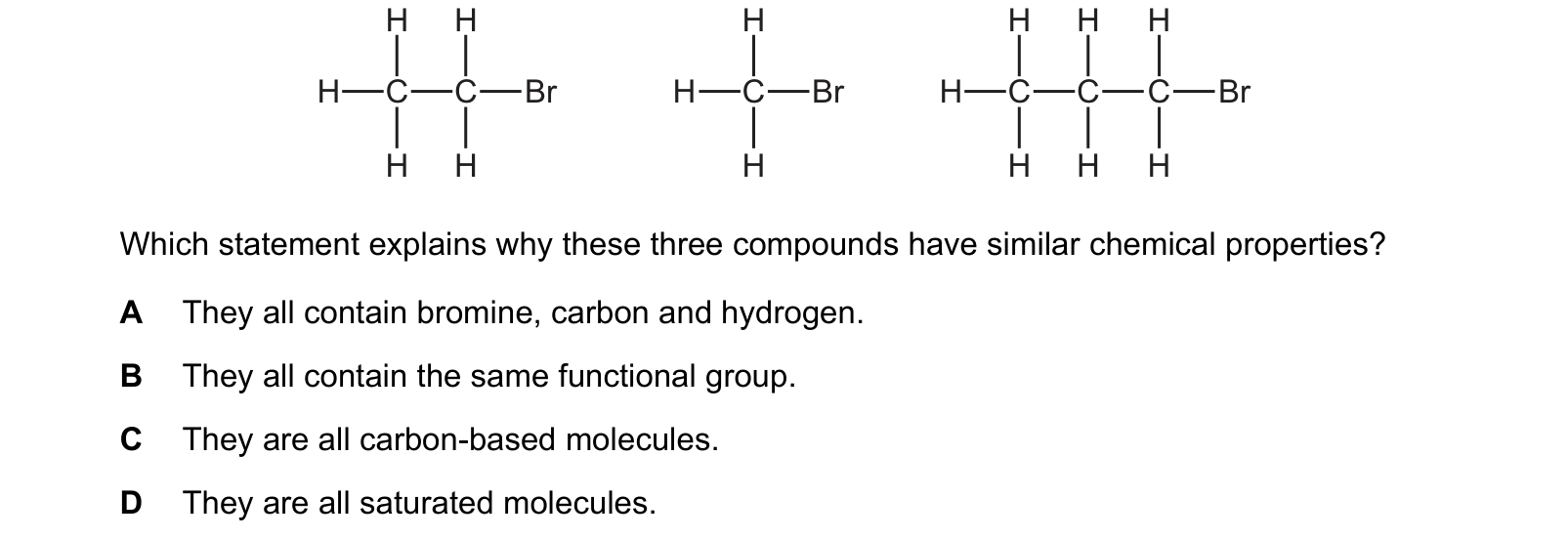
The structures of three compounds are shown. H H H H H H Which statement explains why these three compounds have similar chemical properties?
Answer: B.
All three structures end in a carbon atom bonded to a bromine atom, and that group is the functional group they share, which is why their reactions are alike. Saying they all contain bromine, carbon and hydrogen is a statement about elements rather than structure, and compounds built from the same elements can behave very differently, as ethanol and ethanoic acid do. Being carbon-based is true of every organic compound on the syllabus, so it cannot explain why these three in particular resemble one another. Being saturated is true here too, but alkanes and alcohols are both saturated and their chemistry is nothing alike, so saturation is not what fixes the reactions.
These questions are drawn from past CIE 0620 Chemistry papers and filtered to formulae, functional groups and terminology. You answer, you find out immediately whether you were right, and you get the reasoning for the correct option and for each distractor. Wrong answers go to a mistakes locker so you can come back to exactly those.
Practice is free. You need an account only so your progress and your mistakes are still there next time.
These are the errors that cost marks on formulae, functional groups and terminology, taken from our own topic notes. Read them before you practise and you will recognise the traps in the questions.
Drawing a displayed formula with a carbon showing three or five bonds.
Writing the alcohol group as a lump "OH" in a displayed formula instead of showing the C-O and O-H bonds separately.
Saying members of a homologous series differ by CH₃. They differ by CH₂.
Using CₙH₂ₙ for an alkane. That is the alkene formula; alkanes are CₙH₂ₙ₊₂.
Counting the acid carbon twice in CₙH₂ₙ₊₁COOH.
Calling two drawings of the same molecule "isomers" because they have been turned round on the page.
Saying isomers have identical properties. They share a molecular formula, nothing more.