Alkenes
Contents: 7 sections
What an alkene is
General formula CₙH₂ₙ. Every alkene contains one carbon to carbon double bond, C=C, and that bond is the functional group.
An alkene is unsaturated, which means atoms can be added across the double bond without anything being removed. That single property drives every reaction below.
| Alkene | Molecular formula | Structural formula |
|---|---|---|
| Ethene | C₂H₄ | CH₂=CH₂ |
| Propene | C₃H₆ | CH₃CH=CH₂ |
| But-1-ene | C₄H₈ | CH₂=CHCH₂CH₃ |
| But-2-ene | C₄H₈ | CH₃CH=CHCH₃ |
There is no alkene with a single carbon atom, because a C=C bond needs two carbons. Drawn in full, ethene has two carbons joined by a double line, with two C-H bonds on each carbon, so each carbon still shows four bonds in total.
Cracking
Cracking is the breaking down of larger, less useful, saturated hydrocarbon molecules into smaller, more useful ones, some of which are unsaturated.
Conditions: a high temperature of about 600 to 700 °C, and a catalyst of silica or aluminium oxide.
Fractional distillation gives a refinery far more long-chain fuel oil than it can sell and far less petrol than it needs. Cracking converts the surplus into the shortage, and produces the alkenes the chemical industry needs, which crude oil does not contain at all.
Typical equations:
C₁₀H₂₂ → C₈H₁₈ + C₂H₄
C₁₂H₂₆ → C₁₀H₂₂ + C₂H₄
C₈H₁₈ → C₆H₁₄ + C₂H₄
The first breaks decane into octane, a petrol-range alkane, plus ethene. The ten carbons on the left reappear as eight plus two on the right, and the twenty-two hydrogens as eighteen plus four. Every cracking equation must balance in exactly that way: nothing is added and nothing is lost, the molecule is only broken.
Cracking also makes hydrogen, when the fragment removed is H₂ rather than a small alkene:
C₄H₁₀ → C₄H₈ + H₂
C₂H₆ → C₂H₄ + H₂
That hydrogen is a valuable product in its own right, used in the Haber process and in hydrogenation.
In the laboratory, medicinal paraffin soaked into mineral wool is heated at one end of a boiling tube, its vapour is passed over broken pot or aluminium oxide heated strongly with a Bunsen burner, and the gaseous product is collected over water. Remove the delivery tube from the water before you stop heating, or cold water sucks back into the hot tube and cracks it.
The test for unsaturation
Add aqueous bromine, also called bromine water, and shake.
| Compound | Result |
|---|---|
| Unsaturated, such as ethene | The orange or brown colour turns colourless |
| Saturated, such as ethane | No change; it stays orange or brown |
The bromine adds across the double bond, and since the product is colourless the bromine colour disappears. An alkane has no double bond to add across, so nothing happens.
Say colourless, never "clear" and never "white". A solution can be clear and still orange, so "clear" earns nothing.
Addition reactions (Extended)
In an addition reaction the double bond opens and two atoms or groups join on, one to each of the two carbons, leaving a single product with no by-product at all. Compare that with substitution in 11.4, where an atom is swapped and HCl comes off.
With bromine
Conditions: room temperature. No catalyst and no light are needed.
CH₂=CH₂ + Br₂ → CH₂BrCH₂Br
The product is 1,2-dibromoethane: two carbons joined by a single bond, each carrying two hydrogens and one bromine. The name records that the two bromines sit on carbons 1 and 2, which is where they must be, since one goes to each end of the old double bond.
Propene behaves the same way, giving 1,2-dibromopropane, CH₂BrCHBrCH₃.
With hydrogen
Conditions: 150 °C with a nickel catalyst.
CH₂=CH₂ + H₂ → CH₃CH₃
The alkene becomes the corresponding alkane, so ethene gives ethane and propene gives propane. The reaction is called hydrogenation, and it is used industrially to convert unsaturated vegetable oils into the saturated fats that make margarine solid at room temperature.
With steam
Conditions: 300 °C, 60 atmospheres pressure, and a phosphoric acid catalyst.
CH₂=CH₂ + H₂O → CH₃CH₂OH
The product is ethanol. The H and the OH from the water molecule add across the double bond, one to each carbon. This is the industrial hydration of ethene, and it is the second of the two routes to ethanol covered in 11.6.
All three conditions are examined by name. "Suitable conditions" scores nothing; the marks are for 150 °C and nickel, and for 300 °C, 60 atmospheres and phosphoric acid.
Why alkenes are more reactive than alkanes
An alkane has only strong single bonds and nothing for a reagent to attack, so it needs ultraviolet light before chlorine will touch it. An alkene has a C=C double bond, which is a region of high electron density and a ready site for addition, so bromine reacts with it at room temperature in the dark.
That difference is the whole reason the bromine water test works, and it is the reason alkenes, not alkanes, are the feedstock for making alcohols and polymers.
Common mistakes
- Writing the bromine water result as "clear" or "white" instead of colourless.
- Saying the alkane also decolourises bromine water, just more slowly. It does not react at all.
- Writing an addition product with a by-product, such as CH₂=CH₂ + Br₂ → CH₂BrCH₂Br + HBr. Addition has one product only.
- Putting both bromines on the same carbon.
- Giving a cracking equation that does not balance, or one whose products are all saturated.
- Confusing the two catalysts: nickel is for hydrogen, phosphoric acid is for steam.
- Saying cracking needs a high pressure. The stated conditions are high temperature and a catalyst.
Check you have it
Question 1
Some reactions of substance Q are shown.
add steam under pressure and a catalyst add bromine ethanol is made Q 1,2-dibromoethane is made add hydrogen and a catalyst
P
What is P?
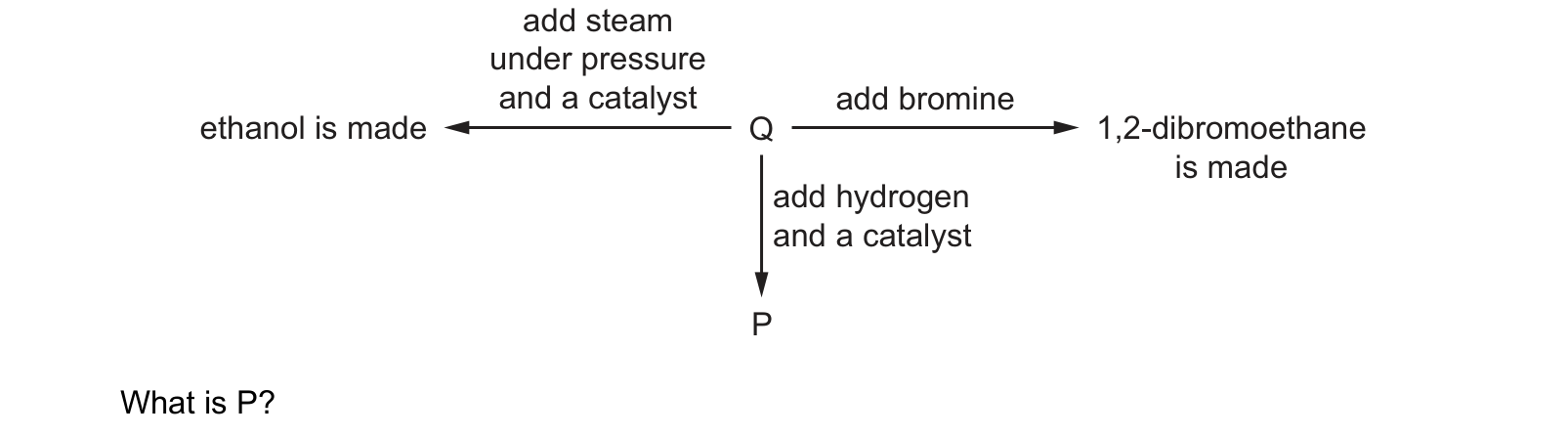
Answer: A.
Question 2
A hydrocarbon W burns to form carbon dioxide and water. W decolourises bromine water. What is the name of W and what is its structure? Each answer gives, in order: name of W; structure of W H H.
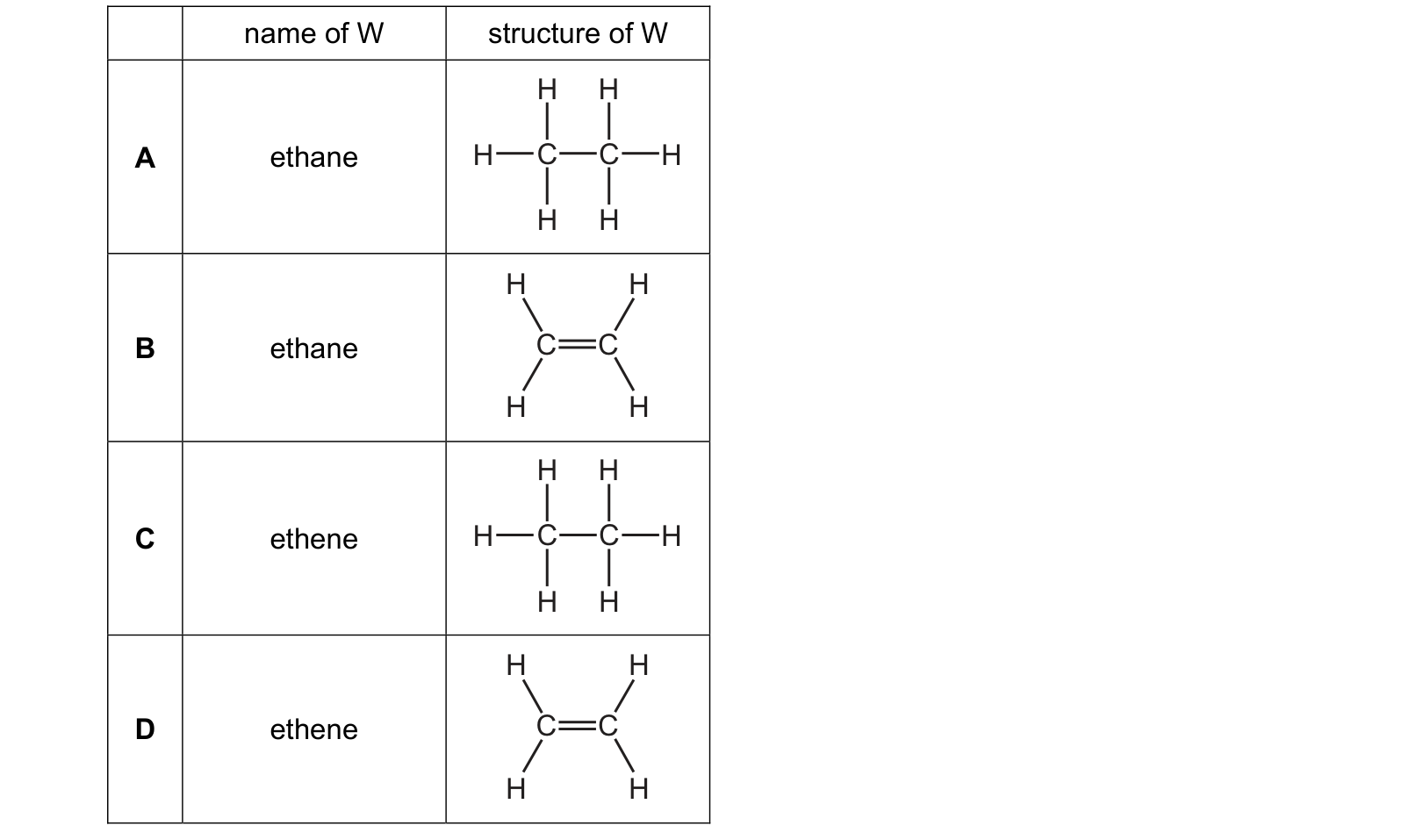
Answer: D.
Question 3
Ethene can be polymerised. Which diagram represents the structure of the product formed? Use the source image for W23 Paper 12, question 37.

Answer: C.
What the syllabus asks for on this topicSyllabus points
Syllabus points
- State that alkenes are unsaturated hydrocarbons with the general formula CₙH₂ₙ, containing a C=C double bond.
- Describe the manufacture of alkenes and of hydrogen by the cracking of larger alkane molecules, using a high temperature and a catalyst.
- Describe the test that distinguishes saturated from unsaturated compounds, using aqueous bromine.
- Extended: describe the addition reactions of alkenes with bromine, with hydrogen and with steam, giving the reagents and conditions.
Related CIE 0620 Chemistry topics
Not the topic you were looking for? Describe what you are stuck on in your own words and we will take you to the notes that answer it.