59 past-paper questions on this unit. Five of them are below. Answer on the page: each one is marked the moment you pick, the correct option is shown whether or not you found it, and the full explanation opens either way.
CIE 0620 ChemistryPaper 1 and Paper 2 MCQsFree account
Alkenes: five questions to try now
Real past-paper questions, the answer key from the mark scheme, and the explanation that goes with it. No account needed to answer them.
Question 1
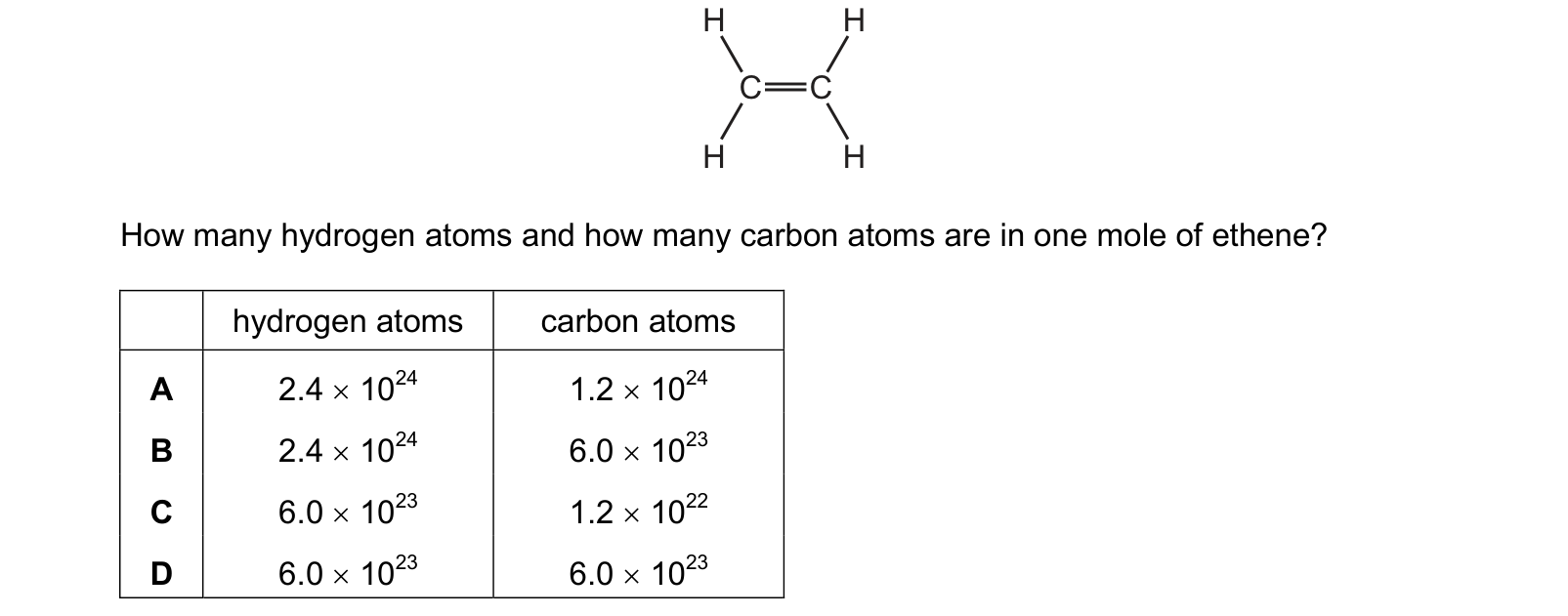
The structure of ethene is shown. How many hydrogen atoms and how many carbon atoms are in one mole of ethene? Each answer gives, in order: hydrogen atoms; carbon atoms.
Answer: A.
One mole of any substance contains 6.0 x 10 to the 23 particles, and ethene is C2H4, so one mole of ethene molecules holds twice that number of carbon atoms and four times that number of hydrogen atoms. Four lots of 6.0 x 10 to the 23 gives 2.4 x 10 to the 24 hydrogen atoms, and two lots gives 1.2 x 10 to the 24 carbon atoms. The row offering 6.0 x 10 to the 23 carbon atoms has counted the molecules instead of the carbon atoms within them, forgetting the subscript 2. The row offering 6.0 x 10 to the 23 hydrogen atoms makes the same slip on the other element, ignoring the 4 in the formula. Treating the subscripts as multipliers of Avogadro's constant is the whole of the method here.
Question 2
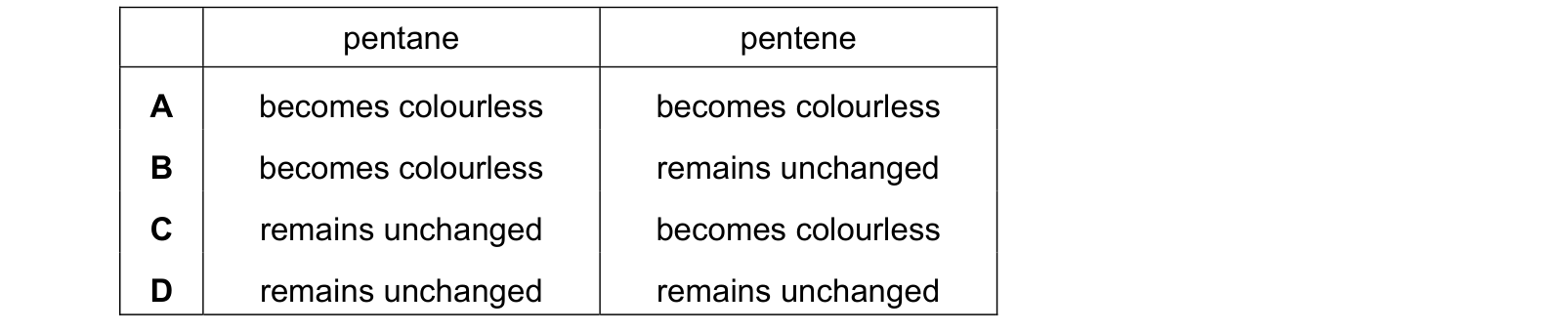
Pentane is an alkane and pentene is an alkene. What is observed when bromine water is added to a sample of each compound? Each answer gives, in order: pentane; pentene.
Answer: C.
Bromine water tests for unsaturation, and what it actually detects is a carbon to carbon double bond. Pentene, C5H10, is an alkene, so bromine adds across that double bond to form a colourless dibromo compound and the orange colour of the bromine water disappears. Pentane, C5H12, is saturated, every carbon atom already holding four single bonds, so there is nothing for bromine to add to and the orange colour stays. The row that has both samples going colourless treats this as a test for hydrocarbons in general, when an alkane gives no visible change whatever, and the row that reverses the results has the saturated compound reacting while the unsaturated one sits inert.
Question 3
Propene, C3H6, reacts with bromine, Br2, in an addition reaction. Which structure represents the product of this reaction? Use the source image for M22 Paper 22, question 38.
Answer: C.
Addition across a double bond puts one atom of the added molecule onto each of the two carbon atoms that were sharing it. Propene is CH3CH=CH2, so bromine goes onto the two carbon atoms at the right-hand end and the product is CH2BrCHBrCH3, with the bromine atoms on neighbouring carbon atoms and every carbon still holding four bonds. The structure carrying both bromine atoms on one central carbon cannot come from an addition, since the opened double bond has two carbon atoms to share the pair between. Putting a bromine atom on each end of the chain would need the double bond to have joined carbon 1 to carbon 3, which no double bond does, and the structure showing a single bromine atom is a substitution product of propane rather than an addition product of propene.
Question 4
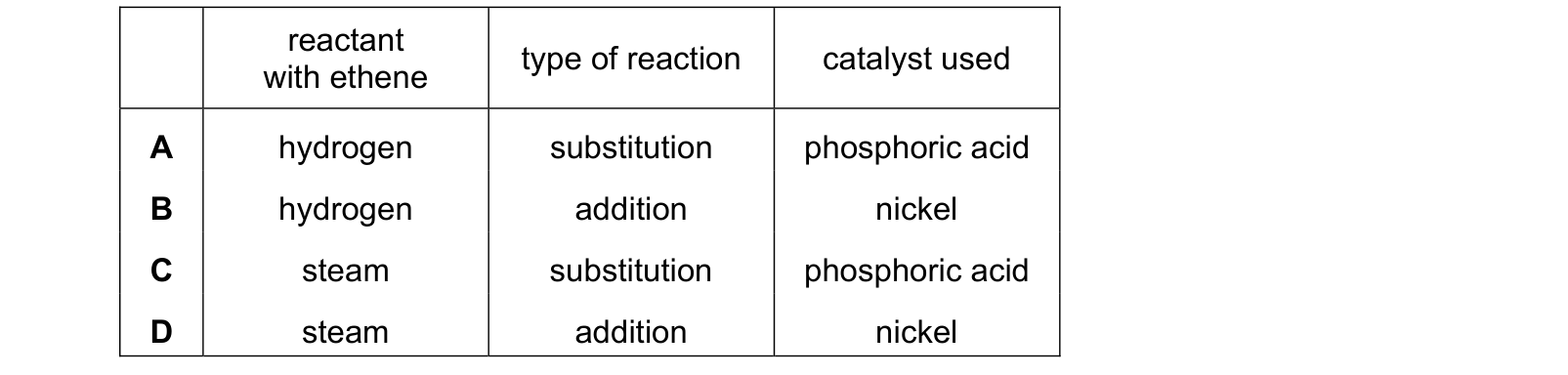
Ethene reacts with both hydrogen and steam. Which row about these reactions is correct? Each answer gives, in order: reactant with ethene; type of reaction; catalyst used.
Answer: B.
Ethene reacts with both of these by addition, because its double bond opens and the whole of the added molecule joins on, so any row calling either reaction a substitution fails at once. The catalyst is what separates the two, since hydrogen adds across the double bond over nickel, the reaction used to harden vegetable oils into margarine, while steam adds over phosphoric acid to give ethanol. The row pairing hydrogen with nickel therefore has both the reaction type and the catalyst right. Pairing steam with nickel keeps the correct type but borrows the catalyst from the hydrogenation.
Question 5
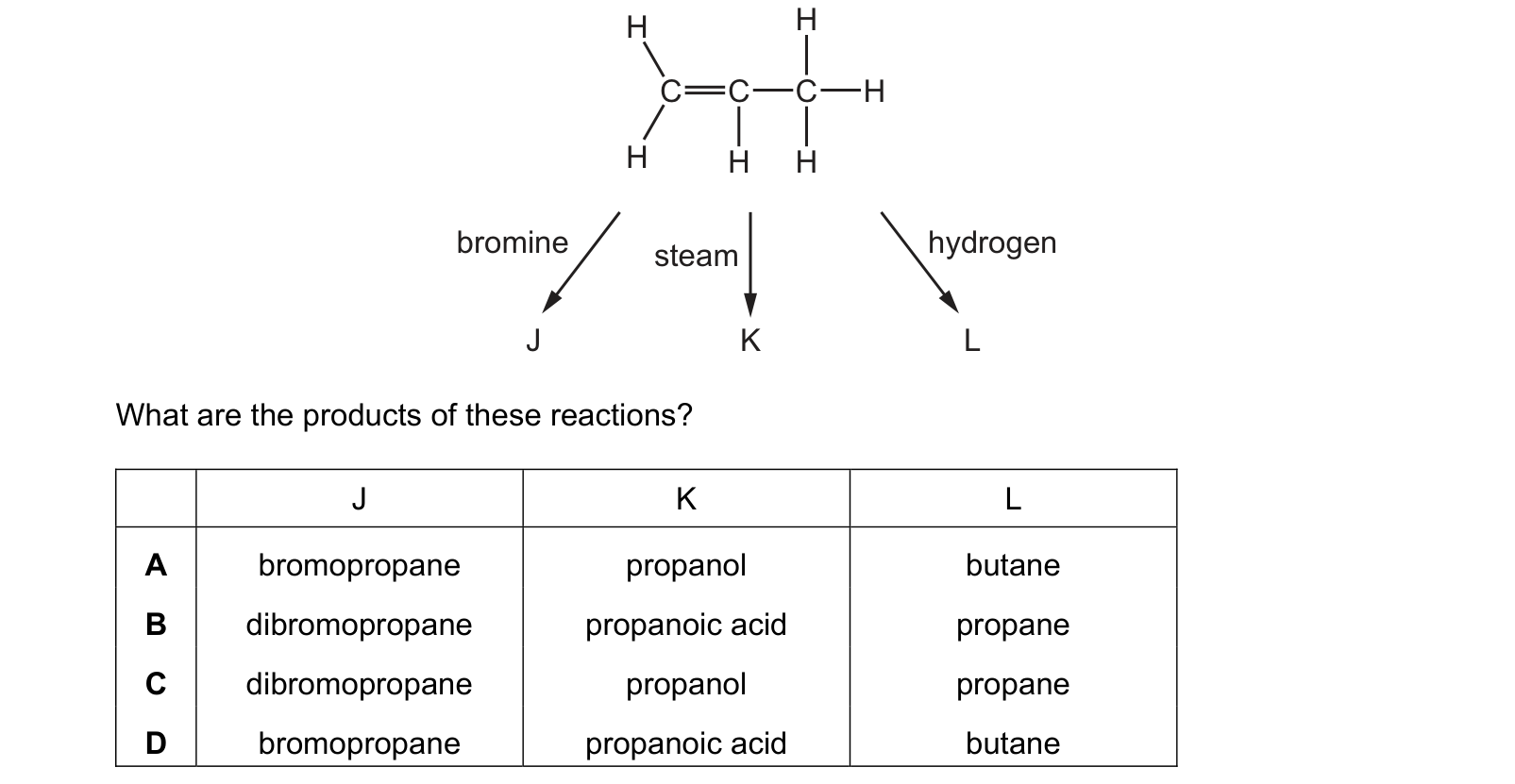
Propene is an alkene that reacts with bromine, steam and hydrogen as shown. H H What are the products of these reactions? Each answer gives, in order: J; K; L.
Answer: C.
Each reagent adds across the double bond of propene, so nothing is lost and no carbon atom is gained. Bromine puts one bromine atom on each of the two carbon atoms, giving dibromopropane, and a product with a single bromine atom would be a substitution product rather than an addition one. Steam adds H and OH, so that product is an alcohol, propanol, whereas propanoic acid would require an oxidation and steam cannot oxidise anything. Hydrogen adds one atom to each carbon and gives propane, while butane is impossible, since an addition of H2 cannot raise the carbon count from three to four.
These questions are drawn from past CIE 0620 Chemistry papers and filtered to alkenes. You answer, you find out immediately whether you were right, and you get the reasoning for the correct option and for each distractor. Wrong answers go to a mistakes locker so you can come back to exactly those.
Practice is free. You need an account only so your progress and your mistakes are still there next time.
These are the errors that cost marks on alkenes, taken from our own topic notes. Read them before you practise and you will recognise the traps in the questions.
Writing the bromine water result as "clear" or "white" instead of colourless.
Saying the alkane also decolourises bromine water, just more slowly. It does not react at all.
Writing an addition product with a by-product, such as CH₂=CH₂ + Br₂ → CH₂BrCH₂Br + HBr. Addition has one product only.
Putting both bromines on the same carbon.
Giving a cracking equation that does not balance, or one whose products are all saturated.
Confusing the two catalysts: nickel is for hydrogen, phosphoric acid is for steam.
Saying cracking needs a high pressure. The stated conditions are high temperature and a catalyst.
Revise it first
If any of the above is unfamiliar, work through the notes before practising: Alkenes revision notes.