Fuels
Contents: 7 sections
The three fossil fuels
Coal, natural gas and petroleum are the fossil fuels. All three formed from the remains of organisms buried millions of years ago and compressed under heat and pressure, and all three are finite: they are being used far faster than they form.
Natural gas is mostly methane, CH₄. It burns completely in a good supply of air:
CH₄ + 2O₂ → CO₂ + 2H₂O
Petroleum, also called crude oil, is a mixture of hydrocarbons. As it comes out of the ground it is useless: a thick dark liquid whose components have boiling points ranging from below room temperature to well over 350 °C.
A hydrocarbon is a compound containing hydrogen and carbon only. Methane, ethane, ethene and butane are hydrocarbons. Ethanol, CH₃CH₂OH, is not, because it also contains oxygen, and neither is ethanoic acid. Questions test that definition by offering a compound with an oxygen atom in it.
Fractional distillation of petroleum
The separation works because the different hydrocarbons have different boiling points, and they have different boiling points because their molecules are different sizes. A larger molecule has stronger attractive forces to its neighbours, so more energy is needed to pull it into the vapour.
The industrial process:
- Crude oil is heated in a furnace to roughly 350 °C, so most of it vaporises.
- The hot vapour is fed into the bottom of a tall fractionating column.
- The column is hot at the bottom and cooler towards the top, a gradient from about 350 °C to about 25 °C.
- The vapours rise. Each hydrocarbon condenses when it reaches a tray whose temperature is below its own boiling point.
- Long molecules have high boiling points, so they condense low down. Short molecules stay as vapour longer and condense high up. The shortest of all leave the top still as gases.
- The liquid collected at each tray is a fraction, drawn off through a side pipe.
A fraction is still a mixture, not a pure compound. It contains molecules within a narrow range of chain lengths, collected over a range of boiling points, which is why a fraction has no single sharp boiling point.
The fractions and their uses
| Fraction | Approximate carbon atoms | Use |
|---|---|---|
| Refinery gas | 1 to 4 | Heating and cooking |
| Gasoline (petrol) | 5 to 10 | Fuel in cars |
| Naphtha | 8 to 12 | Chemical feedstock for making other compounds |
| Kerosene (paraffin) | 10 to 16 | Jet fuel |
| Diesel oil (gas oil) | 14 to 20 | Fuel in diesel engines |
| Fuel oil | 20 to 30 | Fuel in ships, and home heating systems |
| Lubricating oil | 30 to 40 | Lubricants, waxes and polishes |
| Bitumen | more than 70 | Making roads |
Learn the list in order, top of the column to bottom. The order is the exam question as often as any individual use is, because a fraction's position tells you its chain length and its chain length tells you its properties.
Naphtha is the odd one out: it is not burnt. It is the feedstock from which plastics, detergents, dyes and medicines are made.
Trends down the column
Going down the column, so towards longer chains:
| Property | Change going down |
|---|---|
| Number of carbon atoms per molecule | Increases |
| Boiling point | Increases |
| Viscosity | Increases, so the liquid is thicker and flows less easily |
| Colour | Darkens |
| Volatility | Decreases |
| Ease of ignition | Decreases, so it is harder to set alight |
Every one of these follows from molecular size. Bigger molecules attract each other more strongly, so more energy is needed to separate them: hence a higher boiling point, lower volatility and higher viscosity.
The practical consequence is worth stating. Refinery gas ignites from a spark and burns with a clean flame. Bitumen has to be heated to a few hundred degrees before it will flow at all, and it never burns cleanly, which is exactly why one is piped into a kitchen and the other is spread on a road.
Note carefully that ease of ignition and boiling point move in opposite directions. Petrol has a low boiling point and catches fire easily; fuel oil has a high boiling point and is hard to light. A question asking which fraction ignites most easily wants the one nearest the top.
Supply and demand
Crude oil does not come out of the ground in the proportions the world wants. The short-chain fractions, petrol and naphtha, are in heavy demand and are a small part of the barrel; the long-chain fractions, fuel oil and bitumen, are a large part and are wanted much less.
The industry closes that gap by cracking, which breaks long-chain alkanes into shorter alkanes plus alkenes. That is the subject of 11.5, and the surplus of heavy fractions is the commercial reason it exists.
Common mistakes
- Calling ethanol a hydrocarbon. A hydrocarbon contains carbon and hydrogen only.
- Saying fractional distillation separates petroleum into pure compounds. Each fraction is still a mixture.
- Saying the column is cool at the bottom. It is hottest at the bottom, where the vapour enters.
- Saying long-chain molecules rise highest. They have the highest boiling points, so they condense lowest.
- Saying viscosity decreases down the column. It increases; the fractions get thicker.
- Giving naphtha as a fuel. It is the chemical feedstock.
- Naming coal as the main constituent of natural gas. The answer is methane.
Check you have it
Question 1
The pie chart represents the composition of natural gas. Which sector represents methane? Use the source image for M21 Paper 12, question 35.

Answer: D.
Question 2
The pie chart represents the composition of natural gas. Which sector represents methane? Use the source image for M21 Paper 22, question 35.

Answer: D.
Question 3
Fuel oil and naphtha are two fractions obtained from petroleum. What are the major uses of these fractions? Each answer gives, in order: fuel oil; naphtha.
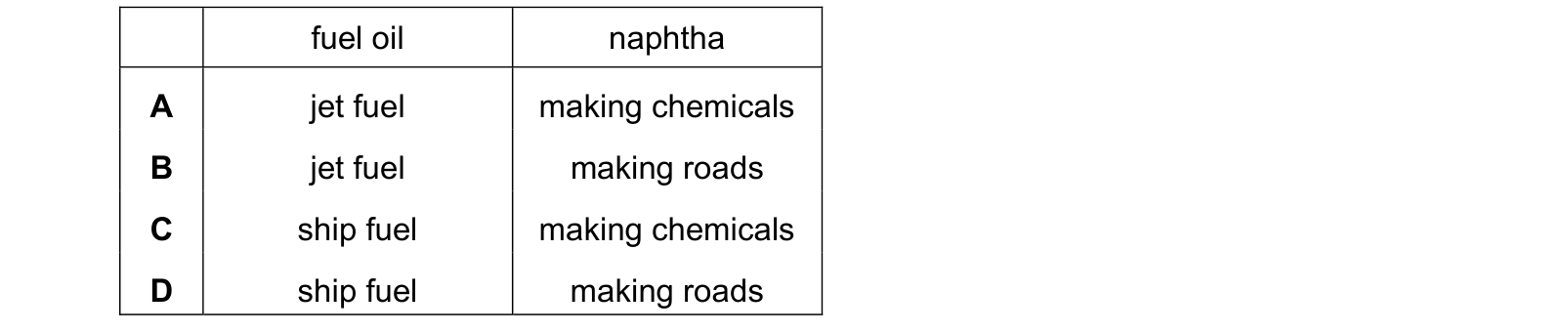
Answer: C.
What the syllabus asks for on this topicSyllabus points
Syllabus points
- Name the fossil fuels: coal, natural gas and petroleum.
- Name methane as the main constituent of natural gas.
- State that hydrocarbons are compounds that contain hydrogen and carbon only.
- Describe petroleum as a mixture of hydrocarbons, and describe its separation into useful fractions by fractional distillation.
- Describe how the properties of the molecules within a fraction change down the column.
- Name the uses of each fraction.
All of this subtopic is Core, so Extended candidates are examined on it too.
Related CIE 0620 Chemistry topics
Not the topic you were looking for? Describe what you are stuck on in your own words and we will take you to the notes that answer it.