Chromatography
Contents: 8 sections
The method
- Draw a baseline in pencil about 1 cm from the bottom edge of a piece of chromatography paper. Pencil, because ink would dissolve in the solvent and run up the paper with the sample.
- Put a small, concentrated spot of the mixture on the baseline, with spots of any known reference substances beside it. Let each application dry before adding the next drop to the same place, so the spot stays small.
- Pour the solvent into a beaker or tank to a depth that is below the baseline. If the solvent covers the spots they dissolve away into the reservoir and nothing separates.
- Hang the paper so its bottom edge dips into the solvent, and cover the tank with a lid, which saturates the air inside and stops the solvent evaporating off the paper as it climbs.
- Leave it until the solvent has risen close to the top of the paper.
- Remove the paper and immediately mark the solvent front in pencil, before it evaporates and becomes invisible. Then let the chromatogram dry.
Why it separates the mixture
The solvent rises through the paper by capillary action, carrying the dissolved components with it. Each component is pulled two ways at once:
- Its solubility in the solvent tends to carry it up the paper.
- Its attraction to the paper tends to hold it back.
A component that is more soluble in the solvent and less strongly attracted to the paper travels further up. One that is less soluble and more strongly held stays near the baseline. Since no two substances balance those two effects the same way, the components end up at different heights.
That is the answer to "explain why the substances separate", and it needs both halves. Saying only "they have different solubilities" is half the reasoning.
Reading a chromatogram
| What you see | What it means |
|---|---|
| One spot only | The sample is a pure substance |
| Two or more spots | The sample is a mixture, with one spot per component |
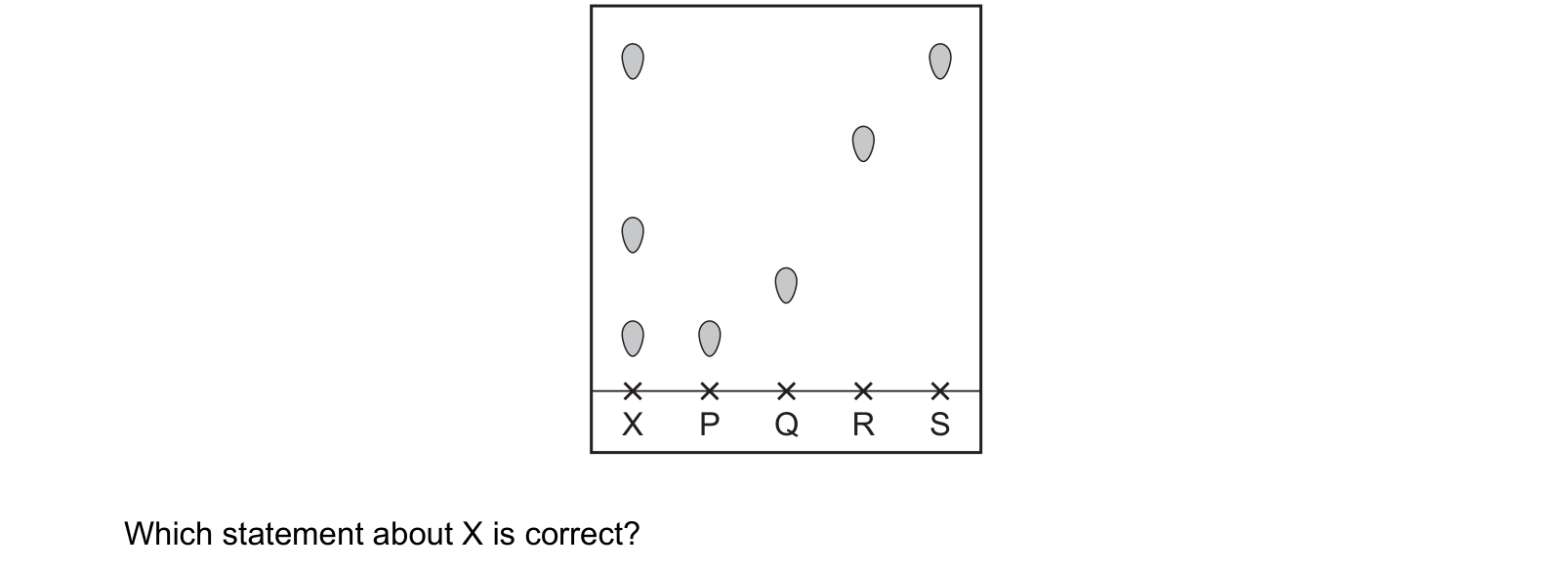
| A sample spot level with a reference spot | The sample contains that known substance |
| A sample spot level with nothing | The sample contains a component not among the references |
A comparison is only valid if the substances were run on the same paper in the same solvent at the same time. Change the solvent and every spot moves.
Rf values (Extended)
Core candidates compare spot heights directly. Extended candidates put a number on it.
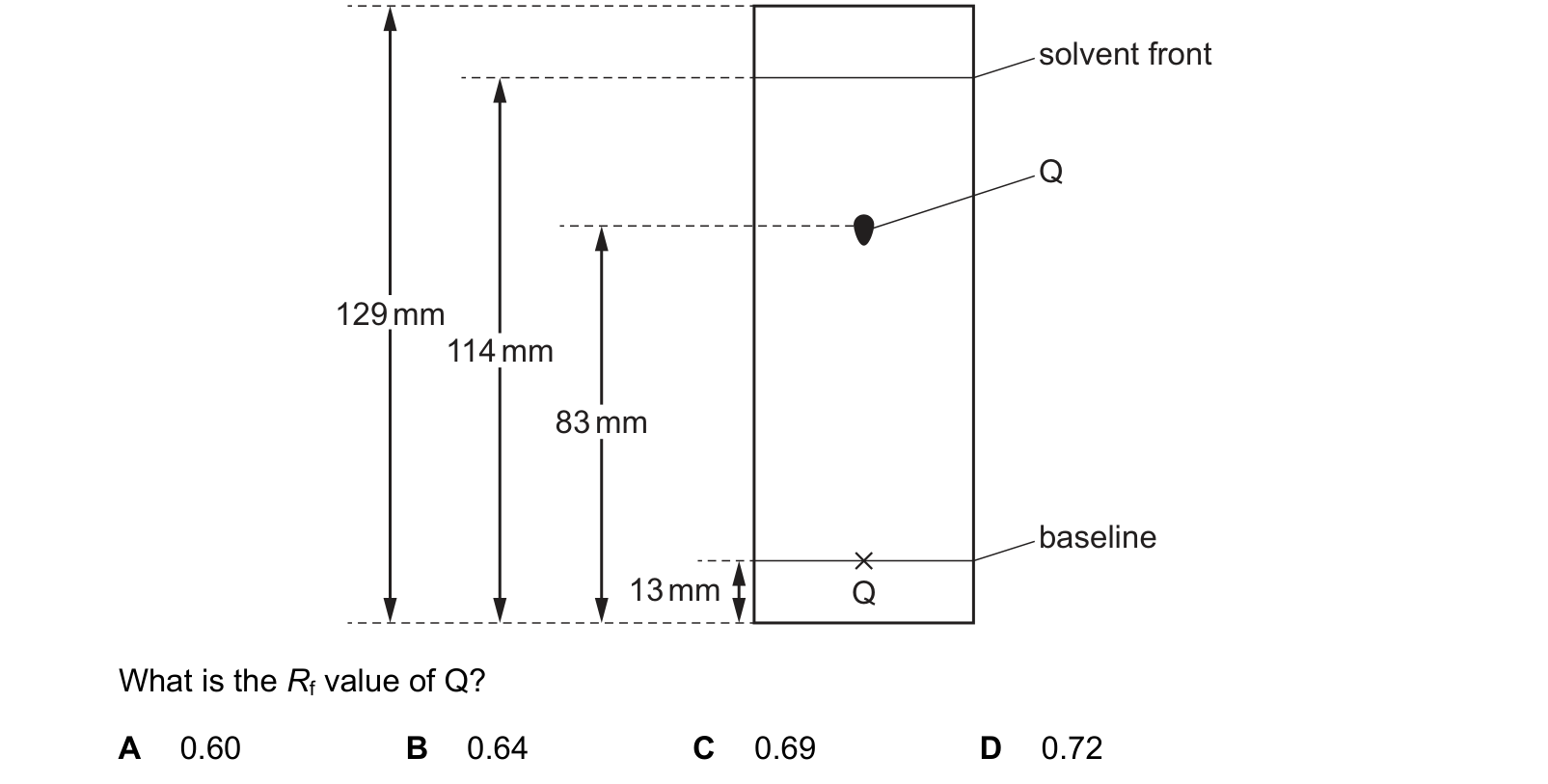
Rf = distance travelled by the substance / distance travelled by the solvent
Both distances are measured from the baseline, and the distance for the substance is measured to the centre of the spot.
Worked example 1. The solvent front is 9.0 cm above the baseline and the centre of the spot is 4.5 cm above it.
Rf = 4.5 / 9.0 = 0.50
Worked example 2. A second spot on the same chromatogram sits 7.2 cm above the baseline, with a solvent front at 8.0 cm.
Rf = 7.2 / 8.0 = 0.90
Two properties make Rf worth using:
- It has no units, because it is a length divided by a length.
- It is always between 0 and 1, because a spot cannot travel further than the solvent that carried it.
An answer greater than 1 means the division was done the wrong way round, and that is the single easiest error to catch in the exam: check the number before writing it down.
Rf depends on the solvent, the paper and the temperature, so an Rf value quoted in a data book can only be used if the same solvent was used. Two spots with the same Rf in the same solvent are the same substance.
Colourless substances (Extended)
Amino acids, sugars and many other compounds are colourless, so the chromatogram appears blank even though the separation has happened perfectly.
The solution is a locating agent. The dried chromatogram is sprayed with a reagent that reacts with the invisible spots to give coloured ones. Ninhydrin is the standard example: it reacts with amino acids to produce purple spots. Some chromatograms are instead viewed under ultraviolet light, under which certain compounds glow.
The order matters. Run the chromatogram, dry it, mark the solvent front, then apply the locating agent, then measure the distances. Spraying before the run would ruin it.
What chromatography is used for
- Separating and identifying the dyes in a food colouring or in a pen ink, by running the ink beside samples of known dyes.
- Checking whether a product is pure, since a pure substance gives one spot and any impurity shows as an extra one.
- Identifying the amino acids present after a protein has been broken down, using ninhydrin to make the spots visible.
Common mistakes
- Drawing the baseline in ink, so the line itself runs up the paper.
- Filling the tank so the solvent covers the spots, which dissolves them away.
- Forgetting to mark the solvent front before the paper dries.
- Measuring the substance distance to the top or bottom edge of a spot rather than to its centre.
- Measuring from the bottom of the paper instead of from the baseline.
- Dividing the solvent distance by the spot distance and reporting an Rf above 1.
- Giving Rf a unit such as cm.
- Comparing Rf values obtained in different solvents.
- Saying a mixture gives one spot, or that a pure substance gives several.
Check you have it
Question 1
Substance Q is investigated using chromatography.
The chromatogram is shown. The diagram is not drawn to scale. What is the Rf value of Q?
Answer: C.
Question 2
Substance X and four known substances, P, Q, R and S, are analysed by chromatography.
The chromatogram produced is shown. Which statement about X is correct?
Answer: C.
Question 3
In the chromatography experiment shown, which label represents the solvent front? Use the source image for W20 Paper 11, question 4.

Answer: A.
What the syllabus asks for on this topicSyllabus points
Syllabus points
- Describe how paper chromatography is used to separate mixtures of soluble coloured substances, using a suitable solvent.
- Interpret simple chromatograms to distinguish pure substances from mixtures.
- Interpret chromatograms to identify substances by comparison with known substances.
- Extended: calculate and use Rf values, using Rf = distance travelled by the substance divided by distance travelled by the solvent.
- Extended: describe the use of a locating agent for substances that are colourless.
Related CIE 0620 Chemistry topics
Not the topic you were looking for? Describe what you are stuck on in your own words and we will take you to the notes that answer it.