32 past-paper questions on this unit. Five of them are below. Answer on the page: each one is marked the moment you pick, the correct option is shown whether or not you found it, and the full explanation opens either way.
CIE 0620 ChemistryPaper 1 and Paper 2 MCQsFree account
Chromatography: five questions to try now
Real past-paper questions, the answer key from the mark scheme, and the explanation that goes with it. No account needed to answer them.
Question 1
The apparatus used in a chromatography experiment is shown. Which line shows the starting depth of the solvent in the beaker? Use the source image for W22 Paper 12, question 2.
Answer: C.
The solvent has to start below the baseline, because if it began level with the spots or above them the spots would dissolve away into the tank instead of travelling up the paper. The line marked just under the baseline is therefore the starting depth of the solvent, low enough to leave the spots dry but high enough to soak into the paper. The line drawn through the spots is the baseline itself, which is where the mixture is applied and never where the solvent begins. The line near the top of the beaker would place the solvent well above the spots, which is precisely the mistake the shallow starting depth prevents. The lowest line lies at the base of the beaker rather than at any liquid surface, so it marks the container and not a depth of solvent.
Question 2
The chromatogram from four different substances is shown. Which pure substance has the largest Rf value? Use the source image for W22 Paper 23, question 2.
Answer: C.
A pure substance leaves one spot on a chromatogram while a mixture separates into several, so the lanes showing more than one spot are set aside before any comparison of heights begins. Two of the four lanes carry two spots each, so those are mixtures and cannot answer a question about a pure substance, however far their upper spots have climbed. That leaves the two lanes with a single spot, and since all four were run in the same solvent with the same front, the higher of those two spots has the larger Rf value. The spot that sits highest of all on the paper belongs to one of the mixtures, and that is exactly the trap the question sets: height alone is not enough when purity is being tested as well.
Question 3
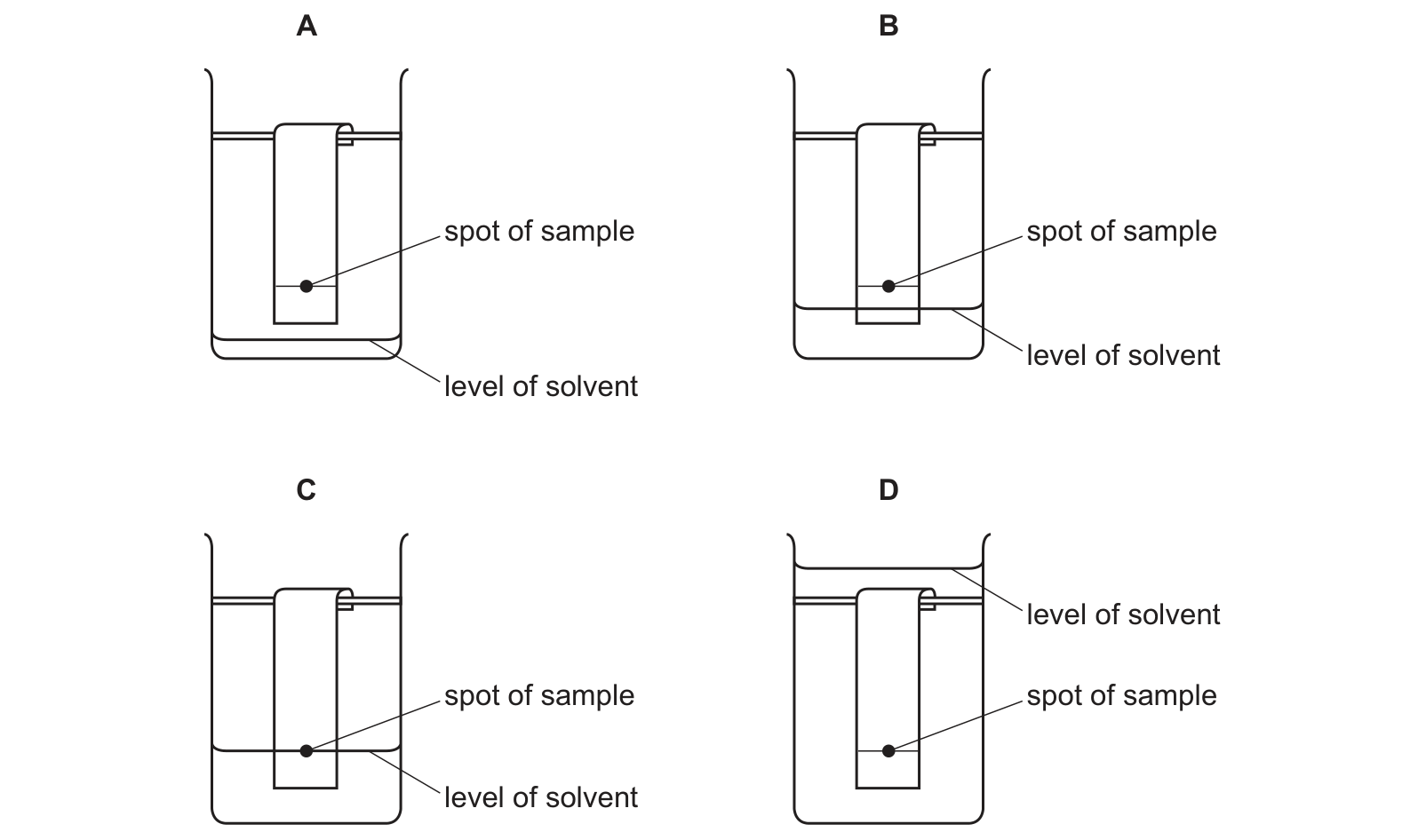
Which diagram shows the correct level of the solvent at the start of a chromatography experiment? Use the source image for S19 Paper 12, question 4.
Answer: B.
The solvent has to reach the paper and creep up it, but it must not touch the baseline, because a spot sitting in the solvent would dissolve away into the tank instead of travelling up the paper. The correct arrangement therefore has the paper dipping into the solvent with the solvent level below the spot. In one diagram the solvent level is exactly at the spot, which would wash the sample straight off. In another the solvent lies above the spot, which is worse still. In the last the level is below the bottom edge of the paper, so the paper never becomes wet and nothing moves at all.
Question 4
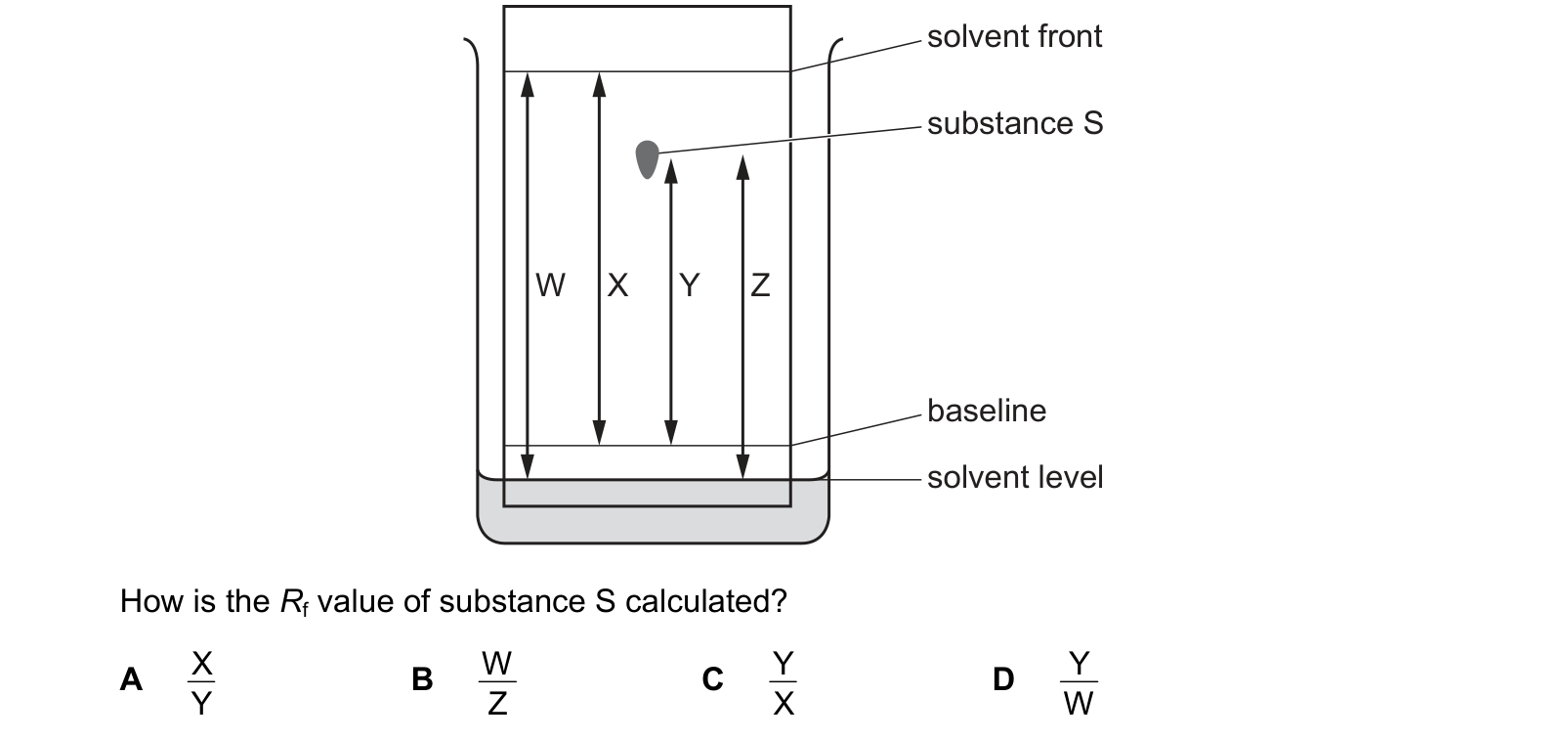
The chromatogram of substance S is shown. Some distances, W, X, Y and Z, are labelled on the diagram. How is the Rf value of substance S calculated?
Answer: C.
The Rf value compares how far the substance travelled with how far the solvent travelled, and both distances are measured from the baseline, never from the bottom edge of the paper or from the solvent level in the tank. In the diagram Y runs from the baseline up to the spot of S and X runs from the baseline up to the solvent front, so the Rf value is Y divided by X. W and Z both begin at the solvent level below the baseline, so any expression using them measures from the wrong place. Dividing X by Y inverts the ratio and would give a value greater than 1, which no Rf value can be.
Question 5
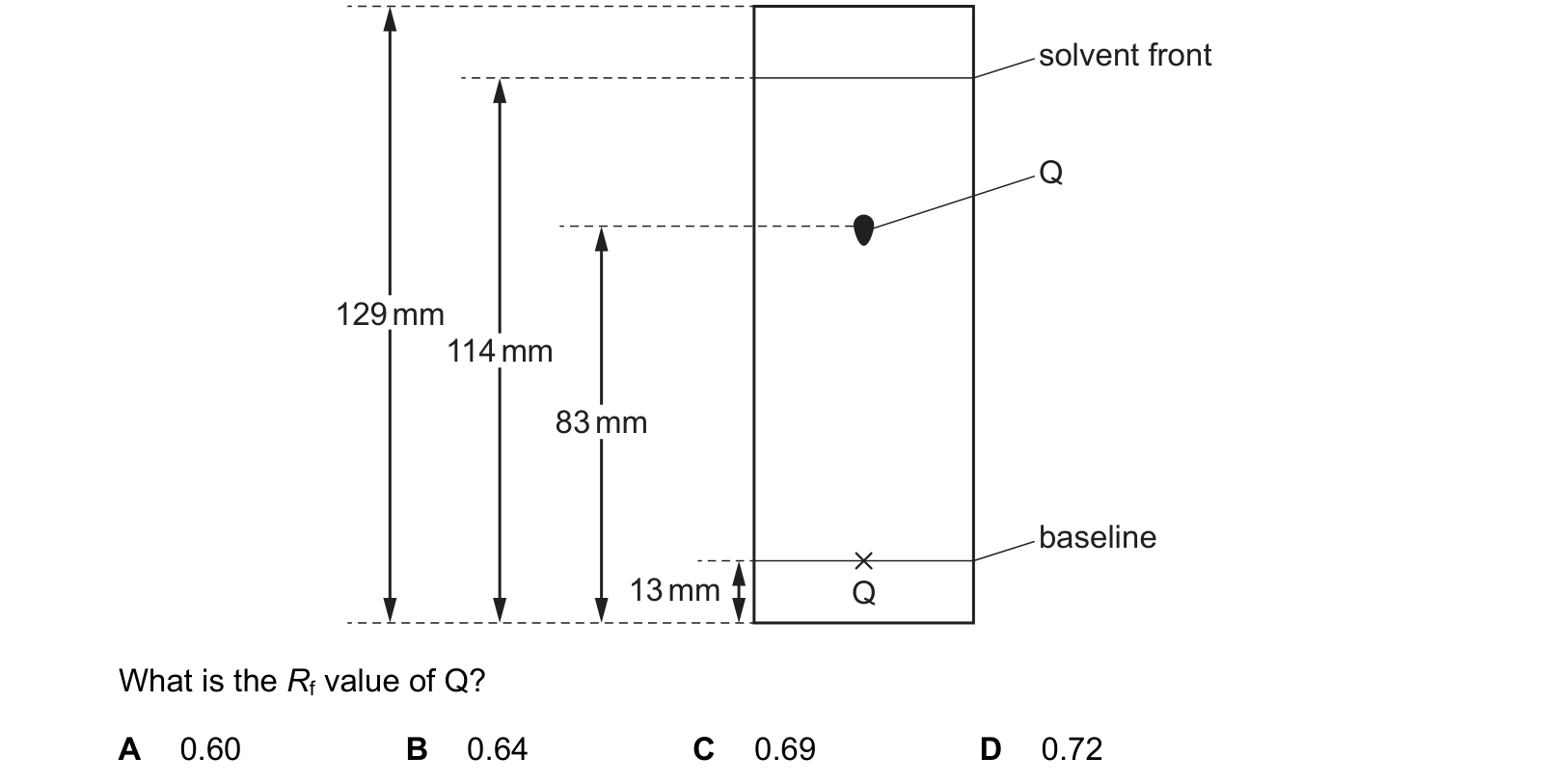
Substance Q was investigated using chromatography. The chromatogram is shown. The diagram is not drawn to scale. What is the Rf value of Q?
Answer: C.
Rf is the distance the spot moved divided by the distance the solvent moved, and both must be measured from the baseline rather than from the bottom edge of the paper. The spot sits 83 mm from the bottom and the baseline sits 13 mm from the bottom, so the spot travelled 83 minus 13 = 70 mm, while the solvent front at 114 mm gives 114 minus 13 = 101 mm. Dividing gives 70 divided by 101 = 0.69. The value 0.72 comes from 83 divided by 114, using both readings from the bottom edge and forgetting that the substance began 13 mm up the paper. The values 0.64 and 0.60 both press 129 mm into service as the solvent distance, but 129 mm is the full height of the paper rather than the point the solvent reached.
These questions are drawn from past CIE 0620 Chemistry papers and filtered to chromatography. You answer, you find out immediately whether you were right, and you get the reasoning for the correct option and for each distractor. Wrong answers go to a mistakes locker so you can come back to exactly those.
Practice is free. You need an account only so your progress and your mistakes are still there next time.
These are the errors that cost marks on chromatography, taken from our own topic notes. Read them before you practise and you will recognise the traps in the questions.
Drawing the baseline in ink, so the line itself runs up the paper.
Filling the tank so the solvent covers the spots, which dissolves them away.
Forgetting to mark the solvent front before the paper dries.
Measuring the substance distance to the top or bottom edge of a spot rather than to its centre.
Measuring from the bottom of the paper instead of from the baseline.
Dividing the solvent distance by the spot distance and reporting an Rf above 1.
Giving Rf a unit such as cm.
Comparing Rf values obtained in different solvents.