Physical and chemical changes
Contents: 8 sections
The one question that decides it
Has a new substance been made?
If yes, the change is chemical. If no, it is physical. Every other difference follows from that answer, and Cambridge marks the answer that names the new substance rather than the answer that lists symptoms.
| Physical change | Chemical change | |
|---|---|---|
| New substance | None | At least one |
| What changes | Arrangement and energy of the particles | The bonds between atoms |
| Reversible | Usually easily, by cooling or evaporating | Usually not, or only by another reaction |
| Mass | Conserved | Conserved |
| Energy | Small change, mostly latent heat | Often a large release or absorption |
| Chemical formula of the substance | Unchanged | Changed |
Notice that mass is conserved in both. Conservation of mass is not a way to tell them apart, and offering it as the difference is a wasted line.
Physical changes
The five changes of state are all physical:
- Melting and freezing at the melting point
- Boiling and condensing at the boiling point
- Evaporating, which happens below the boiling point from the surface only
Ice, water and steam are all H<sub>2</sub>O. The molecules are identical in all three; only their separation and motion differ. That is why steam condensing on a cold window gives back ordinary water and nothing else.
Dissolving is physical. Sodium chloride dissolved in water is still sodium chloride: evaporate the water and the crystals come back unchanged. So is mixing, which is why a mixture can be separated by filtration, distillation or chromatography while a compound cannot.
Two more that catch people out:
- Sublimation of solid carbon dioxide or of iodine is physical. Iodine going from a grey-black solid to a purple vapour is a change of state, not a reaction.
- Grinding, cutting and shaping a solid change only the particle size.
Chemical changes
Signs that a reaction has taken place:
- A gas is given off when no heating to boiling is involved, for example fizzing when magnesium meets dilute hydrochloric acid.
- A precipitate forms when two clear solutions are mixed, for example silver nitrate and sodium chloride giving a white solid.
- A permanent colour change that cannot be undone by cooling, for example green copper(II) carbonate turning black on heating.
- A temperature change with no heater and no cooler, for example the flask warming when magnesium dissolves in acid.
- A flame or a smell appears, as with burning or with rotting.
None of these is proof on its own, and that is the point of the qualifiers. Bubbles appear when a warm fizzy drink is opened, and no reaction has occurred. Copper(II) sulfate turns a colourless solution blue when it dissolves, and that colour change is physical because evaporating the water gives the blue crystals back.
Reversing a change
Reversibility is a useful clue but not a rule. Some chemical changes reverse readily under changed conditions, and 6.3 is built on two of them: heating blue hydrated copper(II) sulfate drives off water to leave white anhydrous copper(II) sulfate, and adding water turns it blue again. Bonds are broken and made in both directions, so both are chemical changes even though the pair reverses in a test tube.
The dependable test remains the first one: is there a substance present at the end that was not present at the start?
Mass, and where it appears to go
Mass is conserved in every change, but it is easy to weigh only part of the system.
Worked example. 2.40 g of magnesium ribbon is burned in a crucible and the white ash is weighed.
The equation is 2Mg + O<sub>2</sub> → 2MgO. The relative atomic mass of magnesium is 24 and the relative formula mass of magnesium oxide is 40, so:
mass of magnesium oxide = 2.40 × 40 / 24 = 4.00 g
The crucible therefore appears to gain 4.00 − 2.40 = 1.60 g. Nothing has been created: 1.60 g of oxygen has been taken from the air and locked into the solid.
A burning candle shows the same effect running the other way. It appears to lose mass because the carbon dioxide and water vapour leave, and if the whole apparatus were sealed the total mass would not change at all.
Dissolving obeys the same accounting.
Worked example. 5.0 g of sodium chloride is stirred into 95.0 g of water.
mass of solution = 5.0 + 95.0 = 100.0 g
The salt has not disappeared. It has separated into ions spread through the water, and evaporating the 95.0 g of water returns 5.0 g of solid.
Sorting a list quickly
Ask the question in this order and you will not be caught:
- Name the substance at the end. If it has the same formula as the substance at the start, the change is physical.
- If the answer is "the same stuff in a different state, a different shape or spread through a solvent", the change is physical.
- If a gas, a precipitate or a permanent new colour has appeared with no change of state to explain it, the change is chemical.
Applying that to a typical list: candle wax melting is physical, candle wax burning is chemical; iron filings mixed with sulfur is physical, the same mixture heated to iron sulfide is chemical; salt dissolving is physical, limestone heated to quicklime is chemical.
Common mistakes
- Saying mass is not conserved in a chemical change.
- Calling dissolving a chemical change because the solid disappears from view.
- Calling a colour change chemical without checking whether it is simply a solution forming.
- Treating sublimation of iodine as a reaction because the purple vapour looks new.
- Using "irreversible" as the definition, when several reactions in this syllabus reverse on heating.
- Saying a burning candle destroys matter, rather than releasing gases that were not weighed.
- Describing the difference without naming the new substance, which is the mark Cambridge is actually awarding.
Check you have it
Question 1
Which diagram represents a chemical change? Use the source image for S20 Paper 11, question 12.
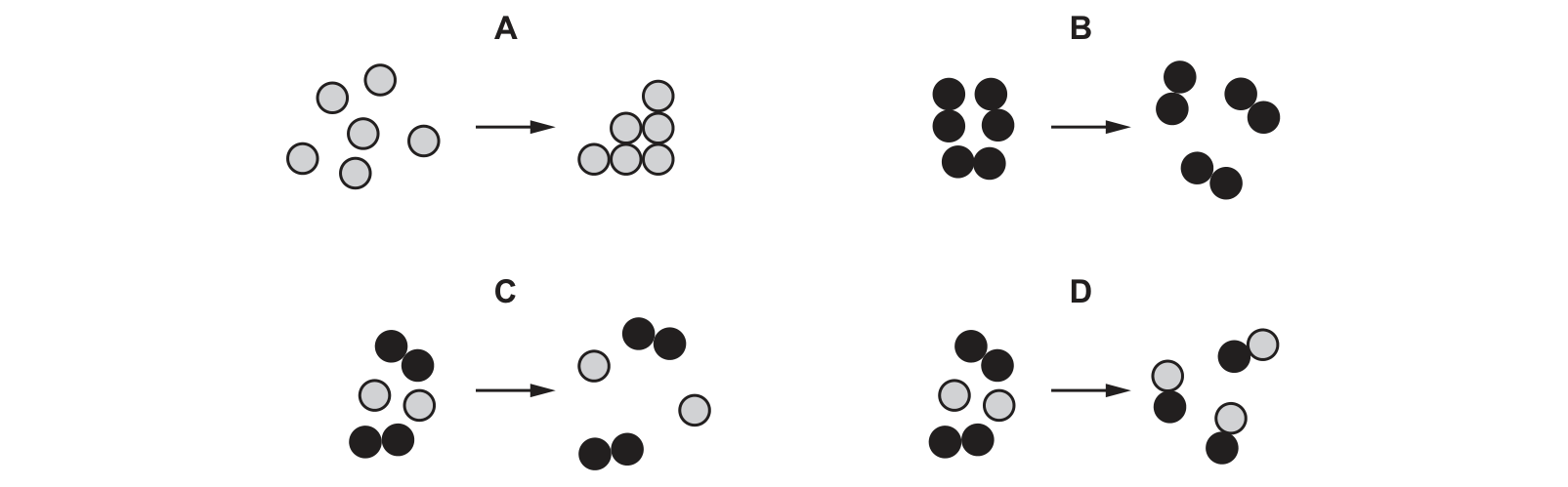
Answer: D.
Question 2
Which diagram represents a chemical change? Use the source image for S20 Paper 21, question 14.
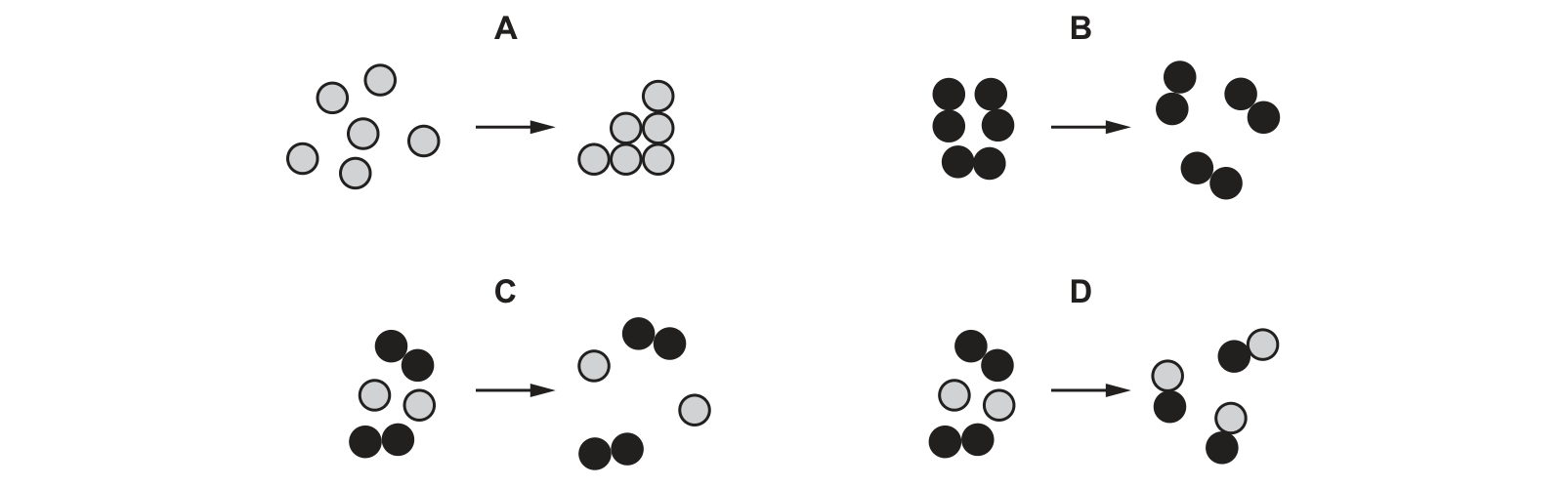
Answer: D.
Question 3
Which diagram represents a chemical change? Use the source image for S24 Paper 11, question 13.
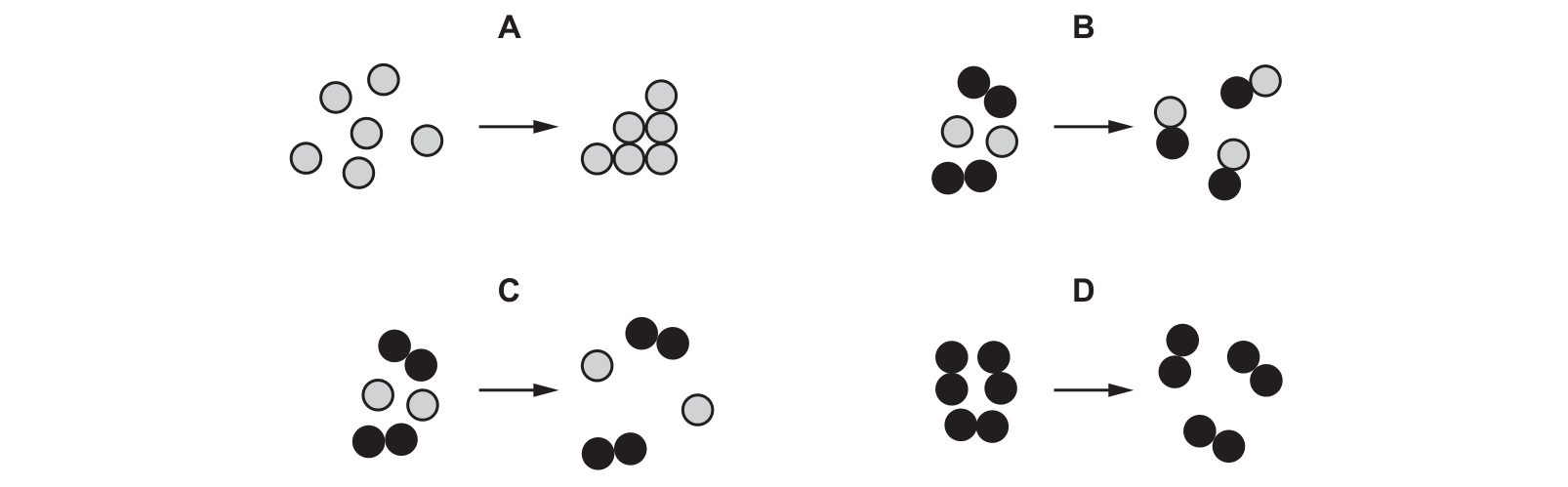
Answer: B.
What the syllabus asks for on this topicSyllabus points
Syllabus points
- Identify physical changes and chemical changes.
- Describe the differences between physical changes and chemical changes.
- State that a change of state, dissolving and mixing are physical changes because no new substance is made.
- Recognise the observations that indicate a chemical reaction has happened.
- Apply conservation of mass to a change, counting any gas that enters or leaves.
Everything in 6.1 is Core. There is no Extended-only content in this subtopic, so a Core student needs the whole of it.
Related CIE 0620 Chemistry topics
Not the topic you were looking for? Describe what you are stuck on in your own words and we will take you to the notes that answer it.