Alkanes
Contents: 7 sections
What an alkane is
General formula CₙH₂ₙ₊₂. Every bond in the molecule is a single covalent bond, C-C or C-H, and every carbon atom holds four of them.
That makes an alkane saturated: it contains no double bond, so no further atoms can be added without something being taken away first. The word is worth defining precisely, because "saturated" is the property that the alkene test in 11.5 is built to detect.
| Alkane | Molecular formula | Structural formula | State at room temperature |
|---|---|---|---|
| Methane | CH₄ | CH₄ | Gas |
| Ethane | C₂H₆ | CH₃CH₃ | Gas |
| Propane | C₃H₈ | CH₃CH₂CH₃ | Gas |
| Butane | C₄H₁₀ | CH₃CH₂CH₂CH₃ | Gas |
Drawn in full, methane is one carbon with four C-H bonds arranged around it. Ethane is two carbons joined by a C-C bond, each carrying three hydrogens, so seven bonds in all.
Why alkanes are unreactive
Alkanes are described as generally unreactive. The C-C and C-H bonds are strong and the molecules carry no region of concentrated charge, so most reagents have nothing to attack.
In practice that means an alkane does not react with aqueous bromine at room temperature, does not react with acids or alkalis, and does not react with aqueous potassium manganate(VII). Only two reactions are on the syllabus:
- combustion, with oxygen
- substitution, with chlorine in ultraviolet light
Being unreactive is useful, not a defect. It is why propane can be stored in a steel cylinder for years and why polymers built from saturated chains, such as poly(ethene), resist attack from almost everything.
Complete combustion
With a plentiful supply of oxygen, an alkane burns to carbon dioxide and water only:
CH₄ + 2O₂ → CO₂ + 2H₂O
C₃H₈ + 5O₂ → 3CO₂ + 4H₂O
2C₄H₁₀ + 13O₂ → 8CO₂ + 10H₂O
The reaction is strongly exothermic, which is the entire reason alkanes are used as fuels.
Balancing the equation
Do it in a fixed order: carbon first, then hydrogen, then oxygen last.
Take propane, C₃H₈. Three carbons need 3CO₂. Eight hydrogens need 4H₂O. Now count the oxygen already placed on the right: 3 × 2 from the carbon dioxide plus 4 from the water gives 10, so 5O₂ is needed on the left. The check confirms it, since 3 × 2 + 4 = 10 and 5 × 2 = 10.
For butane, C₄H₁₀, the same method gives 4CO₂ and 5H₂O, needing 13 oxygen atoms, which is 6.5 O₂. Halves are not allowed, so double the whole equation to get 2C₄H₁₀ + 13O₂ → 8CO₂ + 10H₂O. Doubling is the standard rescue whenever an alkane with an even number of hydrogens produces a half.
Incomplete combustion
With a limited supply of oxygen the products change:
2CH₄ + 3O₂ → 2CO + 4H₂O
and with even less oxygen, carbon itself is left as soot:
CH₄ + O₂ → C + 2H₂O
The products are carbon monoxide, a toxic gas that binds to haemoglobin in place of oxygen, and particulates, tiny solid carbon specks that increase the risk of respiratory problems and cancer. A yellow, smoky Bunsen flame with the air hole closed is incomplete combustion happening on the bench; a blue roaring flame with the air hole open is complete combustion.
Substitution with chlorine (Extended)
Core candidates need only to know that this reaction happens. Extended candidates need the conditions, the equation and the structures.
In a substitution reaction, one atom or group of atoms is replaced by another atom or group of atoms.
Methane and chlorine react in the presence of ultraviolet light, which is why it is called a photochemical reaction. Sunlight supplies the ultraviolet. In the dark the mixture does not react, and stating that condition is where the mark sits.
CH₄ + Cl₂ → CH₃Cl + HCl
The products are chloromethane and hydrogen chloride. One hydrogen atom of the methane has been swapped for a chlorine atom, and the displaced hydrogen leaves attached to the other chlorine.
Chloromethane has a central carbon with three C-H bonds and one C-Cl bond, and each of those four bonds must be drawn separately.
The reaction does not stop there. Each product still has hydrogens to substitute:
CH₃Cl + Cl₂ → CH₂Cl₂ + HCl
CH₂Cl₂ + Cl₂ → CHCl₃ + HCl
CHCl₃ + Cl₂ → CCl₄ + HCl
giving dichloromethane, trichloromethane and finally tetrachloromethane, in which all four hydrogens have gone. Because all four products form together, the mixture is difficult to separate, so this is a poor way to make any single one of them.
Ethane behaves the same way:
C₂H₆ + Cl₂ → C₂H₅Cl + HCl
The product is chloroethane: two carbons joined by a C-C bond, with five hydrogens and one chlorine between them.
Every one of these equations produces HCl as the second product. Leaving it out unbalances the equation and loses the mark, and it is the commonest slip in the whole section.
Common mistakes
- Saying alkanes decolourise bromine water. They do not; alkenes do.
- Writing an addition reaction with chlorine, giving CH₄Cl₂ or similar. Alkanes substitute; they do not add.
- Omitting HCl from a substitution equation.
- Forgetting to state that ultraviolet light is required, or calling it heat.
- Giving carbon dioxide as a product of incomplete combustion.
- Leaving a fractional coefficient such as 6.5O₂ in a final answer instead of doubling through.
- Calling an alkane unsaturated. The general formula CₙH₂ₙ₊₂ has the maximum possible hydrogens.
Check you have it
Question 1
Methane and chlorine react to form chloromethane. Which row describes the necessary reaction condition and the type of reaction? Each answer gives, in order: reaction condition; type of reaction.
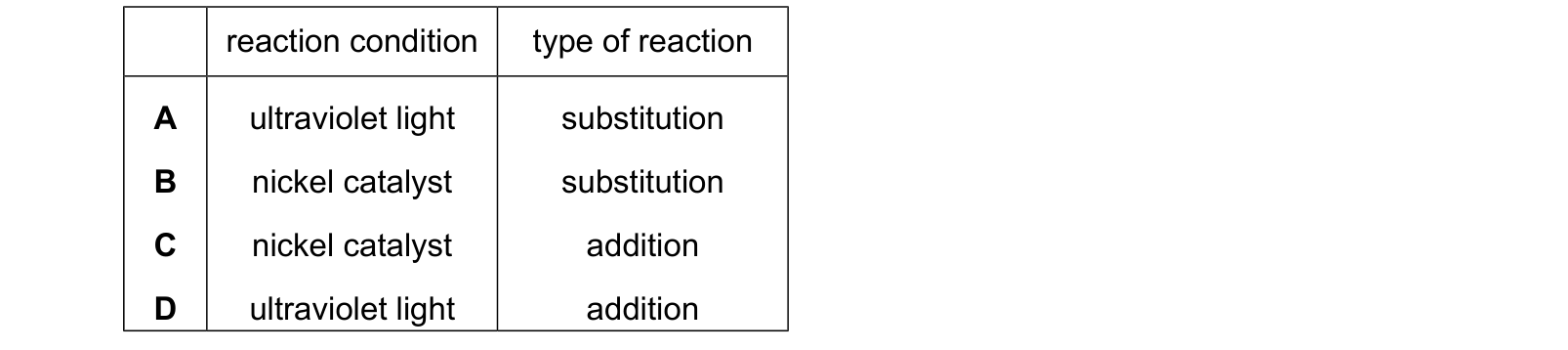
Answer: A.
Question 2
Which row shows the properties of methane? Each answer gives, in order: soluble in water; state at room temperature; gives a positive test with aqueous bromine.
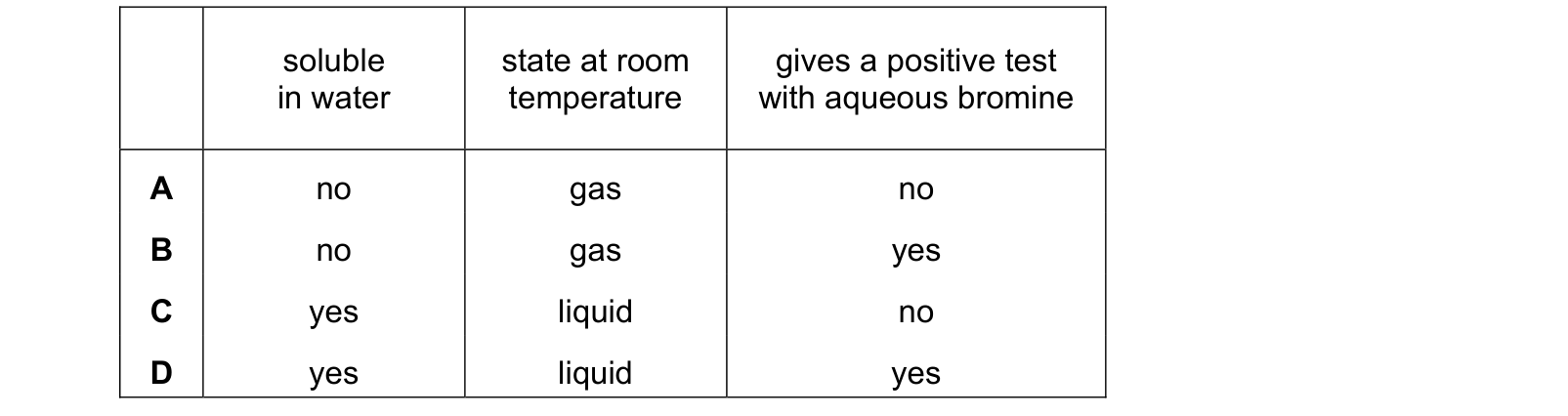
Answer: A.
Question 3
A large hydrocarbon undergoes cracking. A smaller hydrocarbon, X, and a gas are the only two products. Which row identifies hydrocarbon X and the gas? Each answer gives, in order: hydrocarbon X; gas.
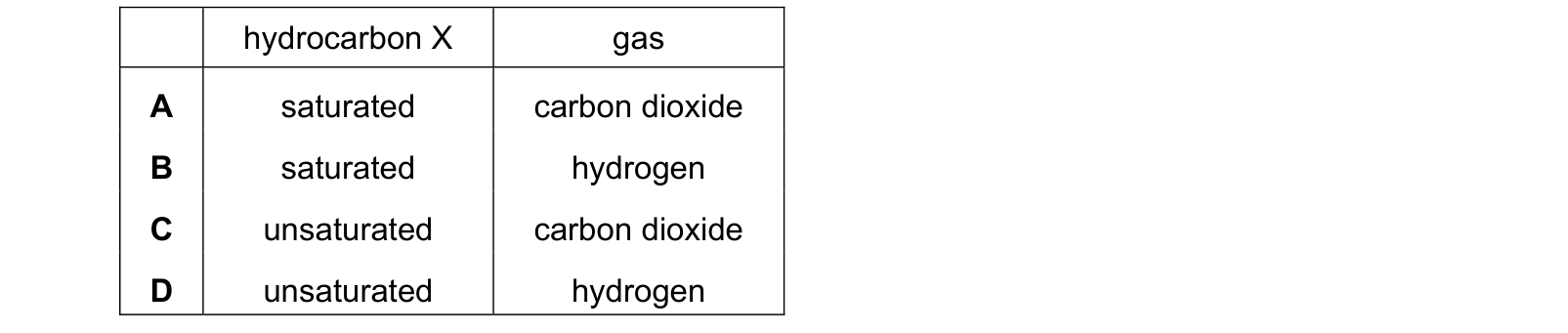
Answer: D.
What the syllabus asks for on this topicSyllabus points
Syllabus points
- State that alkanes are saturated hydrocarbons with the general formula CₙH₂ₙ₊₂.
- Describe the bonding in alkanes as single covalent bonds only.
- Describe the properties of alkanes as generally unreactive, except in terms of combustion and substitution by chlorine.
- Describe and write equations for the complete combustion of alkanes.
- Extended: describe the substitution reaction of alkanes with chlorine as a photochemical reaction requiring ultraviolet light, and draw the structures of the products.
Related CIE 0620 Chemistry topics
Not the topic you were looking for? Describe what you are stuck on in your own words and we will take you to the notes that answer it.