The mole and the Avogadro constant
Contents: 9 sections
The mole and the Avogadro constant
The mole, symbol mol, is the unit of amount of substance. One mole contains 6.02 × 10²³ particles, and that number is the Avogadro constant.
The particles can be atoms, molecules or ions; the question tells you which. One mole of water contains 6.02 × 10²³ molecules but 3 × 6.02 × 10²³ atoms, because each molecule has three.
Half a mole of any substance contains 0.5 × 6.02 × 10²³ = 3.01 × 10²³ particles.
The point of the mole is that one mole of a substance has a mass in grams equal to its Mᵣ. One mole of carbon is 12 g, one mole of water is 18 g, one mole of calcium carbonate is 100 g.
The three relationships
amount in mol = mass in g / Mᵣ
>
amount in mol = volume of gas in dm³ / 24 (at room temperature and pressure)
>
amount in mol = concentration in mol/dm³ × volume in dm³
Two unit conversions cause more lost marks here than any concept:
- cm³ to dm³: divide by 1000. A 25.0 cm³ pipette delivers 0.0250 dm³.
- g/dm³ and mol/dm³ are different. To convert, multiply the concentration in mol/dm³ by the Mᵣ. A 2 mol/dm³ solution of sodium hydroxide is 2 × 40 = 80 g/dm³.
Quick examples. 20 g of calcium carbonate is 20 / 100 = 0.2 mol. 4.4 g of carbon dioxide is 4.4 / 44 = 0.1 mol. 48 dm³ of any gas at r.t.p. is 48 / 24 = 2 mol, and 0.25 mol of hydrogen occupies 0.25 × 24 = 6 dm³.
Reacting masses
Every calculation of this kind runs on the same three steps.
- Turn what you are given into moles.
- Use the balancing numbers as a ratio to find the moles of what you want.
- Turn those moles into the quantity asked for.
Worked example. What mass of calcium oxide is made by heating 25 g of calcium carbonate?
CaCO₃ → CaO + CO₂
Mᵣ(CaCO₃) = 100 and Mᵣ(CaO) = 56.
- Step 1: 25 / 100 = 0.25 mol of calcium carbonate.
- Step 2: the ratio is 1 to 1, so 0.25 mol of calcium oxide is made.
- Step 3: 0.25 × 56 = 14 g of calcium oxide.
Limiting reactant
When the amounts of two reactants are given, one of them runs out first and fixes how much product forms. Find the moles of each, divide each by its balancing number, and the smaller answer is the limiting reactant.
Worked example. 4 g of hydrogen is burned with 16 g of oxygen.
2H₂ + O₂ → 2H₂O
- n(H₂) = 4 / 2 = 2 mol, and dividing by its balancing number, 2 / 2 = 1.
- n(O₂) = 16 / 32 = 0.5 mol, and dividing by its balancing number, 0.5 / 1 = 0.5.
Oxygen gives the smaller figure, so oxygen is limiting and some hydrogen is left over. The equation makes 2 H₂O for every 1 O₂, so 2 × 0.5 = 1 mol of water forms, with a mass of 1 × 18 = 18 g.
Everything after this point must be worked from the limiting reactant. Using the one in excess is the commonest way this question is lost.
Concentration and titration
Worked example. 25.0 cm³ of sodium hydroxide solution is exactly neutralised by 20.0 cm³ of 0.100 mol/dm³ hydrochloric acid. Find the concentration of the sodium hydroxide in mol/dm³ and in g/dm³.
NaOH + HCl → NaCl + H₂O
Start with the solution you know everything about, which is the acid:
n(HCl) = 0.100 × 20.0 / 1000 = 0.00200 mol
The ratio is 1 to 1, so n(NaOH) = 0.00200 mol as well. That amount was in 25.0 cm³, which is 0.0250 dm³:
c(NaOH) = 0.00200 / 0.0250 = 0.0800 mol/dm³
To convert to g/dm³, multiply by Mᵣ(NaOH), which is 23 + 16 + 1 = 40:
0.0800 × 40 = 3.20 g/dm³
Empirical and molecular formulae
The empirical formula is the simplest whole-number ratio of atoms. The molecular formula is the actual number of atoms in one molecule, and it is always a whole-number multiple of the empirical formula.
The method never changes:
- Divide each mass or percentage by that element's Aᵣ.
- Divide every answer by the smallest of them.
- Multiply up if the results are not yet whole numbers.
Worked example. A compound contains 2.4 g of carbon and 0.6 g of hydrogen, and its Mᵣ is 30.
| Element | Mass in g | Divided by Aᵣ | Divided by the smallest |
|---|---|---|---|
| C | 2.4 | 2.4 / 12 = 0.2 | 0.2 / 0.2 = 1 |
| H | 0.6 | 0.6 / 1 = 0.6 | 0.6 / 0.2 = 3 |
The empirical formula is CH₃, whose mass is 12 + 3 = 15. Since 30 / 15 = 2, the molecular formula is C₂H₆.
Percentage yield, purity and composition
percentage yield = actual yield / theoretical yield × 100
If the calculation above predicts 14 g of calcium oxide and only 11.2 g is collected:
11.2 / 14 × 100 = 80%
A yield below 100% is normal. The reaction may be reversible, side reactions may occur, and some product is always lost in transferring and purifying it.
percentage purity = mass of pure substance / mass of impure sample × 100
A 5.0 g sample of limestone that contains 4.0 g of calcium carbonate is 4.0 / 5.0 × 100 = 80% pure.
percentage composition by mass = mass of that element in the formula / Mᵣ × 100
For ammonium nitrate, NH₄NO₃, the Mᵣ is 14 + 4 + 14 + 48 = 80, and the two nitrogen atoms contribute 2 × 14 = 28, so the percentage of nitrogen by mass is
28 / 80 × 100 = 35%
That figure is what makes ammonium nitrate a good fertiliser, and comparing it with the figure for another nitrogen compound is a standard question.
Common mistakes
- Forgetting to divide cm³ by 1000 before using concentration × volume.
- Using 24 dm³ for a solid or a liquid. The molar gas volume applies to gases at r.t.p. only.
- Working the theoretical yield from the reactant in excess rather than the limiting one.
- Mixing g/dm³ and mol/dm³ in the same calculation without converting.
- Stopping the empirical formula calculation at step 1 without dividing by the smallest.
- Rounding part way through. Carry the extra figures and round only at the end.
- Treating any of this as Core material. Subtopic 3.3 is examined on Paper 2 only.
Check you have it
Question 1
Oxide 1 is a solid that reacts with dilute hydrochloric acid. Oxide 2 is a gas that reacts with sodium hydroxide solution. What are the formulae of the oxides? Each answer gives, in order: oxide 1; oxide 2.
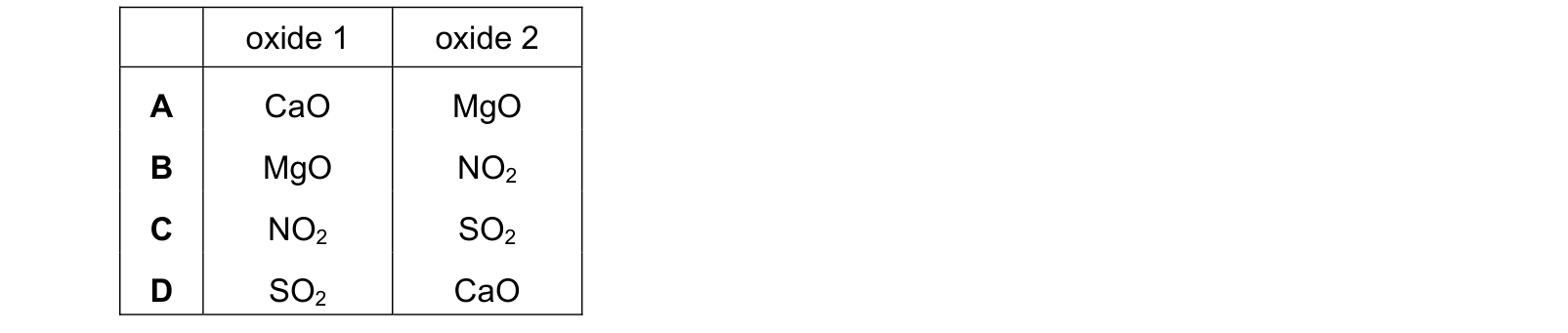
Answer: B.
Question 2
Propane burns in oxygen. C3H8 + xO2 → 3CO2 + yH2O Which values of x and y balance the equation? Each answer gives, in order: x; y.
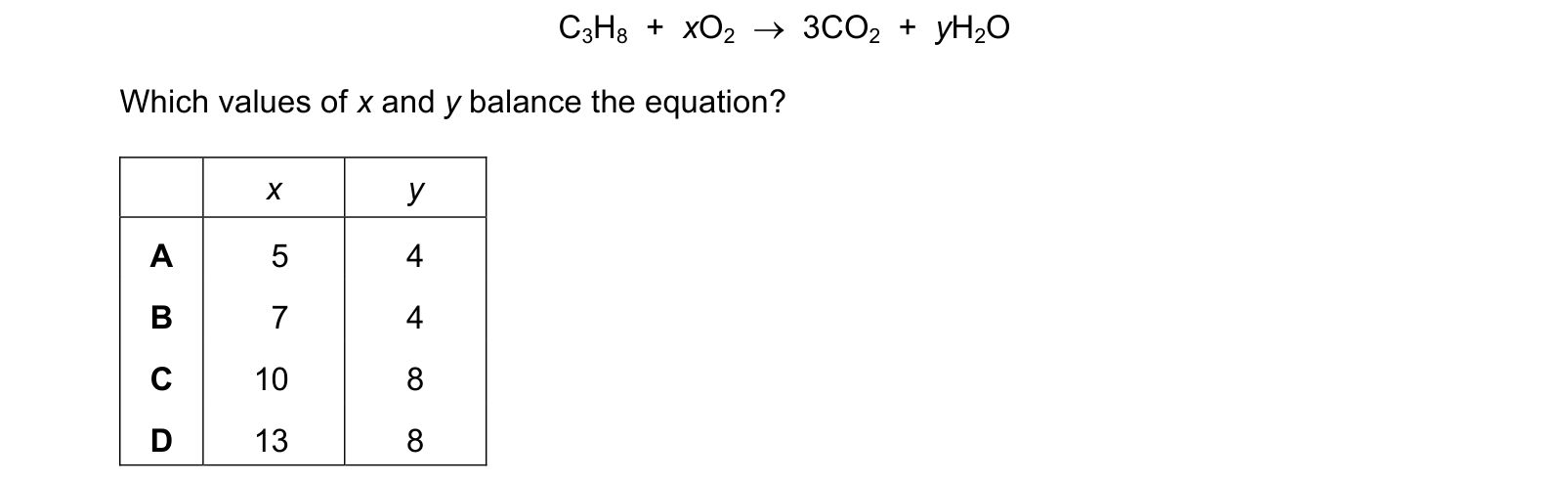
Answer: A.
Question 3
The percentage composition of gases on Neptune is shown. percentage gas composition / % hydrogen 80 helium 18 methane 1.5 other gases 0.5 Which statement about the atmospheres on Neptune and on the Earth is correct?
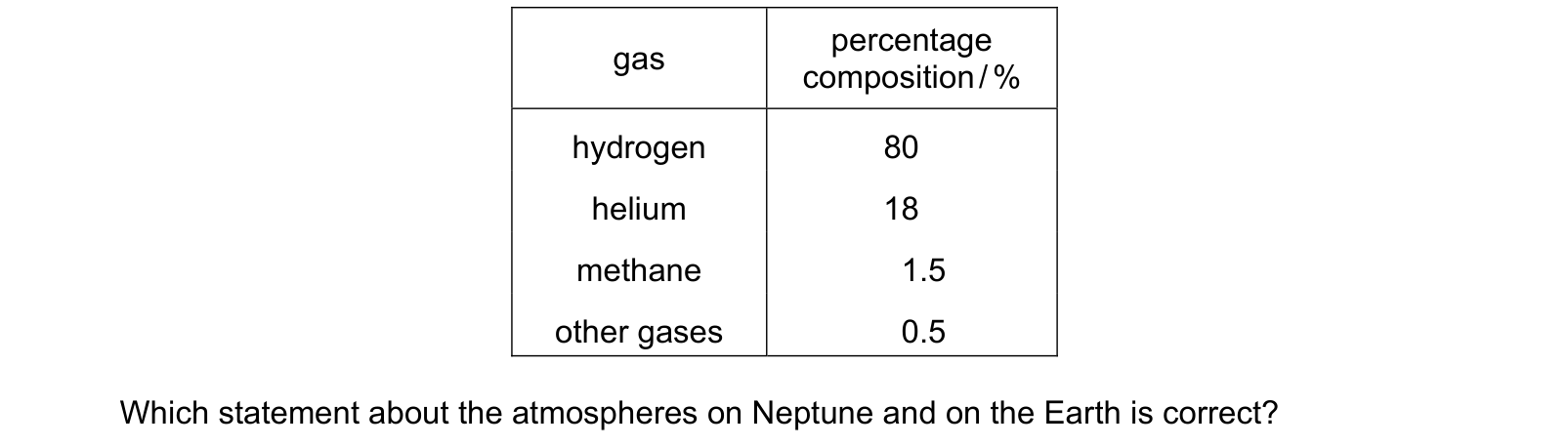
Answer: C.
What the syllabus asks for on this topicSyllabus points
Syllabus points
- Extended only: define the mole as the unit of amount of substance, and state that one mole contains 6.02 × 10²³ particles, the Avogadro constant.
- Extended only: use the relationship amount of substance = mass / Mᵣ, and state that concentration is measured in g/dm³ or mol/dm³.
- Extended only: use the molar gas volume, taken as 24 dm³ at room temperature and pressure.
- Extended only: calculate reacting masses, limiting reactants, gas volumes, and volumes and concentrations of solutions, including titration data.
- Extended only: calculate empirical and molecular formulae from given data.
- Extended only: calculate percentage yield, percentage composition by mass and percentage purity.
The whole of subtopic 3.3 is Extended. None of it appears on Paper 1, so a Core candidate does not need the mole at all and should use the simple proportion method of 3.2 instead. For an Extended candidate this is the single most calculation-heavy subtopic in the syllabus.
Related CIE 0620 Chemistry topics
Not the topic you were looking for? Describe what you are stuck on in your own words and we will take you to the notes that answer it.