53 past-paper questions on this unit. Five of them are below. Answer on the page: each one is marked the moment you pick, the correct option is shown whether or not you found it, and the full explanation opens either way.
CIE 0620 ChemistryPaper 1 and Paper 2 MCQsFree account
The mole and the Avogadro constant: five questions to try now
Real past-paper questions, the answer key from the mark scheme, and the explanation that goes with it. No account needed to answer them.
Question 1
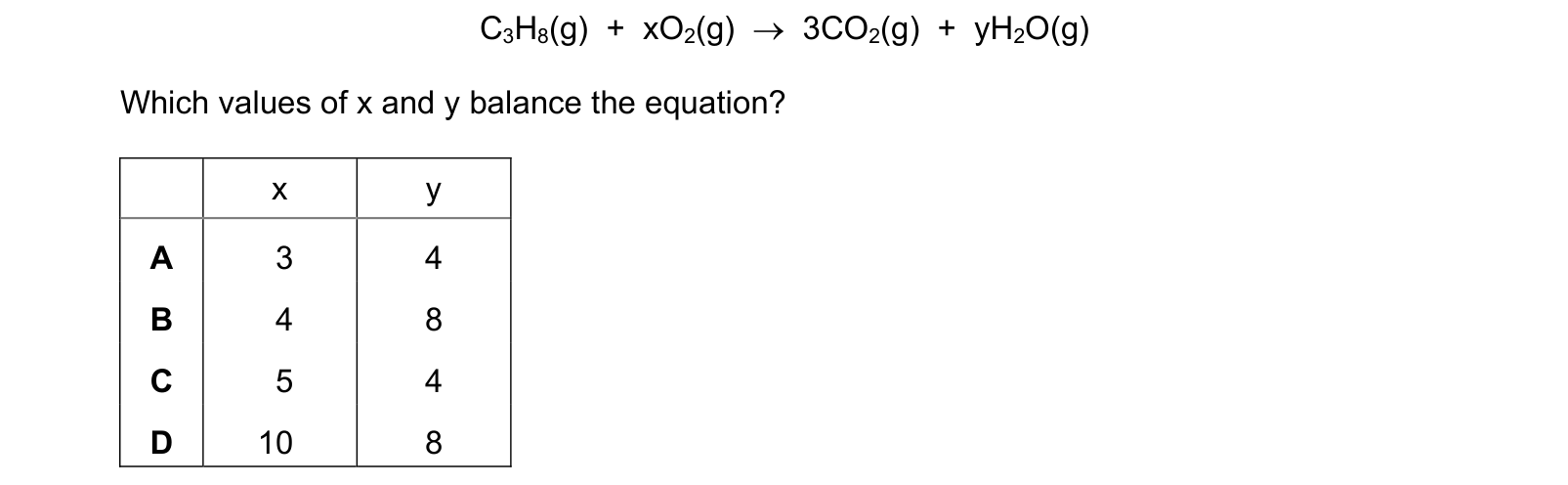
The equation for burning propane in air is shown. C3H8(g) + xO2(g) → 3CO2(g) + yH2O(g) Which values of x and y balance the equation? Each answer gives, in order: x; y.
Answer: C.
The products fix two of the three coefficients before any oxygen is considered: 3CO2 accounts for the three carbon atoms of propane and the eight hydrogen atoms have to appear as 4H2O. Adding the oxygen in those products gives 6 + 4 = 10 atoms, which needs 5 molecules of O2 on the left. The row offering 3 and 4 has the water right but makes only 6 oxygen atoms available. The row offering 4 and 8 doubles the water while leaving carbon dioxide at 3, so hydrogen no longer balances. The row offering 10 and 8 doubles the oxygen and the water together and still leaves the carbon dioxide untouched at 3.
Question 2
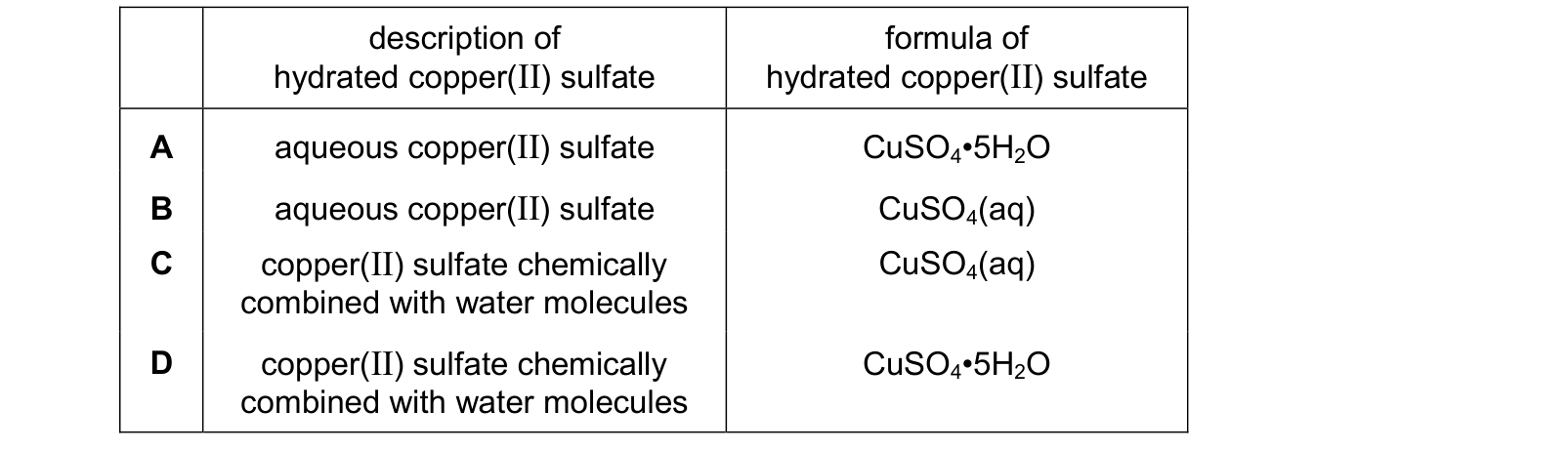
Which row describes and gives the formula of hydrated copper(II) sulfate? Each answer gives, in order: description of hydrated copper(II) sulfate; formula of hydrated copper(II) sulfate.
Answer: D.
Hydrated means water molecules are chemically combined within the crystal as water of crystallisation, not that the compound has been dissolved, so the description mentioning aqueous copper(II) sulfate is wrong in both rows that use it. The formula therefore has to show those water molecules explicitly, which is why hydrated copper(II) sulfate is written as CuSO4 with five water molecules attached. Writing CuSO4(aq) describes a solution, in which the compound is surrounded by far more water than five molecules and in no fixed ratio at all. The row that gets the description right and then pairs it with the aqueous formula is the near miss, since it recognises the chemistry and immediately contradicts it.
Question 3
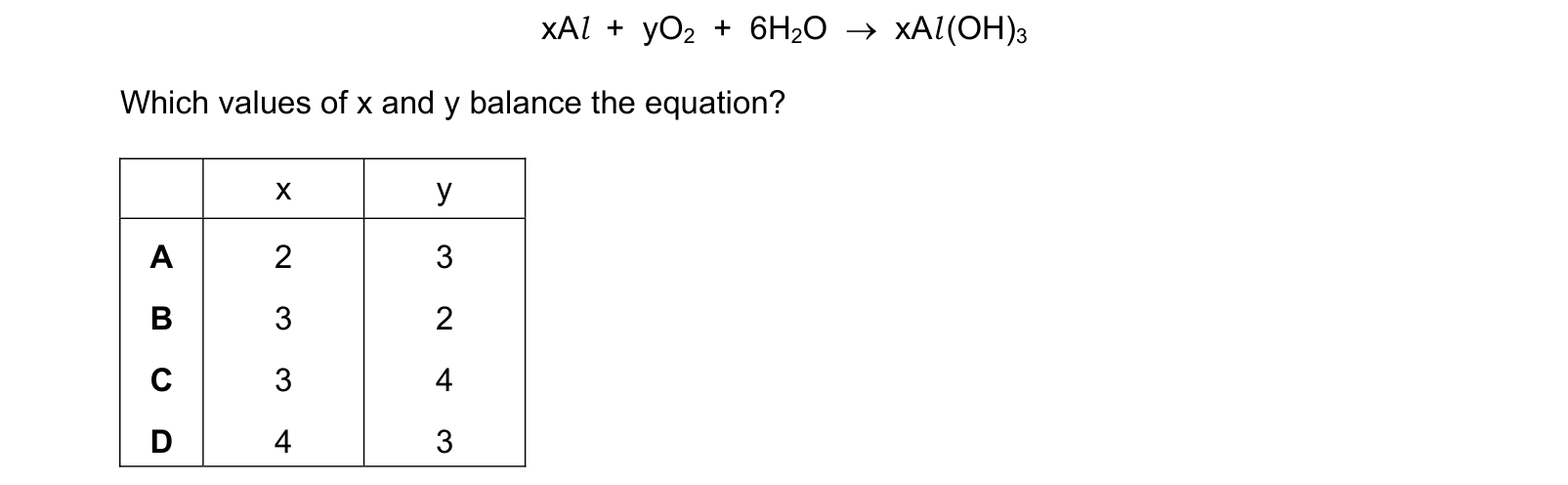
A reaction involving aluminium is shown. xAl + yO2 + 6H2O → xAl (OH)3 Which values of x and y balance the equation? Each answer gives, in order: x; y.
Answer: D.
Aluminium carries the same unknown coefficient on both sides, so the way in is hydrogen: six water molecules supply twelve hydrogen atoms and each Al(OH)3 uses three of them, so four aluminium hydroxide units must form and four aluminium atoms must react. That fixes twelve oxygen atoms in the product, six of which come from the water, leaving six to be supplied by three molecules of O2. The row giving 3 and 2 has the right pair of numbers attached to the wrong symbols. The rows starting with 2 or 3 aluminium atoms cannot use up the twelve hydrogen atoms that the six water molecules bring to the reaction.
Question 4
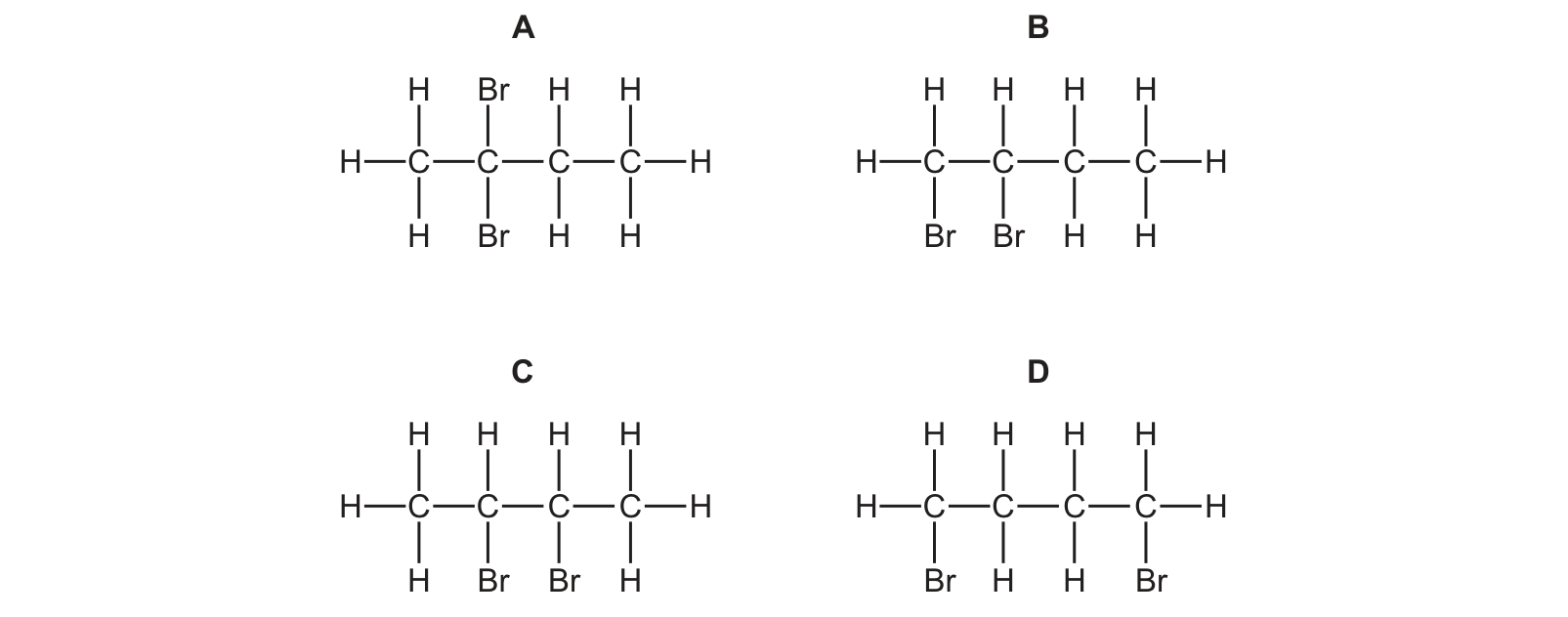
Bromine reacts with but-2-ene. What is the displayed formula of the product of this reaction? Use the source image for W24 Paper 22, question 29.
Answer: C.
Bromine adds across the double bond of an alkene, so the two bromine atoms attach to the two carbon atoms that were doubly bonded and to nothing else. In but-2-ene that bond lies between the second and third carbon atoms, so the product carries one bromine on each of those, with hydrogen everywhere else. The structure with both bromine atoms on the same carbon would require both to add at one end of the double bond, which addition does not do. The structure with bromine on the first and second carbons is what but-1-ene would give, and the structure with a bromine at each end of the chain has them on carbons that were never joined by a double bond.
Question 5
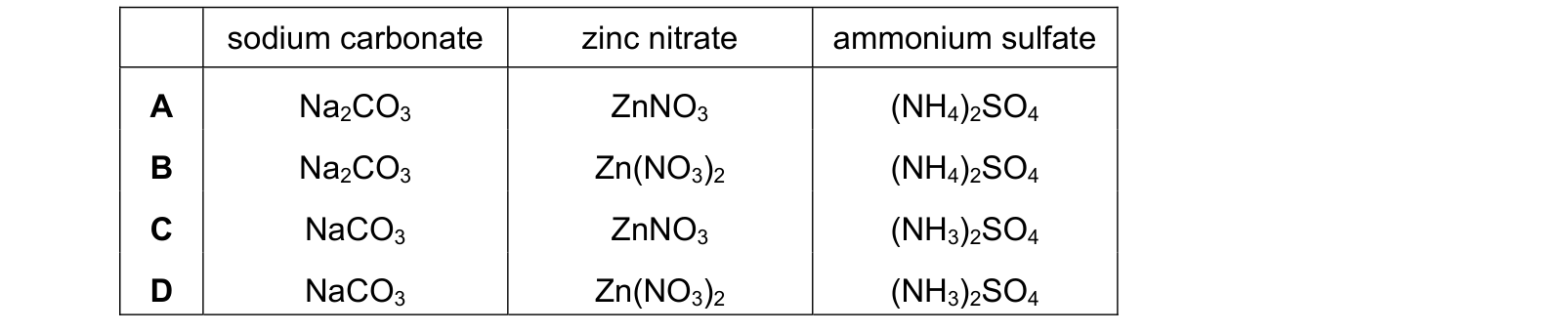
Which row shows the formulae of sodium carbonate, zinc nitrate and ammonium sulfate? Each answer gives, in order: sodium carbonate; zinc nitrate; ammonium sulfate.
Answer: B.
Three formulae have to be right at once. Sodium forms Na+ and carbonate carries a 2 minus charge, so sodium carbonate is Na2CO3, which eliminates both rows written NaCO3. Zinc forms Zn2+ and nitrate is a single negative ion, so two nitrate ions are needed and the bracket is essential: Zn(NO3)2 rather than ZnNO3. Ammonium is NH4+, so ammonium sulfate is (NH4)2SO4, and the rows written (NH3)2SO4 have used the ammonia molecule in place of the ammonium ion, which is the subtlest of the three errors because the two differ by only one hydrogen and a charge.
These questions are drawn from past CIE 0620 Chemistry papers and filtered to the mole and the avogadro constant. You answer, you find out immediately whether you were right, and you get the reasoning for the correct option and for each distractor. Wrong answers go to a mistakes locker so you can come back to exactly those.
Practice is free. You need an account only so your progress and your mistakes are still there next time.
These are the errors that cost marks on the mole and the avogadro constant, taken from our own topic notes. Read them before you practise and you will recognise the traps in the questions.
Forgetting to divide cm³ by 1000 before using concentration × volume.
Using 24 dm³ for a solid or a liquid. The molar gas volume applies to gases at r.t.p. only.
Working the theoretical yield from the reactant in excess rather than the limiting one.
Mixing g/dm³ and mol/dm³ in the same calculation without converting.
Stopping the empirical formula calculation at step 1 without dividing by the smallest.
Rounding part way through. Carry the extra figures and round only at the end.
Treating any of this as Core material. Subtopic 3.3 is examined on Paper 2 only.