Rate of reaction
Contents: 7 sections
What rate means
Rate is how much reactant is used up, or how much product is made, per unit time. It is measured in cm<sup>3</sup>/s for a gas collected, or g/s for a mass lost.
Worked example. A flask of calcium carbonate and dilute hydrochloric acid gives off 48 cm<sup>3</sup> of carbon dioxide and stops after 40 s.
average rate = 48 / 40 = 1.2 cm<sup>3</sup>/s
An average across the whole run hides the shape of it. In the first 10 s the same flask gave 24 cm<sup>3</sup>:
rate over the first 10 s = 24 / 10 = 2.4 cm<sup>3</sup>/s
Twice the average, because a reaction is always fastest at the start, when the concentration of acid is highest, and slows as the acid is used up.
The four factors
| Change | Effect on rate |
|---|---|
| Increase concentration of a solution | Faster |
| Increase pressure of a gas | Faster |
| Decrease particle size of a solid, so increase surface area | Faster |
| Increase temperature | Faster |
| Add a catalyst | Faster |
Every one of these speeds a reaction up. The examinable skill is not the direction but the reason, and for the Extended paper the reason must be given in the language of collisions.
Extended only: collision theory
Particles react only when they collide, and only when the collision has at least a certain minimum energy. That minimum is the activation energy, E<sub>a</sub>. A collision with less energy than E<sub>a</sub> bounces apart unchanged.
- Higher concentration. More particles in the same volume, so the particles are closer together and collisions happen more frequently. The proportion of successful collisions is unchanged.
- Higher pressure of a gas. The same argument. Squeezing the gas puts more particles per unit volume, so collisions are more frequent.
- Smaller particles. The same mass of solid has a much larger surface area, so more of its particles are exposed to the solution and collisions are more frequent. Nothing about the energy of the collisions changes.
- Higher temperature. Two things happen and both matter. The particles have more kinetic energy so they move faster and collide more frequently, and, more importantly, a greater proportion of collisions have energy above E<sub>a</sub>. The second effect is why a rise of 10 °C can roughly double a rate, which frequency alone could never do.
Answers that explain a temperature rise only by "the particles move faster and collide more often" earn part of the mark. The energy point is the one candidates leave out.
Catalysts
A catalyst increases the rate of a reaction and is chemically unchanged in mass and in composition at the end. It does not change the amount of product, only the time taken to get there.
Ones worth knowing by name:
- Manganese(IV) oxide, MnO<sub>2</sub>, for the decomposition of hydrogen peroxide to water and oxygen.
- Iron in the Haber process.
- Vanadium(V) oxide in the Contact process.
- Nickel for adding hydrogen to alkenes.
Enzymes are biological catalysts, and are used in the production of alcoholic drinks and bread through fermentation by yeast, and of yoghurt.
Extended only. A catalyst works by providing an alternative reaction pathway with a lower activation energy. On a reaction pathway diagram the catalysed curve has a lower hump; the energy level of the reactants and the energy level of the products are unchanged, so the overall energy change of the reaction is exactly the same. Drawing a catalyst as lowering the products is wrong.
Following a reaction
Volume of gas produced. Fit a gas syringe, or collect over water in an inverted measuring cylinder, and record the volume every 10 s. Works for magnesium with hydrochloric acid, which gives hydrogen, and for a carbonate with an acid, which gives carbon dioxide.
Loss of mass. Stand the open flask on a balance behind a cotton wool plug and record the mass every 10 s. This works well for carbon dioxide, whose relative formula mass is 44, and badly for hydrogen, whose relative formula mass is 2 and whose escape barely registers on a two decimal place balance.
Formation of a precipitate. Sodium thiosulfate and dilute hydrochloric acid produce a pale yellow precipitate of sulfur that clouds the mixture. Stand the flask on a paper cross and time how long the cross takes to disappear. The shorter the time, the faster the reaction, so 1/t is used as a measure of rate.
Worked example. At 20 °C the cross vanishes in 40 s. At 30 °C it vanishes in 25 s. Comparing 1/t:
- 1 / 40 = 0.025 per second
- 1 / 25 = 0.040 per second
The value of 1/t has risen by a factor of 1.6, so the reaction at 30 °C is 1.6 times as fast. A ten degree rise typically multiplies the rate by something between 1.5 and 2.0, which is why temperature is the most powerful of the four factors.
Reading the graph
A graph of gas volume against time rises steeply, curves over and flattens.
- The gradient at any point is the rate at that moment. Steepest at t equals zero, falling throughout.
- The curve becomes horizontal when the reaction has stopped, because a reactant has been used up.
- The height of the plateau depends only on the amount of the limiting reactant, not on how fast the reaction went.
That last point is the one that decides most exam questions. Raising the temperature, raising the concentration or powdering the solid gives a steeper curve that levels off sooner at the same height, provided the amount of limiting reactant is unchanged. Only using more of the limiting reactant raises the plateau.
If the mass of magnesium is halved and the acid is in excess, the new curve finishes at half the volume of hydrogen.
Extended only. Because surface area matters so much, a solid ground to a fine powder and dispersed in air can react with oxygen almost instantly. This is why flour mills, custard powder factories, sawmills and coal mines take explosion precautions: the fuel is ordinary, but its surface area is enormous.
Common mistakes
- Explaining a temperature rise only as more frequent collisions, leaving out the activation energy.
- Saying a catalyst is used up, or that it increases the yield.
- Drawing a catalysed pathway that lowers the energy of the products.
- Saying "more collisions" when the mark scheme wants "more frequent collisions" or "more collisions per second".
- Raising the plateau of a graph after a change that only speeds the reaction up.
- Using loss of mass to follow a reaction that gives off hydrogen.
- Saying the rate is constant because the average rate is a single number.
- Writing that smaller pieces have more surface area without saying more particles are exposed to collide.
Check you have it
Question 1
Sulfuric acid is produced by the Contact process. Which row shows the typical conditions used in the process? Each answer gives, in order: catalyst; pressure / kPa; temperature / °C.
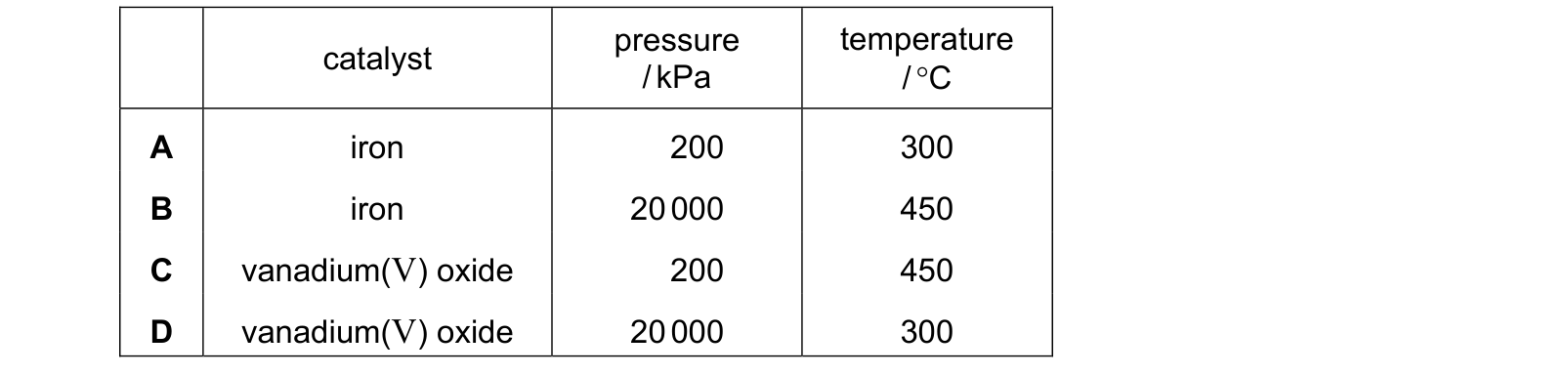
Answer: C.
Question 2
The volume of gas given off in a chemical reaction is measured over time.
The results are shown. time / s
At which time is the rate of reaction greatest?
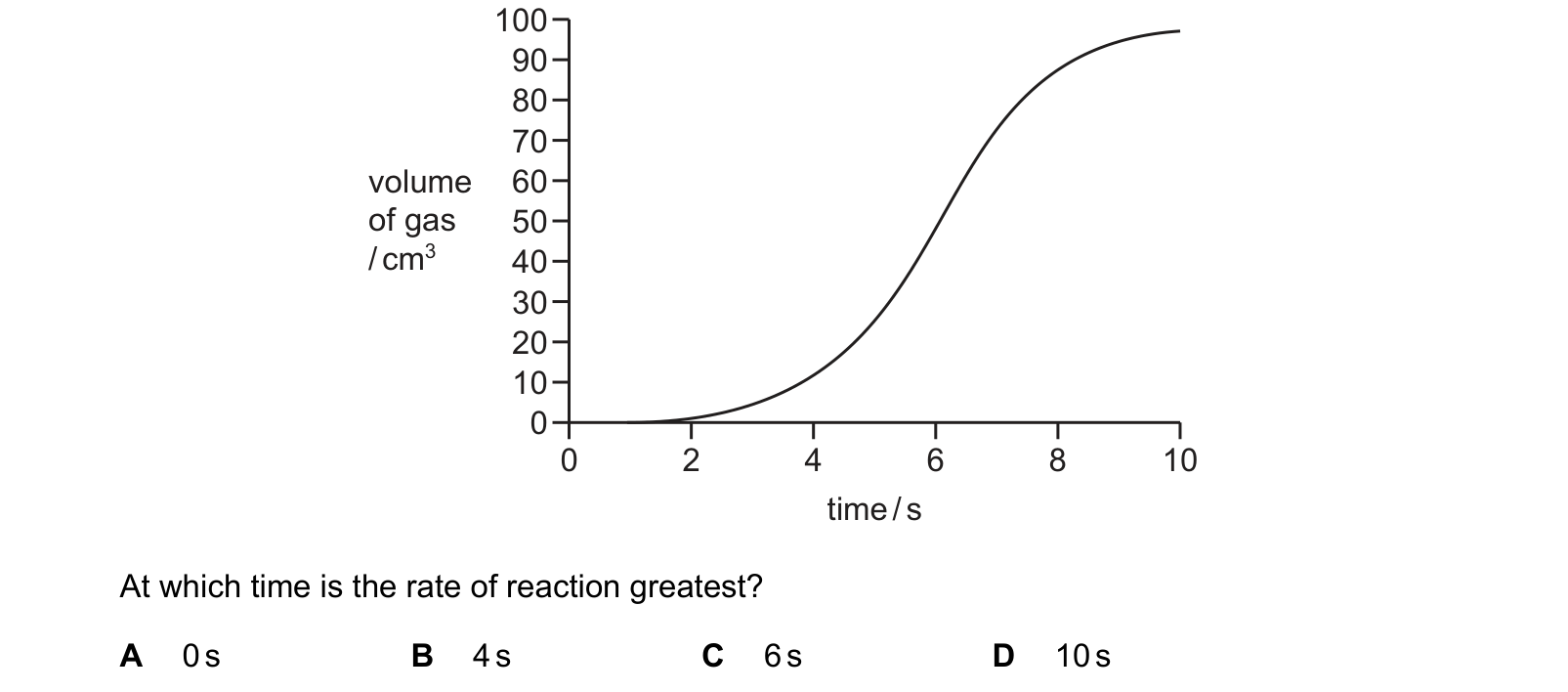
Answer: C.
Question 3
One of the steps in manufacturing sulfuric acid in the Contact process is shown. Which catalyst is used to increase the rate of this reaction?

Answer: D.
What the syllabus asks for on this topicSyllabus points
Syllabus points
- Describe the effect on the rate of a reaction of changing the concentration of a solution, the particle size of a solid, the temperature, and of adding a catalyst.
- State that a catalyst increases the rate of a reaction and is unchanged at the end of the reaction.
- Describe practical methods for investigating rate, including the volume of gas produced, the loss in mass of the flask and the formation of a precipitate.
- Interpret data, including graphs, from rate of reaction experiments.
- Extended only: describe collision theory in terms of the number of particles per unit volume, the frequency of collisions, the kinetic energy of the particles and the activation energy.
- Extended only: explain the effect of concentration, pressure, particle size and temperature in terms of collision theory, describe a catalyst as providing a pathway of lower activation energy, and state the danger of explosive combustion of fine powders.
Related CIE 0620 Chemistry topics
Not the topic you were looking for? Describe what you are stuck on in your own words and we will take you to the notes that answer it.