55 past-paper questions on this unit. Five of them are below. Answer on the page: each one is marked the moment you pick, the correct option is shown whether or not you found it, and the full explanation opens either way.
CIE 0620 ChemistryPaper 1 and Paper 2 MCQsFree account
Rate of reaction: five questions to try now
Real past-paper questions, the answer key from the mark scheme, and the explanation that goes with it. No account needed to answer them.
Question 1
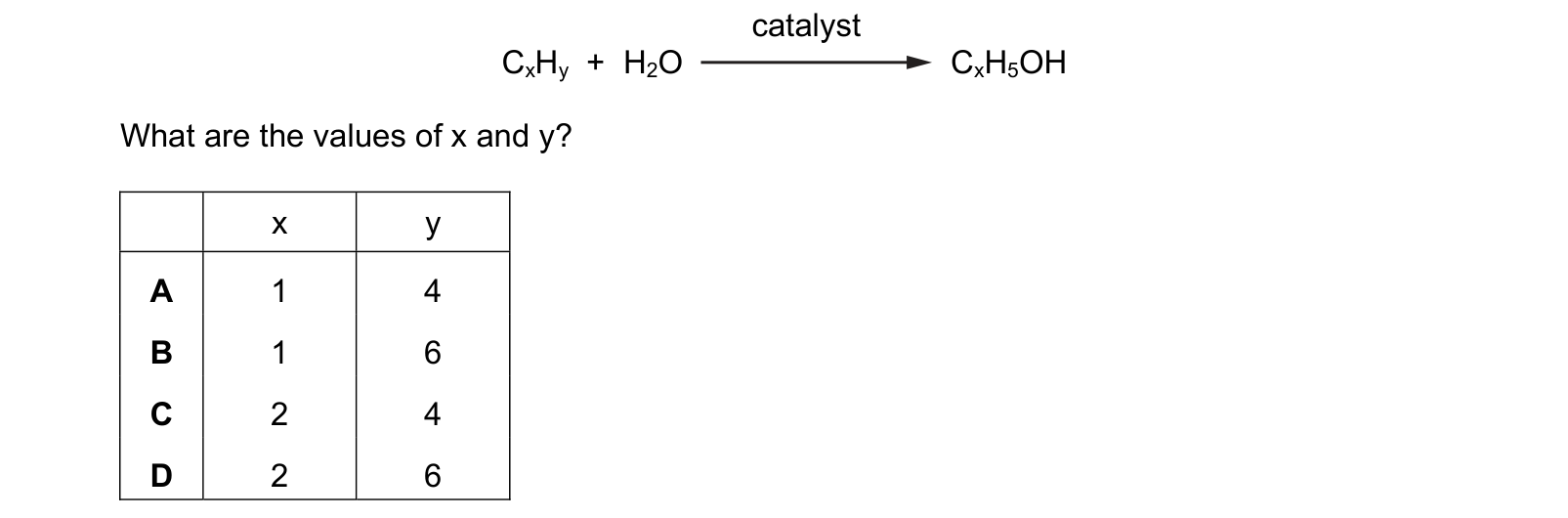
The equation representing the reaction of a hydrocarbon with water is shown. catalyst CxHy + H2O CxH5OH What are the values of x and y? Each answer gives, in order: x; y.
Answer: C.
The product is written CxH5OH, and the only alcohol matching that pattern at this level is ethanol, C2H5OH, which fixes the number of carbon atoms at two. Counting hydrogen then settles the rest: ethanol holds six hydrogen atoms, water contributes two of them, so the hydrocarbon must bring four, making it C2H4. That formula is ethene, an alkene whose double bond opens when steam adds across it over a phosphoric acid catalyst at high pressure. Giving the hydrocarbon six hydrogen atoms would make it ethane, which is saturated and does not react with steam this way, and it would leave the equation with two hydrogen atoms too many.
Question 2
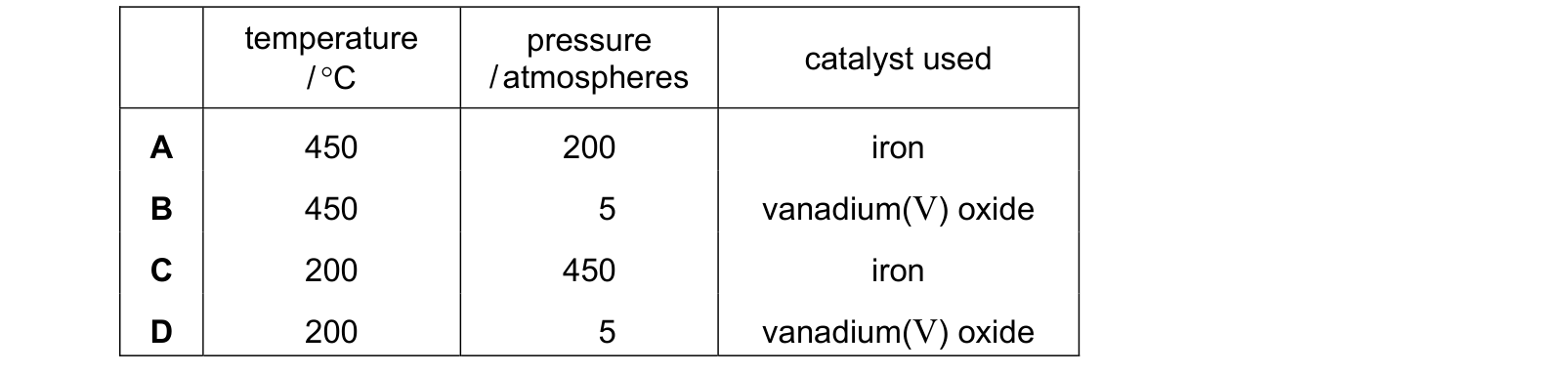
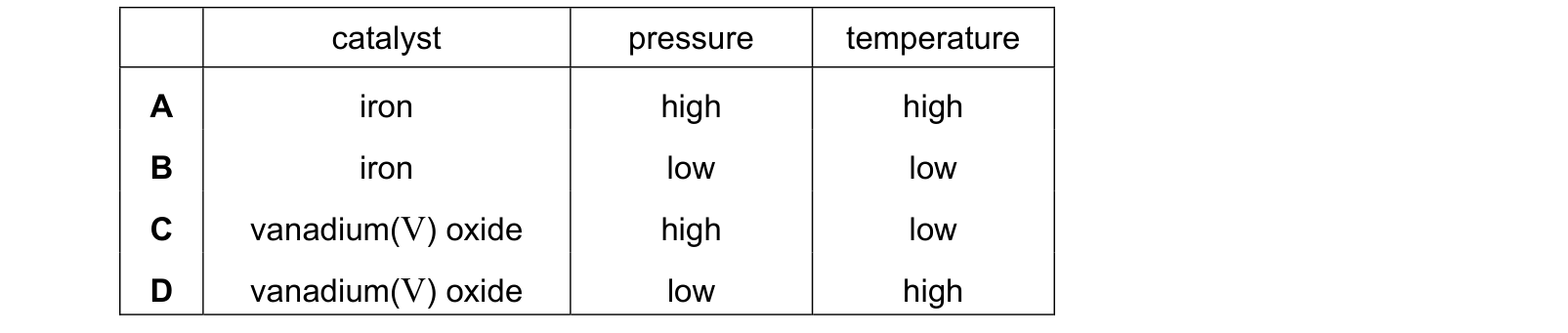
Ammonia is made in the Haber process. Which conditions are used in the Haber process? Each answer gives, in order: temperature / °C; pressure / atmospheres; catalyst used.
Answer: A.
Ammonia is manufactured at roughly 450 °C and about 200 atm over an iron catalyst. The high pressure earns its cost here because four gas molecules become two, so squeezing the mixture really does raise the yield, and 5 atm would throw that advantage away. The temperature is a compromise, since the forward reaction is exothermic and cooler conditions would give more ammonia at equilibrium, yet the reaction would then take far too long, which puts 200 °C on the wrong side of the balance. Vanadium(V) oxide belongs to the Contact process for sulfuric acid, so any row naming it has borrowed the catalyst from a different factory.
Question 3
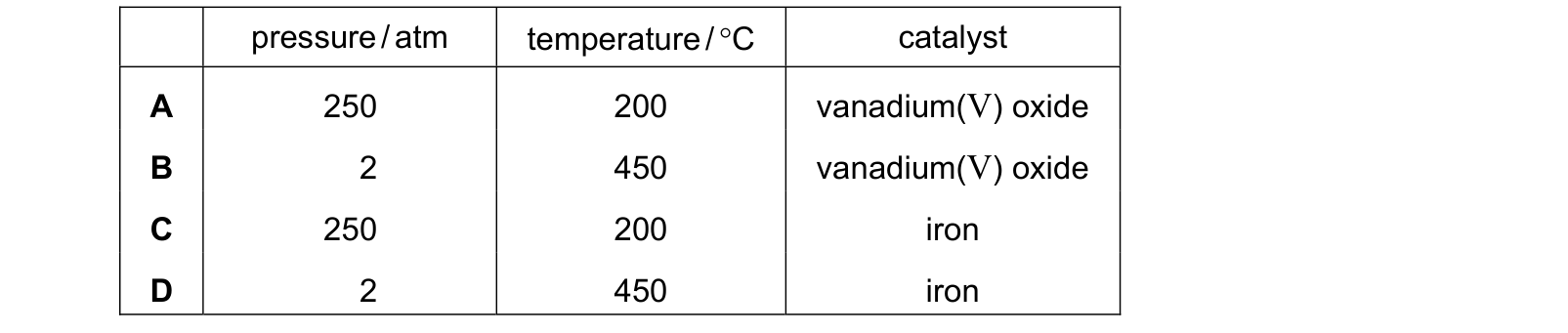
Which row shows the conditions used for the manufacture of sulfuric acid in the Contact process? Each answer gives, in order: pressure / atm; temperature / °C; catalyst.
Answer: B.
Three values must agree at once. Vanadium(V) oxide is the Contact process catalyst, so the rows offering iron have imported the catalyst from the Haber process for ammonia. The pressure is only about 2 atm, because roughly 96 per cent conversion is already achieved there and compressing gases costs money for almost no gain, so 250 atm belongs to a plant with a much less favourable equilibrium. The temperature is around 450 °C, chosen as a compromise between the better yield a cool exothermic reaction would give and the impractically slow rate that would come with it, and 200 °C sits on the wrong side of that trade.
Question 4
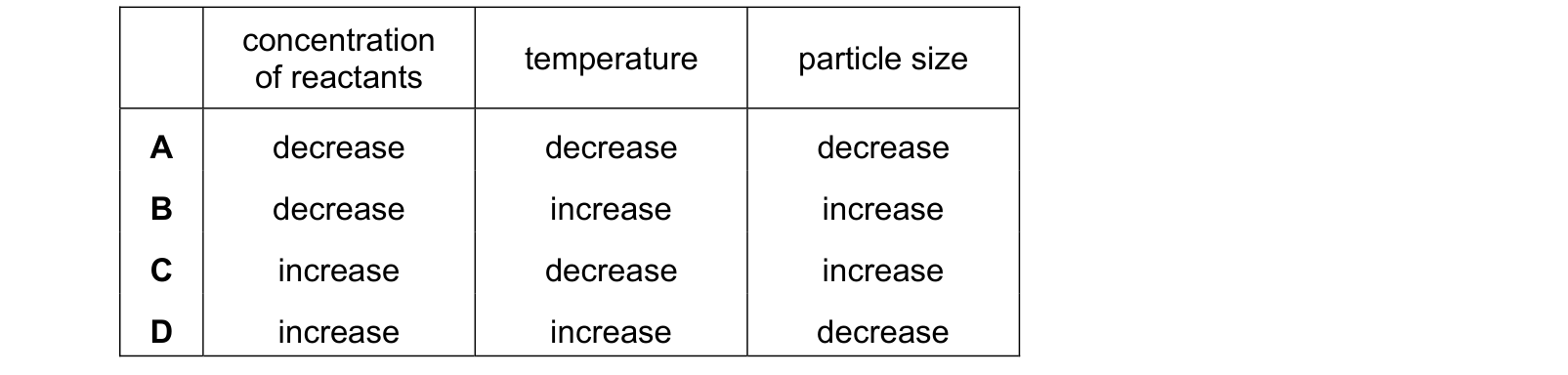
Which row shows the changes that all increase the rate of a chemical reaction? Each answer gives, in order: concentration of reactants; temperature; particle size.
Answer: D.
Rate depends on how often reacting particles collide with enough energy, so anything that packs more particles together or gives them more energy will speed the reaction up. More concentrated solutions hold more reactant particles in each cubic centimetre, warmer particles move faster and carry more energy, and smaller pieces expose more surface for the other reactant to attack, so the winning row must read increase, increase, decrease. Particle size is the column that catches people out, because it is the only one where the number in the table has to go down for the rate to go up. Any row asking for larger particles is describing a lump of marble rather than powdered marble, and a lump reacts more slowly precisely because most of its atoms are buried inside.
Question 5
Which row describes the conditions used in the manufacture of sulfuric acid by the Contact process? Each answer gives, in order: catalyst; pressure; temperature.
Answer: D.
In the Contact process sulfur dioxide is oxidised to sulfur trioxide over vanadium(V) oxide at roughly 450 °C and a pressure only just above atmospheric. Iron is the catalyst for the Haber process, so the two rows naming iron have imported the conditions for making ammonia into a question about sulfuric acid. Pairing high pressure with a low temperature looks defensible on paper, because the forward reaction is exothermic and turns three gas molecules into two. In practice that pairing is rejected: the yield is already around 96 per cent at low pressure, so compressing the gases buys almost nothing for a large cost, and dropping the temperature makes the reaction far too slow to be useful.
These questions are drawn from past CIE 0620 Chemistry papers and filtered to rate of reaction. You answer, you find out immediately whether you were right, and you get the reasoning for the correct option and for each distractor. Wrong answers go to a mistakes locker so you can come back to exactly those.
Practice is free. You need an account only so your progress and your mistakes are still there next time.
These are the errors that cost marks on rate of reaction, taken from our own topic notes. Read them before you practise and you will recognise the traps in the questions.
Explaining a temperature rise only as more frequent collisions, leaving out the activation energy.
Saying a catalyst is used up, or that it increases the yield.
Drawing a catalysed pathway that lowers the energy of the products.
Saying "more collisions" when the mark scheme wants "more frequent collisions" or "more collisions per second".
Raising the plateau of a graph after a change that only speeds the reaction up.
Using loss of mass to follow a reaction that gives off hydrogen.
Saying the rate is constant because the average rate is a single number.
Writing that smaller pieces have more surface area without saying more particles are exposed to collide.