Water
Contents: 7 sections
Two tests for the presence of water
| Reagent | Colour before | Colour after adding water |
|---|---|---|
| Anhydrous cobalt(II) chloride | Blue | Pink |
| Anhydrous copper(II) sulfate | White | Blue |
The reagent must be anhydrous in both cases, because the colour change comes from water joining the solid as water of crystallisation. Hydrated cobalt(II) chloride is already pink and hydrated copper(II) sulfate is already blue, so neither can register anything.
Cobalt(II) chloride is usually used as cobalt chloride paper, dried in an oven until it is blue and then held in the vapour or dipped in the liquid.
Both changes are reversible. Warm the pink solid and it goes back to blue; warm the blue copper(II) sulfate and it goes back to white. That reversibility is often the point of an exam question about heating a hydrated salt.
Presence is not purity
Neither test tells you the liquid is pure water. Orange juice, seawater and dilute hydrochloric acid all turn cobalt chloride paper pink, because all of them contain water.
Purity is judged from fixed points instead:
- Pure water melts at 0 °C and boils at 100 °C at normal atmospheric pressure.
- An impurity lowers the melting point and raises the boiling point.
- An impurity also makes the substance melt or boil over a range of temperature rather than sharply.
So seawater freezes below 0 °C and boils above 100 °C. A sample that boils at 102 °C is not pure, however convincingly it turns copper(II) sulfate blue.
The two ideas fit together like this: the chemical test answers "is there water here?" and the fixed points answer "is this only water?". Questions regularly offer the wrong one of the pair as a distractor.
Why distilled water and not tap water
Distilled water has been boiled and its vapour condensed, so the dissolved solids are left behind. Tap water still contains dissolved ions, and those ions take part in reactions you did not intend.
The clearest example is the test for chloride ions. Tap water carries dissolved chloride ions from chlorination and from the ground. Make up a solution in tap water, acidify it and add aqueous silver nitrate, and you get a white precipitate whether or not your sample contained any chloride. The result is meaningless.
Tap water also contains calcium and magnesium ions, which precipitate with soap and interfere with tests for sulfate and carbonate, and residual chlorine, which bleaches indicator paper.
What is in water from a natural source
River, lake and sea water carries a mixture of dissolved and suspended material:
Beneficial
- Dissolved oxygen, which fish and other aquatic organisms use for respiration.
- Some metal compounds, which supply essential minerals. Calcium compounds are the standard example, needed for bones and teeth.
Potentially harmful
- Some metal compounds are toxic. Compounds of lead, mercury and cadmium are the usual named offenders.
- Plastics harm aquatic life, which swallows the fragments or becomes entangled in the larger pieces.
- Sewage carries harmful microbes that cause diseases such as cholera and typhoid.
- Nitrates from fertilisers, and phosphates from fertilisers and detergents, cause deoxygenation of the water and damage aquatic life.
How nitrates and phosphates kill fish
The chain is worth learning in order, because the marks are given for the steps, not for the word "pollution":
- Nitrates and phosphates wash off farmland into the river.
- They are plant nutrients, so algae grow rapidly and form a mat on the surface.
- The mat blocks light from the plants below, and those plants die.
- Aerobic bacteria decompose the dead plants and algae.
- Those bacteria use up the dissolved oxygen.
- Fish and other aquatic organisms suffocate.
Notice that the nitrate itself is not what poisons the fish. Oxygen is removed by bacteria several steps later.
Treating the domestic supply
Four stages, each doing one job:
| Stage | What happens | What it removes |
|---|---|---|
| Sedimentation | Water stands in a large tank so the denser insoluble solids settle to the bottom under gravity | Silt, grit, larger suspended solids |
| Filtration | The water passes down through beds of sand and gravel | Fine insoluble solids the tank did not settle |
| Carbon | The water passes through activated carbon, which adsorbs dissolved molecules onto its very large surface area | Tastes and odours |
| Chlorination | Chlorine is added in a small, controlled dose | Harmful microbes are killed |
Sedimentation and filtration between them deal only with insoluble material. Carbon deals with the substances that make water taste and smell wrong. Chlorine deals with the living organisms.
Nothing in that list removes dissolved salts. Treated tap water still contains calcium, magnesium, sodium and chloride ions, which is exactly why a school laboratory buys distilled or deionised water rather than turning on a tap.
Chlorine is added deliberately even though it is toxic, because the dose that kills bacteria is far below the dose that harms a person, and untreated water spreads cholera and typhoid. A question asking for a disadvantage of chlorination wants the taste, the smell or the toxicity of chlorine itself, not a claim that it fails to work.
Common mistakes
- Saying a colour change with cobalt chloride paper proves the liquid is pure water. It proves only that water is present.
- Forgetting the word anhydrous, so the reagent described has no colour change left to give.
- Giving the colour change backwards: cobalt(II) chloride goes blue to pink, copper(II) sulfate goes white to blue.
- Saying an impurity raises the melting point. It lowers it, and raises the boiling point.
- Saying nitrates poison fish directly, rather than following the algae, light, bacteria and oxygen chain.
- Saying filtration removes dissolved substances. It removes only insoluble solids.
- Saying chlorine is added to remove the taste. Carbon removes tastes and odours; chlorine kills microbes.
- Claiming treated tap water is pure. It still holds dissolved ions, which is why practical work uses distilled water.
Check you have it
Question 1
Which row describes the colour changes when water is added to anhydrous cobalt(II) chloride and anhydrous copper(II) sulfate? Each answer gives, in order: anhydrous cobalt(II) chloride; anhydrous copper(II) sulfate.
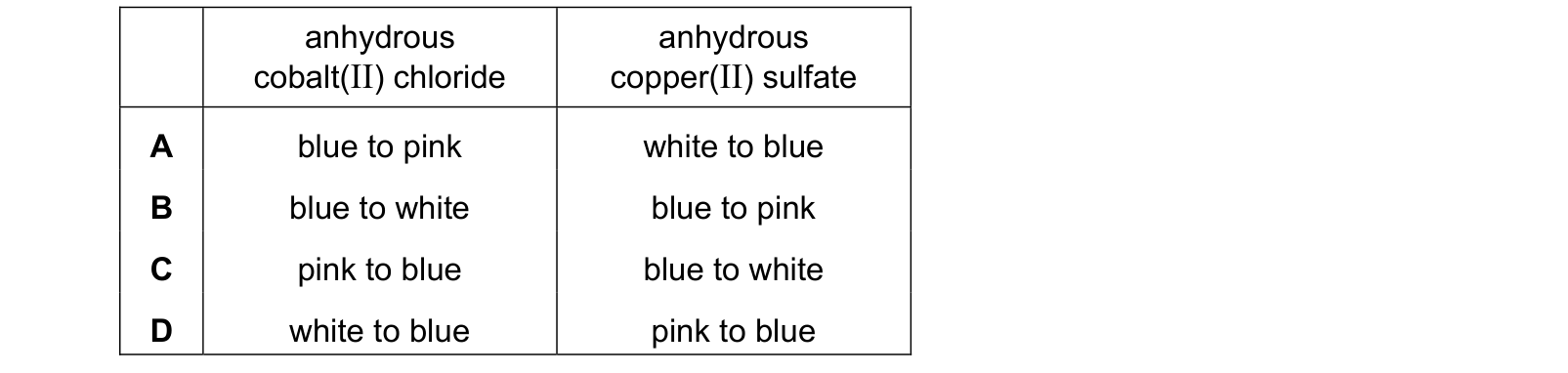
Answer: A.
Question 2
Some uses of water are listed.
1 for drinking
2 in chemical reactions
3 in swimming pools
4 in washing
For which uses is it necessary to chlorinate the water?
Answer: B.
Question 3
The diagrams show some uses of water in the home. For which uses is it important for the water to have been treated?
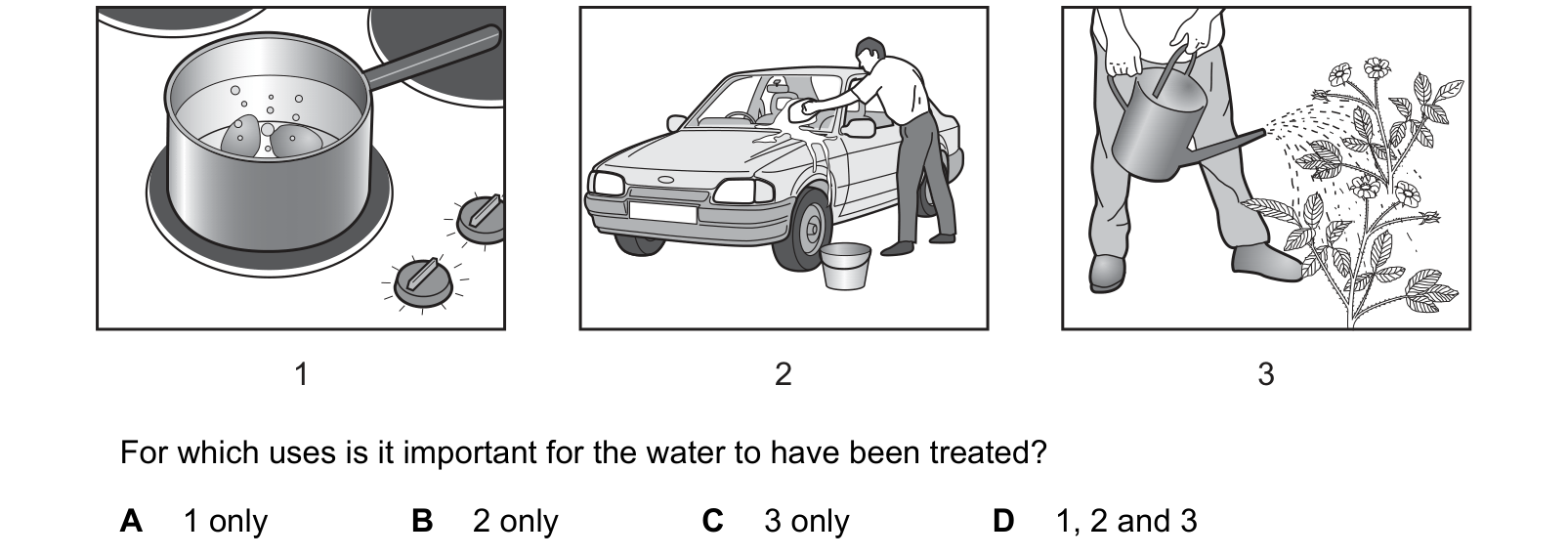
Answer: A.
What the syllabus asks for on this topicSyllabus points
Syllabus points
- Describe chemical tests for the presence of water using anhydrous cobalt(II) chloride and anhydrous copper(II) sulfate.
- Describe how to test the purity of water using melting point and boiling point.
- Explain why distilled water rather than tap water is used in practical chemistry.
- State the substances found in water from natural sources, and say which are beneficial and which are potentially harmful.
- Describe the treatment of the domestic water supply by sedimentation, filtration, carbon and chlorination.
Everything in this subtopic is Core. Extended candidates are examined on all of it as well.
Related CIE 0620 Chemistry topics
Not the topic you were looking for? Describe what you are stuck on in your own words and we will take you to the notes that answer it.