41 past-paper questions on this unit. Five of them are below. Answer on the page: each one is marked the moment you pick, the correct option is shown whether or not you found it, and the full explanation opens either way.
CIE 0620 ChemistryPaper 1 and Paper 2 MCQsFree account
Water: five questions to try now
Real past-paper questions, the answer key from the mark scheme, and the explanation that goes with it. No account needed to answer them.
Question 1
Water is extracted from a river for use in a domestic water supply. Some treatments for domestic water are listed. Which statement about these treatments is correct?
Answer: B.
Each treatment does one job, and the question tests whether those jobs have been kept apart. Activated carbon offers an enormous surface that holds on to the organic molecules responsible for unpleasant tastes and smells, so it is the odour treatment. Chlorination kills bacteria and other microbes, which is a safety measure rather than a matter of taste, and chlorine tends to add a taste of its own. Sedimentation lets heavy particles settle under gravity while filtration traps the solids that remain, so both deal with insoluble material and neither removes dissolved substances or kills anything.
Question 2
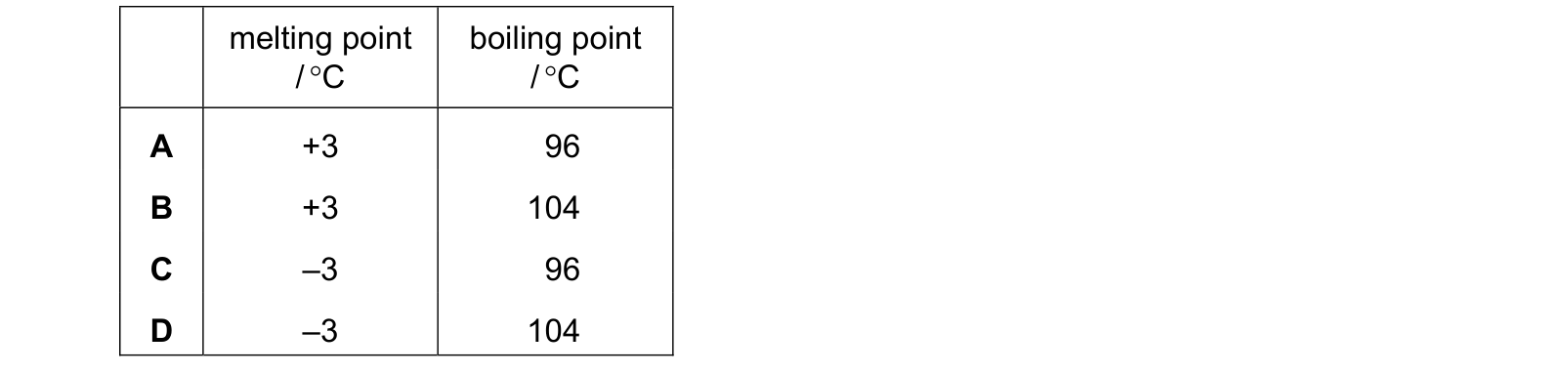
What could be the melting point and boiling point of water containing a dissolved impurity? Each answer gives, in order: melting point / °C; boiling point / °C.
Answer: D.
A pure substance melts and boils at fixed temperatures, and dissolving anything in it pushes those points apart: the melting point falls below 0 °C while the boiling point rises above 100 °C. Only the pairing of minus 3 °C with 104 °C moves both figures in the right direction. The row giving minus 3 °C and 96 °C gets the melting point right and then lowers the boiling point, which would require the impurity to make escape into vapour easier rather than harder. The rows starting at plus 3 °C would need the impurity to make freezing easier, the exact opposite of why salt is spread on icy roads.
Question 3
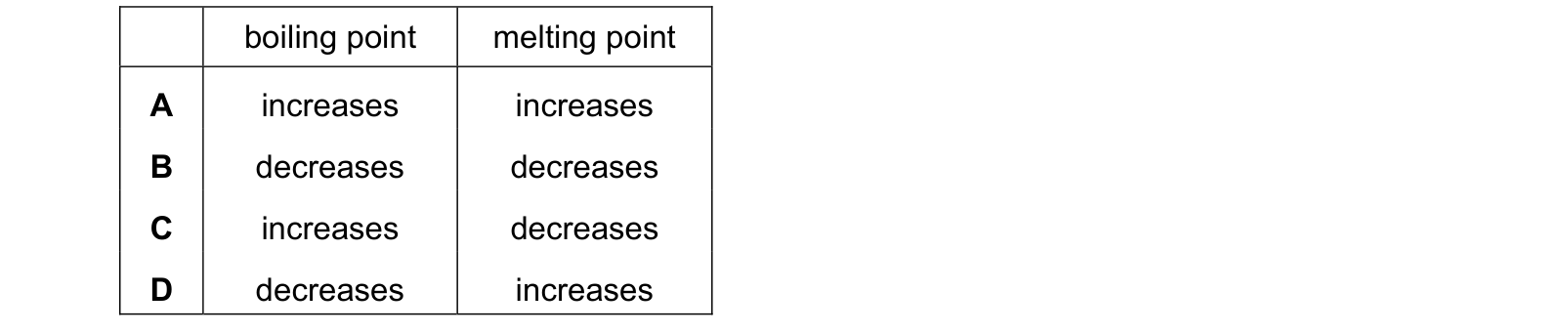
Which row shows how the boiling point and the melting point of water change when a soluble impurity is added to the water? Each answer gives, in order: boiling point; melting point.
Answer: C.
A dissolved impurity widens the range over which a substance stays liquid, pushing the boiling point up and the melting point down. Boiling needs molecules to escape the liquid, and the dissolved particles hold them back, so a higher temperature is required. Freezing needs the molecules to lock into a lattice, and the dissolved particles obstruct that, so the liquid must be cooled further before it will set. Salt on icy roads and the extra minute a pan of salted water takes to boil are the everyday versions of these two effects, and any row moving both points the same way has missed that they pull in opposite directions.
Question 4
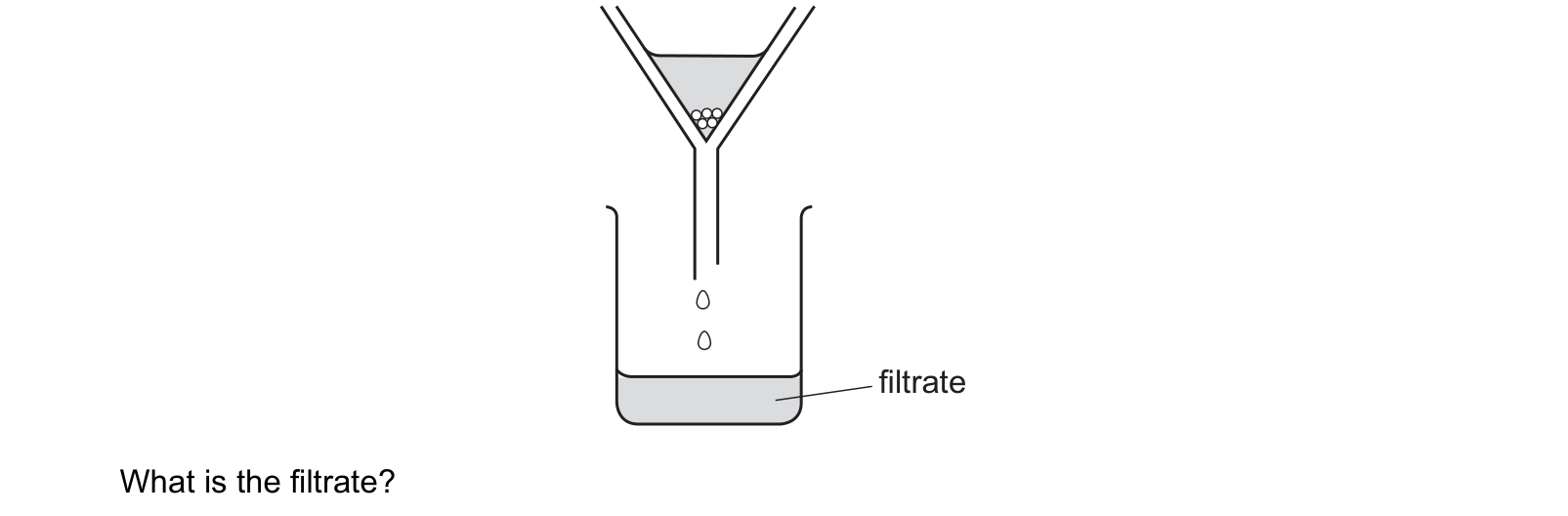
A student separates sugar from pieces of broken glass by dissolving the sugar in water and filtering off the broken glass. What is the filtrate?
Answer: D.
Filtration separates an insoluble solid from a liquid, and the two products have their own names: the residue stays on the paper while the filtrate passes through into the flask below. Sugar dissolves in the water, so it travels through the paper as part of the solution, whereas the broken glass is insoluble and is held back. The filtrate is therefore the sugar solution and the glass is the residue. Calling the filtrate pure water forgets that the sugar is still dissolved in it and would need evaporation or crystallisation to recover, and any answer including the glass has the two products the wrong way round.
Question 5
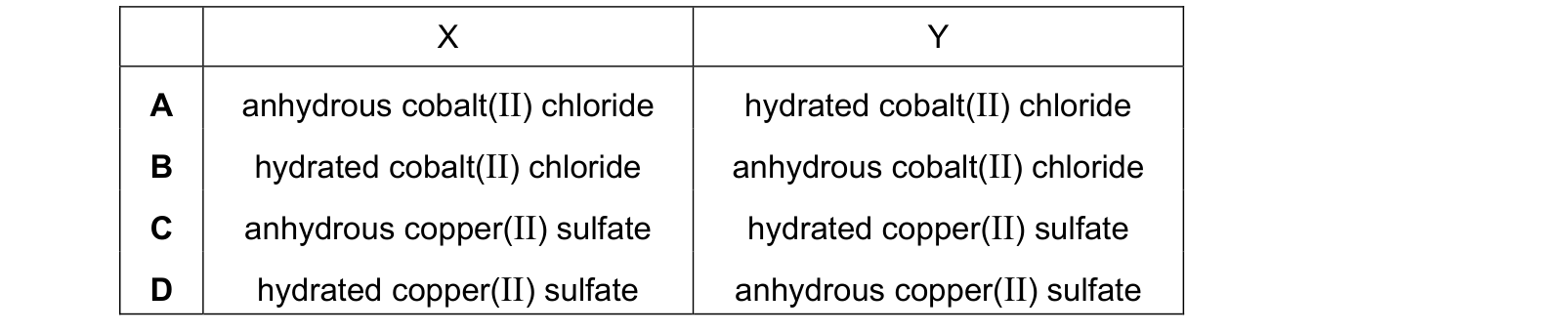
X is a pink solid. Y is a blue solid. When X is heated, water is produced and the solid turns blue. When water is added to Y, the solid turns pink. What are X and Y? Each answer gives, in order: X; Y.
Answer: B.
Pink and blue are the pair of colours belonging to cobalt(II) chloride, so both solids here are cobalt compounds and the copper options can be set aside, since copper(II) sulfate runs blue to white rather than pink to blue. Heating X drives water off and turns it blue, so X must have held water of crystallisation and is the pink hydrated salt. Y turns pink when water is added, so Y is the dry blue anhydrous salt taking that water up. The row naming the anhydrous salt as X reverses the two, because a salt with no water in it cannot give water off when heated.
These questions are drawn from past CIE 0620 Chemistry papers and filtered to water. You answer, you find out immediately whether you were right, and you get the reasoning for the correct option and for each distractor. Wrong answers go to a mistakes locker so you can come back to exactly those.
Practice is free. You need an account only so your progress and your mistakes are still there next time.
These are the errors that cost marks on water, taken from our own topic notes. Read them before you practise and you will recognise the traps in the questions.
Saying a colour change with cobalt chloride paper proves the liquid is pure water. It proves only that water is present.
Forgetting the word anhydrous, so the reagent described has no colour change left to give.
Giving the colour change backwards: cobalt(II) chloride goes blue to pink, copper(II) sulfate goes white to blue.
Saying an impurity raises the melting point. It lowers it, and raises the boiling point.
Saying nitrates poison fish directly, rather than following the algae, light, bacteria and oxygen chain.
Saying filtration removes dissolved substances. It removes only insoluble solids.
Saying chlorine is added to remove the taste. Carbon removes tastes and odours; chlorine kills microbes.
Claiming treated tap water is pure. It still holds dissolved ions, which is why practical work uses distilled water.
Revise it first
If any of the above is unfamiliar, work through the notes before practising: Water revision notes.