103 past-paper questions on this unit. Five of them are below. Answer on the page: each one is marked the moment you pick, the correct option is shown whether or not you found it, and the full explanation opens either way.
CIE 0620 ChemistryPaper 1 and Paper 2 MCQsFree account
Alkanes: five questions to try now
Real past-paper questions, the answer key from the mark scheme, and the explanation that goes with it. No account needed to answer them.
Question 1
Methane reacts with chlorine in the presence of ultraviolet light. Which substance is not produced in this reaction? Use the source image for W22 Paper 22, question 35.
Answer: A.
Chlorine substitutes for hydrogen in methane one atom at a time under ultraviolet light, and every hydrogen atom removed leaves attached to a chlorine atom as HCl. So hydrogen chloride is produced, and so are the substituted molecules, chloromethane first and then dichloromethane once a second hydrogen atom has gone. A molecule of hydrogen is the one thing never made, because the displaced hydrogen atoms do not pair up with each other; there is always a chlorine atom waiting for each of them. Expecting H2 comes from picturing the reaction as methane decomposing rather than as an exchange of one atom for another.
Question 2
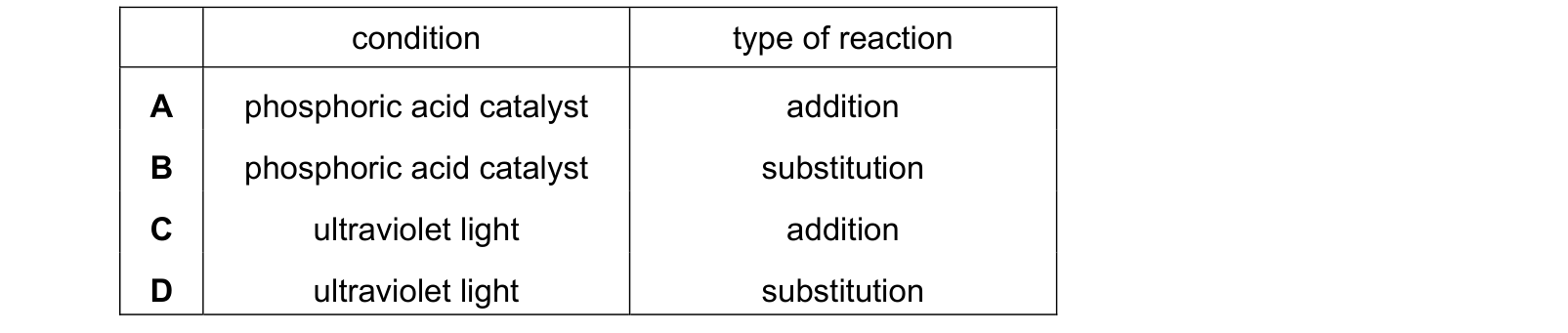
Propane reacts with chlorine. Which row shows a condition required for this reaction and identifies the type of reaction? Each answer gives, in order: condition; type of reaction.
Answer: D.
Propane is an alkane, C3H8, in which every carbon atom already has four single bonds, so it is saturated and cannot take on extra atoms by addition. What it can do is substitution, where one chlorine atom replaces one hydrogen atom to give chloropropane and hydrogen chloride. The reaction needs ultraviolet light to break Cl2 into reactive chlorine atoms, which is why the mixture is stable if kept in the dark. A phosphoric acid catalyst belongs to a completely different reaction, the addition of steam to ethene to make ethanol, so any row pairing it with propane has borrowed the conditions for an alkene. Calling the reaction addition makes that same mistake from the other side, treating a saturated molecule as though it had a double bond waiting to open.
Question 3
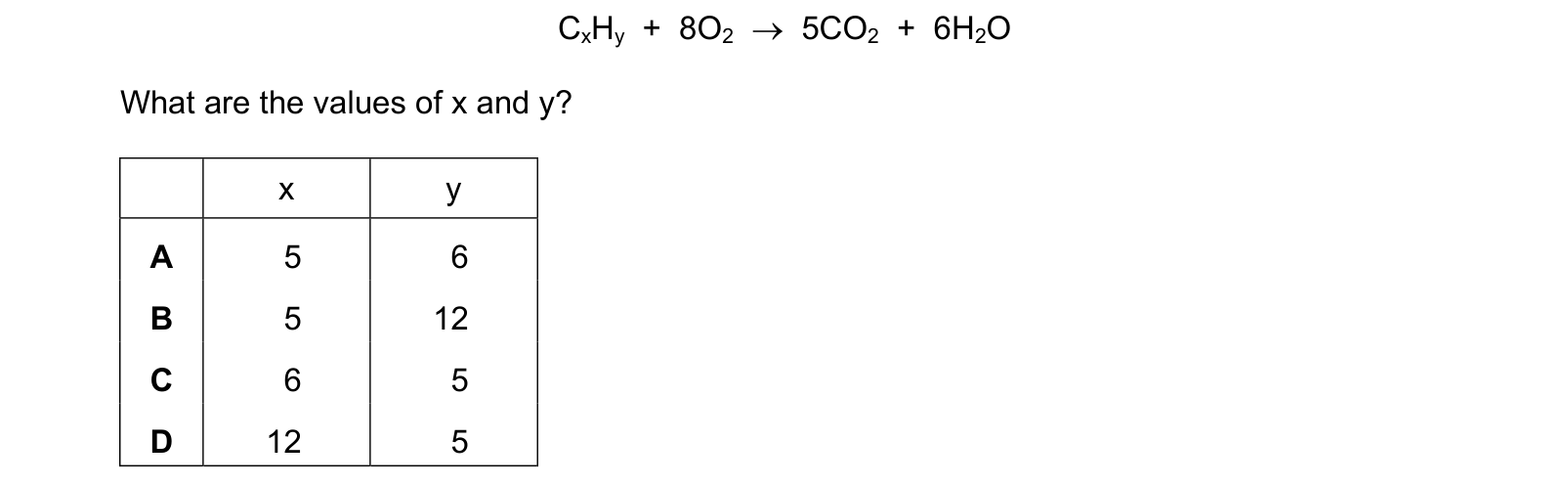
The formula of a hydrocarbon is CxHy. The equation for its complete combustion is shown. CxHy + 8O2 → 5CO2 + 6H2O What are the values of x and y? Each answer gives, in order: x; y.
Answer: B.
Balancing starts with the atoms that appear in only one substance on each side. All five carbon atoms in 5CO2 must have come from the single hydrocarbon molecule, so x = 5, and the six water molecules carry two hydrogen atoms each, so y = 12. Oxygen then confirms it, because 8O2 supplies 16 oxygen atoms while the products use 5 times 2 plus 6, which is also 16. Answering 5 and 6 reads the large number in front of H2O as a count of hydrogen atoms rather than of molecules. The two rows beginning with 6 or with 12 have the two values the wrong way round and describe a hydrocarbon holding more carbon atoms than hydrogen atoms, whereas the compound here is C5H12, pentane.
Question 4
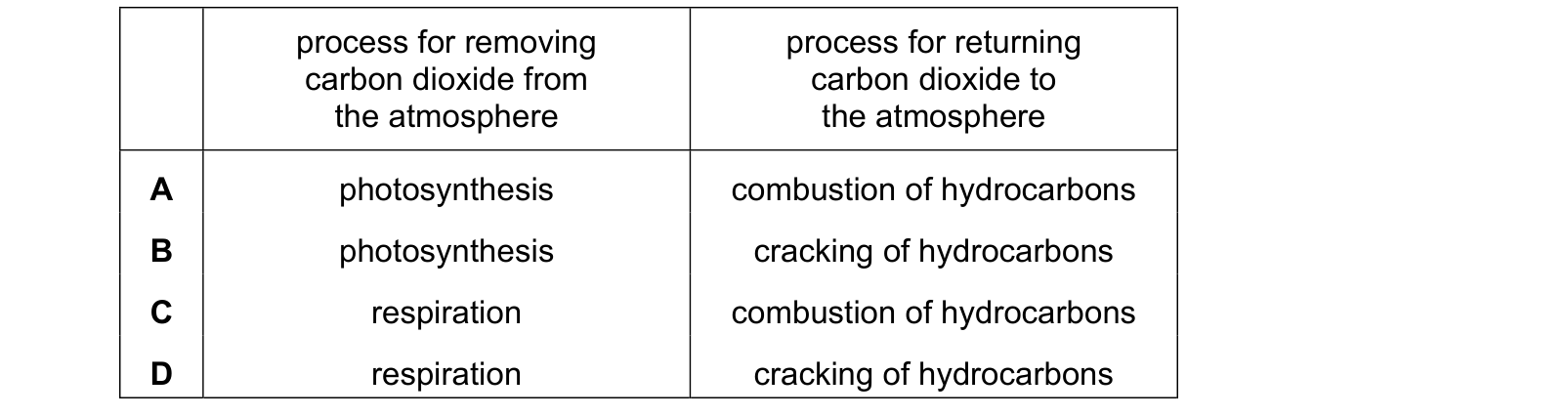
Which row about the carbon cycle is correct? Each answer gives, in order: process for removing carbon dioxide from the atmosphere; process for returning carbon dioxide to the atmosphere.
Answer: A.
Photosynthesis is the only process listed that takes carbon dioxide out of the air, fixing it into glucose using light energy, so the first column has to read photosynthesis. Respiration does the opposite, releasing carbon dioxide as cells break glucose down, which means any row putting respiration in the removal column has the carbon cycle running backwards. In the second column, burning a hydrocarbon oxidises its carbon and sends it back into the atmosphere as carbon dioxide. Cracking does nothing of the kind, breaking long alkane molecules into shorter ones inside a refinery with the carbon still locked up in hydrocarbons, so no carbon dioxide is returned by it.
Question 5
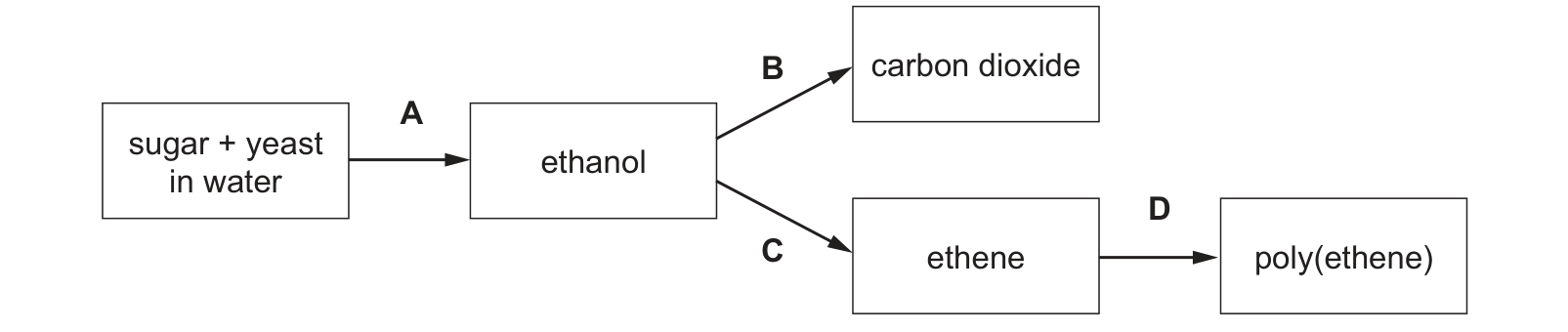
Which process involves combustion? (Some of the reaction products are not shown on the diagram.) Use the source image for S23 Paper 13, question 35.
Answer: B.
Combustion means burning in oxygen, and carbon dioxide appearing as a product is the clue, since water is the other product and the question warns that not everything is shown. Ethanol burns to carbon dioxide and water, so the arrow running from ethanol to carbon dioxide is the combustion. The arrow from sugar and yeast to ethanol is fermentation, which does give off carbon dioxide but uses no oxygen and releases far less energy. Ethanol to ethene is dehydration, the removal of water by concentrated sulfuric acid or hot aluminium oxide, and ethene to poly(ethene) is addition polymerisation, where molecules simply join to one another.
These questions are drawn from past CIE 0620 Chemistry papers and filtered to alkanes. You answer, you find out immediately whether you were right, and you get the reasoning for the correct option and for each distractor. Wrong answers go to a mistakes locker so you can come back to exactly those.
Practice is free. You need an account only so your progress and your mistakes are still there next time.
These are the errors that cost marks on alkanes, taken from our own topic notes. Read them before you practise and you will recognise the traps in the questions.
Saying alkanes decolourise bromine water. They do not; alkenes do.
Writing an addition reaction with chlorine, giving CH₄Cl₂ or similar. Alkanes substitute; they do not add.
Omitting HCl from a substitution equation.
Forgetting to state that ultraviolet light is required, or calling it heat.
Giving carbon dioxide as a product of incomplete combustion.
Leaving a fractional coefficient such as 6.5O₂ in a final answer instead of doubling through.
Calling an alkane unsaturated. The general formula CₙH₂ₙ₊₂ has the maximum possible hydrogens.
Revise it first
If any of the above is unfamiliar, work through the notes before practising: Alkanes revision notes.