24 past-paper questions on this unit. Five of them are below. Answer on the page: each one is marked the moment you pick, the correct option is shown whether or not you found it, and the full explanation opens either way.
CIE 0620 ChemistryPaper 1 and Paper 2 MCQsFree account
Physical and chemical changes: five questions to try now
Real past-paper questions, the answer key from the mark scheme, and the explanation that goes with it. No account needed to answer them.
Question 1
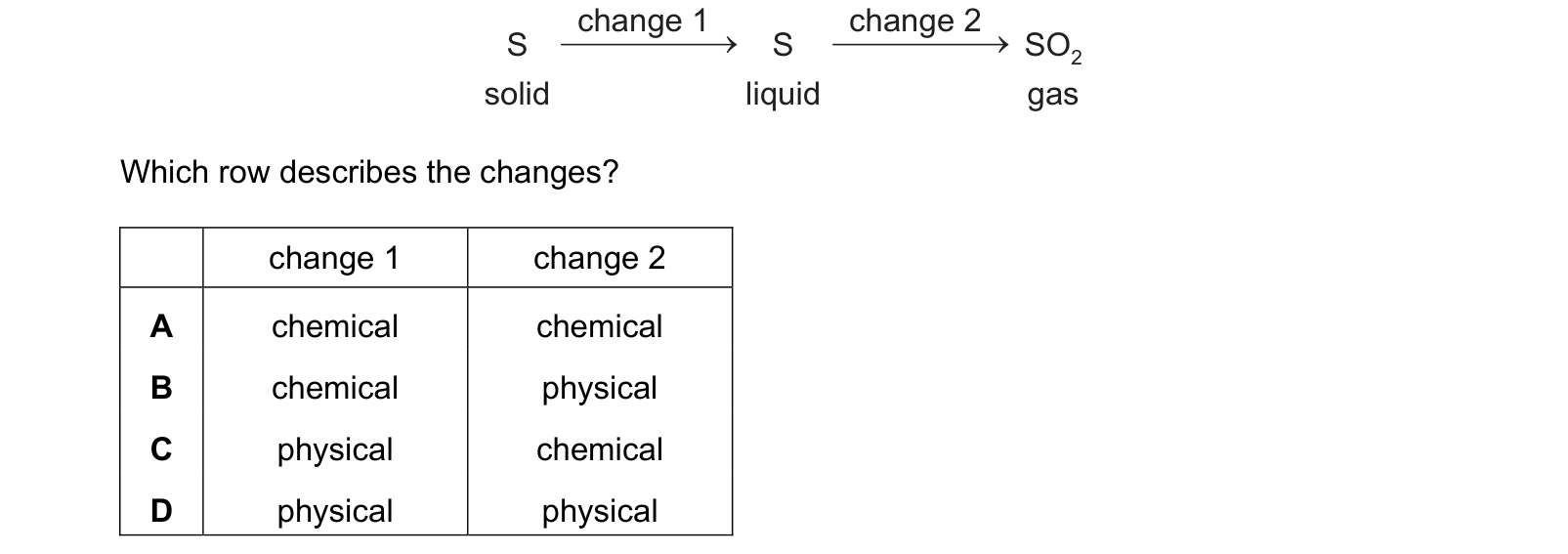
A sequence of changes involving sulfur is shown. Which row describes the changes? Each answer gives, in order: change 1; change 2.
Answer: C.
Change 1 turns solid sulfur into liquid sulfur, which is melting: the particles gain enough energy to break out of the lattice, but they are still sulfur atoms and cooling would set them solid again. Change 2 produces sulfur dioxide, a substance with a different formula, so oxygen has been taken up and a chemical change has happened. Calling both changes physical is the popular error, because solid to liquid to gas looks like the familiar melting then boiling sequence until you notice the final box reads SO2 and not S. Boiling sulfur would indeed be physical, since it would give sulfur vapour; burning it makes an oxide, and that is a different matter.
Question 2
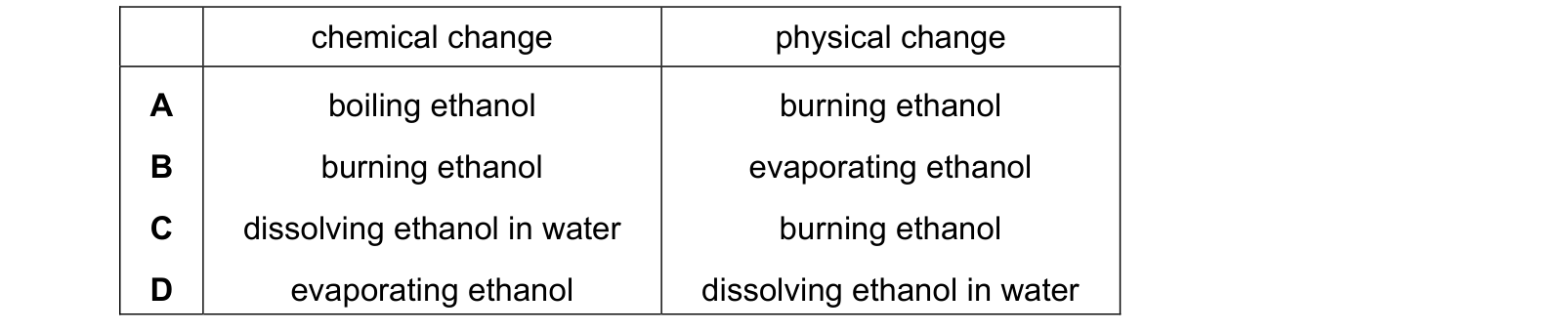
Which row identifies a chemical change and a physical change? Each answer gives, in order: chemical change; physical change.
Answer: B.
A row has to be correct twice over, so checking only one half of it is not enough. Burning ethanol is combustion: the ethanol is destroyed and carbon dioxide and water appear in its place, which is unmistakably chemical. Evaporating ethanol only lifts the same molecules into the vapour phase, and cooling that vapour returns the identical liquid, so it is physical. The row offering boiling ethanol as the chemical change and burning it as the physical one has the two labels exactly reversed, while the rows built on dissolving ethanol in water fail because mixing two liquids that distillation can separate again is physical as well.
Question 3
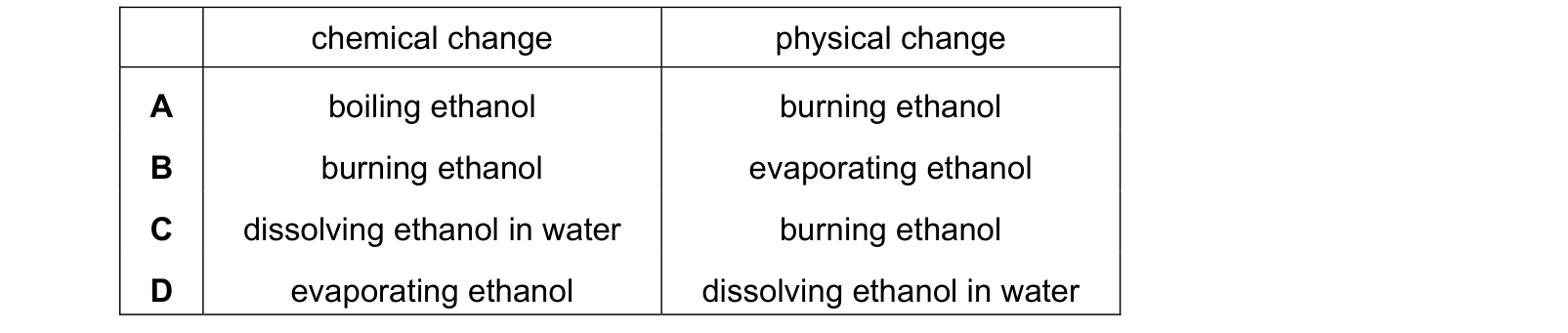
Which row identifies a chemical and a physical change? Each answer gives, in order: chemical change; physical change.
Answer: B.
Both halves of a row have to survive, and burning ethanol is the only entry that certainly makes new substances, since the alcohol is consumed while carbon dioxide and water appear in its place. Evaporation is the plainest physical change offered, because the ethanol molecules escape into the vapour unaltered and condensing them returns the same liquid. Dissolving ethanol in water is physical as well, as the two liquids mix without reacting and distillation separates them again, so a row calling that the chemical change has mistaken mixing for reacting. The row placing boiling in the chemical column and burning in the physical one has the two labels swapped outright.
Question 4
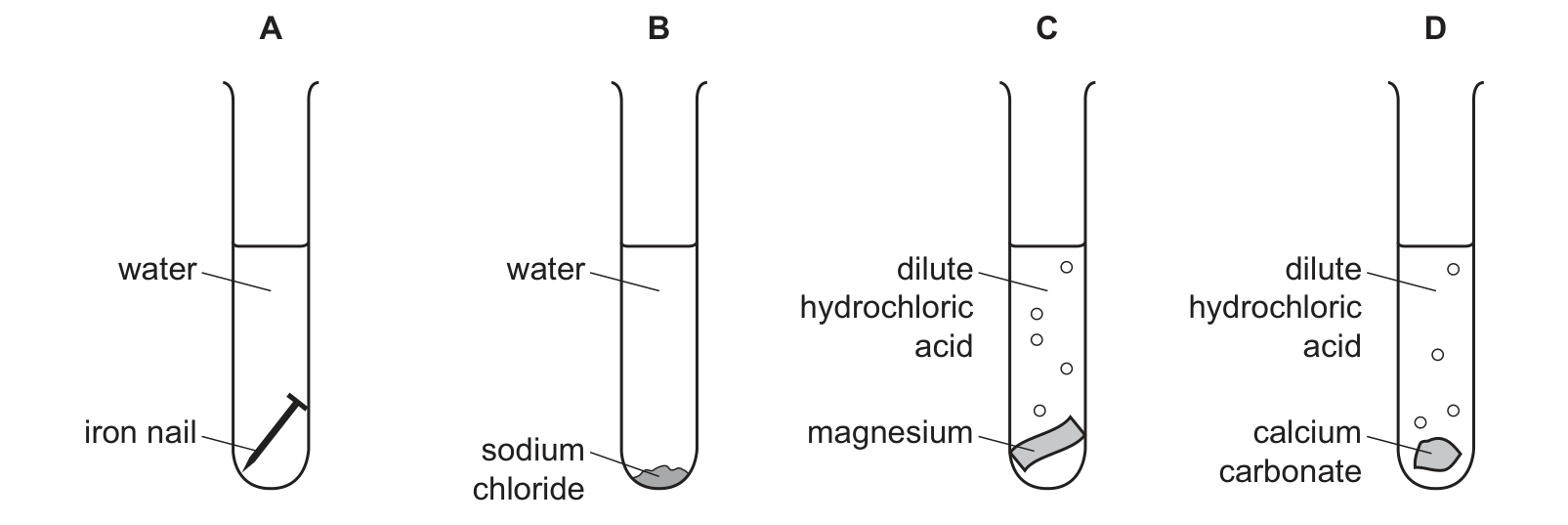
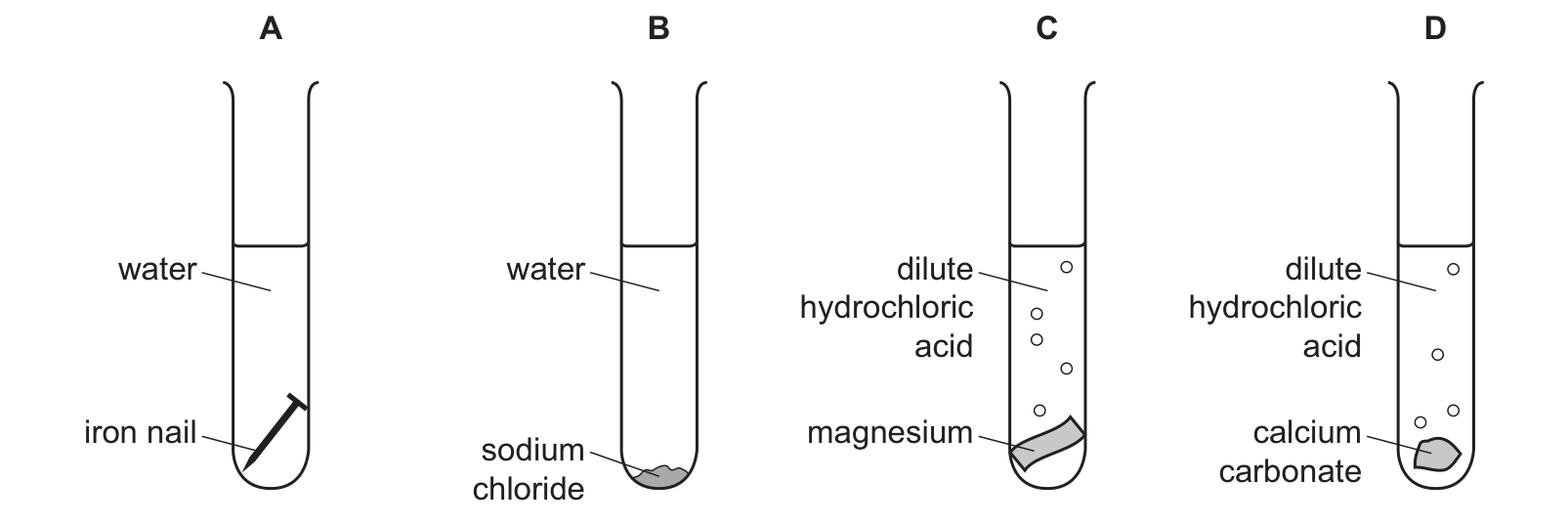
In which tube is a physical change taking place? Use the source image for S20 Paper 13, question 12.
Answer: B.
Sodium chloride dissolving in water is the physical change: the ions separate and spread through the liquid, no new substance is made, and evaporating the water returns the same white solid. An iron nail left standing in water is the most disguised of the others, because nothing appears to happen at first, yet iron is slowly combining with oxygen and water to form rust, which is a genuine chemical reaction. The two tubes containing dilute hydrochloric acid both show bubbles, and a gas appearing where there was none is strong evidence of chemistry: magnesium gives hydrogen, and calcium carbonate gives carbon dioxide. Fizzing and rusting alike leave behind substances that cannot be turned back by simply removing the water.
Question 5
In which tube is a physical change taking place? Use the source image for S20 Paper 23, question 14.
Answer: B.
Only one of these tubes leaves its contents chemically unaltered, and that is the sodium chloride stirred into water, where the ions merely separate and disperse and can be recovered unchanged by evaporation. The iron nail sitting in water is quietly rusting, combining with oxygen and water to build hydrated iron(III) oxide, and no amount of drying will return the flaky orange coating to shiny metal. Both acid tubes give off bubbles, and gas from a solid and a liquid that contained none is a reliable sign of a chemical reaction, hydrogen from the magnesium and carbon dioxide from the calcium carbonate. Bubbles are the loud clue in this question, but the quiet nail is the one that catches people out.
These questions are drawn from past CIE 0620 Chemistry papers and filtered to physical and chemical changes. You answer, you find out immediately whether you were right, and you get the reasoning for the correct option and for each distractor. Wrong answers go to a mistakes locker so you can come back to exactly those.
Practice is free. You need an account only so your progress and your mistakes are still there next time.
These are the errors that cost marks on physical and chemical changes, taken from our own topic notes. Read them before you practise and you will recognise the traps in the questions.
Saying mass is not conserved in a chemical change.
Calling dissolving a chemical change because the solid disappears from view.
Calling a colour change chemical without checking whether it is simply a solution forming.
Treating sublimation of iodine as a reaction because the purple vapour looks new.
Using "irreversible" as the definition, when several reactions in this syllabus reverse on heating.
Saying a burning candle destroys matter, rather than releasing gases that were not weighed.
Describing the difference without naming the new substance, which is the mark Cambridge is actually awarding.