45 past-paper questions on this unit. Five of them are below. Answer on the page: each one is marked the moment you pick, the correct option is shown whether or not you found it, and the full explanation opens either way.
CIE 0620 ChemistryPaper 1 and Paper 2 MCQsFree account
Fuels: five questions to try now
Real past-paper questions, the answer key from the mark scheme, and the explanation that goes with it. No account needed to answer them.
Question 1
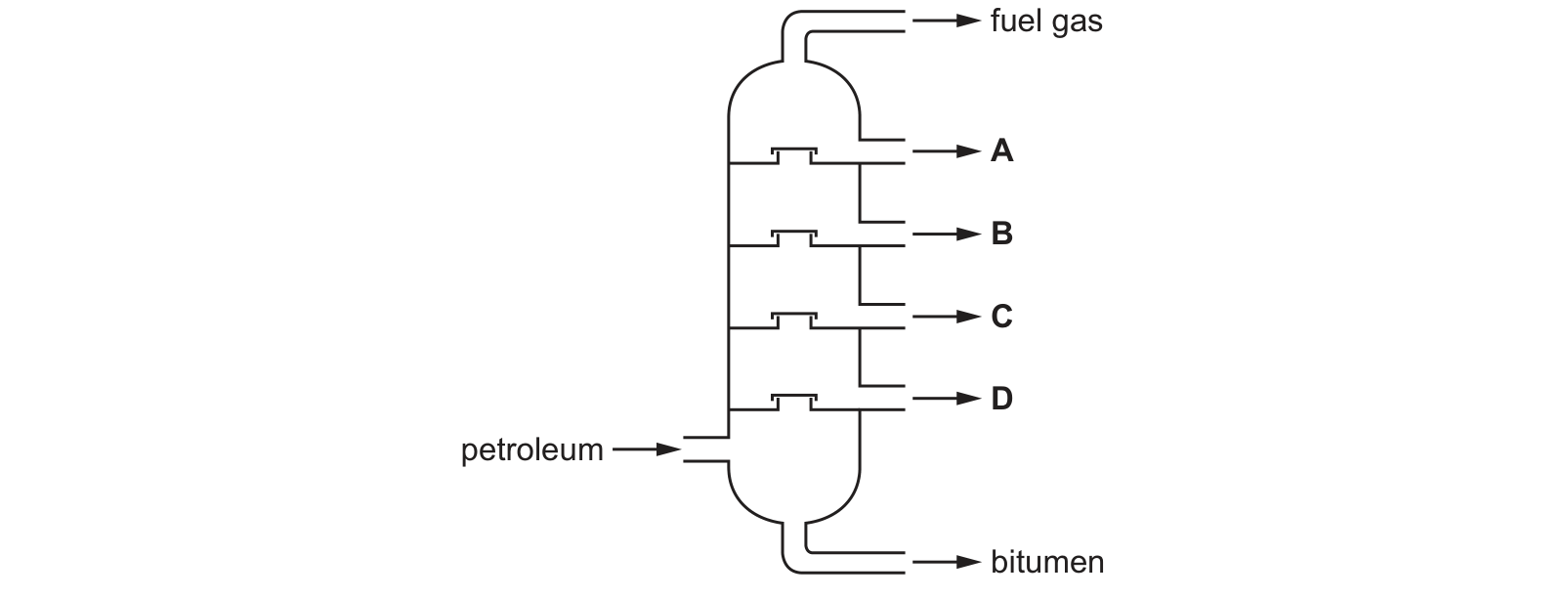
The fractional distillation of petroleum is shown. Which fraction contains hydrocarbons with the longest chain length? Use the source image for S23 Paper 11, question 33.
Answer: D.
Chain length increases downwards, because longer molecules attract one another more strongly, boil at higher temperatures and condense where the column is hottest. The petroleum enters near the bottom and its vapours rise and cool as they climb, so the shortest molecules travel furthest and leave at the top as fuel gas. Of the four labelled outlets, D is the lowest, sitting just above the bitumen that never vaporises at all, so the hydrocarbons leaving there have the longest chains. Choosing A turns the arrangement upside down, since A is the highest of the four and collects molecules shorter than any of the rest.
Question 2
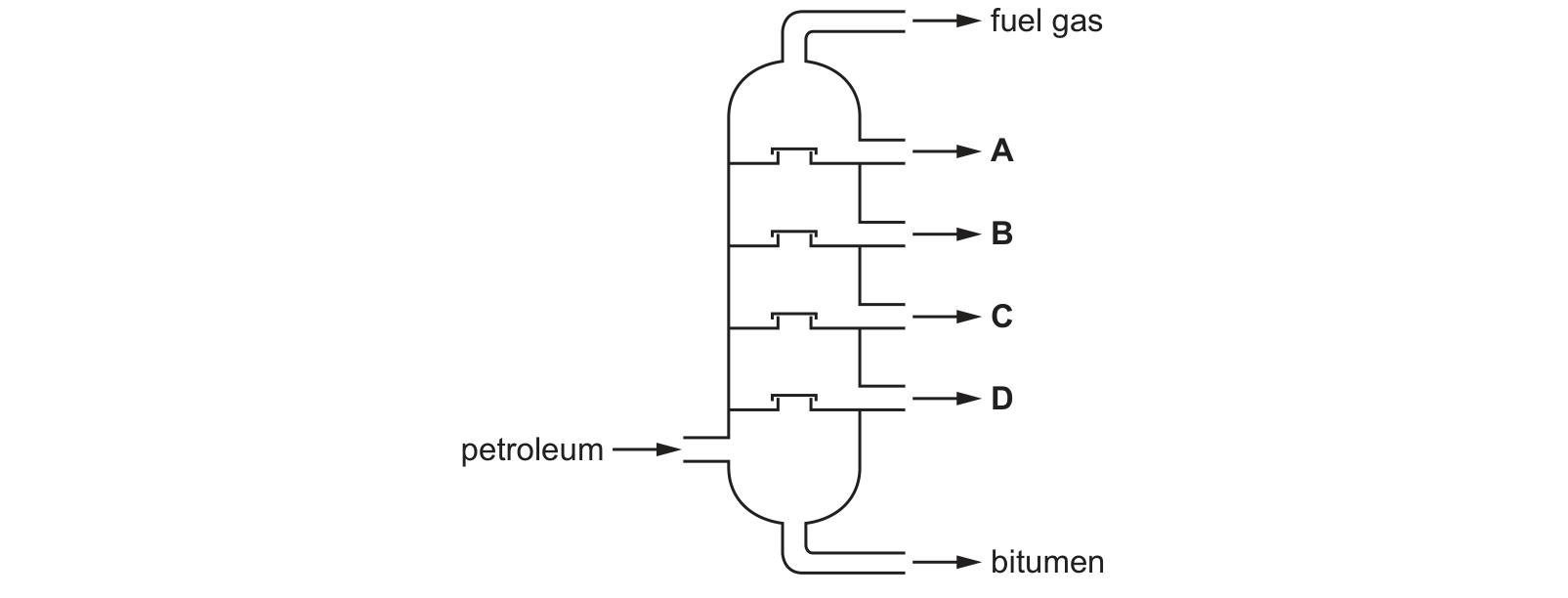
The fractional distillation of petroleum is shown. Which fraction contains hydrocarbons with the longest chain length? Use the source image for S23 Paper 21, question 34.
Answer: D.
The heavier a fraction is, the lower down it condenses, because long molecules attract one another strongly, boil at high temperatures and cannot climb far up a cooling column. Fuel gas escapes from the very top with the shortest molecules of all, and bitumen leaves at the bottom without ever vaporising. Among the four outlets marked on this column, D is the lowest and so behaves most like the bitumen below it, which makes its hydrocarbons the longest chained. The outlet marked A is the highest of the four and carries the shortest molecules, so choosing it reverses the trend the whole column is built on.
Question 3
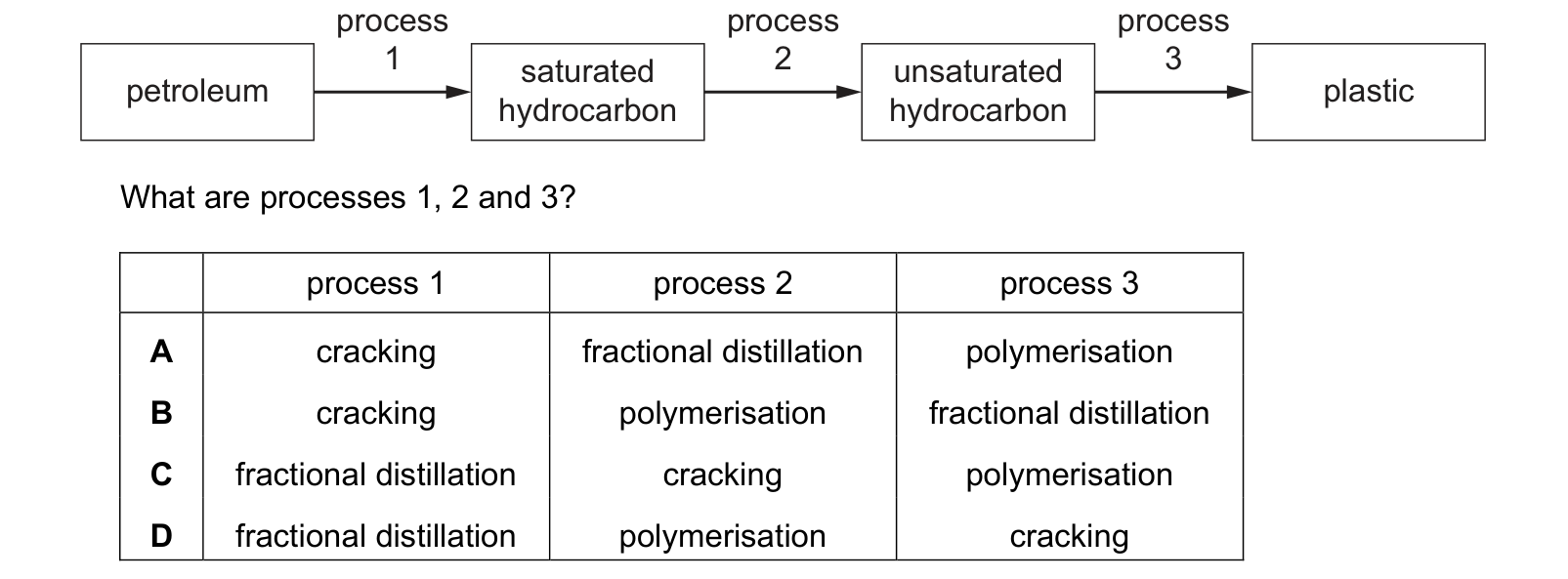
The flow chart shows how petroleum may be turned into a plastic. petroleum plastic What are processes 1, 2 and 3? Each answer gives, in order: process 1; process 2; process 3.
Answer: C.
Follow the flow chart one box at a time. Petroleum is a mixture, so the first task is to separate it by boiling point into fractions, which is fractional distillation, and the alkanes that emerge are the saturated hydrocarbons of the second box. Those long saturated molecules are then heated over a catalyst so that they break into smaller pieces, and it is cracking that supplies the unsaturated hydrocarbon in the third box. Only an alkene can be polymerised, its double bond opening so that thousands of molecules link into the plastic. Any order that places polymerisation earlier is trying to build a chain before there is an alkene to build it from, and beginning with cracking skips the separation that crude oil needs first.
Question 4
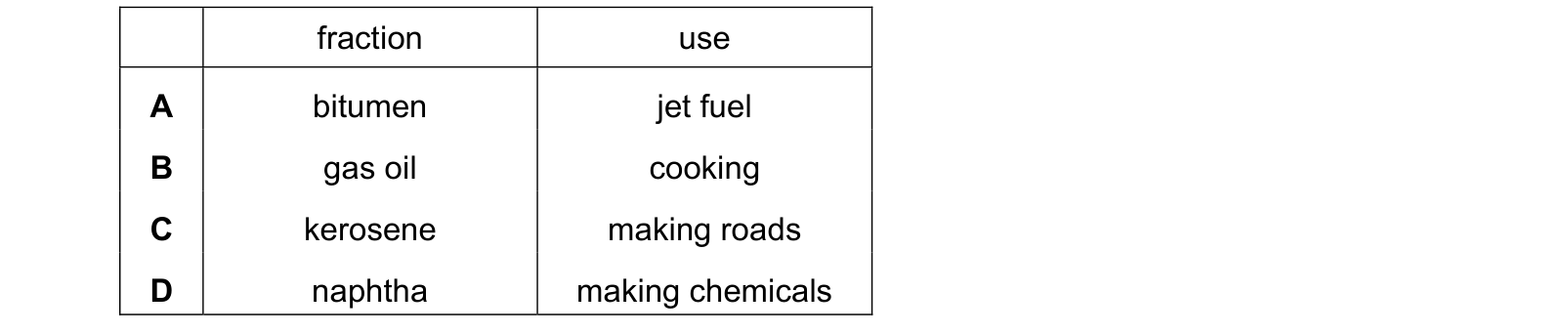
The fractional distillation of petroleum produces a series of fractions with different uses. Which row identifies a use for a fraction? Each answer gives, in order: fraction; use.
Answer: D.
Naphtha leaves the fractionating column near the top and goes to the petrochemical industry, where it becomes plastics, detergents, medicines and dyes rather than being burned, so that pairing is the sound one. Each of the other three matches a real fraction to the wrong job. Bitumen is the thick tarry residue from the very bottom of the column and is used to surface roads, being far too involatile to fly an aircraft, while kerosene is the jet fuel, so those two rows have simply swapped their uses. Gas oil is the diesel fraction burned in lorries and heating boilers, not the light bottled gas that a camping stove burns for cooking.
Question 5
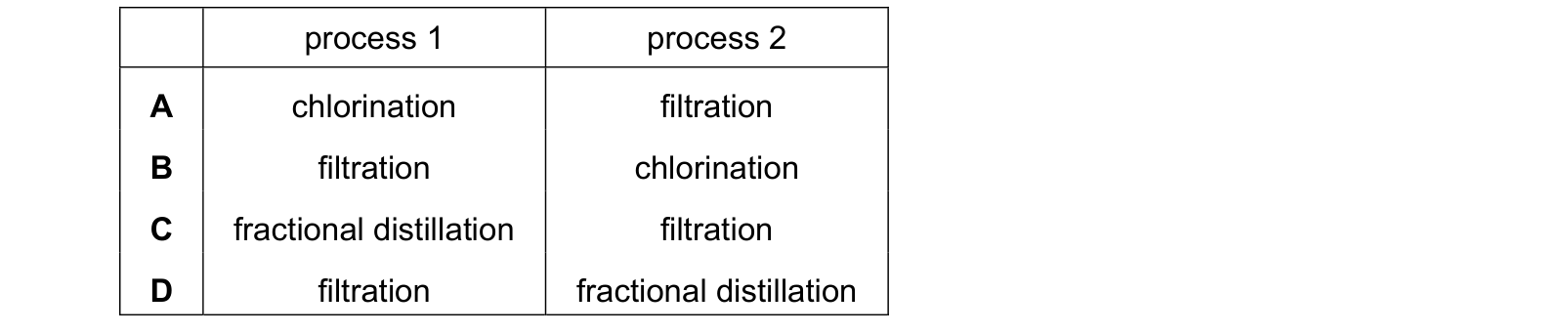
Water from a reservoir flows to the water works where purification process 1 takes place followed by process 2. What are processes 1 and 2? Each answer gives, in order: process 1; process 2.
Answer: B.
Order matters here as much as the names do. Filtration comes first, passing the water through beds of sand and gravel to trap insoluble solids, because chlorine added while the water is still cloudy would be used up on that suspended material. Chlorination follows, adding a small measured dose of chlorine to kill bacteria and keep the supply safe on its way to homes. Fractional distillation appears in two of the rows but has no place in a water works, since it separates liquids by boiling point and would cost an enormous amount for these volumes; reservoir water needs cleaning and disinfecting rather than boiling.
These questions are drawn from past CIE 0620 Chemistry papers and filtered to fuels. You answer, you find out immediately whether you were right, and you get the reasoning for the correct option and for each distractor. Wrong answers go to a mistakes locker so you can come back to exactly those.
Practice is free. You need an account only so your progress and your mistakes are still there next time.
These are the errors that cost marks on fuels, taken from our own topic notes. Read them before you practise and you will recognise the traps in the questions.
Calling ethanol a hydrocarbon. A hydrocarbon contains carbon and hydrogen only.
Saying fractional distillation separates petroleum into pure compounds. Each fraction is still a mixture.
Saying the column is cool at the bottom. It is hottest at the bottom, where the vapour enters.
Saying long-chain molecules rise highest. They have the highest boiling points, so they condense lowest.
Saying viscosity decreases down the column. It increases; the fractions get thicker.
Giving naphtha as a fuel. It is the chemical feedstock.
Naming coal as the main constituent of natural gas. The answer is methane.
Revise it first
If any of the above is unfamiliar, work through the notes before practising: Fuels revision notes.