Exothermic and endothermic reactions Exam Questions
100 past-paper questions on this unit. Five of them are below. Answer on the page: each one is marked the moment you pick, the correct option is shown whether or not you found it, and the full explanation opens either way.
CIE 0620 ChemistryPaper 1 and Paper 2 MCQsFree account
Exothermic and endothermic reactions: five questions to try now
Real past-paper questions, the answer key from the mark scheme, and the explanation that goes with it. No account needed to answer them.
Question 1
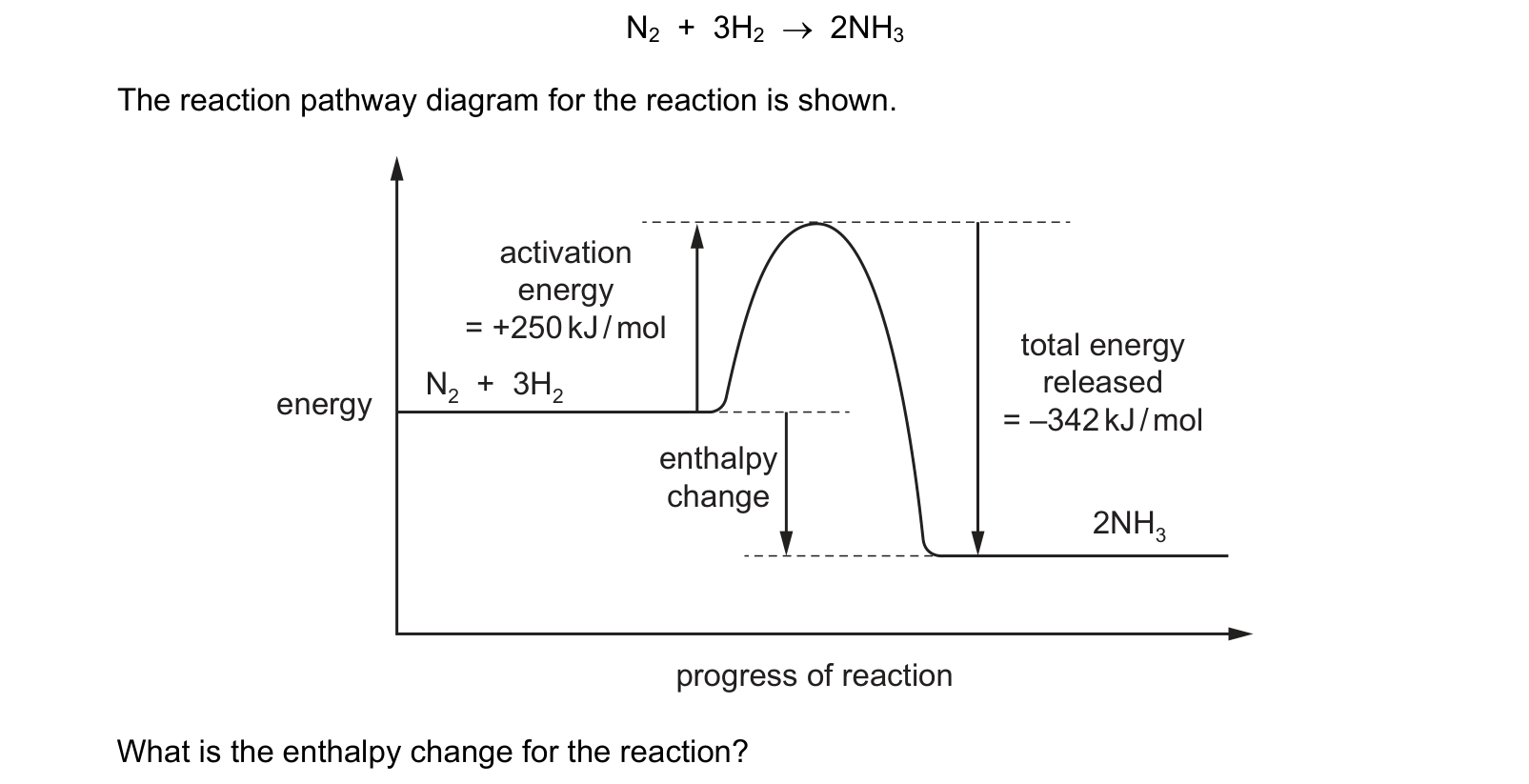
The equation for the formation of ammonia is shown. N2 + 3H2 → 2NH3 The reaction pathway diagram for the reaction is shown. What is the enthalpy change for the reaction?
Answer: B.
A reaction pathway diagram is read as two separate vertical distances. The particles first climb the activation energy of 250 kJ per mole to the top of the hump, then fall by the total energy released, 342 kJ per mole, to reach the product level. The enthalpy change is the net gap between the reactant level and the product level, which is 250 minus 342 = -92 kJ per mole, negative because the ammonia sits below the nitrogen and hydrogen. The answer -592 adds the two figures instead of subtracting them, which would put the products far lower than the diagram shows. The positive answers reverse the sign, and a positive value would mean the ammonia finished above the reactants.
Question 2
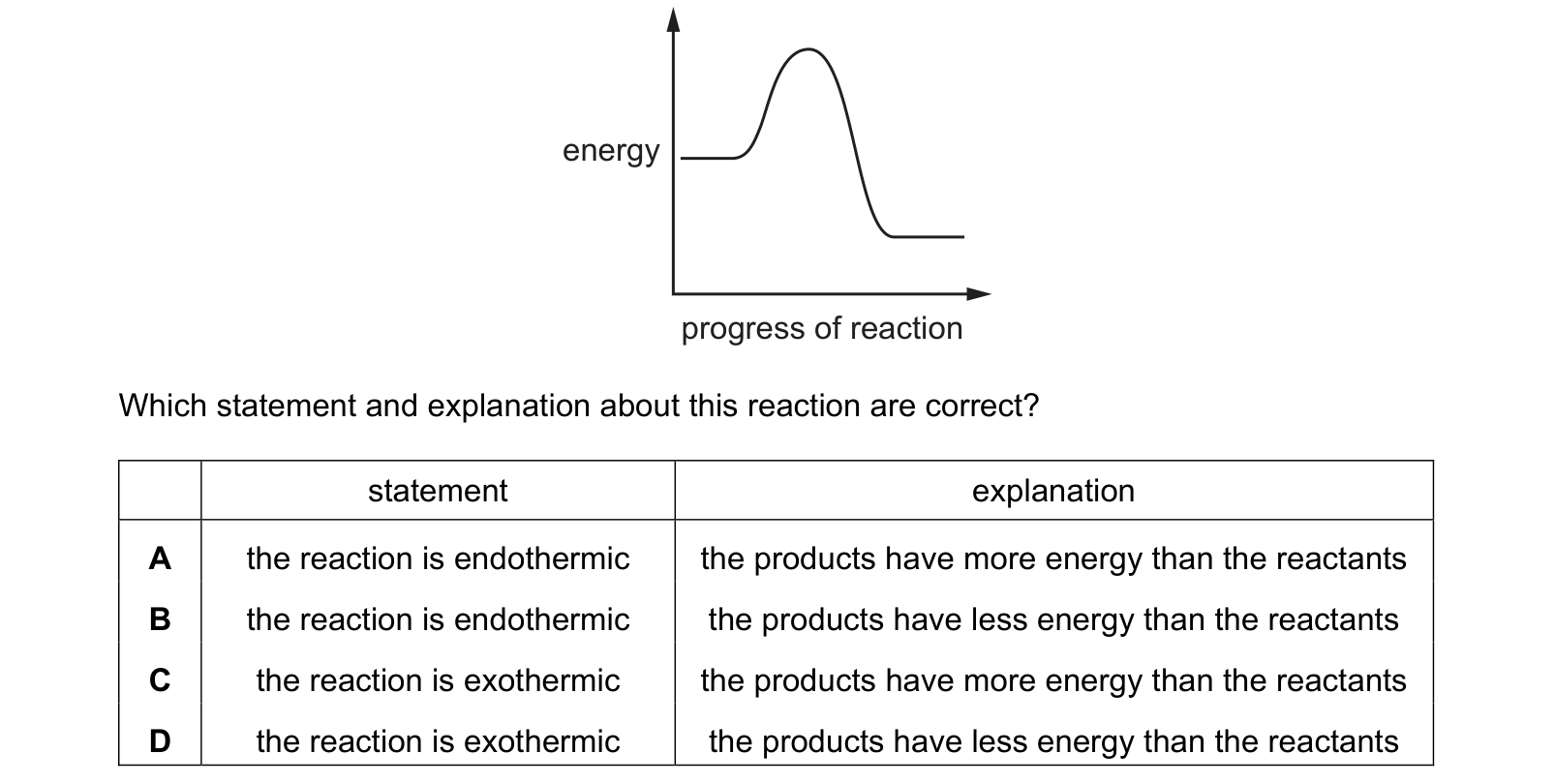
An energy level diagram for a reaction is shown. Which statement and explanation about this reaction are correct? Each answer gives, in order: statement; explanation.
Answer: D.
The diagram falls from the reactant level to a lower product level, so the chemicals have lost energy and the reaction is exothermic. The explanation has to match that shape, describing the products as holding less energy than the reactants, and only one row joins the exothermic label to that explanation. The row calling the reaction exothermic while saying the products have more energy contradicts the diagram outright. The row calling it endothermic with the products holding less energy makes the mirror image of the same mistake. The remaining row is internally consistent but describes an upward step, which is not the diagram given.
Question 3
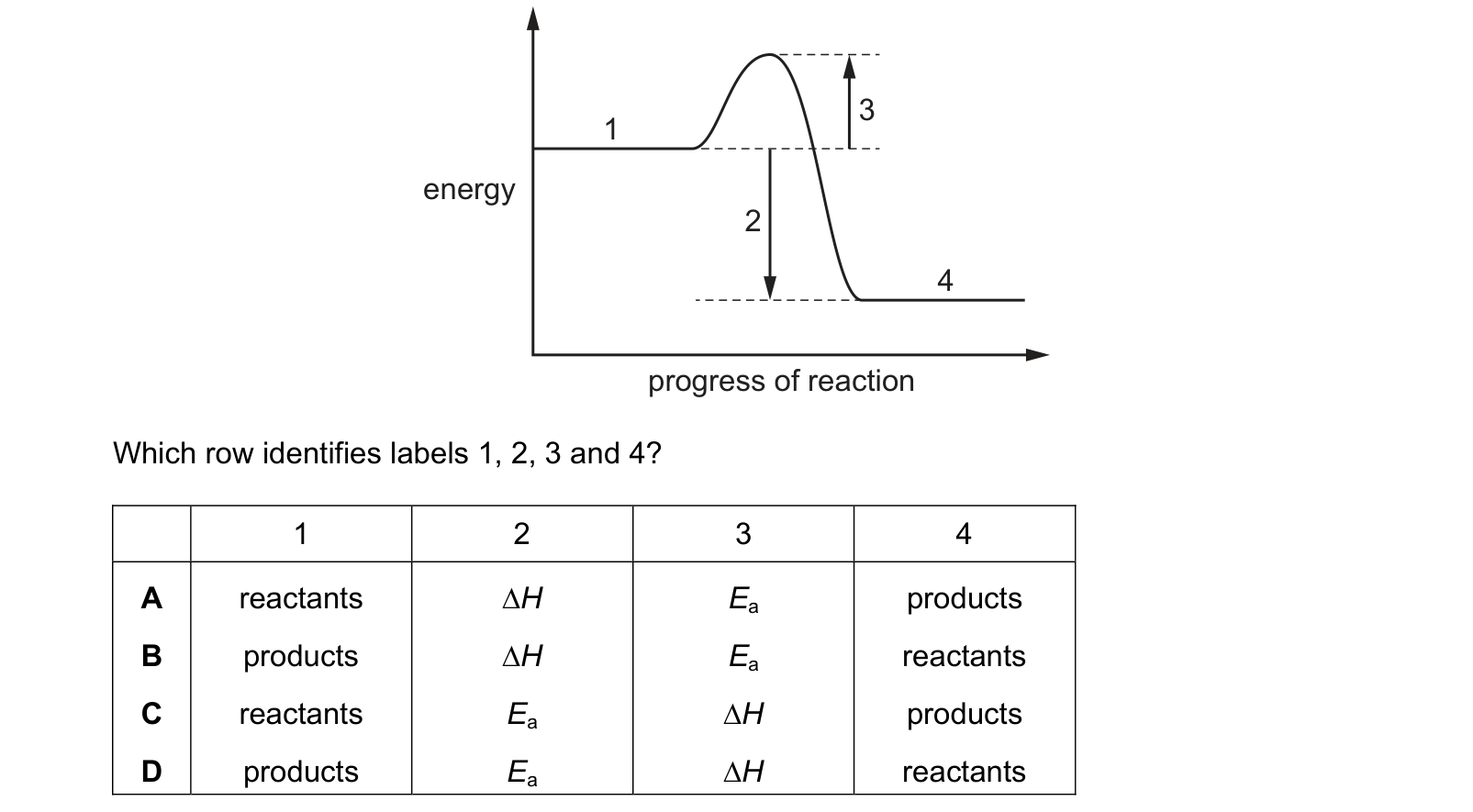
The reaction pathway diagram for an exothermic reaction is shown. Which row identifies labels 1, 2, 3 and 4? Use the source image for S23 Paper 23, question 12.
Answer: A.
Label 1 sits on the flat line at the start of the pathway, so it marks the reactants, and label 4 sits on the flat line at the end, so it marks the products. Label 3 is the upward arrow from the reactant level to the top of the hump, which is the energy particles must acquire before they can react, the activation energy. Label 2 is the downward arrow from the reactant level to the product level, which is the overall energy change, negative here because the reaction is exothermic. Rows that swap 1 and 4 read the pathway from right to left, and rows that swap 2 and 3 confuse the barrier to reacting with the net energy released.
Question 4
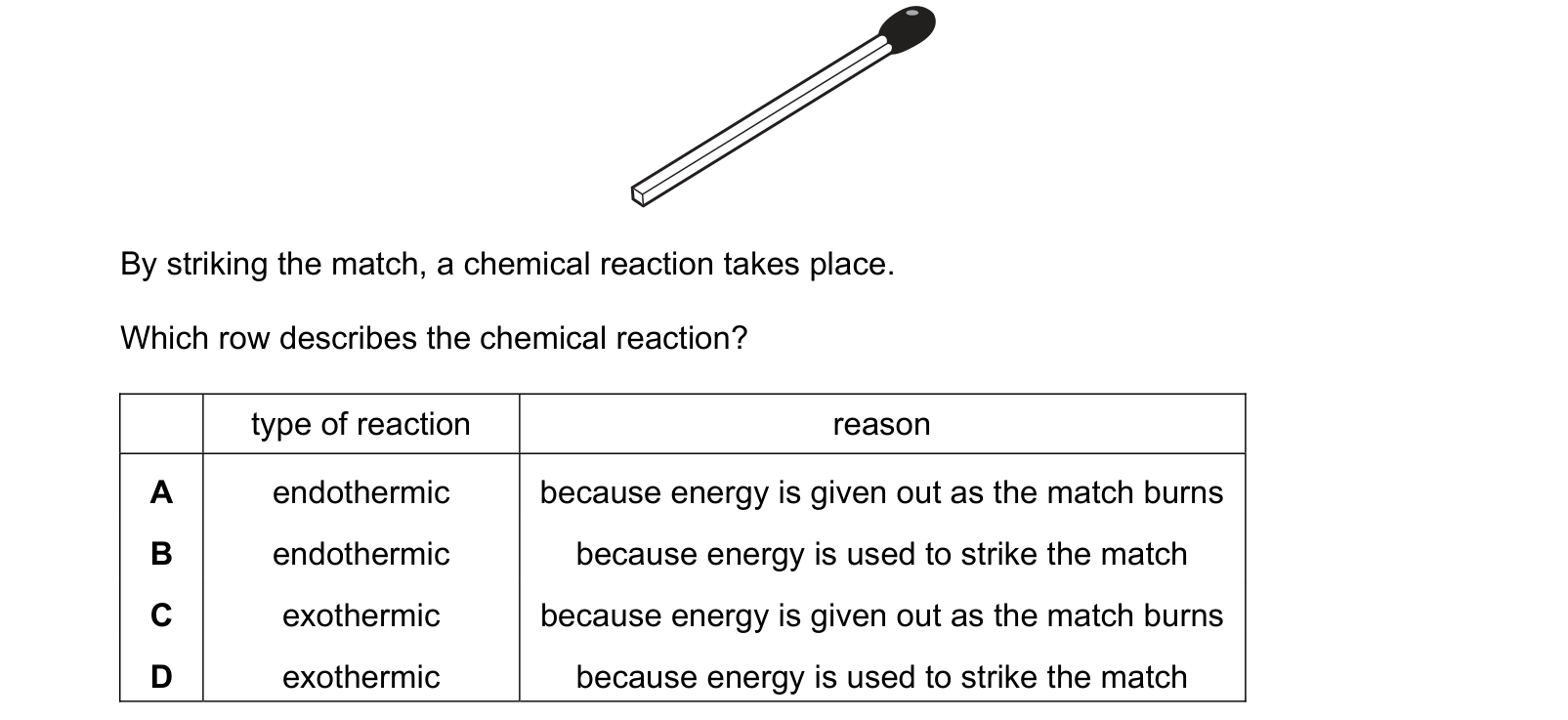
The diagram shows a match. By striking the match, a chemical reaction takes place. Which row describes the chemical reaction? Each answer gives, in order: type of reaction; reason.
Answer: C.
Striking a match sets off a combustion reaction, and combustion releases energy to the surroundings, which is why the match becomes hot enough to see and to feel; the reaction is therefore exothermic and the reason is that energy is given out as it burns. Both rows offering the endothermic label contradict the plain observation that a burning match warms everything near it. The reason about energy being used to strike the match confuses activation energy with the overall energy change, since the friction of striking supplies only the small amount needed to start the reaction, and far more comes back out once it is running.
Question 5
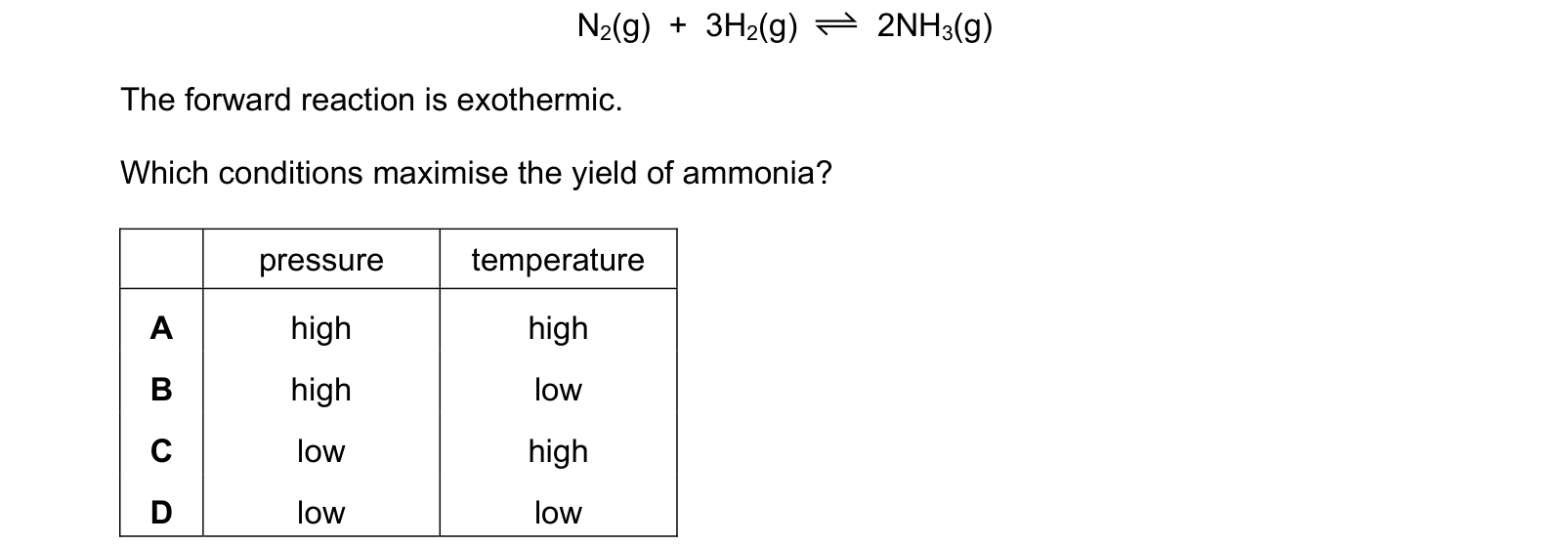
Ammonia is manufactured by the Haber Process. The forward reaction is exothermic. Which conditions maximise the yield of ammonia? Each answer gives, in order: pressure; temperature.
Answer: B.
The forward reaction is exothermic, so cooling the system drives it towards ammonia and raises the yield. The equation converts one nitrogen molecule and three hydrogen molecules, four in all, into two ammonia molecules, so raising the pressure drives it the same way, towards the side occupying less volume. High pressure with low temperature therefore maximises the yield. The row with a high temperature reverses the energy argument, and although the real plant runs at around 450 °C, that is a compromise for rate rather than a way of improving the equilibrium position. Low pressure works against the halving of the number of gas molecules.
These questions are drawn from past CIE 0620 Chemistry papers and filtered to exothermic and endothermic reactions. You answer, you find out immediately whether you were right, and you get the reasoning for the correct option and for each distractor. Wrong answers go to a mistakes locker so you can come back to exactly those.
Practice is free. You need an account only so your progress and your mistakes are still there next time.
These are the errors that cost marks on exothermic and endothermic reactions, taken from our own topic notes. Read them before you practise and you will recognise the traps in the questions.
Saying an exothermic reaction takes in energy because the reaction "gets hot". It is the surroundings that gain the energy.
Giving ΔH a positive value for an exothermic reaction, or leaving the sign off altogether.
Measuring the activation energy from the products rather than from the reactants.
Drawing an endothermic diagram with the products below the reactants.
Saying bond breaking releases energy. It always absorbs energy.
Subtracting the bonds broken from the bonds made, giving the right number with the wrong sign.
Forgetting the balancing numbers when counting bonds.